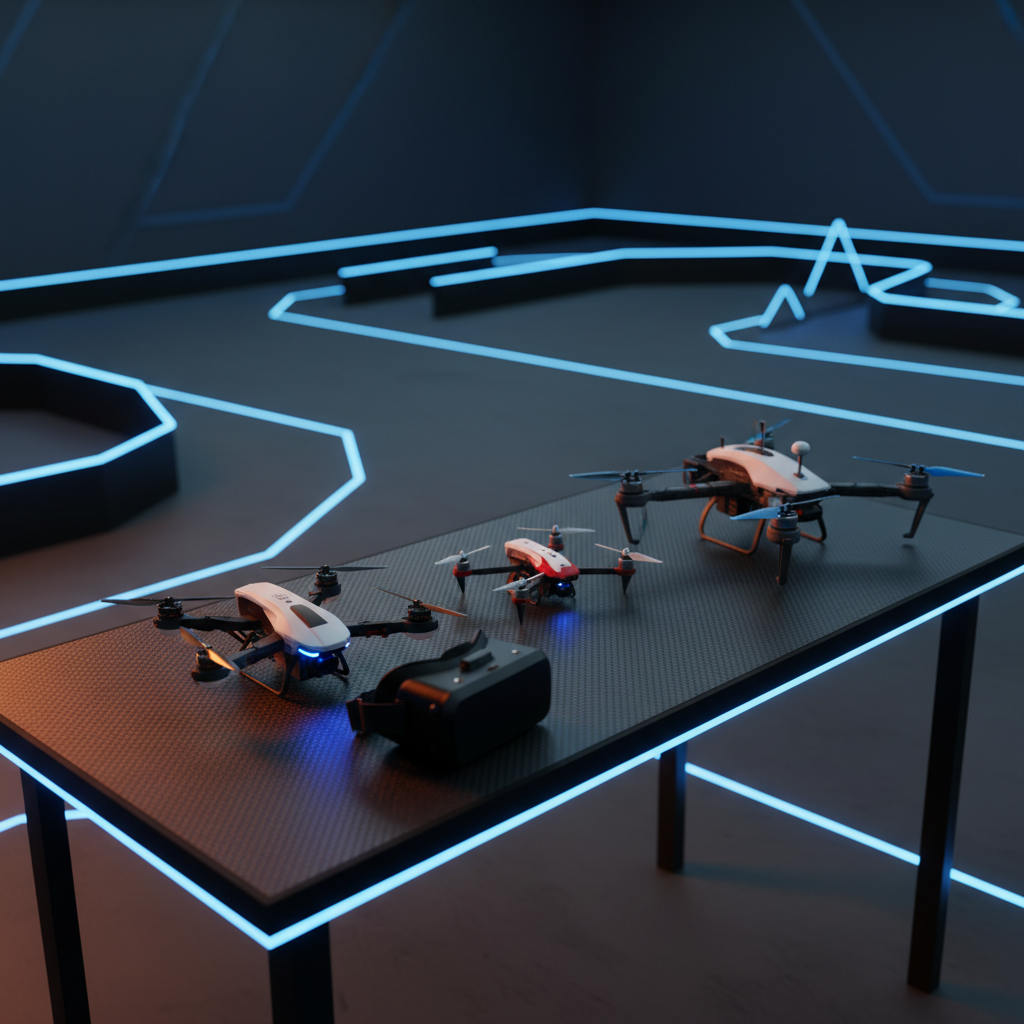
If you want the most rounded starter kit, the Betafpv Cetus Pro Kit takes the top spot. Priced at $247.99 it ships with a brushless whoop, two 450 mAh BT2.0 batteries, a transmitter and 1200 TVL goggles in a portable EVA case. Its 3.9‑star rating from 541 reviewers reflects beginner‑friendly features like altitude‑hold, turtle mode and a durable PA12 frame, while the 30° tilt angle and 1.625‑pound weight keep it stable for indoor freestyle.
Seven kits are split into three price tiers. Budget picks—Betafpv Cetus Lite ($142.99), Apex FPV ($169.99) and EMAX Tinyhawk 2 II ($224.99)—focus on ease of use and safety. The mid‑range Betafpv Cetus Pro offers a fuller package without hitting the $299.99 price point. Premium choices—Betafpv Aquila16 and Cetus X at $299.99 each, plus the $310.00 EMAX Tinyhawk 3—add longer flight time, higher motor KV and sharper video for racers ready to push harder.
The following sections detail each kit’s specs, highlight its strongest use‑case, and point out any drawbacks, helping you pick the perfect FPV racing drone for your skill level and budget.

Betafpv Cetus Pro Kit
Offers tight positioning with horizontal accuracy of ±0.2 m and vertical accuracy of ±0.3 m, delivering reliable flight control.

Betafpv Aquila16 Kit
Ideal for serious racers who want longer flights; at $299.99 it’s about $52 pricier than the Cetus Pro, reflecting its premium battery capacity.
EMAX Tinyhawk 3 Kit
Stands out with a compact 450 mAh, 4.35 V battery, making it perfect for indoor racing where agility outweighs longer flight times.
Also considered
Score Analysis
Key score advantages vs. runner-up (Betafpv Aquila16 Kit)
Price Range
Betafpv Cetus Pro Kit
$247.99
Betafpv Aquila16 Kit
$299.99
EMAX Tinyhawk 3 Kit
$259.99
Betafpv Cetus Lite Kit
$142.99
Betafpv Cetus X Kit
$299.99
EMAX Tinyhawk 2 II Kit
$219.99

Apex FPV Kit
$169.99
Spec Comparison
TL;DR: The Betafpv Cetus Pro Kit bundles a brushless 1102‑18000KV whoop, 1200 TVL camera and 4.3‑inch FPV goggles for $247.99, offering altitude‑hold and turtle mode but only 4‑5 minute flights and an ~80 m range.
The kit’s standout is its 1200 TVL C02 FPV micro‑camera with a 30° tilt angle, paired with a 14 dBi antenna and a 25 mW VTX, delivering a clear view for indoor freestyle. A 12 A ESC powers the 1102‑18000KV brushless motor, and the integrated Lite 1‑2S Pro brushless flight controller provides altitude‑hold (±0.2 m horizontal, ±0.3 m vertical) and turtle mode for crash recovery.
At 1.625 pounds, the Cetus Pro is heavier than the 0.3125‑pound Tinyhawk 2 II and the 0.220 pound Apex kit, yet lighter than the 3.09‑pound Cetus X and the 3.24‑pound Tinyhawk 3. Its 450 mAh batteries match the capacity of the Tinyhawk 2 II and Tinyhawk 3, but fall short of the 1100 mAh cells found in the Aquila16. The 1200 TVL resolution outpaces the 700 TVL camera on the Tinyhawk 2 II and the 600 TVL sensor on the Tinyhawk 3, giving a sharper image for beginners learning to pilot.
Reviewers repeatedly praise the altitude‑hold and turtle mode for reducing crashes, and the PA12 frame for surviving classroom bumps. Users love the all‑in‑one packaging that includes the VR02 goggles (4.3‑inch screen, 55° FOV, 300 cd/m² brightness, 300 g weight) and the LiteRadio2 SE transmitter. The most common complaints focus on the short 4‑5 minute flight window and the modest 80 meter range, while some find the goggles a bit bulky for smaller heads.
Pros
Cons
Best for: FPV beginners, youth education programs, indoor freestyle practice, and anyone who wants a ready‑to‑fly kit with goggles.
Avoid if: You are an experienced pilot needing long flight times, extended range, higher‑resolution goggles, or a very lightweight setup.
“Perfect starter drone—hovering is stable, and turtle mode saved me so many trips across the room.”
“Love that it’s brushless. Feels way more responsive than my old Tiny Whoop.”
TL;DR: The Betafpv Aquila16 Kit offers a ready‑to‑fly brushless micro quad with an 1100 mAh battery delivering up to 8 minutes of flight, 4.3″ LCD goggles and beginner‑friendly flight modes for $299.99.
The standout spec is the 1100 mAh default battery that powers the drone for up to 8 minutes per charge, while the 18000 KV brushless motor pushes the quad to a top speed of 5.00 m/s in Normal mode. Video transmission can reach 200 m when the VTX runs at its 350 mW maximum, and the 4.3‑inch LCD goggles display 800 × 480 px footage.
Compared with the other six kits, the Aquila16 is dramatically lighter—its 47.1 g frame (72.5 g with battery) is far below the multi‑pound weights of the Betafpv Cetus X, EMAX Tinyhawk 3, and the Betafpv Cetus Pro. It also carries a larger battery (1100 mAh vs. the 450 mAh cells listed for those rivals) and offers a longer VTX range than the Apex FPV Kit, which tops out at 25 mW. Its 4.3‑inch goggles are larger than the Tinyhawk 3’s 90 mm screen, giving a clearer view for new pilots.
Reviewers consistently praise the Aquila16’s stability, noting the PA12 nylon‑based frame and inverted duct design help keep it steady even after minor crashes. The auto‑hover, position‑hold and turtle modes make learning to fly feel safe, and educators love the included simulator support. On the downside, several users report that the tight battery compartment can cause the battery to detach after hard impacts, and the LiteRadio 2 SE transmitter doesn’t work with Windows 10/11 AMD laptops for simulator use.
Pros
Cons
Best for: Beginners learning FPV, youth programs, and educators who want a sturdy, feature‑rich starter kit.
Avoid if: You’re an experienced freestyle pilot needing higher performance, require a wide‑angle camera, or need a transmitter that works with AMD‑based Windows laptops.
“Perfect first FPV drone”
“Flight time is amazing”
TL;DR: The EMAX Tinyhawk 3 Kit bundles a 600 TVL analog camera, 450 mAh 1S HV battery and lightweight 42 g drone for a beginner‑friendly indoor FPV experience, though flight time tops out at about four minutes.
The kit’s standout spec is its 600 TVL CMOS camera paired with 40 analog video channels, delivering a clear enough feed for indoor racing while staying under the 25 mW VTX power limit. Powered by a 450 mAh 1S HV LiPo, the drone can stay aloft for roughly 3–4 minutes per charge, and its 15000 Kv motors push it to a top speed of 56 km/h.
Compared with the other six kits, the Tinyhawk 3 is heavier than the Tinyhawk 2 II Kit (0.3125 lb) and the Cetus Pro Kit (1.625 lb), but still lighter than the bulkier Aquila16 which lists a larger frame. Its 450 mAh battery is far smaller than the Aquila16’s 1100 mAh pack, and its flight time is shorter than the Cetus Lite Kit’s 4–5 minute claim. On the video side, it matches the Tinyhawk 2 II’s 40‑channel goggles, while many competitors either omit channel counts or list higher VTX power.
Reviewers repeatedly praise the Tinyhawk 3 for being ready‑to‑fly out of the box, with a durable polypropylene frame and built‑in propeller guards that survive beginner crashes. Professional reviewers highlighted the smooth, low‑latency control from the F4 flight controller and 4‑in‑1 ESC (3 A). On the downside, users note the 3–4 minute flight window feels limiting, and the analog 600 TVL feed can look grainy compared with higher‑resolution options. The included basic E6 transmitter lacks programmable switches, which more advanced pilots may miss.
Pros
Cons
Best for: Beginners learning FPV, indoor pilots, teens and hobbyists who want an all‑in‑one kit.
Avoid if: You need long flight times, high‑definition video, advanced telemetry, or hover/altitude hold capabilities.
TL;DR: The Betafpv Cetus Lite Kit delivers a beginner‑friendly FPV experience at $142.99, featuring ±0.3 m auto‑hover accuracy, a 300 mAh battery for 4–5 minute flights, and a lightweight 36 g frame.
The standout spec is the barometer‑based altitude hold that keeps the drone steady within ±0.3 m, a feature many new pilots appreciate for smooth indoor hovering. Coupled with automatic calibration on power‑up and an emergency auto‑locking system that disarms the motors on impact, the kit emphasizes safety as much as fun.
Compared with the six other kits in this roundup, the Cetus Lite is the most compact—its 90 mm length, 85 mm width, and 45 mm height are far smaller than the Apex FPV Kit’s 340 mm length and 239 mm width, and it also undercuts the dimensions of the Betafpv Cetus Pro and Aquila16 kits, which exceed 130 mm in height. At 36 g, it's lighter than the Apex FPV Kit’s listed 0.220462262 pounds and considerably lighter than the Tinyhawk 2 II’s 0.3125 pounds, making it easy to carry in the included gray drawstring bag. The 300 mAh battery is modest, lower than the 400 mAh cells in the Apex kit and the 450 mAh batteries found in most competitors, which shortens flight time to 4–5 minutes per charge. The 25 mW video transmitter matches the Apex kit’s output but falls short of the Aquila16’s 350 mW VTX, limiting reliable range to roughly 80 meters as advertised.
Reviewers consistently praise the kit’s plug‑and‑play simplicity and the safety‑first design, noting that the full propeller guard and auto‑disarm feature make indoor flying feel “thoughtful” and forgiving for kids. The 720p camera provides a clear enough view for beginners, though professional‑grade users note the lack of detail compared to the Cetus Pro’s 1200 TVL sensor. Users also mention that the VR02 goggles, while included, have modest screen brightness, which can be a drawback in brightly lit rooms.
Pros
Cons
Best for: Entry‑level buyers or those on a tight budget
Avoid if: You need advanced features or professional‑grade performance
“Perfect starter drone—hovering is stable, and turtle mode saved me so many trips across the room.”
“Love that it’s brushless. Feels way more responsive than my old Tiny Whoop.”
TL;DR: The Betafpv Cetus X Kit bundles a 2S brushless quad, 4.3‑inch VR03 goggles and a LiteRadio 3 ELRS transmitter for $299.99, offering a beginner‑friendly yet powerful FPV experience.
The standout spec is its 2S power system: two 450 mAh 1S cells in series deliver 7.4 V to an 11000 KV brushless motor, giving noticeably more thrust than a typical 1S setup. The frame measures 137 mm × 263 mm × 216 mm with a 95 mm wheelbase, and the whole package weighs 3.086471668 pounds, making it a solid‑built micro drone that still fits in a small carry case.
In comparison, the Cetus X is heavier than the Betafpv Cetus Pro Kit (1.625 pounds) but slightly lighter than the EMAX Tinyhawk 3 Kit (3.2407952514 pounds). Its dimensions are a shade smaller than the Aquila16 Kit (140 mm × 265 mm × 220 mm) while being taller than the Apex FPV Kit (94 mm height) yet more compact in length and width. Compared with the ultra‑light Tinyhawk 2 II Kit (0.3125 pounds), the Cetus X feels more substantial, which many users associate with durability.
Everyday flyers praise the kit’s durability and the ease of moving from Angle to Horizon to Air flight modes, noting that the durable composite frame survives crashes well. Professional reviewers highlight the upgraded 2S system as a key improvement for outdoor range. However, users frequently mention the short 3–4 minute flight time and the horizontal VTX antenna placement that can cause signal loss when flying directly toward or away from the pilot. The lack of a buzzer also makes locating a downed quad a bit trickier.
In practice, the VR03 goggles add a 4.3‑inch screen with a 40° field of view and a built‑in 2000 mAh battery that lasts up to 120 minutes in normal mode (70 minutes in DVR mode). The transmitter offers selectable power outputs of 25 mW, 50 mW or 100 mW, and the kit includes eight spare 20×20 mm 4‑blade propellers, so you’re ready to fly straight out of the box.
Pros
Cons
Best for: Beginners and intermediate pilots who want a complete, plug‑and‑play FPV system with solid build quality and room to grow.
Avoid if: You need long flight times, advanced telemetry, or a fully customizable antenna setup.
“Perfect starter drone—hovering is stable, and turtle mode saved me so many trips across the room.”
“Love that it’s brushless. Feels way more responsive than my old Tiny Whoop.”
TL;DR: The EMAX Tinyhawk 2 II Kit packs a 700 TVL camera, 450 mAh battery and 5‑minute flight time into a 0.3125‑lb micro‑drone that’s ready to fly straight out of the box.
This kit’s standout spec is the RunCam Nano 2 delivering 700 TVL video, paired with goggles that show a 480 × 272 pixel feed and 40 selectable video channels. At just 0.3125 pounds, the drone feels solid yet light enough for indoor maneuvers, while the 450 mAh 1S HV LiPo gives you a maximum of 5 minutes of airtime per charge.
Compared with the other six entries, the Tinyhawk 2 II is heavier than the ultra‑light Apex FPV Kit but considerably lighter than the bulkier Betafpv Cetus Pro Kit. It also offers more video channels than the Betafpv Cetus Lite Kit, though its VTX defaults to 25 mW until you switch levels. The package includes a 6‑channel transmitter, which sits in the middle of the range of channel counts among its peers.
Reviewers consistently praise the drone’s beginner‑friendly, factory‑tuned flight profiles and the crash‑resistant carbon‑fiber (outdoor) or polypropylene (indoor) frame. Users love the crisp colors from the 700 TVL camera, but they also flag the short 5‑minute flight window and the modest 480 × 272‑pixel goggles as limiting for longer sessions. Professional reviewers note the VTX’s multiple power levels, yet the default 25 mW output can feel under‑powered for open‑air racing.
From a technical standpoint, the kit ships with two 450 mAh 1S 4.35 V batteries, a 4‑in‑1 5 A BlHeli_S ESC, and a 7000 Kv motor for freestyle flying. Its top speed reaches 32.3 km/h (20.1 mph) and the control link works over 2400–2483.5 MHz, giving a reliable 100 m (328 ft) operating range. The wheelbase measures 115 mm for outdoor freestyle and 75 mm for indoor use, providing stability without sacrificing agility.
Pros
Cons
Best for: Buyers in the budget price range seeking the best quality at that price point
Avoid if: You need advanced features or professional‑grade performance
TL;DR: The Apex FPV Kit bundles a 100 g drone, three 400 mAh batteries for up to 54 minutes of flight, 120° low‑latency video and beginner‑friendly controls at a budget price.
The kit’s standout spec is its three 400 mAh batteries, which together promise up to 54 minutes of total flight time, making it a rare offering in entry‑level kits. The drone itself weighs just 100 g (0.220462262 lb) and carries a 120° field‑of‑view camera that streams analog video on 5.8 GHz with a transmission range of 305 meters.
Compared with the six other kits in this roundup, the Apex is lighter than the Betafpv Cetus Pro Kit (1.625 lb) and far lighter than the Betafpv Cetus X Kit (over 3 lb). Its battery capacity is lower than the 450 mAh cells found in the Cetus Pro and Cetus X, but the inclusion of three cells gives it a longer cumulative flight window than the Cetus Lite Kit’s 300 mAh battery that only manages 4–5 minutes per charge. Size-wise, the Apex’s 340 mm length and 239 mm width make it larger than the compact EMAX Tinyhawk 2 II (length 76.2 mm, width not listed) but still fits within a medium‑sized frame.
Reviewers often praise the kit’s beginner‑oriented altitude‑hold mode and the immersive head‑tracking feature that works with version 2.0 goggles. Professional reviewers highlight the low‑latency analog transmission and the flexibility of the ELRS remote, which can boost power up to 500 mW. A downside, users frequently note the 480p camera resolution as a limitation for those seeking sharper video, and intermittent pairing hiccups between the drone and controller are a common complaint. The modest 3.0/5‑star rating reflects this mixed sentiment.
Pros
Cons
Best for: Entry-level buyers or those on a tight budget
Avoid if: Reliability and user satisfaction are your top concerns
“Perfect for learning FPV flying without breaking the bank.”
“The head tracking makes it feel like you’re really flying.”
Breakdown
Betafpv Cetus Pro Kit
Pros
Betafpv Aquila16 Kit
Pros
EMAX Tinyhawk 3 Kit
Pros
Betafpv Cetus Lite Kit
Pros
Based on scoring data and product specs
Personalized picks
Best Overall Pick
Betafpv Cetus Pro Kit
Best OverallBest for: Home and office users seeking a balance of features and value
Betafpv Aquila16 Kit
Best for: Those prioritizing quality and willing to pay for premium performance
$299.99+$52.00 vs winner
Skip Apex FPV Kit if…
Reliability and user satisfaction are your top concerns
The Betafpv Cetus Pro Kit takes the top spot as the best FPV racing drone kit. It ships with a full set of components—including the Cetus Pro brushless quadcopter, LiteRadio2 SE transmitter and VR02 FPV goggles—so you’re ready to fly straight out of the box. Its auto‑hover system delivers ±0.2 m horizontal and ±0.3 m vertical accuracy, and the kit offers a respectable 5‑minute maximum flight time on its two 450 mAh batteries.
The runner‑up is the Betafpv Aquila16 Kit, which shines if you need longer endurance and range. Its 1100 mAh battery pushes flight time up to 8 minutes, and the VTX can reach 200 m at 350 mW, giving you more room to explore the track. With a top speed of 5.00 m/s and a takeoff weight of 72.5 g (battery installed), it’s a solid choice for pilots who prioritize distance over compactness.
For tighter budgets, the Betafpv Cetus Lite Kit delivers essential performance at $142.99, making it the best value entry point. If you want a premium experience, the EMAX Tinyhawk 3 Kit at $310.00 offers higher‑end specs and the highest user rating among the alternatives. These two options let you step into FPV racing without stretching your wallet.
Pick the Cetus Pro Kit now and start racing with confidence.
The Betafpv Cetus Pro Kit includes altitude hold in Normal mode, three flight modes (Normal, Sport, Manual) with selectable speed levels, and self‑protection features like emergency landing on low battery or signal loss. The Aquila16 Kit also offers Normal, Sport and Manual modes with altitude hold, but its feature list is slightly less extensive, lacking the same range of safety options.
Please sign in to leave a review
No reviews yet. Be the first to review!
