Rankings
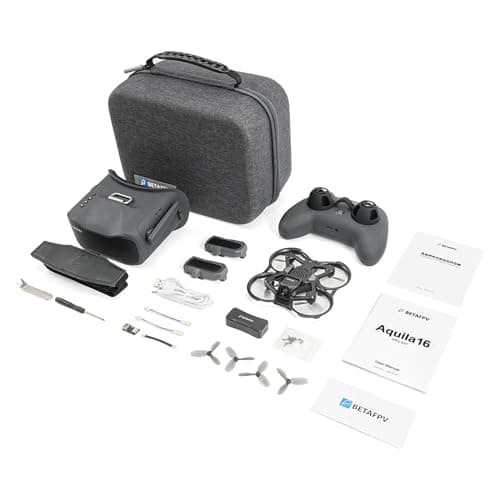
The BetaFPV Aquila16 FPV Kit bundles a brushless micro quad, VR03 goggles and LiteRadio 2 SE transmitter, delivering up to 8 minutes of flight time and strong 200 m video range. It targets beginners and simulator users with multiple assisted flight modes, though battery handling can be finicky.
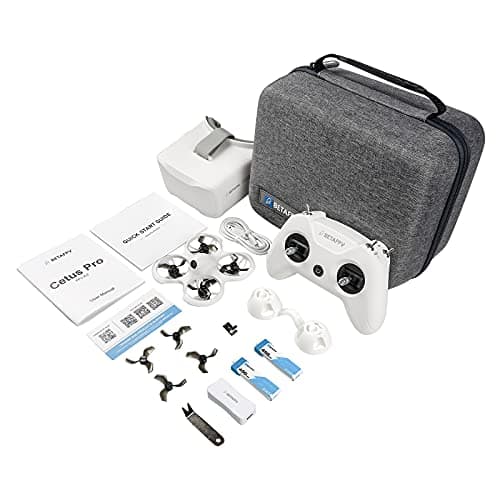
The BetaFPV Cetus Pro FPV Kit is an all-in-one brushless whoop system aimed at beginners, offering altitude-hold, turtle mode and a portable case with goggles and transmitter. It delivers solid brushless performance but is limited by short flight time and modest video hardware.
The BetaFPV Cetus Lite FPV Kit is a compact, beginner-oriented micro drone system that bundles a quadcopter, transmitter and goggles, offering altitude hold and safety features for indoor and short-range outdoor flying.
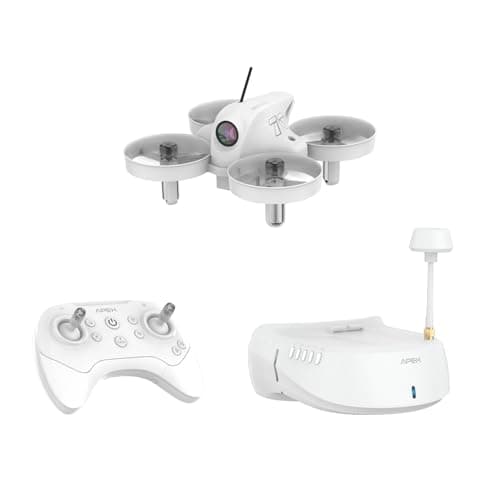
The APEX FPV Drone Kit offers an all-in-one entry-level FPV experience with goggles, head-tracking, and optical-flow, packaged in a lightweight 100 g drone. It excels at beginner accessibility but is limited by a low-resolution camera and occasional controller pairing issues.
The EMAX Tinyhawk 2 II RTF Kit is a compact, ready-to-fly micro FPV drone that bundles a carbon-fiber frame, transmitter, goggles and batteries. It excels for beginners and indoor pilots but suffers from short endurance and modest video quality.
The BetaFPV Cetus X FPV Kit is a plug-and-play micro drone package with a 2S brushless quad, ELRS transmitter and VR03 goggles, targeting beginners who want a step up in power and range. It offers solid build quality and simulator support but suffers from very short flight times and some antenna-related signal quirks.
The EMAX Tinyhawk 3 RTF Kit offers a compact, brushless micro quad with analog FPV, a basic transmitter and goggles, aimed at beginners for indoor flying. It provides solid build quality and low-latency video but is limited by very short flight times and basic accessories.
| Attribute | | | EMAX Tinyhawk 3 Kit | Betafpv Cetus Lite Kit | Betafpv Cetus X Kit | EMAX Tinyhawk 2 II Kit | |
|---|---|---|---|---|---|---|---|
4 minutes | 8 minutesbest | — | 4.5 minutes | — | 5 minutes | — | |
— | 72.5 g | 42 g | — | 81 gbest | 43.5 g | — | |
450 mAh | 1,100 mAhbest | 450 mAh | 300 mAh | 450 mAh | 450 mAh | 400 mAh | |
| ↓ lower better | 737 g | — | 1,470.5 g | 36 gbest | 1,400 g | 141.75 g | 100 g |
— | — | 4.35 V | 3.7 V | 7.4 Vbest | 4.35 V | — | |
18,000 KV | 18,000 KV | 15,000 KV | 19,000 KVbest | 11,000 KV | 7,000 KV | — | |
1.57 in | 1.77 in | 1.57 in | 1.2 in | 0.79 in | 2.5 inbest | — | |
4.3 inbest | 4.3 inbest | — | — | 4.3 inbest | — | 4.3 inbest |
Click an attribute name to sort · Green = best, red = worst (relative to this comparison)
| Attribute | | | EMAX Tinyhawk 3 Kit | Betafpv Cetus Lite Kit | Betafpv Cetus X Kit | EMAX Tinyhawk 2 II Kit | |
|---|---|---|---|---|---|---|---|
Camera & Imaging(1) | |||||||
Video Resolution | — | — | — | 720p | — | — | 480p |
Goggles & Display(1) | |||||||
Goggles Resolution | 800x480 | 800x480 | 480x272 | — | 800x480 | 480x272 | 800x480 |
Performance(5) | |||||||
Maximum Takeoff Weight (g) | — | 72.5 g | 42 g | — | 81 g | 43.5 g | — |
Total Kit Weight (g) | 737 g | — | 1470.5 g | 36 g | 1400 g | 141.75 g | 100 g |
Propeller Size (in) | 1.57 in | 1.77 in | 1.57 in | 1.2 in | 0.79 in | 2.5 in | — |
Motor KV Rating (KV) | 18000 KV | 18000 KV | 15000 KV | 19000 KV | 11000 KV | 7000 KV | — |
Motor Type | brushless | brushless | brushless | brushed | brushless | brushless | Brushed |
Build & Design(3) | |||||||
Frame Material | PA12 | PA12 | Polypropylene | PA12 | Durable composite | carbon fiber | Plastic |
Connectivity Type | Frsky D8 | ELRS | FrSky D8 | Frsky D8 | ExpressLRS | 2.4 GHz radio | RF, Wi‑Fi |
Number of Included Accessories (count) | 12 count | 13 count | 7 count | 15 count | 10 count | 6 count | 8 count |
Battery & Power(5) | |||||||
Flight Time (minutes) | 4 minutes | 8 minutes | 3-4 minutes | 4.5 minutes | 3-4 minutes | 5 minutes | 15-18 minutes |
Battery Capacity (mAh) | 450 mAh | 1100 mAh | 450 mAh | 300 mAh | 450 mAh | 450 mAh | 400 mAh |
Battery Voltage (V) | — | — | 4.35 V | 3.7 V | 7.4 V | 4.35 V | — |
Battery Discharge Rate (C) | — | — | 80 C | 75 C | 30 C | — | — |
ESC Current Rating (A) | 12 A | — | 3 A | — | 12 A | 5 A | — |
Products in the top-left offer the best value (high score, low price).
Professional reviewers and editors commend the Cetus Pro for its beginner-oriented features like altitude hold and turtle mode, its durable PA12 frame, and the realistic brushless performance that bridges the gap to higher-end freestyle drones.
Everyday users overwhelmingly praise the kit's ease of use, durability and the comprehensive package that requires no extra purchases. Common praise centers on stable hovering, brushless responsiveness, and the clear FPV view.
“Perfect starter drone-hovering is stable, and turtle mode saved me so many trips across the room.”
“Love that it's brushless. Feels way more responsive than my old Tiny Whoop.”
“Everything you need in one box. Great for teaching kids or friends.”
Choose Aquila16 for longer flight time and stronger video range; stick with Cetus Pro if price is the primary concern.
BetaFPV Cetus suits users who prefer an all-in-one drone with a built-in battery, whereas the Tinyhawk RTF excels for those prioritizing compact size and durability.
Choose Cetus X for upgraded performance and ELRS; stick with Cetus Pro if price is the primary concern.
Choose APEX for a more feature-rich starter kit; choose Cetus if higher native camera resolution is a priority.
Professional reviewers praise the Aquila16 as one of the best beginner-to-intermediate FPV kits, noting its pre-tuned build, impressive 8-minute flight time, 200 m video range, and durable PA12 frame with an inverted duct design that enhances thrust and stability.
Everyday users consistently praise the Aquila16 for its stability, long flight time, clear goggles and the ability to practice on a simulator, while also noting its ruggedness after crashes.
Professional reviewers praise the Tinyhawk RTF Kit as an excellent entry point to FPV, highlighting its well-tuned flight modes, low-latency analog video, and solid build quality. They note the inverted motor layout and F4 flight controller as contributors to stable, agile handling, while pointing out the lack of hover assist and the analog video's limited resolution as trade-offs for the low price.
Everyday users consistently commend the kit for being ready-to-fly, durable, and fun to pilot indoors, with many calling it perfect for beginners and appreciating the all-in-one packaging. Common frustrations revolve around the short battery life, uncomfortable goggles, and the basic nature of the included transmitter.
Professional reviewers consider the Cetus Lite one of the best entry-level FPV systems for kids, praising its safety-centric design, altitude hold and complete kit, while noting the low-power VTX and modest camera keep it in the budget tier.
Everyday users love the safety features, altitude hold and plug-and-play simplicity, but frequently complain about the brief flight time and limited video quality.
Professional reviewers, led by Oscar Liang, consider the Cetus X one of the best beginner kits available, highlighting its upgraded 2S power system, durable frame, and adjustable camera tilt that aid skill development. They commend the ELRS integration for range and reliability but criticize the horizontal VTX antenna, the absence of a buzzer, and the SPI-based receiver that restricts future firmware upgrades.
Everyday users overwhelmingly view the Cetus X as an excellent entry-level package, praising its durability, ease of use, and the ability to train in simulators. Common complaints focus on the very short flight time and occasional signal issues due to antenna placement, with some wishing for a buzzer for crash recovery.
Professional reviewers praise the Tinyhawk II as a benchmark micro FPV drone, highlighting its immersive FPV experience, upgraded VTX power, improved frame durability and the high-quality RunCam Nano 2 camera.
Everyday users overwhelmingly praise the Tinyhawk II for its beginner-friendly handling, crash-resistant build and the convenience of an all-in-one package, while noting the short battery life and low-resolution goggles as drawbacks.
Professional reviewers highlight the APEX kit as a strong entry point into FPV racing, emphasizing its all-in-one ecosystem, the rare inclusion of head-tracking and optical-flow at this price tier, and the generous triple-battery bundle.
Everyday users consistently praise the kit for its ease of use, durability and the immersive feel provided by the goggles and head-tracking, while noting occasional pairing issues and the low-resolution camera.
