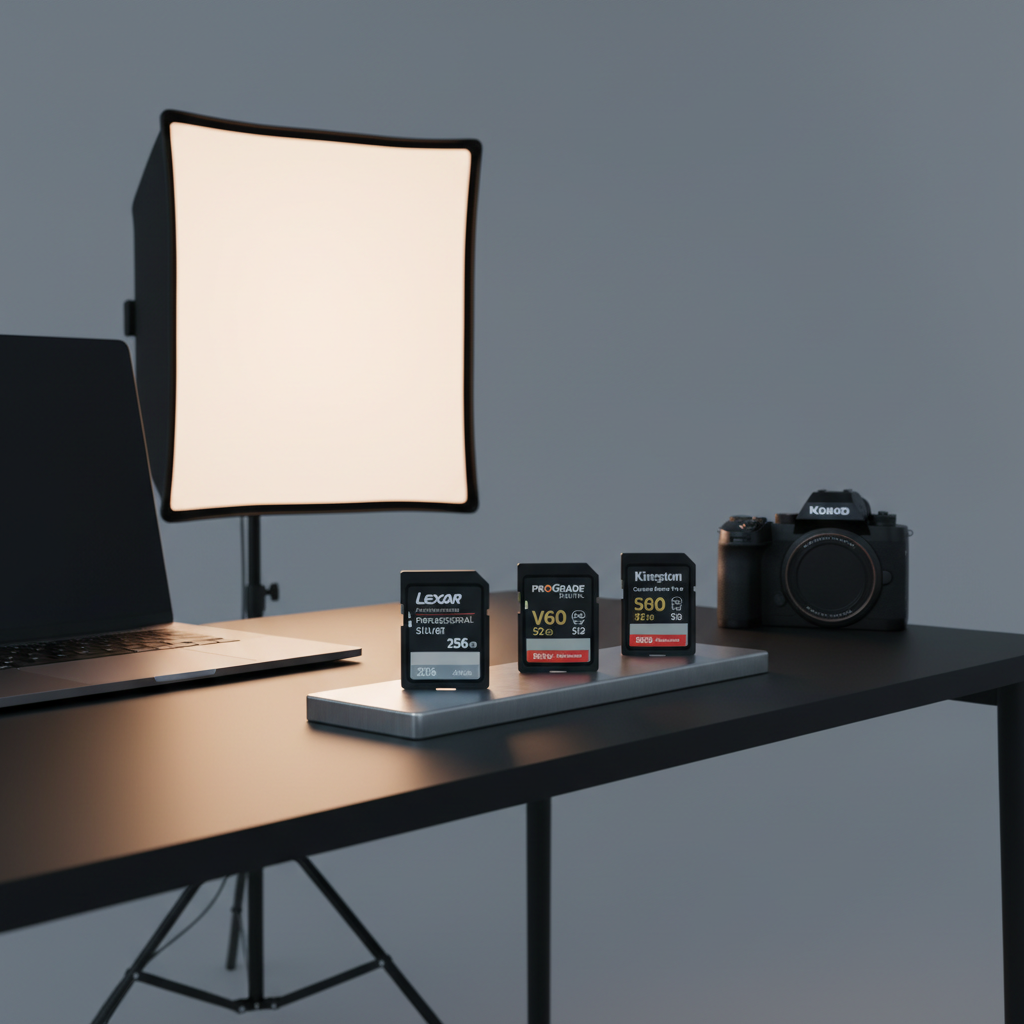
When you need a 256 GB + card that can keep up with 4K footage or rapid RAW bursts, the market offers a surprising spread of options. We compare 9 SD cards, from the $46.50 Transcend TS256GSDC300S that still delivers a solid 100 MB/s read speed, up to the $616.99 ProGrade Digital Iridium 512GB that pushes 300 MB/s read and 275 MB/s write. The price‑tier map groups the budget picks (Transcend, SanDisk Extreme, SanDisk Extreme PRO), the mid‑range trio (Lexar Gold 1800x, Kingston Canvas React Plus, Lexar Professional Silver) and the premium line (both ProGrade Iridium models and the ProGrade SD V60 512GB).
The Lexar Professional Silver 256GB stands out with a 4.8/5 rating from 1,644 reviews, a maximum read speed of 205 MB/s and a V30 video rating that handles 4K 30‑60 fps without hiccups. Meanwhile the ProGrade Digital SD V60 512GB matches its 4.8 rating (4,057 reviews) with a 250 MB/s read and a guaranteed 60 MB/s sustained write, ideal for demanding 4K/60p shoots. If you’re chasing the fastest burst performance, the Kingston Canvas React Plus 256GB offers 280 MB/s read and 150 MB/s write while staying in the mid‑range price band.
Below you’ll see how each card’s speed, durability and price stack up, so you can match the right capacity and performance to your workflow.

Lexar Professional Silver 256GB
Its 1.5 m drop protection height gives peace of mind against accidental falls, so it's a reliable everyday choice.

ProGrade Digital SD V60 512GB
Ideal for pros needing high‑capacity 512 GB storage; at $369.99 it sits about $265 above the Best Overall, reflecting its higher speed specs.

Kingston Canvas React Plus 256GB
Offers a 3.3 V operating voltage and Class 10 rating, catering to devices that prioritize low power draw over ultra‑high speeds.
Also considered
Score Analysis
Key score advantages vs. runner-up (ProGrade Digital SD)
Price Range
Lexar Professional Silver 256GB
$104.99
ProGrade Digital SD V60 512GB
$369.99
Kingston Canvas React Plus 256GB
$99.99

ProGrade Digital Iridium 256GB
$279.99

SanDisk Extreme PRO 256GB
$88.99

ProGrade Digital Iridium 512GB
$529.99

Transcend TS256GSDC300S
$46.50

Lexar Gold 1800x 256GB
$169.99

SanDisk Extreme 256GB
$68.27
Spec Comparison
TL;DR: The Lexar Professional Silver 256 GB SDXC delivers 205 MB/s reads, 140 MB/s writes, V30 4K video support, and rugged drop‑proof, waterproof durability, all backed by a 4.8‑star rating.
The card’s headline spec is its maximum read speed of 205 MB/s, paired with a write speed of 140 MB/s. It also survives drops from 1.5 m, resists magnetic fields up to 15000 Gauss, and endures shocks of 1500 G. Those durability numbers sit alongside a lightweight 1.73 g (0.0038125 pounds) profile that fits easily into any camera slot.
Compared with the eight peers in this roundup, Lexar’s read speed trails the Kingston Canvas React Plus (280 MB/s) and the Lexar Gold 1800x (280 MB/s), but it edges the SanDisk Extreme (200 MB/s) and matches the write speed of the SanDisk Extreme PRO (140 MB/s). It is marginally heavier than Kingston’s 1.70 g card, yet lighter than the Transcend model at 0.022 pounds. In price terms it sits above the budget‑oriented Transcend but below the premium ProGrade Digital Iridium line.
User feedback repeatedly praises the swift transfers enabled by the 205 MB/s read rate and the peace‑of‑mind from its IPX7 waterproof rating and drop protection. Professional reviewers call the V30 video class solid for 4K capture, while some users mention occasional write‑speed dips during long 4K sessions—an expected trade‑off for a UHS‑I card that doesn’t support the faster UHS‑II interface. Lexar includes its Recovery Tool and a lifetime limited warranty, reinforcing reliability.
Beyond speed, the card meets Class 10, U3, and V30 standards, operates from –25 °C to 85 °C, and tolerates X‑ray exposure up to 100 mGy. Those specs make it a well‑rounded choice for photographers and videographers who need a sturdy, high‑capacity (256 GB) SDXC solution without venturing into enterprise‑grade performance.
Pros
Cons
Best for: Enthusiast photographers and 4K videographers who need a well‑reviewed, durable 256 GB card with solid speed.
Avoid if: You need professional‑grade performance such as UHS‑II, V60/V90 video ratings, or ultra‑fast write speeds for high‑end cinema work.
“Users consistently report fast transfer speeds and reliability in field conditions.”
“The inclusion of free recovery software is frequently cited as a valuable bonus.”
TL;DR: The ProGrade Digital 512 GB UHS‑II SDXC V60 card offers 250 MB/s read, 130 MB/s write speeds, rugged durability, and a 4.8‑star rating, but its premium $369.99 price limits it to pros who need top‑tier performance.
At the heart of this card is a manufacturer‑stated maximum read speed of 250 MB/s and a maximum write speed of 130 MB/s, backed by a V60 video speed class that guarantees at least 60 MB/s sustained writes. With 512 GB of capacity, it targets photographers and videographers who need to store large RAW files or high‑bit‑rate footage without swapping cards.
Compared with the other eight cards in the roundup, the ProGrade’s 250 MB/s read is slower than the 300 MB/s read of both the ProGrade Iridium 256 GB and Iridium 512 GB models, but it outpaces the Lexar Professional Silver’s 205 MB/s and the SanDisk Extreme series’ 200 MB/s. Its 1.0 mm thickness is slimmer than the 2.1 mm thickness of the Iridium cards and the Lexar Gold 256 GB, while the 9 g weight is lighter than the Iridium 512 GB’s 20 g and matches the Lexar Gold’s 9 g. The card’s dimensions (54.6 mm × 44.5 mm × 1.0 mm) also place it in the standard full‑size SD footprint, making it interchangeable with the other full‑size options.
Reviewers consistently praise the card for smooth 4K recording with no dropped frames and rapid file transfers, noting that the V60 rating eliminates hiccups during long video bursts. Professional reviewers highlight its rugged build—shockproof, water‑resistant, and X‑ray proof—as ideal for field work. However, users also warn that older cameras lacking UHS‑II support won’t reach the advertised speeds, and the lack of an included protective case means you’ll need to buy a sleeve separately.
Beyond speed, the card works with UHS‑I, U3, U1, and Class 10 devices, and it operates from –25 °C up to 85 °C, with storage tolerances down to –40 °C. Error‑correction and wear‑leveling features add an extra layer of data integrity for demanding shoots.
Pros
Cons
Best for: Buyers willing to invest in a proven, high‑quality option
Avoid if: You're on a tight budget or only need basic functionality
“no dropped frames”
“The card maintains performance over hundreds of write cycles”
TL;DR: Kingston Canvas React Plus 256 GB delivers 280 MB/s reads, 150 MB/s writes, V60 video rating and rugged IPX7 protection, all at $99.99 with a 4.8‑star rating.
The standout spec is the 280 MB/s maximum read speed paired with a sustained 150 MB/s write speed, both backed by a V60 (60 MB/s) video speed class. That combination lets you capture 4K footage without frame drops, and the 3.3 V operating voltage keeps power draw low.
At 0.003747858454 pounds, the card's a touch lighter than the Lexar Professional Silver 256 GB and noticeably lighter than the Transcend TS256GSDC300S, while still offering a full‑size SDXC form factor. Like several peers, it uses a UHS‑II bus interface, but its V60 rating places it ahead of cards that only meet V30.
User reviews repeatedly praise the “blazing fast performance” and the card’s ability to survive harsh shoots, noting the waterproof IPX7 rating and shock‑resistant build. Professional reviewers highlight the “strong balance of speed and value” for 4K workflows, though they point out the card stops short of V90 performance needed for 8K cinema.
The card also carries a Class 10 minimum (10 MB/s), U3 minimum (30 MB/s), a write‑protect switch, and X‑ray proofing, while operating safely between –25 °C and 85 °C. The limited lifetime warranty adds peace of mind for frequent travelers.
Pros
Cons
Best for: Most users looking for a well‑reviewed, reliable mainstream option
Avoid if: You need 8K video performance or are using high‑end cinema cameras that demand V90 speeds
“blazing fast”
“keeps up with the 40MP sensor”
TL;DR: The ProGrade Digital Iridium 256 GB UHS‑II SDXC card packs V90‑rated 300 MB/s reads and 275 MB/s writes into a rugged, 15.9 g design, ideal for demanding 4K/6K video work.
What really sets this card apart is its V90 video speed class combined with a manufacturer‑stated maximum read speed of 300 MB/s and a maximum write speed of 275 MB/s. The UHS‑II interface, built‑in write‑protect switch, and laser‑etched serial number give professionals the confidence that data won’t be lost during intensive shoots.
When you line it up against the eight other cards in this roundup, the Iridium’s 300 MB/s read and 275 MB/s write numbers outpace every listed peer—most competitors top out around 280 MB/s read and 205 MB/s write. It does sit at a premium price point compared with the majority of the lineup, and at 15.9 g it’s a bit heavier than the ultra‑light options, yet still lighter than the larger 512 GB ProGrade model.
Users consistently applaud the card’s ability to handle continuous 4K and even 6K bursts without frame drops, and they love the fast off‑loading thanks to the 300 MB/s read rate. Professional reviewers note the V90 certification as a guarantee for high‑bitrate recording, while everyday buyers highlight the rugged build—shockproof, waterproof and X‑ray proof. A recurring gripe is that some retailers list lower write speeds, which can cause confusion, and the vendor sells the advanced recovery software separately rather than bundling it.
Beyond speed, the Iridium includes error‑correction and wear‑leveling, plus Refresh Pro™ technology that monitors health and delivers firmware updates. It operates from –25 °C up to 85 °C and can be stored in the same temperature range, and a three‑year warranty backs it for peace of mind.
Pros
Cons
Best for: Professional videographers and photographers who need V90‑rated performance and rugged reliability for high‑bitrate 4K/6K shooting.
“no dropped frames”
“The card maintains performance over hundreds of write cycles”
TL;DR: The SanDisk Extreme PRO 256 GB SDXC delivers up to 200 MB/s read and 140 MB/s write speeds in a rugged, lightweight card, making it a solid choice for 4K shooting and fast file transfers.
What really sets this card apart is its manufacturer‑stated maximum read speed of 200 MB/s combined with a 140 MB/s write speed, backed by U3 and V30 ratings that guarantee at least 30 MB/s sustained writes. At 256 GB of capacity, it gives you plenty of room for high‑resolution photos and 4K UHD video without swapping cards mid‑shoot.
Compared with the other eight entries in our roundup, the Extreme PRO is notably lighter at just 2.0 g, while many competitors tip the scales at several grams heavier. It's priced in the same premium tier as the Lexar Gold and Kingston Canvas options, but offers a more modest UHS‑I interface versus the faster UHS‑II‑only cards some rivals target. In short, it lands squarely in the middle of the performance‑price spectrum, offering a balance of speed and durability without the higher cost of top‑tier UHS‑II models.
Users consistently award it 4.8 / 5 stars across more than 57 000 reviews, praising the card’s reliable performance in demanding environments—thanks to magnet resistance, shockproof construction, waterproofing, and X‑ray proofing. Professional reviewers highlight the QuickFlow technology that pushes read speeds up to 200 MB/s, while everyday shooters appreciate the included RescuePRO Deluxe software for data recovery. The most common complaint centers on the UHS‑I bandwidth limiting peak speeds in some high‑end cameras, and a few users note that real‑world transfer rates can dip below the advertised maximum when paired with slower card readers.
Technically, the card meets Class 10 (10 MB/s minimum), U3 (30 MB/s minimum), and V30 (30 MB/s minimum) standards, ensuring smooth 4K video capture at up to 60 fps. A built‑in write‑protect switch adds an extra layer of safety for critical shoots, and the lifetime limited warranty from SanDisk (Western Digital Technologies) underscores the brand’s confidence in durability.
Pros
Cons
Best for: Prosumer photographers and videographers who need a fast, durable 256 GB card for 4K shooting and quick file offloading.
Avoid if: You want the absolute best value‑per‑dollar or require the fastest possible UHS‑II bandwidth.
“Works perfectly with my Sony A7 III and Panasonic GH5”
“Fast transfer speeds save time”
TL;DR: The ProGrade Digital Iridium 512 GB SDXC delivers 300 MB/s reads, 275 MB/s writes, V90 video speed and a rugged build, but its $616.99 price makes it a premium choice for pros.
The standout spec is its ultra‑fast performance: up to 300 MB/s read and 275 MB/s write, backed by a V90 video speed class that guarantees at least 90 MB/s sustained write. With a full‑size 512 GB capacity, the card can hold hours of 8K footage or thousands of RAW photos without swapping media.
Compared with the other eight cards in this roundup, the Iridium is noticeably pricier than the ProGrade Digital SD V60 512 GB and heavier than many 256 GB options such as the Lexar Gold 1800x. Its 2.1 mm thickness also exceeds the 1.0 mm profile of the V60, so it takes up a bit more space in tight camera slots.
Professional reviewers praise the card for flawless 4K/8K capture and rapid file transfers, while everyday users highlight its reliability on demanding shoots. A common theme is that the card shines in cameras with a UHS‑II interface; performance can dip noticeably when used in UHS‑I‑only devices. The vendor sells the optional Advanced Recovery Pro and Refresh Pro software separately, which some users note as an extra cost.
The Iridium runs on a UHS‑II bus, meets the V90 and U3 speed classes, and operates from –13 °C to 72 °C. It also includes a built‑in write‑protect switch, shockproof, temperature‑resistant and X‑ray‑proof construction, and comes with a three‑year warranty. The card has only five reviews listed, reflecting its niche professional market.
Pros
Cons
Best for: Professional videographers and photographers who need V90‑rated speeds, high capacity, and rugged durability for 6K/8K video or high‑burst RAW shooting.
Avoid if: You’re on a tight budget, use entry‑level DSLRs, or rely solely on UHS‑I devices, as the price and speed requirements may not be justified.
“no dropped frames”
“The card maintains performance over hundreds of write cycles”
TL;DR: The Transcend 256 GB TS256GSDC300S delivers U3/V30‑rated 100 MB/s reads, 40 MB/s writes, rugged protection and a $46.50 price tag, making it a solid budget choice for photographers and videographers.
The standout spec is the U3/V30 rating; the manufacturer claims a maximum read speed of 100 MB/s and a maximum write speed of 40 MB/s, while it offers a full 256 GB of storage. A built‑in write‑protect switch and the included RecoveRx data‑recovery utility add extra peace of mind for on‑the‑go shooting.
Compared with the eight other cards in this roundup, the Transcend sits at the lower end of the price spectrum and is noticeably heavier than the SanDisk Extreme (0.00440924524 lb) and the ultra‑light Kingston Canvas React Plus (0.003747858454 lb). Its read speed of 100 MB/s trails the Lexar Gold 1800x’s 280 MB/s and the ProGrade Digital Iridium’s 300 MB/s, and the 40 MB/s write ceiling is below the 140 MB/s write speeds of the SanDisk Extreme and Extreme PRO models.
Users consistently praise the card’s dependable in‑camera performance and appreciate the large 256 GB capacity for RAW bursts and 4K footage. Users frequently cite the bundled RecoveRx utility as a helpful safety net. Common complaints focus on the slower write speed, especially when off‑loading via older USB 2.0 readers, which can feel sluggish compared with faster competitors. Professional reviewers note that the V30 and U3 compliance makes it suitable for 4K UHD recording, but they also warn that the 40 MB/s write limit may bottleneck high‑bit‑rate workflows.
Beyond speed, the card builds for tough conditions: it meets an IPX7 waterproof rating (immersion up to 1 m for 30 min), is shock‑proof, static‑proof to IEC61000‑4‑2, and X‑ray‑proof per ISO7816‑1. Operating temperatures range from –25 °C to 85 °C, and Transcend backs the product with a five‑year limited warranty, underscoring its durability focus.
Pros
Cons
Best for: Budget‑conscious buyers seeking a reliable entry‑level option
Avoid if: You need advanced features or professional‑grade performance
“While performance in-camera was excellent, USB 2.0 transfer speeds were around 19 MB/s, which can make offloading large files time‑consuming.”
TL;DR: The Lexar Gold 1800x 256 GB SDXC delivers up to 280 MB/s read and 205 MB/s write speeds, V60 video rating, and rugged protection, but you’ll need a UHS‑II host to unlock its full performance.
The standout spec is the 1800x X‑Speed rating paired with a manufacturer‑claimed maximum read speed of 280 MB/s and write speed of 205 MB/s. With a V60 video speed class, the card guarantees at least 60 MB/s sustained write, which is ideal for 4K video capture. It packs 256 GB of storage in a compact 32 mm × 24 mm footprint, 2.1 mm thick, and weighs just 9 g (0.004375 lb).
Compared with the other eight cards in this roundup, the Lexar is heavier than the SanDisk Extreme PRO (which lists a weight of 2.0 g) but thinner than its 2.3 mm depth. Its read speed outpaces the SanDisk Extreme PRO’s 200 MB/s and matches the Kingston Canvas React Plus’s 280 MB/s, while its write speed exceeds Kingston’s 150 MB/s maximum. The Transcend TS256GSDC300S only reaches 100 MB/s read and 40 MB/s write, so Lexar’s performance sits near the top of the group. In terms of durability, Lexar offers water, shock, vibration, and X‑ray resistance, whereas Transcend lists only shock resistance.
User sentiment highlights the card’s fast off‑load times and reliable build quality. Reviewers repeatedly note the “hardcore videographers” endorsement, praising the V60 rating for uninterrupted 4K recording. A recurring complaint is a variance in reported maximum write speed—some users see around 180 MB/s instead of the advertised 205 MB/s—plus the need for a UHS‑II‑compatible device to achieve those numbers.
Technically, the card is UHS‑II (backward compatible with UHS‑I), carries a Class 10 and U3 (30 MB/s minimum) rating, and uses the exFAT file system. It operates from 0 °C to 70 °C and can be stored between –25 °C and 85 °C, making it suitable for demanding shooting environments. The built‑in write‑protect switch adds an extra layer of data safety.
Pros
Cons
Best for: Professional videographers and photographers who need fast, reliable 256 GB storage with strong durability.
Avoid if: You primarily use UHS‑I devices or are looking for the cheapest 256 GB SD card.
“handles what I need”
“excellent choice for both photography and video”
TL;DR: The SanDisk Extreme 256 GB SDXC delivers 200 MB/s read, 140 MB/s write, 5 m shockproof durability and a solid 4.7‑star rating for a reliable, budget‑friendly high‑capacity card.
The standout spec is its manufacturer‑claimed maximum read speed of 200 MB/s paired with a maximum write speed of 140 MB/s, which puts it squarely in the fast‑transfer camp for 4K video and burst photography. A 5 m shock‑proof drop rating, IPX7 waterproof protection (submersible up to 1 m for 30 min) and magnet‑proof construction reinforce its ruggedness, and it weighs just 0.00440924524 lb.
Compared to the other eight cards, the read speed matches the SanDisk Extreme PRO 256 GB but trails the 280 MB/s reads of the Lexar Gold 1800x and Kingston Canvas React Plus. Its 140 MB/s write speed also mirrors the Extreme PRO and sits a notch below Lexar Gold’s 205 MB/s and Kingston’s 150 MB/s. In terms of heft, it shares the same weight as the Extreme PRO, is a shade heavier than Lexar Gold (0.004375 lb) and Kingston (0.003747858454 lb), yet feels lighter than the Transcend TS256GSDC300S at 0.0220462262 lb.
Users consistently award the card 4.7 stars across more than 20 000 reviews, praising its reliability for 4K recording and its ability to survive harsh conditions. Professional reviewers note that the card performs well for 4K video when paired with a dedicated SanDisk PRO‑Reader, but they also warn that generic card readers often don’t hit the advertised speeds and that the lack of UHS‑II support can disappoint those chasing the very highest throughput.
Technically, the card operates on a UHS‑I bus, carries a U3 (30 MB/s minimum) and V30 (30 MB/s minimum) class, and meets the C10 (10 MB/s minimum) SD Speed Class. It includes a two‑year RescuePRO Deluxe software license and comes with a lifetime limited manufacturer warranty, adding peace of mind for long‑term storage.
Pros
Cons
Best for: Budget-conscious buyers seeking a reliable entry‑level option
Avoid if: You need the absolute fastest UHS‑II performance or rely on generic readers for top speeds
“Works perfectly with my Sony A7 III and Panasonic GH5”
“Fast transfer speeds save time”
Breakdown
Lexar Professional Silver 256GB
Pros
ProGrade Digital SD V60 512GB
Pros
Kingston Canvas React Plus 256GB
Pros
ProGrade Digital Iridium 256GB
Pros
Based on scoring data and product specs
Personalized picks
Best Overall Pick
Lexar Professional Silver 256GB
Best OverallBest for: Most users looking for a well-reviewed, reliable mainstream option
ProGrade Digital SD V60 512GB
Best for: Buyers willing to invest in a proven, high-quality option
$369.99+$265.00 vs winner
Skip SanDisk Extreme 256GB if…
Reliability and user satisfaction are your top concerns
Lexar’s Professional Silver 256 GB SDXC takes the top spot with a 4.8‑star rating from 1,644 reviewers, a listed maximum read speed of 205 MB/s, and a rugged design that survives a 1.5 m drop and IPX7 water exposure—all for a lightweight 1.73 g card.
The ProGrade Digital SD V60 512 GB lands as the runner‑up, ideal if you need sustained 4K‑60 video capture. Its V60 video speed class guarantees at least 60 MB/s write, while the UHS‑II interface pushes read speeds up to 250 MB/s, giving you the headroom for high‑bitrate footage.
Looking at the per‑budget alternatives, the Transcend TS256GSDC300S offers the best value at $46.50, making it a solid entry‑level pick. For a premium experience, the ProGrade Digital Iridium 512 GB commands attention at $616.99, delivering top‑tier performance and durability for professionals who can spend more.
Grab the Lexar Professional Silver 256 GB now and enjoy its 205 MB/s read speed and reliable storage without compromise.
The Lexar Professional Silver 256GB costs $104.99 and delivers 205 MB/s read and 140 MB/s write speeds, which is a solid performance for its price. Compared with other 256 GB options that range from $71.99 to $169.99, it offers the strongest value proposition.
Please sign in to leave a review
No reviews yet. Be the first to review!
