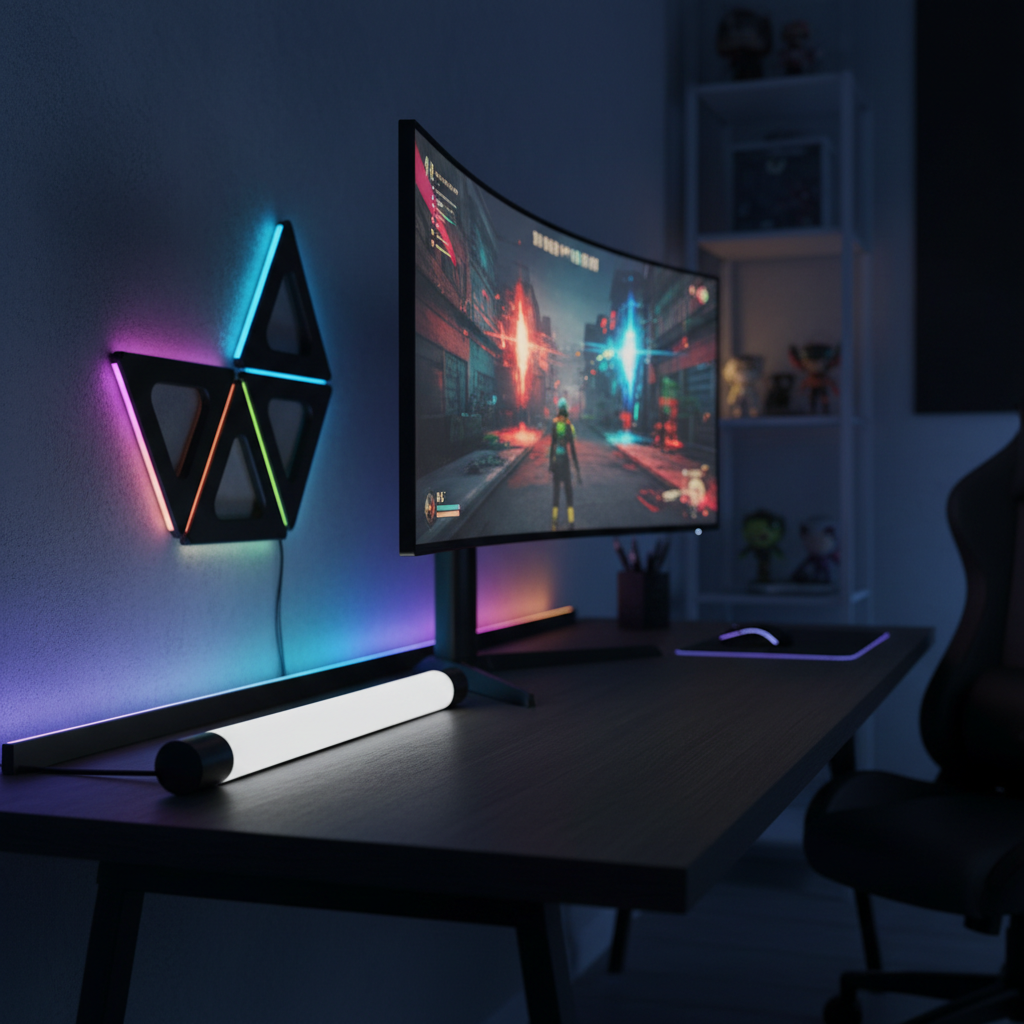
When you want your gaming rig to pulse in time with every explosion, the Philips Hue Light Tube steals the show. At $241.99 it carries a 4.5‑star rating from 300 reviewers and can push up to 2,600 lm at 4000 K, delivering enough brightness to fill a large room without drowning the screen.
The roundup covers 7 products across three price tiers. Budget‑friendly choices include Nanoleaf Shapes Triangles at $44.99 (4.3 stars from 1,361 reviews) and the Govee TV Backlight 3 Pro at $149.99. Mid‑range options are the Philips Hue Play Gradient 55 for $153.95 and the Play Gradient 65 for $154.95, each offering 7 zones of color control. Premium offerings feature the Hue Light Tube and the Hue Light Strip 75 at $289.99, both promising high lumen output and seamless Hue Sync integration. The Nanoleaf Screen Mirror lacks price info, so we don’t place it in a tier.
Next, the article examines how each of these lights performs in real‑world gaming setups, helping you choose the right sync solution for your space.

Philips Hue Light Tube
Its 80 CRI delivers accurate color rendering, supporting the premium performance that earned it top honors.

Nanoleaf Shapes Triangles
Ideal for budget‑conscious gamers, it offers reliable entry‑level lighting at $44.99—about $197 less than the Best Overall model.

Philips Hue Light Strip 75
The 85.2‑inch installed length lets you cover larger screens, a scale the Light Tube and Shapes don’t match.
Also considered
Score Analysis
Key score advantages vs. runner-up (Nanoleaf Shapes Triangles)
Price Range
Philips Hue Light Tube
$217.77
Nanoleaf Shapes Triangles
$44.99
Philips Hue Light Strip 75
$247.49
Nanoleaf Screen Mirror
$39.99

Philips Hue Play Gradient 55
$149.00
Philips Hue Play Gradient 65
$149.99

Govee TV Backlight 3 Pro
$149.99
Spec Comparison
TL;DR: The Philips Hue Light Tube delivers up to 2,600 lm of RGBW light across a 54.21‑in span, but you’ll need a Hue Bridge and Sync Box for full gaming sync, and it sits at $241.99.
The standout spec is its 2,600 lm peak output at 4000 K, paired with a full RGBW color engine and an 80 CRI, which means vivid, accurate colors for immersive gaming ambi‑light. At 29.5 W it pulls respectable power for a tube of its size, and its 54.21 in length fits well above a monitor or TV without crowding the room.
Compared with the other six contenders, the Light Tube is lighter than the Philips Hue Play Gradient 65 (1.8959754532 lb) but heavier than the Nanoleaf Shapes Triangles (0.992080179 lb). It’s also considerably slimmer than the Hue Light Strip 75, which uses a 0.63 in strip, and it offers far more lumen output than the Play Gradient 55’s 1,100 lumens. Price‑wise it sits above most peers, making it pricier than the Hue Play Gradient 55 and the Govee TV Backlight 3 Pro, though those products lack the same high‑output tube form factor.
Reviewers love the “vivid colors” and “strong brightness” that turn a bedroom gaming rig into a mini‑theater, especially when paired with the Hue Sync Box for real‑time screen sync. The downside that pops up repeatedly is the extra cost of a required Hue Bridge and optional Sync Box, plus the need to mount the tube on a Perifo track, which some users find fiddly.
Technical notes: the tube runs on 24 V DC, draws 29.5 W, and delivers an efficacy of ≈90 lm/W. Philips guarantees a 25,000‑hour lamp life and backs the product with a 2‑year warranty. Bluetooth and Zigbee support let you control it via the Hue app or voice assistants like Alexa, Google Assistant, and Apple HomeKit (Matter).
Pros
Cons
Best for: Those prioritizing quality and willing to pay for premium performance
Avoid if: You're shopping on a tight budget — it's priced at $241.99
TL;DR: Nanoleaf Shapes Triangles deliver modular, over‑16‑million‑color LED panels with music and screen sync for $44.99, offering Thread support and touch control, though brightness and mounting are modest.
The standout feature is the Connect+ technology, which lets you snap panels together in virtually any layout. You can run up to 21 panels on the included 42 W power supply and control as many as 500 panels with a single controller. Each panel renders over 16 million colors, supports screen‑mirror sync, and offers a CRI of 80.
At under 1 lb (0.992080179 pounds), the kit is lighter than the Philips Hue Play Gradient 55, which weighs 1,310 g, and its total brightness of 720 lumens (9‑pack) falls short of the 1,100 lumens listed for that Hue model. It’s also more affordable than the Govee TV Backlight 3 Pro, while providing Thread integration that the other six products don’t mention.
Reviewers love the freedom to craft custom geometric art and the responsive touch and music‑sync features that react to gameplay. Professional reviewers highlight the forward‑looking Thread support and screen‑mirror performance. On the downside, users note that the linkers aren’t lockable and can detach, the supplied double‑sided tape may struggle on certain walls, and Wi‑Fi is limited to 2.4 GHz, which can feel flaky.
Technically, the panels provide a 25,000‑hour lifetime and achieve an efficiency of 53.33 lumens per watt. Each panel draws only 2 W, and a full 9‑panel set consumes 13.5 W. The 2500 mm cable provides 2.5 m of reach for most room setups.
Pros
Cons
Best for: Gamers and streamers who want affordable, customizable lighting that reacts to screen content and music.
Avoid if: You need high brightness for task lighting or a rock‑solid mounting solution for long‑term installations.
“Looks amazing on the wall — like a futuristic art piece”
“Music sync is perfect for parties and gaming”
TL;DR: The Philips Hue Light Strip 75 delivers 85.2 in of immersive, 1,200 lm color‑rich lighting for a 75″ TV, but you’ll need a separate Hue Bridge and Sync Box, pushing the total cost higher.
This strip’s standout spec is its 85.2 in installed length, letting you cover a full‑size 75″ screen with a continuous gradient. It draws 20 W and can output up to 1,200 lm at 4000 K, while the CRI lists >80 for accurate color rendering.
Compared with the other six contenders, the Hue Light Strip 75 is noticeably longer than the Philips Hue Light Tube (54.21 in) and the Play Gradient 65 and 55 models (both 11.4 in). At 3.15 lb gross, it also tops the weight chart, heavier than the Light Tube, Play Gradient units and the Nanoleaf Shapes Triangles, which sit under 2 lb.
Reviewers love the dramatic immersion and the ease of mounting the strip with the included brackets, noting that voice control through Alexa or Google Assistant works reliably. The main complaints focus on the extra expense of a required Hue Bridge and Sync Box, the fact that the strip can’t be cut or extended, and occasional app lag during sync sessions.
Technical notes: the strip runs on 100‑120 V, consumes a max of 0.5 W on standby, and rates for 25,000 hours of operation. It tolerates indoor humidity from 5 % to 95 % (non‑condensing) and temperatures between –20 °C and 45 °C.
Pros
Cons
Best for: Buyers willing to invest in a proven, high‑quality option
Avoid if: You're on a tight budget or only need basic functionality
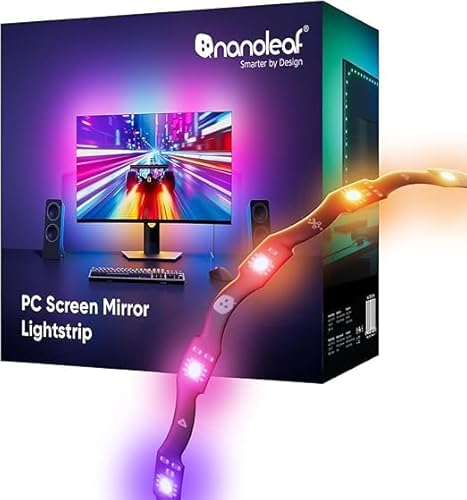
TL;DR: Nanoleaf’s Screen Mirror adds 75 addressable zones of 16 million‑color RGBW light along a 2.5 m USB‑C‑powered strip, delivering real‑time screen and music sync for immersive PC gaming.
The strip’s headline spec features 75 individual color zones, each driven by a high‑density array of 30 LEDs per meter and spaced 33.33 mm apart. With a brightness of 300 lm measured at 2.5 m, you get a vivid backlight that can be dimmed from 1 % to 100 % and tuned between 2700 K and 6500 K. The entire 2500 mm (8.2 ft) length plugs directly into a PC via a 5 V USB‑C cable, eliminating the need for an external adapter.
Compared with the other six contenders, the Screen Mirror offers far more granularity than the Philips Hue Play Gradient models, which provide only 7 zones. Its 2500 mm length also exceeds the installed length of the Philips Hue Light Strip 75 (2162 mm), giving you broader coverage behind larger monitors. At roughly 155 g, the strip weighs less than the Nanoleaf Shapes Triangles set, which weighs about 0.99 lb, and only this product in the group supports dual‑monitor setups out of the box.
Professional reviewers note the plug‑and‑play USB‑C connection as a major convenience, and users consistently praise the immersive screen‑mirroring that reacts instantly to in‑game action. The music‑sync feature captures PC audio through the Nanoleaf Desktop App and also receives strong approval. On the downside, the strip cannot mirror DRM‑protected streams such as Netflix or Disney+, and a handful of owners report occasional connectivity hiccups that require restarting the app. It doesn’t suit ultrawide or larger‑than‑32″ displays, and it lacks smart‑home or mobile‑app control.
Technical details round out the picture: the strip rates for indoor use only (IP20), operates in 10 %–90 % relative humidity, and tolerates temperatures from 0 °C to 40 °C. Its LEDs last for 25 000 hours, and you can trim the controller along marked lines for a custom fit; smart remapping automatically adjusts the lighting zones.
Pros
Cons
Best for: Gamers and streamers who want a highly responsive, PC‑driven ambient light that syncs to both screen visuals and audio on monitors up to 32 inches.
“Screen mirroring is really cool and immersive.”
“Often have connectivity issues—need to restart the app or power cycle the strip.”
TL;DR: The Philips Hue Play Gradient 55 delivers a 7‑zone, 16‑million‑color ambient backlight for a 55‑inch TV at $153.95, but you’ll need a Hue Bridge and Sync Box for full sync.
The strip’s standout spec is its seven independently controllable zones that blend into smooth gradients across a 55‑inch screen, backed by 16 million colors and a color temperature range of 2,000 K – 6,500 K. At 20 W it produces 1,100 lumens, and Philips rates the LED source for 25,000 hours of use.
Compared with the other six products, the Gradient 55 offers fewer zones than the Govee TV Backlight 3 Pro’s 32 zones, yet matches the Philips Hue Play Gradient 65’s 7‑zone design while being lighter than the 1.9‑pound Gradient 65. It shares the same 290 mm strip length as the Hue Light Strip 75 but weighs considerably less than that model’s 3.15‑pound rating. Against Nanoleaf Shapes Triangles, the Hue strip is heavier but provides far more luminous output (1,100 lumens vs. the triangles’ modest panel output).
User sentiment highlights an “awesome, immersive, cinematic” effect that reduces eye strain, especially during gaming sessions. Professional reviewers praise the smooth gradient blending and high color accuracy. The most common complaints focus on the lack of bottom‑edge illumination, the fixed 55‑inch length that can’t be extended, and occasional adhesive issues on textured TV backs. Full content sync also demands a separate Hue Bridge and optional Sync Box, adding to the total cost.
Technical context notes that the strip runs on a 120 V corded adapter, weighs 1,310 g, and measures 16 mm high by 17 mm wide. Install the strip surface‑mounted using the included brackets and adhesive clips, and the product integrates with Apple HomeKit, Amazon Alexa, Google Assistant, Samsung SmartThings, and IFTTT via the Hue app or voice commands.
Pros
Cons
Best for: Home‑theater enthusiasts and gamers who already use Philips Hue and want a well‑reviewed ambient lighting solution.
Avoid if: You have a smaller TV, a tight budget, or need bottom‑edge illumination without adding a Hue Bridge and Sync Box.
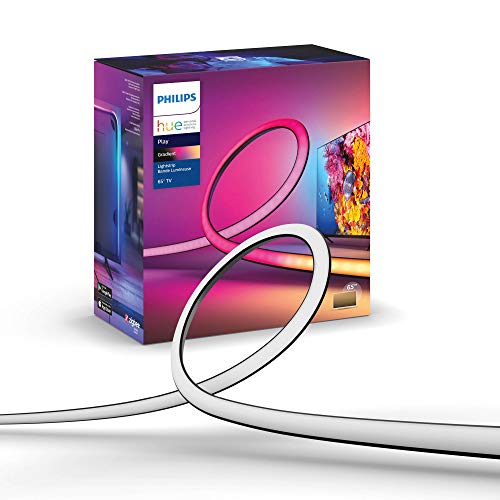
TL;DR: The Philips Hue Play Gradient 65 delivers 16 million colors and 1,100 lumens across seven segments for immersive HDMI‑synced lighting, but it needs a Hue Bridge, Sync Box and carries a premium $154.95 price tag.
The strip’s standout spec is its 7 independently controllable segments that blend 16 million colors into a smooth gradient, all powered by a 20‑watt LED source delivering 1,100 lumens of brightness. Its slim profile—0.67 inches (17 mm) thick, 0.63 inches (16 mm) wide, and 11.4 inches (289.6 mm) long—lets it wrap neatly around a 65‑inch TV while staying lightweight at 1.8959754532 pounds.
Compared with the other six contenders, the Gradient 65 is heavier than the Nanoleaf Shapes Triangles (under 1 pound) but lighter than the Philips Hue Light Tube (around 1.87 pounds). It offers far fewer calibration zones than the Govee TV Backlight 3 Pro’s 32 zones, yet matches the Hue Play Gradient 55’s 7‑zone architecture while being slightly narrower (16 mm vs 17 mm) and lighter than the Gradient 55’s 1,310 g. Its 1,100‑lumen output outshines the Nanoleaf Screen Mirror’s 300 lm, and its 25,000‑hour lifespan aligns with both the Hue Light Tube and Hue Light Strip 75.
User sentiment highlights the “mesmerizing” color flow and the ease of mounting with adhesive brackets, while professional reviewers commend the zero‑lag HDMI sync and the durable silicone sleeve that diffuses light evenly. However, customers repeatedly note the missing bottom illumination, which limits full‑circle ambience, and the requirement for a separate Hue Bridge and Sync Box adds to the total cost.
Pros
Cons
Best for: Home‑theater enthusiasts, gamers, and smart‑home users who already own a Hue Bridge and want premium, sync‑ready ambient lighting.
Avoid if: You need full‑wrap illumination, a cut‑table strip, or want a low‑cost solution without additional Hue accessories.
TL;DR: Govee TV Backlight 3 Pro uses a 32‑zone HDR triple‑camera system with 1080p/30 fps capture and 105 dB dynamic range to deliver precise, bright ambient lighting for TVs up to 85‑inches.
The standout hardware is the HDR triple‑camera module, which records at 1080p resolution, 30 fps and offers a 105 dB dynamic range across 32 calibrated zones. That combination lets the strip mirror on‑screen colors with a level of fidelity that most competitors simply can’t match.
Compared with the other six kits, Govee offers a longer LED strip—up to 16.4 ft for 75‑85″ screens—while the Philips Hue Light Strip 75 lists an installed length of 85.2 in, and the Hue Play Gradient models are fixed‑size light bars. In terms of brightness, Govee’s 337 lm/m works across its 75 LEDs/m density, whereas the Hue Play Gradient 55 and 65 each claim 1,100 lumens total across seven zones. Govee also weighs 2.68 lb, making it lighter than the Hue Play Gradient 55 (1,310 g) but heavier than Nanoleaf Shapes Triangles (0.992080179 lb). Its package dimensions (3.58 in × 11.89 in × 8.35 in) are comparable to the compact footprints of the Hue Play Gradient lights.
User feedback highlights the AI mood‑matching and Black Screen Detection as handy features for movie nights, while the DreamView sync lets you link up to 10 additional Govee lights for a full‑room effect. Owners generally praise the installation as straightforward thanks to adhesive strips and mounting clamps, though several owners note the top‑mounted camera can look intrusive and may clash with low‑profile soundbars. Owners find cable routing around curved corners another recurring pain point, and the system only supports 2.4 GHz Wi‑Fi, which can be limiting for households that rely on 5 GHz networks. The kit ships with Bluetooth 5.3, Matter, Alexa, Google Assistant, and Apple HomeKit compatibility, and includes a 1‑year warranty.
Pros
Cons
Best for: Entry-level buyers or those on a tight budget
Avoid if: You need powerful performance or professional‑grade features, have an ultra‑thin TV that can’t accommodate a top‑mounted camera, or rely on 5 GHz Wi‑Fi for stability
Breakdown
Philips Hue Light Tube
Pros
Cons
Nanoleaf Shapes Triangles
Cons
Philips Hue Light Strip 75
Pros
Cons
Based on scoring data and product specs
Personalized picks
Best Overall Pick
Philips Hue Light Tube
Best OverallBest for: Those prioritizing quality and willing to pay for premium performance
Nanoleaf Shapes Triangles
Best for: Budget-conscious buyers seeking a reliable entry-level option
$44.99-$172.78 vs winner
Skip Govee TV Backlight 3 Pro if…
You need powerful performance or professional-grade features
Philips Hue Light Tube takes the top spot thanks to its strong 4.5‑star rating from 300 reviewers, a luminous output that peaks at 2,600 lm, and an efficacy of roughly 90 lm/W. It supports full RGBW color with a 2,000–6,500 K temperature range and pairs directly with the Hue Sync Box for smooth screen‑to‑light syncing, making it the most capable option for immersive gaming ambience.
Nanoleaf Shapes Triangles earns the runner‑up title if you want a modular, wall‑mounted solution that reacts to music and on‑screen action. At $44.99 it offers over 16 million colors, music sync, and screen‑mirror features, and you can expand up to 21 panels on a single 42 W power supply, delivering a flexible setup for budget‑friendly gaming caves.
For shoppers with different budgets, the alternatives line up nicely:
Pick the Philips Hue Light Tube now to transform your gaming space with premium, synchronized lighting.
The Philips Hue Light Tube pairs with the Hue Sync Box to capture HDMI video and reproduce colors across the entire tube, creating a full‑room ambience, while the Nanoleaf Shapes Triangles use their own screen‑mirror feature but cover a smaller surface area. Because the Light Tube covers a 54.21‑inch length and works with the dedicated Hue Bridge, it generally delivers a more encompassing effect for TV gaming.
Please sign in to leave a review
No reviews yet. Be the first to review!
