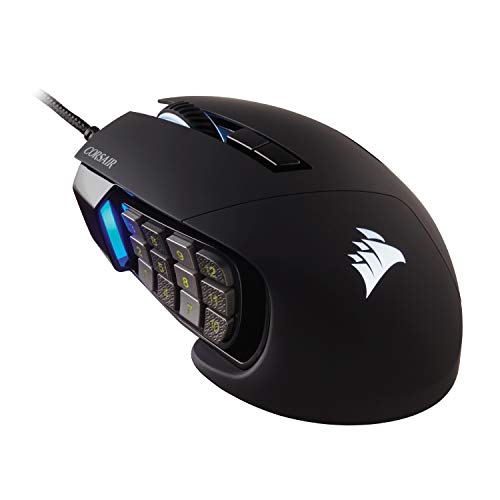
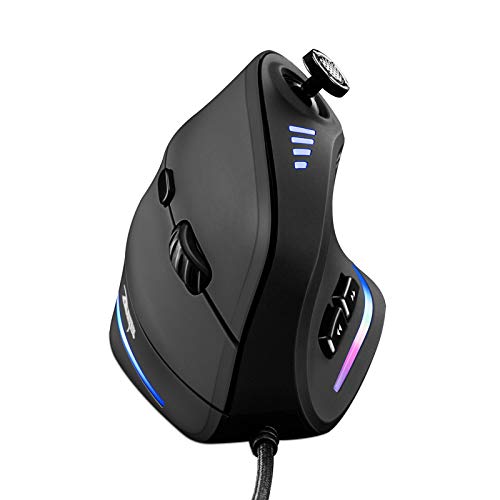
The Logitech G502 HERO, released a decade ago, still includes a HERO 25K sensor, 11 programmable buttons, and a tunable weight system, priced at $35.99. It holds a 4.6/5 rating from 57,434 reviewers, showing that precision and customization can be affordable.
On the budget side, the Redragon M612 Predator ($16.99, 4.6/5 from 10,643 reviews) and the Redragon M602 (also $16.99) both deliver solid DPI and button counts for under $20. Mid‑range options include the UtechSmart Venus ($32.99, 4.4/5 from 23,791 reviews) and the Redragon M801 ($33.99, 4.4/5 from 9,904 reviews), which add extra programmable keys and wireless capability. Premium models such as the Razer Basilisk V3 X ($48.99), Corsair Scimitar Elite ($89.00), and ASUS ROG Spatha X ($126.99) provide wireless freedom, advanced sensors, and extensive button arrays.
We compared 12 gaming mice across budget, mid‑range, and premium tiers, weighing specs, ratings, and price to help you find the right fit for your play style.

Logitech G502 HERO
It wins thanks to its 11 programmable buttons, giving you extensive customization for any game.

UtechSmart Venus
Ideal for gamers who want multiple onboard profiles without breaking the bank—offers five customizable profiles and costs $3 less than the G502 HERO.

Redragon M612 Predator
Stands out with two side macro buttons and a rock‑bottom $16.99 price, delivering 11 buttons at entry‑level cost.
Also considered
TL;DR: The Redragon M602 features a 1.8 m braided cable, eight buttons, and a DPI range up to 8000, all in a 0.29‑lb ergonomic mouse that holds a 4.6 / 5 rating from more than 33 k reviewers.
The 1.8 m braided fiber cable with a gold‑plated USB connector offers a sturdy link and low desk drag. DPI can be set between 250 and 8000, with preset steps at 800, 1200, 1600, 2400 and 7200, while the polling rate is adjustable from 125 Hz to 1000 Hz. At 0.29 pounds (131.5 g) the mouse feels solid yet portable for extended use.
Compared with other Redragon models, the M602 is lighter than the M614 (0.489 pounds) and slightly heavier than the M801 (0.264 pounds). It matches the M690 PRO with eight buttons, while the M612 offers eleven programmable keys. Cable length is identical to the M612 and M801, both listed with 1.8 m leads.
Reviewers highlight the ergonomic right‑hand shape and PTFE Teflon feet, noting smooth glide at this price. Users appreciate the seven RGB lighting modes and five onboard profiles, though some find the mouse a bit heavy for fast‑paced competitive play and note that the configuration software launches automatically on boot. A few users also report occasional scroll‑wheel or middle‑click failures after long use.
Pros
Cons
Best for: Budget‑focused buyers who want a reliable entry‑level mouse with a 1.8 m braided cable.
Avoid if: You need advanced features or professional‑grade performance.
“very comfortable”
“fantastic”
TL;DR: The Redragon M614 packs 11 programmable buttons, an 8000 DPI sensor and vibrant RGB into a wired, Windows‑only mouse for $22.99, making it a solid budget pick for gamers who want customization without breaking the bank.
The headline spec of the M614 is its 8000 DPI maximum, paired with five preset DPI levels ranging from 1200 up to 8000. That level of sensitivity puts it on par with higher‑priced flagship mice, while the 11 programmable buttons—including a dedicated sniper button—give you plenty of room for macros and quick binds in FPS or MOBA titles.
When you line it up against the other eleven entries, the M614 is heavier than the Redragon M602 (0.29 lb) and the M690 PRO (0.330693393 lb), and also outweighs the M612 Predator (0.27778245012 lb) and the TRELC Gaming Mouse (0.36 lb). Its 0.48942622164 lb (222 g) chassis is almost identical to the UtechSmart Venus (0.4875 lb), but noticeably heftier than the ultra‑light M801 (0.2645547144 lb). In terms of button count, the M614 matches the M612 and TRELC’s 11‑button layouts and exceeds the M602’s 7‑button offering, though it falls short of the UtechSmart’s 18 total buttons.
Users consistently praise the M614’s “great quality” for its price, highlighting the comfortable grip of its wider right‑handed shape and the eye‑catching 16.8 million‑color RGB with seven dynamic modes. Professional reviewers note the high‑DPI sensor’s suitability for competitive aiming, while the Windows‑only driver gets mentioned as a limitation for Mac users. A few buyers report occasional squeaky clicks and occasional DPI number mismatches across listings, but the overall sentiment is that the mouse delivers solid performance for a budget‑focused gamer.
Pros
Cons
Best for: Budget-conscious buyers seeking a reliable entry-level option — the Redragon M614 offers Programmable Buttons: 11 programmable buttons (including extra sniper button)
Avoid if: You have limited desk space or need portability
“Red Dragon products are very affordable and are great quality. If you're a budget gamer, look no further!”
“I wish there were more of this product, but sadly, it is no longer in production.”
TL;DR: The Redragon M612 Predator delivers an 8000 DPI optical sensor, 11 fully programmable buttons, and 1000 Hz polling at a $16.99 price, making it a solid budget gaming mouse.
The M612 packs a Pixart optical sensor that tops out at 8000 DPI, giving you fine‑grained control in fast‑paced shooters. All 11 buttons are fully programmable, and a dedicated rapid‑fire button adds a tactical edge. With a 1000 Hz polling rate and a 1 ms response time, the mouse reports movements instantly, while the switches are rated for 10 million clicks.
At 0.27778245012 pounds, the M612 is lighter than the Redragon M614 (0.48942622164 pounds) and the M690 PRO (0.330693393 pounds), yet only a shade heavier than the M801 (0.2645547144 pounds). Its 1.8 m braided fiber cable matches the length of the M602 and the TRELC Gaming Mouse, giving you plenty of reach without excess slack. With 11 programmable buttons, it outnumbers the M602’s eight and the M801’s nine, and sits alongside the TRELC’s 11‑button offering.
Users consistently praise the mouse’s comfortable shape and the precision of its sensor, noting that the 11‑button layout works well for MMOs and MOBA keybinds. Professional reviewers highlight the excellent value‑for‑money, especially given the high‑end specs. The main complaints revolve around a software interface that many find unintuitive, occasional chassis cracks after a few months, and the lack of a wireless option for those who prefer a cable‑free setup.
Beyond the core specs, the M612 features a 3‑zone RGB lighting system with five dynamic backlight modes, allowing you to sync colors with your rig. The DPI can be adjusted in five preset steps (500‑4000) and fine‑tuned up to 8000 DPI via the Redragon software, which also lets you assign macros to the two side macro buttons and the rapid‑fire key.
Pros
Cons
Best for: Budget-conscious buyers seeking a reliable entry-level option — the Redragon M612 Predator offers Number of Buttons: 11
Avoid if: You need advanced features or professional-grade performance
“Users love the comfort and grip, especially during extended sessions.”
“The software is difficult to navigate and unreliable on first setup.”
TL;DR: The Redragon M690 PRO packs an 8000 DPI PAW3104 sensor, 1000 Hz polling, 87‑hour Eco‑Mode battery and 10 m wireless range into a $24.99 mouse, making it a feature‑rich budget pick.
The mouse’s standout specs include a PAW3104 optical sensor that reaches up to 8000 DPI, a 1000 Hz polling rate in both wired and wireless modes, and a 10‑meter 2.4 GHz wireless range. Its rechargeable lithium‑ion cell delivers 87 hours of playtime in Eco‑Mode, and the device weighs 0.330693393 pounds (150 g) with a slim 1 mm height.
Compared with the other eleven mice in this roundup, the M690 PRO is heavier than the ultra‑light Redragon M612 Predator (about 125.9 g) and the Redragon M602 (131.5 g), but lighter than the Redragon M614 (222 g) and the UtechSmart Venus (258 g). It offers eight programmable buttons, which is fewer than the 11‑button layouts of the M614, TRELC Gaming Mouse, and M612 Predator, yet more than the seven‑button M602. Its 87‑hour battery life outlasts the Redragon M801’s 70‑hour claim, and its wireless capability sets it apart from the mostly wired peers.
User reviews repeatedly praise the long battery life and the solid 1000 Hz polling that keeps input lag low. Professional reviewers highlight the accurate PAW3104 sensor and the stable 2.4 GHz link up to 10 m. The main criticism centers on the Redragon software, which many find unintuitive, and the side macro buttons that don’t work on macOS. The mouse also features an Eco Mode that disables RGB and auto‑sleeps after one minute, and it can charge via USB‑C while you play.
Pros
Cons
Best for: Budget-conscious buyers seeking a reliable entry-level option — the Redragon M690 PRO offers Battery Life (Eco‑Mode): 87 hours
Avoid if: You have limited desk space or need portability
“smooth and responsive experience”
“pro‑grade features at a budget price”
TL;DR: The Razer Viper V3 Pro costs $129.89, carries a 4.6‑star rating from nearly 2,000 reviewers, and is praised for its feather‑light feel and ultra‑fast wireless response, though its premium price and limited battery life at top speed are noted.
Razer’s Viper V3 Pro sits at the higher end of the price spectrum in this twelve‑product gaming mouse roundup, with a price tag of $129.89 and a solid 4.6‑star rating based on 1,906 reviews. Among the competitors, it holds one of the strongest consumer scores, reflecting the brand’s reputation for performance‑focused peripherals.
Users consistently highlight how effortless the mouse feels in hand, describing the experience as almost weightless and perfect for rapid, precise movements in fast‑paced games. Reviewers also commend the near‑instantaneous wireless response, noting a clear advantage over many wired alternatives. At the same time, many point out that the battery drains quickly when the mouse is pushed to its highest performance mode, and the lack of customizable lighting or weight options leaves some buyers wanting more personalization.
In the context of the overall lineup, the Viper V3 Pro is a premium choice that appeals to competitive players willing to invest for top‑tier responsiveness. Its high rating places it near the top of the pack, but the price is noticeably above several other options, making it a fit for those who prioritize speed and feel over budget considerations.
Pros
Cons
Best for: Buyers willing to invest in a proven, high‑quality option — the Razer Viper V3 Pro is available at $129.89
“It disappears in your hand—perfect for long sessions.”
“Tracking is flawless, even on my glass desk.”
TL;DR: The UtechSmart Venus packs 18 programmable buttons, 5 onboard profiles and a 16,400 DPI sensor into a wired mouse for $32.99, offering high‑end specs at a budget‑friendly price.
The standout feature is its massive button count: 12 side buttons plus a dedicated auto‑fire button and a total of 18 programmable inputs, all stored across 5 customizable onboard profiles. With a DPI range that stretches from 200 up to 16,400 and a 1,000 Hz polling rate, the mouse promises precise tracking, while the 12,000 FPS frame rate and 30 G acceleration keep motion smooth even in fast‑paced MMO battles.
Compared with peers in this roundup, the Venus offers more buttons than the Logitech G502 HERO’s 11 and the Redragon M801’s 9, though it does weigh more than the HERO’s 0.27 pounds and the Redragon M602’s 0.29 pounds. Its 6 ft braided fiber cable matches the length of the Redragon M801, and its 30 G acceleration is on par with that same model. While the TRELC Gaming Mouse and Redragon M690 PRO are lighter at roughly 0.36 pounds and 0.33 pounds respectively, the Venus compensates with a richer feature set, including RGB lighting and adjustable weight tuning.
Reviewers consistently praise the mouse’s price‑to‑feature ratio, especially the 18‑button layout and the ability to add up to 19.2 g of weight in 2.4 g increments. Professional reviewers note it as a budget‑friendly alternative to premium MMO mice, thanks to its high‑end sensor and on‑board memory. However, user sentiment flags durability concerns: a notable number of owners report left‑click double‑click failures and a scroll‑wheel LED that can stick on yellow. The software is Windows‑only, though profiles persist on macOS and Linux without the app.
Beyond the button bounty, the Venus includes dual Teflon skates for low‑friction gliding, a frosted anti‑slip finish, and 5 preset RGB backlight modes (breathing effect can be disabled). The 258 g weight with all eight 2.4 g weights installed gives a solid feel, while the 221 g baseline keeps it manageable for long sessions. An 18‑month manufacturer warranty backs the build.
Pros
Cons
Best for: MMO and RPG gamers who need many programmable buttons, power users who want macro profiles and weight tuning — the UtechSmart Venus offers Onboard Profiles: 5 customizable profiles.
Avoid if: You’re left‑handed, need wireless connectivity, or require a highly durable build for intensive daily use.
“Best mouse for the money”
“Perfect for WoW, Guild Wars 2, and other MMOs”
TL;DR: The ASUS ROG Spatha X packs a 19000 DPI optical sensor, 12 programmable buttons and hot‑swappable Omron switches into a magnesium‑alloy chassis, but its 1.9pounds weight and premium price set it apart from most mainstream mice.
What really stands out is the X model’s 19000 DPI optical sensor paired with 12 programmable buttons and a magnetic charging dock. The mouse itself weighs just 168 g, while the full docked package is 1.9pounds, and the body is built from magnesium alloy for a solid feel. It also ships with two extra Omron D2F‑01F switches, giving you up to 70 million clicks on hot‑swappable parts.
Compared with the other eleven contenders, the Spatha X is pricier than the Logitech G502 HERO and the Razer Viper V3 Pro, and it’s noticeably heavier than the Razer Viper V3 Pro’s 0.11904962148pounds and the Corsair Scimitar Elite’s 0.268964pounds. Its 12 programmable buttons sit between the G502’s 11 buttons and the Scimitar Elite’s 17 total, offering more MMO‑style controls than the Razer Basilisk V3 X’s 7.
Reviewers consistently praise the premium magnesium alloy build and the ability to swap Omron switches, noting the durability this brings. The 1 ms wireless response time and 1000 Hz polling rate earn professional kudos for low latency, while the 1000 mAh battery delivers up to 67 hours of use. On the flip side, users flag the 1.9pounds weight as a drawback for fast‑paced FPS titles, and the legacy laser sensor (Pixart ADNS‑9800) can jitter on glossy surfaces. The ROG Armoury software is also described as slower than rivals.
Pros
Cons
Best for: Buyers willing to invest in a proven, high-quality option — the ASUS ROG Spatha X offers Battery Capacity: 1000 mAh
Avoid if: You're shopping on a tight budget — it's priced at $126.99
“one of the best mice to work with for long hours”
“everything you need from a high‑end rodent”
TL;DR: The Razer Basilisk V3 X delivers 535 hour Bluetooth battery life, an 18,000 DPI sensor and Razer HyperSpeed low‑latency wireless, but its premium price may deter budget shoppers.
This mouse’s standout spec is its battery endurance – up to 535 hours on Bluetooth and 285 hours on HyperSpeed – meaning you can game for weeks without swapping the AA cell. It also houses Razer’s 5G Advanced 18K Optical Sensor with a maximum DPI of 18,000, 40 G acceleration and a 1000 Hz polling rate, giving you the precision needed for fast‑paced shooters.
Compared with the other eleven entries, the Basilisk V3 X is lighter than the Logitech G502 HERO (0.2425084882Pounds vs 0.27 Pounds) and carries fewer programmable buttons than the G502’s 11, though it still offers 7 dedicated buttons and 9 total programmable controls. Its price sits above the budget‑oriented Redragon M801 and UtechSmart Venus, placing it in the premium tier of the roundup.
Reviewers consistently praise the mouse’s comfort and the reliability of its HyperSpeed wireless link, noting that the low‑latency connection feels “rock‑solid” even in competitive matches. However, many users flag the scroll wheel as “floaty” and report that the PTFE mouse feet wear noticeably fast on certain mouse pads. Professional reviewers also highlight the durability of the Razer Gen‑2 mechanical switches, which are rated for 60 million clicks.
Pros
Cons
Best for: Buyers willing to invest in a proven, high-quality option — the Razer Basilisk V3 X offers Battery Life (Bluetooth): 535 hours
Avoid if: You're on a tight budget or only need basic functionality; left‑handed users may find the asymmetric shape unsuitable.
TL;DR: The Corsair Scimitar Elite packs a 12‑button adjustable side keypad, an 18,000 DPI PixArt sensor and 17 programmable buttons in a 122 g, wired mouse priced at $89, ideal for MMO and MOBA gamers.
The standout feature is the patented Key Slider system that lets you reposition all 12 side‑keypad buttons to match your thumb comfort, while the main sensor—a PixArt PMW3391—offers a maximum of 18,000 DPI with 1 DPI step resolution. With a total of 17 programmable buttons, a 1.8 m braided fiber cable and PTFE feet, the mouse balances precision and durability in a compact 175 mm length, 114 mm width and a surprisingly low 0.268964 pounds weight.
Compared with the other eleven mice in this roundup, the Scimitar Elite is heavier than the ultra‑light Razer Viper V3 Pro (0.11904962148 pounds) but about the same as the Logitech G502 HERO (0.27 pounds). It is lighter than the UtechSmart Venus (0.4875 pounds) and offers more programmable inputs than the Logitech G502 HERO’s 11 buttons and the Razer Basilisk V3 X’s 9 controls, though it falls just short of the Venus’s 18 total buttons. Its 1.8 m cable length matches the Redragon M801, while many peers list no cable length at all.
Reviewers consistently praise the adjustable side panel for MMO macro work and the sensor’s accuracy, noting the 50 million click‑rated Omron switches and sturdy braided cable as signs of long‑term durability. However, users with smaller hands often describe the 122 g weight and larger footprint as cumbersome, and the wired‑only design limits freedom for those who prefer wireless mice. Some professional opinions also point out occasional iCUE software hiccups.
Additional technical details include four independent RGB zones, onboard memory for three profiles, and polling‑rate options ranging from 125 Hz to 1000 Hz. The mouse supports Windows 7+, macOS, PS4/5 and Xbox, and comes with a two‑year manufacturer warranty.
Pros
Cons
Best for: MMO and MOBA gamers who need a highly customizable side keypad and plenty of programmable buttons.
Avoid if: You have small hands or require a wireless mouse for unrestricted movement.
“Best mouse I’ve ever used for WoW”
“Too big for my hands”
TL;DR: The TRELC Gaming Mouse packs 11 programmable buttons, a 10 million‑click button lifespan, and a 10,000 DPI sensor into a vertical ergonomic design for $28.99, offering solid precision at a mid‑range price.
What really stands out is the 5‑D rocker paired with 11 programmable buttons, letting you assign five rapid thumb commands without moving your hand. The optical PMW3325 sensor swings from 1,500 DPI up to 10,000 DPI, while 20 G acceleration and a 100 IPS tracking speed keep cursor movement buttery smooth. The mouse also boasts a button lifespan of 10 million clicks and a scroll‑wheel lifespan of 1.2 million rotations, promising durability for long gaming sessions.
In the broader lineup, the TRELC weighs 0.36 lb, making it heavier than the Logitech G502 HERO (0.27 lb) and Redragon M801 (≈0.26 lb) but lighter than the Redragon M614 (≈0.49 lb). Its 1.8 m (1800 mm) cable matches the length of the Redragon M801 and UtechSmart Venus, so you won’t be short‑changed on reach. With 11 programmable buttons, it ties the Logitech G502 HERO and Redragon M614, exceeds the Redragon M801’s nine, yet falls just short of the UtechSmart Venus’s twelve.
Users consistently praise the vertical ergonomic shape for easing wrist strain, and the 5‑D rocker is highlighted as a game‑changer for FPS, MOBA, and MMO titles. The trade‑off is a 2–3 day adaptation period for newcomers to the handshake grip, and the stiff 1.8 m cable can feel restrictive on cramped desks. Reviewers also note that the customization software can be fiddly to install, though once set up the onboard memory stores your profiles reliably.
Technical details reinforce its value: the mouse runs on a 5 V, 100 mA supply, supports a polling rate range of 125–1000 Hz, and offers five RGB lighting effects (Neon, Marquee, Streamer, plus two others). Onboard memory lets you save configurations without the PC, and the sensor’s 1500–10,000 DPI range provides enough granularity for both casual play and high‑speed competitive matches.
Pros
Cons
Best for: Most users seeking a balanced, mainstream option — the TRELC Gaming Mouse offers Button Lifespan: 10 million clicks
Avoid if: You have limited desk space or need portability
“well‑being enhancer”
“significantly reduces discomfort during long gaming hours”
Breakdown
Logitech G502 HERO
Pros
UtechSmart Venus
Pros
Redragon M612 Predator
Pros

Razer Basilisk V3 X
Pros
Based on scoring data and product specs
Personalized picks
Best Overall Pick
Logitech G502 HERO
Best OverallBest for: Most users looking for a well-reviewed, reliable mainstream option — the Logitech G502 HERO offers Programmable Buttons: 11
UtechSmart Venus
Best for: Most users looking for a well-reviewed, reliable mainstream option — the UtechSmart Venus offers Onboard Profiles: 5 customizable profiles
$25.16-$10.83 vs winner
Skip TRELC Gaming Mouse if…
You have limited desk space or need portability
We crown the Logitech G502 HERO as the clear winner. It ships at $35.99 (list $69.99) yet scores a 4.6 / 5 rating from 57,434 reviews. Its HERO 25K sensor reaches 25,600 DPI, the mouse offers 11 programmable buttons, and an adjustable‑weight system lets you add up to five 3.6 g weights for a total of 139 g. A 1,000 Hz polling rate and a dual‑mode scroll wheel round out a feature set that outpaces every other contender.
The UtechSmart Venus lands as the runner‑up, and it shines if you need a macro‑heavy, button‑rich mouse for MMOs or creative shortcuts. It packs 18 total buttons—including 12 side buttons—and a dedicated auto‑fire button, while its high‑precision Avago laser sensor hits 16,400 DPI with a 1,000 Hz polling rate. At $32.99 it also carries an 18‑month manufacturer warranty, giving extra peace of mind for heavy‑use setups.
For tighter budgets, the Redragon M602 at $16.99 delivers solid performance at a price most gamers can’t beat. If you’re willing to splurge, the Razer Viper V3 Pro at $129.89 provides the premium experience with top‑tier ratings and cutting‑edge features.
Pick the Logitech G502 HERO today and get flagship‑level precision and customization without overpaying.
It offers the HERO 25K sensor with up to 25,600 DPI, 11 programmable buttons, an adjustable weight system (5 × 3.6 g, total 18 g) that lets you fine‑tune the 121 g base weight, and a 1000 Hz polling rate, all for $35.99. Its 4.6/5 rating and durable >50 million click switches add to the premium feel at a budget price.
Please sign in to leave a review
No reviews yet. Be the first to review!