Our top pick for the best gaming speakers with Bluetooth is the Edifier G2000. At $99.99 it balances price and performance, earning a 4.6‑star rating from over 3,300 reviewers. Its 70 mm drivers and 10 m Bluetooth range deliver clear, punchy sound on a compact desk, while 12 RGB preset effects add a gamer‑friendly glow that you can switch off for a low‑key setup.
The roundup spans 15 models across three price tiers. Budget‑friendly options include the Jeecoo M20 at $18.04, Nylavee SK100 at $53.99, Ohayo C6 at $69.99, and Razer Leviathan V2 X at $84.99, each scoring around 4.2–4.4 stars. Mid‑range choices feature the Edifier G2000 and Audioengine A1 ($199.00), offering stronger drivers and higher fidelity. Premium contenders such as the Logitech G560 ($249.99), Sony HTAN7 ($298.00), Kanto YU4GR ($479.99) and SteelSeries Arena 9 ($543.99) push power and surround capabilities for immersive setups.
Below you’ll find a deeper dive into each speaker’s strengths, connectivity options, and ideal gaming environments, so you can match the right sound to your play style.
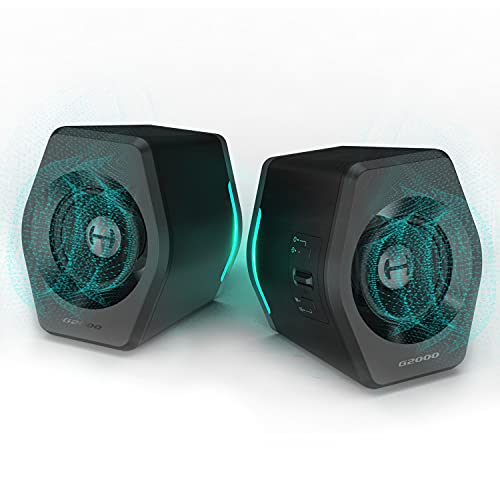
Edifier G2000
Its 70 mm driver delivers strong mids and highs, giving a fuller soundstage than many rivals at the same price point.

Logitech G560
Designed for gamers who want immersive lighting and sound, it’s $150 more than the Edifier G2000, reflecting its premium build and RGB features.

Ohayo C6
At $69.99, the Ohayo C6 offers an 80 dB SNR and a compact 19 mm tweeter, delivering clear audio for tight budgets where space matters.
Also considered
Score Analysis
Key score advantages vs. runner-up (Logitech G560)
Price Range
Edifier G2000
$99.99
Logitech G560
$249.99
Ohayo C6
$66.49
Jeecoo M20
$18.04

Razer Leviathan V2 X
$84.99

Kanto YU4GR
$479.99

Nylavee SK100
$53.99

SteelSeries Arena 9
$543.99

Sony HTAN7
$198.00

Audioengine A1
$199.00

Littoak GM03
$59.89

SteelSeries Arena 3
$149.99
Bluedee BD-SK010
$53.99

Logitech Z207
$59.96

SteelSeries Arena 7
$299.99
Spec Comparison
TL;DR: The Edifier G2000 offers 70 mm drivers, 16 W RMS power and 12‑preset RGB lighting at $99.99, delivering balanced sound and solid bass in a compact desktop package praised by gamers and reviewers.
At the heart of the G2000 is a 70 mm full‑range dynamic driver paired with 16 W RMS output, giving it enough punch for gaming explosions while it's quiet enough for a shared space. The speakers also include an integrated USB sound card, a 10 m Bluetooth range (Bluetooth 4.2) and a 180 cm inter‑speaker cable that keeps the pair synced without extra wiring.
Compared with the other fourteen entries, the G2000 is heavier than the Razer Leviathan V2 X (1.98 lb) and Logitech Z207 (2.88 lb), but its driver size of 70 mm outstrips Razer’s 48 mm full‑range unit. Its Bluetooth range matches most peers – Razer Leviathan V2 X, Bluedee BD‑SK010 and Nylavee SK100 all list 10 m – yet it falls short of Logitech’s 20 m range. The 12 RGB preset effects give it a visual edge over the SteelSeries Arena 3’s unspecified lighting zones.
Reviewers consistently note the G2000’s balanced sound and surprisingly strong bass for its size, crediting the 75 Hz–20 kHz frequency response and the three EQ presets (Music, Game, Movie). Professional outlets praise the solid build and the subtle, non‑blinding lighting. The main trade‑offs include the fixed 180 cm cable, which limits placement flexibility, and the single‑button interface that cycles RGB and EQ modes without granular control.
Pros
Cons
Best for: Most users looking for a well‑reviewed, reliable mainstream option
Avoid if: You need a detachable speaker cable or a studio‑grade audio setup
TL;DR: The Logitech G560 delivers 120 W RMS audio, DTS:X Ultra virtual 7.1 surround, and 16.8 million‑color LIGHTSYNC RGB lighting, all packed into a 12.1‑lb 2.1‑speaker system with Bluetooth connectivity.
The standout spec is the 120 W RMS output, backed by a 240 W peak rating and a 60 W RMS subwoofer that together create a “huge soundscape” for gaming.
At 12.1 lb, the G560 is substantially heavier than the sub‑pound Sony HTAN7 and the 6.0‑lb Audioengine A1, yet lighter than the 23.95‑lb SteelSeries Arena 7. Its Bluetooth range of 25 m outpaces the Arena 7’s 5 m but falls short of the Audioengine A1’s 30.5 m. The G560 uses Bluetooth 4.1, a generation behind the 5.0 modules that equip the Arena 7, Audioengine A1, and Razer Leviathan V2 X.
Professional reviewers praise the booming bass and the dynamic lighting, noting that the subwoofer’s 60 W RMS power and the 30 W per satellite deliver clear mids and crisp highs across the 40 Hz–18 kHz frequency range. In practice, users love the immersive feel but frequently mention that they can’t turn off the subwoofer, which leads to unwanted vibrations during quiet moments, and that the screen‑sampling lighting mode can be overly aggressive.
Pros
Cons
Best for: Buyers willing to invest in a proven, high‑quality option
Avoid if: You're on a tight budget or only need basic functionality
“solid for gaming”
“great for use when not using a headset”
TL;DR: The Ohayo C6 offers 60 W of active stereo sound, Bluetooth 5.3 and a compact MDF desktop design for $69.99, delivering clear audio that shines in small‑room gaming setups.
The standout spec is its Bluetooth 5.3 connectivity paired with a total output power of 60 W (30 W per speaker). The speakers house a 76 mm woofer and a 19 mm tweeter, and the integrated independent sound card promises low‑latency playback for gaming. With a signal‑to‑noise ratio of 80 dB and a frequency response of 50 Hz – 20 kHz, the C6 delivers balanced highs and mids.
Compared with the other 14 speakers in this roundup, the C6 sits at a higher price point than the Logitech Z207 and the Bluedee BD‑SK010, yet it offers a more powerful 60 W output versus the 15 W of the Bluedee. It's heavier than the Logitech Z207’s 2.88 pounds, as each Ohayo driver weighs 2,436 g, but it's lighter than the Littoak GM03’s 4.2 lb. The Bluetooth version (5.3) is newer than the 5.0 found in both the Logitech Z207 and the Razer Leviathan V2 X, giving it a slight edge in wireless stability.
User feedback repeatedly praises the clear, distortion‑free sound at normal volumes and the easy desktop setup. Reviewers note the rear‑facing bass port adds low‑end depth, though the bass can feel thin in larger rooms and the sound may lose clarity when cranked to maximum volume. The USB‑powered design's convenient for a clutter‑free desk but limits true portability, a point many users flag when they want a truly mobile solution.
From a technical standpoint, the MDF enclosure helps dampen unwanted resonance, while the front rotary volume knob and rear bass/treble knobs give you quick on‑the‑fly adjustments. Professional reviewers highlight the 3‑inch carbon‑fiber full‑range driver and 0.75‑inch silk‑dome tweeter for delivering “crystal‑clear highs and rich mid‑bass.” The package includes both an active and a passive speaker, an AC power cable, a USB‑C data cable, and a 3.5 mm AUX cable, covering most desktop audio needs.
Pros
Cons
Best for: Value-conscious buyers seeking quality at $69.99
Avoid if: You have limited desk space or need portability
“deliver crystal-clear highs and rich mid-bass”
“an excellent choice for gaming”
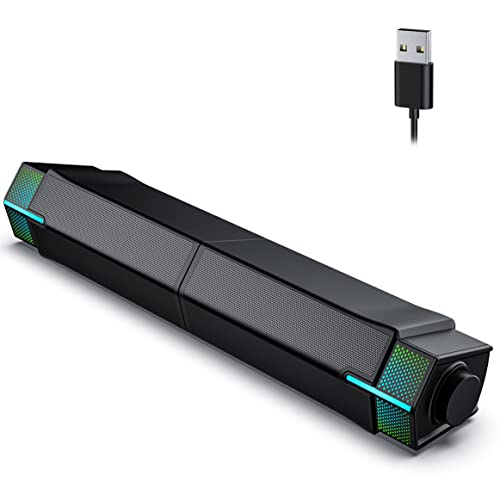
TL;DR: The Jeecoo M20 offers a compact, USB‑powered 2.0 soundbar with Bluetooth 5.3, 10 W output and RGB lighting for under $20, making it a solid entry‑level gaming speaker.
The standout spec is its Bluetooth 5.3 connection paired with a 10 W maximum output and a 50.8 mm dynamic driver, all packed into a tabletop footprint of 200 × 66 × 66 mm. The modular design lets you slide the two speakers together or keep them separate, and you can fully adjust the gradient RGB LEDs via touch controls and a rotary knob. Power comes from a single 5 V DC USB cable that’s 1.6 m long, so you can run it from any laptop or PC USB port.
When you line it up against the other 14 speakers in this roundup, the M20 is dramatically lighter – at 640 g (about 1.41 lb) it’s well under the 4.2 lb Littoak GM03 and also lighter than the Bluedee BD‑SK010 (2.0 lb) and the Logitech Z207 (2.88 lb). Its driver size of 50.8 mm is smaller than the Littoak’s 70 mm unit, but the newer Bluetooth 5.3 version outpaces the 5.0 found in Logitech and Razer models, promising a more stable wireless link.
Reviewers consistently praise the M20’s easy setup, clear mids at moderate volumes and the eye‑catching RGB lighting that adds a gaming vibe to a small desk. Professional reviewers note the balanced audio across the 20,000 Hz frequency response, yet they also point out noticeable distortion and bass loss when you crank the volume up. Users also mention occasional LED flicker and a lightweight plastic chassis that feels less durable than higher‑priced rivals.
Pros
Cons
Best for: Budget‑conscious buyers seeking a reliable entry‑level option
Avoid if: You have limited desk space or need portability
“Perfect for my small desk—love that I can separate the speakers!”
“Sound is clear for YouTube, Zoom calls, and music.”
TL;DR: The Razer Leviathan V2 X delivers bass‑heavy 2.1 sound, THX Spatial Audio and 16‑zone RGB for $84.99, but its limited inputs and Windows‑only software may deter non‑PC users.
Razer equips the system with a 5.5‑in subwoofer driver that reaches a maximum SPL of 90 dB, and pairs it with a 2.0‑in full‑range driver and a 0.75‑in tweeter for crisp highs. It also packs 16 separate lighting zones into a downward‑facing RGB strip, letting you sync colors with in‑game events.
At 1.98 lb, the Leviathan V2 X is lighter than the Edifier G2000, Logitech Z207 and Littoak GM03, and sits right alongside the Bluedee BD‑SK010 and Nylavee SK100 in weight. Its full‑range driver (2.0 in or 48 mm) is smaller than the Edifier’s 70 mm unit and the Ohayo C6’s 76 mm woofer, while the Bluetooth version (5.0) matches Logitech’s but is older than Ohayo’s 5.3. The 16‑zone lighting outpaces Littoak’s six customizable modes and Edifier’s 12 preset effects, giving it a clear edge in visual customization.
Reviewers consistently praise the “full, crisp sound with thunderous bass” and the immersive feel that THX Spatial Audio adds to PC gaming. Users also love the eye‑catching RGB that reacts to game action. On the downside, the system omits a 3.5 mm or optical input, so hooking up a TV or console can be tricky. The subwoofer has no separate volume or crossover knobs, and all advanced features require the Windows‑only Razer Synapse app, which some find restrictive.
Pros
Cons
Best for: Value-conscious buyers seeking quality at $84.99
Avoid if: You need TV or home‑theater connectivity, macOS support, or multiple analog/optical inputs.
TL;DR: The Kanto YU4GR packs 70 W RMS into a compact bookshelf pair with aptX Bluetooth, a built‑in phono preamp, and a sleek glossy‑red finish, but its bass is modest and the price sits at $479.99.
At the heart of the YU4GR is a Class D amp delivering 70 W RMS into a 4 Ω load, paired with a 2.0 kHz crossover that directs mids and highs to a 25 mm silk‑dome tweeter and lows to a 102 mm Kevlar‑composite woofer. The frequency response spans 60 Hz – 20 kHz and total harmonic distortion stays below 0.25 %, giving a clean, detailed soundstage in a footprint that fits comfortably on a desk or bedside shelf.
Weighing 13.22773572 pounds, the YU4GR is lighter than the SteelSeries Arena 9’s 33.2‑pound chassis but a touch heavier than the Logitech G560’s 12.1 pounds. Its Bluetooth version 4.0 trails the Arena 7’s Bluetooth 5.0 and the Arena 9’s 4.2, which may affect range and latency. With eight rubber feet, a 6.5‑ft auxiliary cable and a 16‑ft speaker wire, it offers more physical accessories than the SteelSeries Arena 3, which lists fewer connection lengths.
Reviewers consistently praise the built‑in phono preamp for letting turntables plug straight in, and they note the variety of inputs—including aptX‑enabled Bluetooth, dual optical, and RCA with a phono switch—as a major convenience. Professional critics highlight the speaker’s precise imaging and fast transients, but they also point out that the 60 Hz low‑end limit leaves bass‑heavy games feeling a bit thin, and Bluetooth latency can be noticeable during fast‑paced action.
Beyond the connectivity, the YU4GR’s class‑D design keeps standby power under 0.5 W, and its <0.25 % THD rating ensures the music stays true to the source. The remote uses two AAA batteries, and the USB port supplies 5 V at 1.0 A for charging devices, though it doesn't accept audio input.
Pros
Cons
Best for: Buyers willing to invest in a proven, high-quality option
Avoid if: You're shopping on a tight budget — it's priced at $479.99
“Plug-and-play with turntables and Bluetooth devices”
“Rich, clear sound with balanced mids and crisp highs”
TL;DR: The Nylavee SK100 is a 1.9‑lb USB‑powered soundbar with Bluetooth 5.0, 33 ft range, 40 ms latency and 5 W output, offering clear stereo sound and modest bass for budget‑friendly gaming setups.
The standout spec is its low Bluetooth latency of 40 ms, which helps keep audio in sync during fast‑paced games. It also reaches 33 ft (10,058 mm) with Bluetooth 5.0, giving you freedom to place your PC or console a short distance away without a cable. Powered via a 5 V USB source, the unit draws only 5 W, so it's easy to run off any standard charger or laptop USB port.
At 1.9 lb, the SK100's lighter than the Littoak GM03’s 4.2 lb chassis but a touch heavier than the Jeecoo M20’s 1.41 lb design. Its 72 dB signal‑to‑noise ratio beats the Bluedee BD‑SK010’s 70 dB yet sits below the Littoak’s 80 dB, placing it in the middle of the pack. The 5 W maximum output is lower than the Bluedee’s 15 W, and its Bluetooth range matches the Bluedee’s roughly 33 ft but is shorter than the Logitech Z207’s 20‑meter reach.
Users consistently praise the plug‑and‑play USB power and the “crystal‑clear” mids and highs that come from the 2‑inch tweeter and four full‑range drivers. Professional reviewers note the “premium driver materials” and “cavity‑optimized design” that deliver balanced audio despite the modest wattage. Common complaints focus on the modest bass depth and occasional pairing hiccups, especially in larger rooms where the 5 W output's limited.
Pros
Cons
Best for: Budget‑conscious buyers seeking a reliable entry‑level option
Avoid if: You want the best value‑per‑dollar in its price range
TL;DR: The SteelSeries Arena 9 is a premium 5.1 gaming speaker system delivering 300 W of power, 100 dB SPL, and wireless rear speakers, but its $543.99 price and large 33.2‑lb footprint may limit its appeal.
The Arena 9 packs a full 5.1 surround layout with a 165.1 mm down‑firing subwoofer and front‑center drivers that together output 300 W of power. Its maximum SPL reaches 100 dB, and the frequency response spans 35–20,000 Hz, giving you a wide tonal range for both explosive explosions and subtle ambience.
At 33.2 pounds, the system weighs significantly more than the Logitech G560 (12.1 pounds) and the Kanto YU4GR (13.22773572 pounds). Its Bluetooth version 4.2 sits between Kanto’s 4.0 and the Arena 7’s 5.0, offering a modest upgrade over older models while still lagging behind the newer 5.0 standard. The $543.99 list price also places it above many of the other 15 speakers in this roundup.
User reviews (4.2/5 stars from 922 reviewers) frequently praise the immersive positional audio and the convenience of the monochrome OLED control pod with a touch‑sensitive rotating bezel. Professional reviewers note the solid build quality of the organic‑fiber woofers and silk‑dome tweeters, though they point out that RGB lighting doesn't work beyond the front speakers and works only on PC, not on consoles.
Beyond raw output, the Arena 9 offers 16.8 million color options across four lighting zones and a 10‑band equalizer that can be tuned through SteelSeries GG’s Sonar audio interface (PC only). These customization tools let you match the sound and look of the system to your gaming setup without additional hardware.
Pros
Cons
Best for: PC gamers who want true 5.1 positional audio and are willing to invest in a high‑performance, feature‑rich speaker system.
Avoid if: You have a very small desk, rely solely on console audio, or need high‑resolution Bluetooth sound quality.
“The sound is bombastic and pleasing, with strong mids and highs ideal for gaming and music.”
“The system’s substantial speaker build and immersive soundstage really set it apart.”
TL;DR: Sony’s HT‑AN7 is a lightweight, wearable neckband speaker that delivers 360 ° Spatial Sound with Dolby Atmos, offers up to 12 hours of playback, and commands a premium $298 price.
The standout feature of the HT‑AN7 is its upward‑facing driver paired with an X‑Balanced speaker unit, which Sony says directs sound straight to your ears without disturbing anyone else. At just 0.59745273002 pounds and measuring 235 mm × 48 mm × 178 mm, it’s compact enough to wear for marathon gaming sessions while still packing a full‑range dynamic driver that covers 20 Hz – 20,000 Hz.
In a roundup of fifteen gaming speakers, the HT‑AN7 sits at the higher end of the price spectrum, making it pricier than most of its peers. It is also considerably lighter than the bulkier desktop‑style systems, and its Bluetooth 5.2 with multipoint support gives it a connectivity edge over many competitors that only offer older Bluetooth versions or single‑device pairing.
Reviewers consistently praise the immersive 360 ° Spatial Sound and Dolby Atmos support, noting that the dedicated “360 Spatial Sound Personalizer” app helps fine‑tune the experience. Users love the comfort of the neckband and the long‑lasting battery—up to 12 hours of continuous playback—while professional critics point out that the bass can feel thin compared with larger speaker setups, and the audio balance shifts noticeably when the head moves. The built‑in microphone optimizes voice pickup but isn’t suited for in‑game voice chat, a limitation mentioned by several consumers.
Beyond the audio, the HT‑AN7 houses a 1200 mAh battery that reaches a full charge in 12 hours, and a rapid‑charge feature adds 60 minutes of playback after just 10 minutes on the charger. An IPX4 rating means it can handle occasional splashes, and the low‑latency wired gaming mode (USB‑C or 3.5 mm) ensures sync‑perfect sound for single‑player titles.
Pros
Cons
Best for: Those prioritizing quality and willing to pay for premium performance
Avoid if: You're on a tight budget or only need basic functionality
“Best thing ever”
“Crystal clear dialogue”
TL;DR: The Audioengine A1 offers a 15 W RMS per‑channel, Bluetooth 5.0 speaker pair with aptX/AAC support, clear stereo imaging and a sleek design for $199.00.
The standout spec is the Bluetooth 5.0 connection with aptX and AAC codecs and a quoted range of 100 ft (30.5 m), which easily covers a typical gaming desk and nearby couch. Powered by Class D digital hybrid amplifiers, each driver delivers 15 W RMS, and the system tops out at 60 W peak total. The tweeter’s 19 mm silk dome and the woofer’s 70 mm aramid fiber work together for a frequency response of 65 Hz – 22 kHz, while the <0.05 % THD+N and >95 dB SNR keep the sound clean.
Compared with the other fourteen speakers, the A1 is lighter than the Logitech G560’s 12.1 pounds but heavier than Sony’s sub‑pound unit. Its Bluetooth range far exceeds the 10 m range of the SteelSeries Arena 3 and the 10 m range of the Edifier G2000, and it matches the 5 m range of the SteelSeries Arena 7 only in version (both use Bluetooth 5.0). Power‑wise, its 60 W peak total sits well below the G560’s 240 W peak but is comparable to the modest outputs of the arena‑class speakers, making it a mid‑range power option.
Reviewers consistently praise the A1’s “accurate, detailed audio” and “true stereo separation” that come without any DSP processing. The minimalist gray chassis fits nicely on a desk, and users like the reliable Bluetooth link. However, the same reviewers note the 65 Hz low‑end is shallow, the rear‑mounted volume knob's hard to reach during play, and the drivers fire straight ahead, which can make high‑frequency clarity drop on reflective surfaces. Professional critics echo these points, calling the build quality excellent but pointing out the lack of deep bass.
Pros
Cons
Best for: Most users seeking a balanced, mainstream option
Avoid if: You're shopping on a tight budget — it's priced at $199.00
“the best 2.0 desktop system under $200”
“Crisp, clear sound with excellent vocal and instrument separation”
TL;DR: The Littoak GM03 offers 30 W of stereo power, 2.75‑inch drivers, RGB lighting and three EQ presets for under $60, making it a solid budget‑friendly gaming speaker pair.
The standout spec is the 30 W total output (15 W per channel) driven by 2.75 in (70 mm) full‑range drivers, a 6 Ω impedance and an 80 dB signal‑to‑noise ratio. Its frequency response of 20 Hz – 20 kHz covers the full audible range, while the compact 5.8 in × 8.3 in × 12.0 in chassis weighs 4.2 lbs, which gives it a solid desktop presence without crowding a desk.
Compared with the other fourteen speakers in this roundup, the GM03 is heavier than the Bluedee BD‑SK010 (2.0 lb) and the Nylavee SK100 (1.9 lb), yet still lighter than many larger gaming sets that include subwoofers. It sits in a mid‑price tier—more affordable than the Razer Leviathan V2 X but pricier than the ultra‑budget Jeecoo M20. While several peers list Bluetooth range (10 m for Bluedee and Nylavee, 20 m for Logitech Z207), the GM03’s Bluetooth range isn’t listed in the specs, so you’ll rely on typical indoor performance.
Users consistently praise the GM03 for delivering clear, loud sound that fills a small room, and they love the eye‑catching RGB lighting that syncs with game ambience. Reviewers highlight the three preset EQ modes—Music, Movie, and Gaming—as helpful for quickly tailoring the sound without fiddling with sliders. However, many wish for a dedicated subwoofer to deepen the bass, and some find the front‑panel touch controls overly sensitive, which causes accidental volume changes.
Beyond the audio core, the speakers accept Bluetooth, a 3.5 mm AUX input, a USB audio/power line and even a speaker‑out jack for daisy‑chaining. The 19 V DC power adapter provides stable AC power, and the ABS plastic housing keeps the pair sturdy. Six customizable RGB lighting modes let you match your rig’s aesthetic, while the three built‑in EQ presets give a quick boost for competitive gaming sessions.
Pros
Cons
Best for: Entry‑level buyers or those on a tight budget who want built‑in lighting and preset sound profiles for gaming, study or office use.
Avoid if: You want the best value‑per‑dollar in its price range or need deep bass and extensive lighting customization for high‑fidelity audio.
“Excellent sound quality for the price”
“RGB looks amazing on my desk”
TL;DR: The SteelSeries Arena 3 packs 4‑inch two‑way drivers and 100 dB SPL into a compact 7.72‑inch‑deep desktop set, but its older Bluetooth 4.2 and premium price make it a niche choice for gamers who value clarity over bass.
The most eye‑catching spec is the 4‑inch full‑range driver in each speaker, paired with a maximum sound pressure level of 100 dB. Those dimensions—7.72 inches deep, 4.97 inches high and 4.13 inches wide—keep the system small enough for a typical gaming desk while still delivering enough volume to fill a medium‑sized room.
Compared with the other 14 speakers in this roundup, the Arena 3’s drivers are larger than the Edifier G2000’s 70 mm unit and the Razer Leviathan V2 X’s 2.0‑inch driver. Its Bluetooth version 4.2 is older than the 5.0 or 5.3 implementations found in the Logitech Z207, Audioengine A1 and Ohayo C6, which may affect codec support. At over a kilogram per driver (1040 g left, 1094 g right), it feels heavier than the Logitech Z207’s 2.88 lb pair and the Bluedee BD‑SK010’s 2.0 lb speakers. Price‑wise, it sits above the budget‑friendly Logitech and Edifier options, making it a pricier mid‑range alternative.
User sentiment repeatedly praises the crystal‑clear mids and precise instrument separation, a point professional reviewers echo when they note the “strong midrange performance” and “durable plastic construction with stable bases.” The on‑speaker volume dial and the ability to mix Bluetooth and wired inputs highlight convenient daily features. On the downside, several reviewers mention weak low‑end response because the system lacks a dedicated subwoofer, and they report occasional Bluetooth instability in crowded RF environments.
Additional technical touches include front‑firing bass‑reflex ports that help the speakers perform better when placed near a wall, and SteelSeries Sonar software that offers EQ customization and virtual surround sound—though the software currently runs only on PC or Mac. Power comes from an external 12 V DC adapter, and a small LED indicator provides status feedback.
Pros
Cons
Best for: Gamers and content creators who need precise positional audio and appreciate on‑speaker controls.
Avoid if: You prioritize deep bass, need a portable Bluetooth solution, or have a very tight budget.
“The sound is bombastic and pleasing, with strong mids and highs ideal for gaming and music.”
“The system’s substantial speaker build and immersive soundstage really set it apart.”
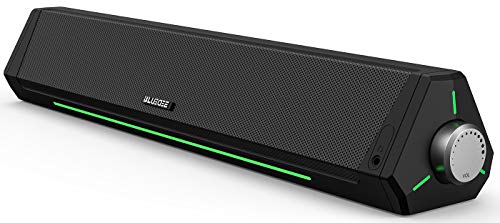
TL;DR: The Bluedee BD‑SK010 is a compact 2.0 soundbar with dual drivers, 15 W output and 10 m Bluetooth range, offering clear mids and RGB lighting at a budget‑friendly price.
What really stands out is the dual‑driver architecture paired with anti‑magnetic technology, delivering a listed 15 W of maximum output power while keeping the impedance low at 4 Ω. The unit also has a signal‑to‑noise ratio of 70 dB and a frequency response that reaches up to 20 kHz, which helps it reproduce crisp mids and vocals. Its Bluetooth 5.0 connection works reliably up to 10 m, and the soundbar runs off a 5 V USB source, meaning you won’t need a separate power brick.
Compared with the other fourteen speakers in this roundup, the BD‑SK010 sits near the middle of the weight range – it’s a touch heavier than the Nylavee SK100 at 1.9 pounds but lighter than the Littoak GM03, which tips the scales at 4.2 lbs. Its 10 m Bluetooth range matches the Nylavee’s advertised 33 ft (about the same distance) while falling short of the Logitech Z207’s 20‑meter claim. The 70 dB SNR is modest when stacked against the Littoak’s 80 dB and the Nylavee’s 72 dB, indicating a slightly noisier background. Nonetheless, its price point aligns with other entry‑level options, making it a competitive pick for budget‑focused gamers.
Users consistently praise the BD‑SK010 for its clear mid‑range and vocal reproduction, which shines during voice chat and in‑game dialogue. The RGB breathing light adds a subtle gaming vibe without overwhelming the desk. Professional reviewers highlight the large illuminated volume knob for precise control and note the unit’s vibration resistance even at higher volumes. The most common drawbacks are a thin bass response and sound that doesn’t fill larger rooms, which aligns with the “weak bass” criticism found across consumer feedback.
From a technical standpoint, the soundbar’s dimensions – 67.8 mm depth, 67.8 mm height and 417.8 mm width – let it slip neatly under most monitors. The 2.0 pound chassis uses 85 % ABS plastic and 5 % metal, offering a sturdy feel for a desktop speaker. With a 3.5 mm AUX input, Bluetooth 5.0 and USB power, it covers the essential connectivity bases without needing extra adapters.
Pros
Cons
Best for: Budget‑conscious buyers seeking a reliable entry‑level option
Avoid if: You have limited desk space or need portability
“Perfect for my home office—clear voice during Zoom calls.”
“Love the RGB lights; they look great at night.”
TL;DR: The Logitech Z207 offers Bluetooth 5.0 with a 20 m range, dual active drivers plus passive radiators, and a 5 W RMS output, delivering balanced stereo sound at a budget‑friendly price.
The standout spec is the Bluetooth 5.0 connection that reaches up to 20 meters, and includes two active full‑range drivers and two passive radiators. Each speaker houses a 38.1 mm tweeter and delivers 5 W RMS power, which professionals note provides surprisingly deep bass for a 2.0 system.
In the broader lineup, the Z207 is heavier than the Bluedee BD‑SK010 (2.0 lb) and the Nylavee SK100 (1.9 lb), yet lighter than the Littoak GM03 (4.2 lb) and the Edifier G2000 (over 4 lb). Its 20 m Bluetooth range also outpaces the 10 m range listed for several peers, giving you more freedom to place your device across the room.
Users highlight the ease of pairing and the handy 3.5 mm headphone jack for private listening. Reviewers praise the balanced sound and multi‑device switching, but many note that the bass can thin out at higher volumes and the exposed drivers are prone to dust or finger marks. The speakers sit about 9.5 in tall, which some desk‑bound users find a bit bulky.
Pros
Cons
Best for: Budget-conscious buyers seeking a reliable entry-level option
Avoid if: You have limited desk space or need portability
“Budget speakers that don’t sound budget”
“Easy setup and reliable Bluetooth pairing”
TL;DR: The SteelSeries Arena 7 delivers 150 W RMS power, a 6.5‑inch down‑firing sub, and 16.8 million‑color RGB across four zones, but its large footprint and Xbox‑compatibility quirks may limit some setups.
At the heart of the Arena 7 is a 150 watts RMS amplifier paired with a 6.5‑inch down‑firing subwoofer, giving you punchy bass that’s audible even on louder game explosions. The two satellite speakers each house a 3‑inch organic‑fiber woofer and a 0.75‑inch silk‑dome tweeter, delivering a balanced mids‑and‑highs picture that reviewers praise for clarity. Bluetooth 5.0 and a 5‑meter (1640.4 ft) maximum range let you stream from phones or tablets without cables, while the PrismSync RGB system offers 16.8 million colors split across four zones that react to on‑screen action.
Compared with the Logitech G560, the Arena 7 sits at a higher price point and weighs considerably more than the G560’s 12.1 pounds, while still offering a richer feature set like RGB zoning and a 10‑band parametric equalizer. It is also heavier than the ultra‑light Sony HTAN7 at 0.597 pounds and the Audioengine A1 at 6.0 pounds, making the Arena 7 a more substantial desktop presence. However, it brings more connectivity options—optical TOSLINK, USB‑C, USB‑A, and a 3.5 mm auxiliary input—than those competitors, which often rely on fewer ports.
Consumer sentiment highlights the system’s striking visual impact and the “punchy bass that doesn’t drown out dialogue.” Professional reviewers note the “sound clarity and balance, especially in mids and highs,” and they commend the reactive lighting that syncs with music and gameplay. The main pain points revolve around the lack of official Xbox Series X/S support and a learning curve for the SteelSeries Sonar software, which controls both RGB and the 10‑band EQ. Some users also mention the subwoofer’s size and the total system weight of 23.95102 pounds as a challenge for tighter desk arrangements.
Beyond the power and lighting, the Arena 7’s 2.1‑channel layout, organic‑fiber woofer, and silk‑dome tweeter combine for a frequency response that spans 35 Hz to 20 kHz. The included 2 m speaker‑to‑subwoofer cable and 1.98 m power cable give you flexibility in placement, while the 1‑year limited warranty adds a safety net for the premium investment.
Pros
Cons
Best for: PC and PlayStation gamers, streamers, and multimedia enthusiasts who want powerful audio and immersive lighting.
Avoid if: You own an Xbox Series X/S, have a tight budget, or need a compact speaker system for a small desk.
“The sound is bombastic and pleasing, with strong mids and highs ideal for gaming and music.”
“The system’s substantial speaker build and immersive soundstage really set it apart.”
Breakdown
Edifier G2000
Pros
Logitech G560
Pros
Cons
Ohayo C6
Pros
Jeecoo M20
Pros
Cons
Based on scoring data and product specs
Personalized picks
Best Overall Pick
Edifier G2000
Best Mid-Range PickBest for: Most users looking for a well-reviewed, reliable mainstream option
Logitech G560
Best for: Buyers willing to invest in a proven, high-quality option
$249.99+$150.00 vs winner
Skip SteelSeries Arena 7 if…
You're on a tight budget or only need basic functionality
The Edifier G2000 takes the top spot in our Bluetooth gaming‑speaker roundup. At $99.99 it undercuts the typical mid‑range price tag, while its 4.6‑star rating from 3,393 reviewers shows strong approval. Weighing about 4.21 lb, the column‑shaped pair packs a 70 mm dynamic driver with a 75 – 20,000 Hz frequency response. Its built‑in USB sound card delivers 16 W RMS (32 W peak) power, and three preset EQ modes let you tailor sound for music, games, or movies. A 10 m Bluetooth range keeps your PC or phone nearby without drop‑outs.
The Logitech G560 lands as runner‑up if you need immersive surround sound and a full‑RGB light show. Its 240 W peak (120 W RMS) 2.1‑channel system, paired with DTS:X Ultra virtual 7.1, creates a spacious soundstage that lets you pinpoint in‑game actions. LIGHTSYNC offers 16.8 million‑color effects that pulse to the audio, while Bluetooth reaches up to 25 m. The system also includes a dedicated USB input for DTS:X and Windows‑only software, making it a solid choice for a high‑performance PC rig.
When price is the primary driver, the Jeecoo M20 provides basic Bluetooth speaker functionality for just $18.04, earning it the best budget label. If you’re willing to splurge on a high‑end desktop solution, the SteelSeries Arena 9 stands out at $543.99, offering premium‑grade audio features that cater to audiophiles and competitive gamers alike.
For the most balanced performance, value, and gaming‑focused features, choose the Edifier G2000 today.
The Edifier G2000 costs $99.99 and provides solid 32 W peak power, a built‑in USB sound card and a 10 m Bluetooth range, making it a strong budget choice. The Logitech G560 is $249.99, delivering far higher power (240 W peak) and DTS:X virtual surround, but at a much higher price, so the Edifier gives the better overall value for most gamers.
Please sign in to leave a review
No reviews yet. Be the first to review!
