Finding the right high‑performance M.2 NVMe SSD can feel like hunting for a needle in a sea of specs. In this roundup we’ve sliced through the clutter and compared 12 options, from the $109.99 Western Digital WD Blue SN5000 that still punches above its price, up to the $556.18 Crucial T710 that targets the most demanding creators. The Sabrent Rocket 5 dazzles with a listed 14,000 MB/s sequential read, while the Samsung 990 EVO Plus 2TB balances a $328.20 price tag with a 4.8‑star rating and 1,000,000 IOPS random read capability.
To make sense of the spread, we grouped the drives into three price tiers. The budget bucket holds the WD Blue SN5000, Kingston NV3 1TB ($164.49), Samsung 990 EVO Plus 1TB ($164.99) and Crucial P310 1TB ($175.00), all priced under $200. Mid‑range picks—Teamgroup MP44L 1TB and Crucial P510 2TB—bring higher endurance and slightly faster sequential rates without breaking the bank. Premium choices—Samsung 990 EVO 2TB, Samsung 990 EVO Plus 2TB, Sabrent Rocket 5 2TB, and Crucial T710 4TB—deliver top‑tier endurance, random IOPS in the millions and the fastest advertised speeds.
Below we break down each model’s strengths, so you can match the SSD that fits your workload and budget.

Samsung 990 EVO Plus 2TB
Its ultra‑thin 0.1‑in (2.54 mm) profile packs 2 TB into a compact M.2 form factor, delivering high capacity without sacrificing space.

Crucial P310 1TB
Ideal for mainstream users who need reliable 1 TB storage, it's priced at $175.00—about $153 cheaper than the 2 TB Samsung.

Samsung 990 EVO Plus 1TB
Delivers up to 1,350,000 IOPS write performance, offering entry‑level speed that rivals larger drives while keeping the 1 TB price point.
Also considered
Score Analysis
Key score advantages vs. runner-up (Crucial P310 1TB)
Price Range
Samsung 990 EVO Plus 2TB
$329.99
Crucial P310 1TB
$135.22
Samsung 990 EVO Plus 1TB
$164.49

Kingston NV3 1TB
$164.99

Crucial P510 2TB
$260.99

Teamgroup MP44L 1TB
$184.99

Western Digital WD Blue SN5000 500GB
$119.99

Samsung 990 EVO 2TB
$299.95

Crucial T710 4TB
$554.16

Sabrent Rocket 5 2TB
$339.99
Silicon Power UD90 1TB
$178.97

Sabrent Rocket 4 2TB
$499.99
Spec Comparison
TL;DR: The Samsung 990 EVO Plus 2TB delivers up to 7,250 MB/s sequential reads, 6,300 MB/s sequential writes, and 1.35 million IOPS while staying under 5 W of power, earning a 4.8‑star rating from nearly 9.5 K reviewers.
Samsung’s latest 2 TB model packs a PCIe Gen 4 x4 (or Gen 5 x2) interface and a DRAM‑less Piccolo controller that uses Host Memory Buffer. It hits a theoretical 7,250 MB/s read and 6,300 MB/s write speed, backed by 1,000,000 IOPS read and 1,350,000 IOPS write figures. The drive also carries a 1,200 TBW endurance rating and a five‑year warranty, giving you plenty of room for games, media libraries, and large projects.
Compared with the Sabrent Rocket 5, the Samsung is slightly cheaper and lighter (0.01984 lb vs. 0.01625 lb) but offers a lower sequential read speed (7,250 MB/s vs. 14,000 MB/s) and a longer warranty (five years vs. two years). It matches the Samsung 990 EVO’s dimensions and weight while delivering far higher IOPS numbers than that model’s listed 20,000 IOPS read ceiling. Against the heavier Crucial P510, the 990 EVO Plus feels feather‑light at 9.0 g, and its power draw of 4.6 W (read) and 4.2 W (write) is notably lower than many older drives.
Users consistently praise the drive’s “snappy” boot times and smooth game loading, noting the single‑sided 22 mm × 80 mm form factor fits tight laptop bays. The main complaints revolve around the DRAM‑less design, which leans on system RAM via HMB, and the lack of an included heatsink or thermal pad—issues professional reviewers flag for sustained heavy‑write workloads. Still, the high rating of 4.8/5 from 9,481 reviews suggests most owners appreciate the balance of speed and efficiency.
Technically, the SSD supports NVMe 2.0, AES‑256 encryption, and Samsung’s Intelligent TurboWrite 2.0, while drawing just 5 mW in device‑sleep mode. Its MTBF of 1.5 million hours and shock resistance of 1,500 G add confidence for mobile users, and the included Samsung Magician software handles firmware updates and health monitoring without extra hassle.
Pros
Cons
Best for: Laptop owners and desktop builders who want fast, power‑efficient storage with a solid warranty.
Avoid if: You need a DRAM‑backed SSD for constant heavy‑write workloads or an included thermal solution for extreme performance scenarios.
“snappy performance and fast boot/load times”
“excellent as a boot drive”
TL;DR: The Crucial P310 1TB delivers flagship‑class 7100/6000 MB/s sequential speeds and 1.2 million IOPS in a compact, single‑sided M.2 2280 package, but its 220 TBW endurance and DRAM‑less design may limit heavy‑write use.
The standout spec is its sequential performance: up to 7100 MB/s read and 6000 MB/s write, which puts it in the same league as higher‑priced Gen4 drives. Randomly, it can hit 1,000,000 IOPS reads and 1,200,000 IOPS writes, thanks to the Phison PS5027‑E27T controller and a host‑memory buffer.
Compared with the other eleven entries, the P310 is heavier than the Silicon Power UD90 (0.0176 lb) and Kingston NV3 (0.0145 lb), about the same as Samsung’s 990 EVO Plus (0.0198 lb), but lighter than the Teamgroup MP44L (0.0705 lb). Its 220 TBW endurance is lower than the 600 TBW of both Silicon Power and Teamgroup, and below Kingston’s 320 TBW, so it sits on the modest end of durability in this group.
User feedback's overwhelmingly positive: reviewers praise the instant boost in system responsiveness, the ease of installation, and noticeable load‑time reductions in games and applications. Professional reviewers also note the drive stays cool without a heatsink and appreciate the five‑year limited warranty. The main criticisms echo the specs—some users flag the lack of hardware encryption and the QLC NAND’s lower endurance as concerns for long‑term heavy workloads.
Pros
Cons
Best for: Gamers (especially PS5 owners), general consumers seeking faster boot and app loads, and laptops or small‑form‑factor PCs that need a compact, high‑speed SSD.
Avoid if: You need professional‑grade endurance, hardware‑based encryption, or plan to run constant heavy‑write workloads.
“Everything just feels faster—apps load almost instantly.”
“Installation was simple, drive was detected right away.”
TL;DR: The Samsung 990 EVO Plus 1TB delivers up to 7,150 MB/s read and 1.35 million IOPS write speeds in a slim 2.54 mm M.2 2280 form factor, backed by a 5‑year warranty and strong user ratings.
What really sets this drive apart is its headline sequential performance – up to 7,150 MB/s read and 6,300 MB/s write – and a random write capability of up to 1,350,000 IOPS. Those numbers sit at the top of the PCIe Gen 4 tier and Samsung pairs them with its 236‑layer V‑NAND TLC and a 5 nm in‑house PiccoloQ controller, which reviewers note keeps the drive cool while pulling only 4.3 W under load.
Compared with the other eleven SSDs in the roundup, the 990 EVO Plus is faster than the Kingston NV3 (which tops out at 6,000 MB/s read) and the Silicon Power UD90 (5,000 MB/s read). Its 600 TBW endurance matches the Silicon Power and Teamgroup MP44L, and exceeds the Kingston’s 320 TBW and Crucial P310’s 220 TBW. At 9.0 g it is heavier than the Kingston’s 6.57 g and WD Blue SN5000’s 5.7 g, but far lighter than the Teamgroup’s 32 g. Its 2.54 mm height is identical to the WD model and slimmer than the 3.5 mm‑tall Silicon Power unit.
User sentiment is overwhelmingly positive: the 4.8‑star average from 9,481 reviews highlights “blazing‑fast boot times” and a “noticeable jump in system responsiveness.” Professional reviewers praise the drive’s power efficiency and thermal design, noting it runs cooler than the previous 990 EVO. Common criticisms focus on the lack of an onboard DRAM cache, which means the drive relies on Host Memory Buffer, and the omission of a mounting screw in the package. Some users on older PCIe 3.0 platforms report a modest performance dip and occasional BIOS updates to ensure proper detection.
Pros
Cons
Best for: Gamers and content creators who need top‑tier PCIe Gen 4 speeds without breaking the bank, and laptop users who value low power draw.
Avoid if: Your workload demands sustained heavy writes with onboard DRAM, or you rely on older PCIe 3.0 hardware.
“snappy performance and fast boot/load times”
“excellent as a boot drive”
TL;DR: The Kingston NV3 1TB delivers up to 6,000 MB/s sequential reads in a lightweight, single‑sided M.2 2280 package for $164.49, earning a 4.8‑star rating from over 11 k reviewers.
The drive’s standout spec is its sequential read speed of up to 6,000 MB/s, paired with a DRAM‑less architecture that uses Host Memory Buffer. It fits the standard M.2 2280 form factor (22 mm × 80 mm × 2.3 mm) and weighs just 0.01448 lb (≈6.57 g), making it one of the lighter options in the lineup.
Compared with the other eleven SSDs, Kingston is lighter than the Samsung 990 EVO Plus, Silicon Power UD90, Crucial P310, and Teamgroup MP44L, while only the WD Blue SN5000 is a bit lighter. Its 6,000 MB/s read rate outpaces the 5,000 MB/s figures listed for Silicon Power and Teamgroup, though it trails the Samsung’s 7,150 MB/s. Endurance sits at 320 TBW, which is lower than the 600 TBW of Silicon Power and Teamgroup but higher than the 220 TBW of the Crucial P310.
Users consistently praise the quick installation, fast boot times, and noticeable game‑load improvements, especially when upgrading from SATA or PCIe Gen 3 drives. Professional reviewers highlight the solid value proposition for mainstream builds. However, several owners note that the DRAM‑less design can cause performance dips under heavy workloads, and some report that real‑world write speeds fall short of the advertised 4,000 MB/s. A few reliability complaints say drives become undetectable after a period of use.
Pros
Cons
Best for: Budget-conscious buyers seeking a reliable entry-level option
Avoid if: You need advanced features or professional‑grade performance
“It’s fast when it works, but I’ll never buy another Kingston M.2. It’s a gamble.”
TL;DR: The Crucial P510 2TB SSD packs a 5‑year warranty, 4.8‑star rating from 559 reviewers, and a lightweight 0.066 lb design for solid Gen5 performance at $260.99.
What really stands out is the drive’s weight of 0.0661386786 pounds combined with a single‑sided M.2 2280 form factor, making it easy to fit into thin laptops and the PlayStation 5. It also ships with seven active features such as Active Garbage Collection, Device Sleep Support, Dynamic Write Acceleration, ECC, a Multi‑step Data Integrity Algorithm, SMART and TRIM support, and Crucial backs it with a five‑year limited warranty.
Compared with the other eleven drives in this roundup, the P510 is heavier than the Samsung 990 EVO (0.02 lb) and Samsung 990 EVO Plus (0.01984 lb) but lighter than the Teamgroup MP44L (0.07055 lb). It also carries a higher price tag than several peers, which many reviewers note as a trade‑off for its Gen5 capability. While the Sabrent Rocket 5 is lighter (0.01625 lb) and the Crucial P310 is lighter (0.02205 lb), the P510 offers a larger 2 TB capacity versus the 1 TB models.
Users consistently praise the drive’s reliability and the noticeable boost in boot‑up and application load times, especially on laptops where heat and power draw matter. Professional reviewers highlight its excellent power efficiency—about 25 % lower draw than earlier Gen5 models—and the low‑heat single‑sided design that eases installation in cramped systems. However, some enthusiasts point out that the DRAM‑less architecture can limit sustained random performance, and the performance uplift over high‑end Gen4 drives is modest.
Pros
Cons
Best for: Most users looking for a well‑reviewed, reliable mainstream option
Avoid if: You're shopping on a tight budget — it's priced at $260.99
TL;DR: The Teamgroup MP44L 1TB delivers 5,000 MB/s read and 4,500 MB/s write speeds with a dynamic SLC cache, but its DRAM‑less design makes sustained random performance fall behind faster rivals.
The drive’s most eye‑catching spec is the 5,000 MB/s sequential read and 4,500 MB/s sequential write performance, powered by a Phison E21T controller that relies on Host Memory Buffer instead of dedicated DRAM. A graphene‑coated aluminum label on the single‑sided PCB helps keep temperatures low without a heatsink, and professional reviewers praise it for laptop compatibility.
Compared with the eleven other SSDs in this roundup, the MP44L is noticeably heavier at 0.07054792384 lb (≈32 g) and a bit thicker at <1.5 mm, making it heavier and thicker than the ultra‑light Crucial P310, Silicon Power UD90, Samsung 990 EVO Plus, Kingston NV3 and WD Blue SN5000. Its 600 TBW endurance matches the Silicon Power UD90 and exceeds the Crucial P310’s 220 TBW, but its 525,000 IOPS read and 550,000 IOPS write figures sit below the 570,000/600,000 IOPS of the UD90 and far under the 850,000/1,350,000 IOPS Samsung 990 EVO Plus lists.
Everyday users appreciate the fast boot times and snappy responsiveness that come from the high sequential speeds, and many note the drive stays cool during extended gaming sessions. However, the DRAM‑less architecture means sustained random I/O can dip once the dynamic SLC cache is exhausted—a point both consumer feedback and expert reviewers echo. Power‑efficient NVMe 1.4 features such as Predictable Latency Mode further reduce draw, which's useful for ultrabooks.
Pros
Cons
Best for: Most users looking for a well‑reviewed, reliable mainstream option
Avoid if: You need advanced features or professional‑grade performance
TL;DR: The WD Blue SN5000 500 GB delivers up to 5,000 MB/s read speeds, a 5‑year warranty, and a thin graphene heatspreader—all for $109.99, making it a solid budget Gen4 SSD.
What stands out is the 5,000 MB/s sequential read speed paired with a 4,000 MB/s write speed, which puts this drive in the fast‑lane of entry‑level PCIe Gen4 SSDs. It uses Western Digital’s in‑house 4‑channel DRAM‑less controller and 112‑layer TLC BiCS 5 NAND, offering 460,000 IOPS random read and 770,000 IOPS random write. The single‑sided 2.54 mm profile and thin graphene heatspreader keep the drive slim (81.28 mm × 22.86 mm) and cool without an external heatsink, weighing just 0.012566348934 pounds (5.7 g).
At $109.99 the SN5000 sits well below the $164‑plus price tags of the Kingston NV3 and Samsung 990 EVO Plus, giving it a clear value advantage. It’s also lighter than the Kingston NV3’s 0.01448 pounds, and its 2.54 mm height is comparable to the NV3’s 2.3 mm thickness, so it fits easily into thin laptops and compact desktops. The 5‑year limited warranty adds confidence, rivaling the longer‑term promises of higher‑priced peers.
Everyday users praise the drive for lightning‑quick boot times and reliable day‑to‑day performance, noting the long warranty as a reassuring safety net. Professional reviewers highlight the jump in sequential and random performance over the older SN580 and commend the TLC NAND as a sturdier choice than QLC in this price segment. Some owners have reported the controller running warm—up to 60 °C idle—and a few have experienced fulfillment mix‑ups, so be prepared for occasional heat and verify you receive the correct 500 GB capacity.
Pros
Cons
Best for: Shoppers on a tight budget who want the most for their money
Avoid if: You need advanced features or professional‑grade performance
“Works flawlessly”
“No issues after months of use.”
TL;DR: The Samsung 990 EVO 2TB offers up to 5,000 MB/s read and 4,200 MB/s write speeds in a lightweight 9 g, DRAM‑less M.2 2280 drive and comes with a five‑year warranty.
The drive’s standout spec is its sequential performance: Samsung lists a maximum read speed of 5,000 MB/s and a write speed of 4,200 MB/s, while the DRAM‑less design relies on a 400–500 MB Host Memory Buffer. Power efficiency also improves, with a 70% improvement over the previous generation and idle consumption of just 60 mW.
Compared with the other eleven contenders, the 990 EVO is lighter than the Crucial P510 (0.0661386786 lb) and the Teamgroup MP44L (0.07054792384 lb), but a touch heavier than the Sabrent Rocket 5 (0.01625 lb). Its 80 mm length and 22 mm width make it slightly shorter and narrower than the Samsung 990 EVO Plus, which measures 81.28 mm long and 22.86 mm wide. In raw speed, the Rocket 5’s 14,000 MB/s read rating outpaces the 990 EVO, so the Samsung isn’t class‑leading in sequential throughput. Random‑read capability (up to 700,000 IOPS at QD32) also trails the 990 EVO Plus’s listed 1,000,000 IOPS, though it still exceeds many mid‑range drives.
Users consistently praise the drive for quick system boots and noticeable responsiveness upgrades over older SATA or PCIe 3.0 SSDs. Professional reviewers note the flexibility of operating in either PCIe 4.0 x4 or PCIe 5.0 x2 mode without losing bandwidth, and they highlight the 70% power‑efficiency gain. However, the DRAM‑less architecture can cause slower performance under very heavy workloads, and sustained writes dip once the SLC cache is exhausted; several consumer comments echo this point.
Pros
Cons
Best for: Most users looking for a well‑reviewed, reliable mainstream option
Avoid if: You need top‑tier sustained write performance for heavy 4K video editing or other intensive workloads
“snappy performance and fast boot/load times”
“excellent as a boot drive”
TL;DR: The Crucial T710 4TB delivers PCIe Gen5 speeds up to 14,500 MB/s, 2.2 million IOPS, and a 5‑year warranty, but its premium $556 price limits it to enthusiasts.
The standout spec is the advertised sequential read speed of up to 14,500 MB/s and write speed of up to 13,800 MB/s, paired with a 4 GB LPDDR4 cache. Its Silicon Motion SM2508 controller and 276‑layer TLC NAND give it a theoretical endurance of 2,400 TBW and a mean‑time‑to‑failure of 1.5 million hours.
At 0.0161 lb (7.3 g), the T710 is lighter than the Sabrent Rocket 4’s 0.0176 lb, though its 3.15 mm height is a bit thicker than that drive’s 2 mm profile. Random I/O peaks at 2.2 million IOPS, far exceeding the Rocket 4’s 1 million and the Rocket 5’s unspecified but lower figures. Its sequential read of 14,500 MB/s also nudges ahead of the Rocket 5’s listed 14,000 MB/s, placing it near the top of the Gen5 field while remaining single‑sided for tight builds.
Reviewers praise the drive’s low‑latency load times for games and smooth 4K/8K video editing, noting the optional aluminum heatsink and adaptive thermal protection keep temperatures well below the 70 °C maximum. Users flag occasional throttling in cramped cases without adequate airflow and note that the firmware update process can be confusing. The 5‑year limited warranty and AES‑256 hardware encryption boost confidence for professional workloads.
Pros
Cons
Best for: Gamers who need low‑latency load times and DirectStorage support, as well as creators handling large 4K/8K video projects.
Avoid if: You need more than 4 TB of storage, or you’re looking for the cheapest Gen5 SSD on the market.
“Noticeably faster game load times and OS responsiveness”
“No throttling when paired with motherboard heatsinks or the included cooler”
TL;DR: The Sabrent Rocket 5 2TB SSD offers a blister‑fast 14,000 MB/s advertised sequential read, 2 TB capacity, and PCIe Gen 5 compatibility, all in a lightweight 7.37 g M.2 2280 form factor.
The Rocket 5’s headline spec is the advertised 14,000 MB/s sequential read speed, a figure that places it at the top of the high‑performance tier. It packs 2 TB of TLC NAND with an included DRAM cache, and its M.2 2280 dimensions (3.56 mm × 78.74 mm × 22.10 mm) keep it slim enough for most modern desktops and laptops. At just 7.37 g (0.01625 lb), the drive feels almost weightless, and the 1,800,000‑hour MTBF rating adds a layer of reliability confidence.
Compared with the other eleven SSDs in this roundup, the Rocket 5 is the only model that explicitly lists PCIe Gen 5 x4 support, giving it a clear generational edge. Its 14,000 MB/s read speed dwarfs the 5,000 MB/s listed for the Teamgroup MP44L and the up‑to‑7,450 MB/s claim on the Sabrent Rocket 4, while still fitting the same 22 mm × 80 mm footprint. It's lighter than the Samsung 990 EVO Plus (9.0 g) and the Rocket 4 (8 g), though its 3.56 mm height is taller than the Rocket 4’s 2.0 mm. Warranty‑wise, it offers a 2‑year limited period (extendable to 5 years with registration), which is shorter than the straight 5‑year coverage on the Samsung 990 EVO Plus.
User sentiment highlights the noticeable drop‑in load times for games and 4K/8K video editing, confirming the drive’s speed appeal. However, reviewers consistently note that real‑world read performance often settles around 10,250 MB/s, below the 14,000 MB/s claim, and that the price‑to‑performance ratio feels steep compared with Gen 4 alternatives. A few users have mentioned occasional reliability worries, and Sabrent sells the optional heatsink separately, which some see as an extra step.
Pros
Cons
Best for: Enthusiast gamers, video editors handling 4K/8K footage, and workstation users needing top‑tier sequential read performance.
Avoid if: You are building a budget system, lack PCIe 5.0 support, or prioritize proven long‑term reliability over peak speed.
“You will not achieve the advertised speed of up to 14GB/s... best I got was 10.25GB/s. So barely faster than a Samsung PCIe Gen 4 NVMe.”
“Great performance / price”
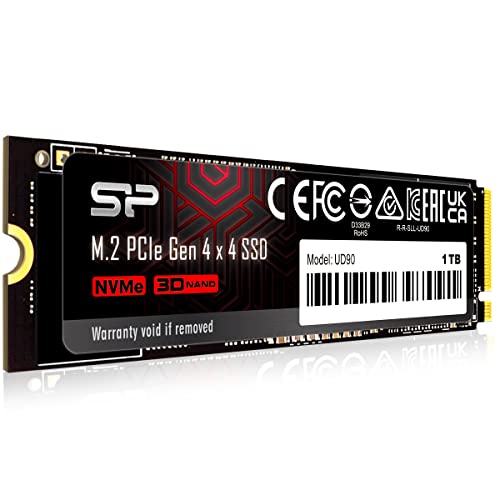
TL;DR: The Silicon Power UD90 1TB delivers up to 5,000 MB/s reads, 4,800 MB/s writes and 600 TBW endurance at a $173.97 price, but its DRAM‑less design can run hot without a heatsink.
At the core of the UD90 is a PCIe Gen 4 x4 interface paired with a Phison E21T controller that forgoes onboard DRAM. It still manages sequential read speeds of 5,000 MB/s and sequential write speeds of 4,800 MB/s, while offering 570,000 IOPS read and 600,000 IOPS write. The drive carries a 600 TBW endurance rating, a 1,500,000‑hour MTBF, and a five‑year limited warranty. Physically it measures 3.5 mm × 80 mm × 22 mm and weighs just 0.01763698096 lb (8 g), making it one of the lighter options in the list.
Compared with its peers, the UD90 is heavier than the Kingston NV3 (0.01448 lb) but far lighter than the Teamgroup MP44L (0.07054792384 lb). Its 3.5 mm height sits a touch taller than the Crucial P310 (2.3 mm) and Samsung 990 EVO Plus (2.54 mm), yet matches the Teamgroup’s 3.56 mm profile. In endurance, it ties with the Teamgroup’s 600 TBW figure and outpaces the Crucial P310’s 220 TBW and Kingston’s 320 TBW. However, its sequential speeds fall short of Samsung’s 7,150 MB/s read / 6,300 MB/s write and Kingston’s 6,000 MB/s read, and its random IOPS are lower than the Crucial P310’s 1,000,000 read and Samsung’s up to 1,350,000 write.
Users consistently praise the UD90’s fast boot times and responsive gaming performance, calling it a “great deal” for a PCIe 4.0 SSD at its price point. Professional reviewers note its solid power efficiency and the value‑for‑price balance, but they’ve also flagged the lack of an included heatsink and the tendency to run hot under load. Some owners have reported overheating and early‑life failures, so you should monitor temperatures.
Pros
Cons
Best for: Budget-conscious buyers seeking a reliable entry-level option
Avoid if: You need advanced features or professional‑grade performance
“"New Value Champion"”
“"excellent value"”
TL;DR: The Sabrent Rocket 4 2TB delivers up to 7,450 MB/s sequential reads, 6,400 MB/s writes and 1 million IOPS in a lightweight 8‑gram M.2 2280 package, but its $499.99 price and modest endurance may narrow its audience.
At the top of its spec sheet, the Rocket 4 offers a maximum sequential read speed of 7,450 MB/s and a write speed of 6,400 MB/s, backed by up to 1 million random read IOPS. Coupled with onboard DRAM and Toshiba BiCS4 96‑layer TLC NAND, the drive is built for fast game loads, 4K video editing and other data‑intensive tasks while keeping the 2 TB capacity you’d expect from a premium SSD.
Compared with its peers, the Rocket 4 sits between the 5,000 MB/s reads of the Teamgroup MP44L and the 14,000 MB/s reads claimed for the Sabrent Rocket 5, making it a solid middle‑ground performer. Its random read ceiling of 1 million IOPS trails the 2.2 million IOPS of the Crucial T710, and its endurance of roughly 400 TBW falls short of the 1,200 TBW of the Samsung 990 EVO Plus and the 2,400 TBW of the Crucial T710. Regarding weight, the Rocket 4’s 8 g mass is lighter than the Samsung 990 EVO Plus’s 9 g, though it’s comparable to the 7.37 g of the Rocket 5.
Users consistently praise the drive’s lightning‑quick boot times and the convenience of the bundled Acronis True Image cloning software. Professional reviewers note that the TLC + DRAM combo and the Phison E16‑class controller provide reliable sustained performance, especially when paired with a heatsink. However, several owners have flagged the absence of a mounting screw and the need to add an aftermarket heatsink to avoid thermal throttling under prolonged loads.
Pros
Cons
Best for: Those prioritizing quality and willing to pay for premium performance
Avoid if: You need advanced features or professional‑grade performance
“You will not achieve the advertised speed of up to 14GB/s... best I got was 10.25GB/s. So barely faster than a Samsung PCIe Gen 4 NVMe.”
“Great performance / price”
Breakdown
Samsung 990 EVO Plus 2TB
Pros
Crucial P310 1TB
Pros
Samsung 990 EVO Plus 1TB
Pros
Kingston NV3 1TB
Pros
Based on scoring data and product specs
Personalized picks
Best Overall Pick
Samsung 990 EVO Plus 2TB
Best ValueBest for: Buyers willing to invest in a proven, high-quality option
Crucial P310 1TB
Best for: Most users looking for a well-reviewed, reliable mainstream option
$135.22-$194.77 vs winner
Skip Sabrent Rocket 4 2TB if…
You need advanced features or professional-grade performance
Samsung’s 990 EVO Plus 2 TB takes the top spot, thanks to its blistering 7,250 MB/s sequential read and 6,300 MB/s sequential write speeds, plus a massive 1,350,000 IOPS random‑write rating. It also offers a high 1,200 TBW endurance rating and carries a 5‑year warranty, all for $328.20. With a 4.8‑star rating from 9,481 reviewers, it’s the most consistently praised option in the lineup.
The runner‑up, Crucial’s P310 1 TB, shines when you need a cost‑effective Gen4 drive for a gaming PC or a PlayStation 5. It delivers 7,100 MB/s sequential reads, 6,000 MB/s writes, and 1,200,000 IOPS random writes, while staying DRAM‑less and costs $175.00. Its 4.8‑star rating from 8,341 reviews and 220 TBW endurance make it a solid choice for tight budgets.
For tighter wallets, the Western Digital WD Blue SN5000 500 GB at $109.99 provides a reliable entry‑level NVMe experience. In the mid‑range segment, the Crucial P310 1 TB (already highlighted above) balances performance and price at $175.00. If capacity is king, the Crucial T710 4 TB premium model offers 4 TB storage for $556.18, ideal for creators and power users.
Pick the Samsung 990 EVO Plus 2 TB for the best high‑performance value and enjoy fast, reliable storage today.
The Samsung 990 EVO Plus 2TB bundles AES‑256‑bit encryption, TCG Opal 2.0, IEEE 1667 support, Intelligent TurboWrite 2.0 and a 5 nm Piccolo controller with Host Memory Buffer, giving it a richer security and performance feature set than the DRAM‑less, non‑encrypted drives in the list.
Please sign in to leave a review
No reviews yet. Be the first to review!
