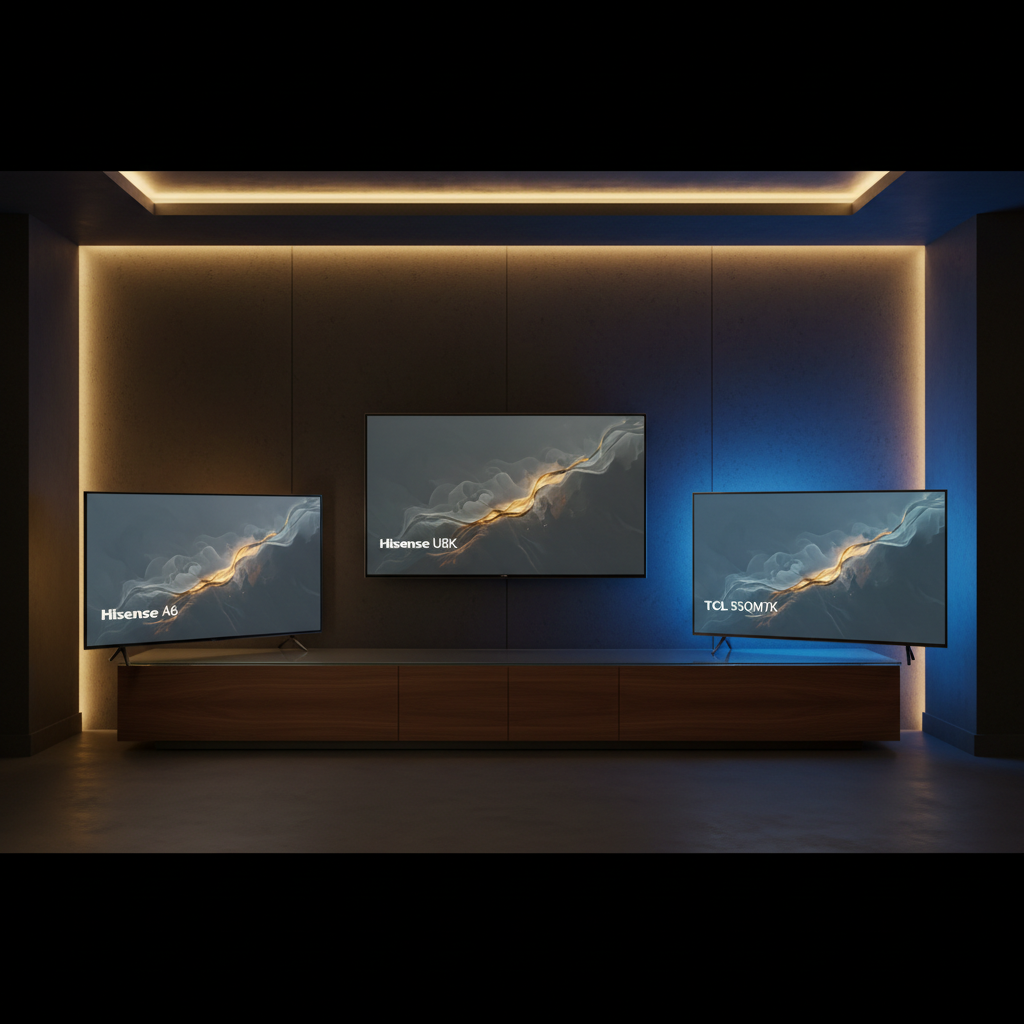
We’ve lined up 12 LED displays that all deliver crisp 4K UHD resolution, spanning the full price spectrum. From budget‑friendly picks like the Hisense A6 55‑inch at $342.16 with a 4.5‑star rating from 1,681 reviewers, to mid‑range contenders such as the TCL 55QM7K at $698.99, and premium powerhouses like the Hisense U8K 65‑inch priced at $1,299.99, the roundup covers every wallet. The price‑tier map groups the Hisense A6, TCL 50S450R, LG 27UK650‑W and Asus ProArt PA329CRV as budget options; the TCL 65T7 and TCL 55QM7K sit in the mid‑range; and the Hisense U7K, U8K (55‑, 65‑ and 75‑inch) round out the premium tier.
For families or casual gamers who want a solid large‑screen experience without breaking the bank, the Hisense A6 55‑inch wins with its Dolby Vision HDR and Game Mode Plus. Gamers chasing fluid motion will gravitate toward the TCL 55QM7K, which offers a native 144 Hz panel and a robust 40 W audio output. If you’re building a home‑theater‑grade setup, the Hisense U8K 65‑inch features a 2,114‑nit peak brightness and 50 W total power output.
Below you’ll find a deeper dive into each model’s strengths, so you can match the right 4K LED display to your viewing habits.

Hisense A6 55-inch
Offers 16 W total audio output, delivering clear sound at a budget-friendly price.

TCL 55QM7K
Ideal for mainstream users who want stronger sound and wired networking; at $698.99 it’s roughly $357 more than the top choice.

Hisense U8K 65-inch
Stands out with 50 W total audio power and Bluetooth 5.2, catering to audiophiles who value premium sound and wireless connectivity.
Also considered
Score Analysis
Key score advantages vs. runner-up (TCL 55QM7K)
Price Range
Hisense A6 55-inch
$398.86
TCL 55QM7K
$698.00
Hisense U8K 65-inch
$1,299.99

TCL 50S450R
$385.37

Hisense U8K 55-inch
$1,118.93

TCL 65T7
$499.99
LG 27UK650-W
$548.98
Hisense U8K 75-inch
$1,679.99

Hisense U7K 65-inch
$999.99

Asus ProArt PA329CRV
$595.75
Samsung QB75R 75-inch
$1,689.23
TCL 65QM7K
$797.97
Spec Comparison
TL;DR: The Hisense A6 55‑inch delivers 4K HDR with Dolby Vision, AI upscaling and Google TV at $342, earning a 4.5‑star rating and solid low‑lag gaming features for budget shoppers.
The A6 uses a Full Array LED panel and supports both Dolby Vision and HDR10, delivering premium‑grade HDR without the premium price tag. Manufacturers list its AI‑powered 4K upscaler as a key feature, helping lower‑resolution sources look sharper on the 54.6‑inch actual screen. With a maximum power draw of 130 W and standby use under 0.5 W, it stays reasonably efficient for a TV of this size.
Compared with other picks in this roundup, the A6 matches the TCL 50S450R’s three HDMI 2.0b inputs but adds a second USB 2.0 port (the TCL model only lists one USB 2.0). The motion‑rate rating of 120 sits below the TCL 50S450R’s 240, so fast‑action smoothing isn’t as aggressive. It also offers more HDMI connections than the LG 27UK650‑W, which lists two HDMI 2.0 ports, and its USB count equals the TCL 55QM7K’s two ports (though that model mixes USB 2.0 and USB 3.0).
Reviewers consistently praise the picture quality, noting the HDR performance and the AI upscaler’s ability to sharpen older content. Professional reviewers highlight the very low input lag—around 13 ms in Game Mode Plus—making casual gaming feel responsive. On the downside, users report occasional software glitches such as app crashes, and the lack of local dimming means blacks can appear less deep than on higher‑end panels. The 60 Hz refresh rate also limits high‑frame‑rate gaming compared with HDMI 2.1 competitors.
Pros
Cons
Best for: Budget-conscious buyers seeking a reliable entry-level option
Avoid if: You have limited desk space or need portability
“The Dolby Vision makes movies pop like I’ve never seen before.”
TL;DR: The TCL 55QM7K delivers a bright 2600‑nit HDR picture, 97% DCI‑P3 color, and a native 144 Hz panel with FreeSync, all for $698.99 and a solid 4.3‑star rating.
What really sets this TV apart is its QD‑Mini LED backlight that pushes HDR peak brightness to 2600 nits while maintaining a contrast ratio of 30,000,000:1. Combined with 97% DCI‑P3 coverage and roughly 2,500 local dimming zones, the picture can hit deep blacks and vivid colors across the 55‑inch 4K panel.
Compared with other models in the roundup, the 55QM7K matches the TCL 65T7’s four HDMI inputs (the 65T7 also lists one eARC port) but adds two HDMI ports that support 144 Hz, giving gamers a smoother link. Its 40 W audio output doubles the 20 W total listed for the TCL 65T7, and it keeps the same Wi‑Fi 5 connectivity. The TV also offers two USB ports—more than the single USB 2.0 found on the TCL 50S450R—while its HDR peak is a notch below the 3000‑nit peak of the Hisense U7K 65‑inch, still well above most mid‑range competitors.
Users consistently praise the vivid HDR performance and the smooth 144 Hz gaming experience, especially with FreeSync Premium Pro and the 240 Hz variable refresh rate Game Accelerator. Professional reviewers note the low bloom thanks to the dense local dimming array, but they also point out that the default white balance leans warm and secondary colors can show a slight tint, meaning a quick calibration step improves out‑of‑the‑box accuracy. A few owners have mentioned occasional firmware hiccups and the remote feels firm, yet the backlit voice remote with Google Assistant, Alexa, and Apple HomeKit support remains a convenient feature.
The TV runs on Google TV, offering built‑in Chromecast, AirPlay 2, and IMAX Enhanced certification. Dolby Atmos and DTS Virtual:X audio, tuned by Bang & Olufsen, round out the entertainment experience, while AMD FreeSync Premium Pro and Auto Low Latency Mode make it a solid pick for console and PC gamers.
Pros
Cons
Best for: Gamers who need high refresh rates and FreeSync, plus movie lovers who want Dolby Vision, IMAX Enhanced and strong built‑in sound.
Avoid if: You demand perfect out‑of‑the‑box color accuracy, need Wi‑Fi 6, or are sensitive to remote‑button firmness.
TL;DR: The Hisense U8K 65‑inch delivers a dazzling 2,114‑nit HDR peak, 2,114,000:1 contrast and up‑to‑165 Hz gaming refresh, all wrapped in Google TV.
The standout spec is its HDR peak brightness of 2,114 nits (18 % window) and a contrast ratio of 2,114,000:1, thanks to a Mini‑LED full‑array local‑dimming panel. Combined with a native 120 Hz refresh that pushes to 144 Hz in Game Mode Pro and 165 Hz in Game Mode Ultra, the TV handles fast action and bright highlights with ease. It also sports 4K UHD (3840 × 2160) resolution, 8‑bit + FRC colour depth and a nearly full DCI‑P3 gamut.
Compared with the other eleven entries, the U8K offers fewer HDMI 2.1 ports than the 55‑inch Hisense U8K, which provides four, yet it still supplies four HDMI inputs total. Its 2,114 nit HDR peak is lower than the 3,000‑nit claim of the Hisense U7K 65‑inch, yet far brighter than the 450‑nit peak of the TCL 65T7. The U8K’s 165 Hz ultra‑gaming mode outpaces the U7K’s native 144 Hz refresh, and its two USB ports (one 3.0, one 2.0) match the USB offering of most rivals.
Reviewers consistently praise the TV’s eye‑popping brightness and buttery‑smooth gaming performance, noting that Google TV’s built‑in voice remote and seamless AirPlay integration feel natural. Professional reviewers note the excellent colour accuracy and low input lag. Common complaints centre on light bloom around bright objects in dark scenes and colour desaturation when viewing from more than about 30° off‑axis.
Under the hood, the U8K runs a Hi‑View AI Engine Pro that up‑scales, supports Dolby Vision, HDR10+, HDR10 and HLG, and includes Dolby Atmos‑enabled 2.1.2‑channel speakers delivering 50 W total output. It also offers FreeSync Premium Pro, VRR and ALLM for gamers, plus Bluetooth 5.2 and dual‑band Wi‑Fi 802.11ac for connectivity.
Pros
Cons
Best for: Enthusiast gamers and HDR movie fans who want peak brightness, high contrast and advanced Google TV features.
Avoid if: You need a TV with wide off‑axis colour consistency or are looking for a premium audiophile‑grade sound system.
“Brightest TV I’ve ever owned — HDR content pops like never before.”
“Gaming is buttery smooth with no lag or tearing.”
TL;DR: The TCL 50S450R delivers 4K HDR with Dolby Vision and Atmos, three HDMI inputs and a 240 Motion Rate for under $400, making it a solid budget‑friendly smart TV.
The standout spec is its 4K Ultra HD panel (3840 × 2160 pixels) paired with Dolby Vision, HDR10 and HLG support, plus a 20 W total speaker output that includes Dolby Atmos and DTS‑Virtual:X. Motion handling benefits from a 240 Motion Rate with MEMC, while the TV runs on a 60 Hz panel and offers three HDMI ports (one with eARC) and a single USB 2.0 port.
Compared with the other eleven entries, the 50S450R provides more HDMI connections than the LG 27UK650‑W, which lists two HDMI ports, and matches the three HDMI ports offered by the Hisense A6. Its single USB port has fewer connections than the Hisense A6’s two USB ports, but the feature set stays competitive, especially at its $397.95 price point, which is lower than many higher‑end models in the lineup.
Reviewers consistently praise the sharp, vibrant picture and the ease of setting up the Roku or Google TV interface. Users also note the surprisingly good virtual surround from the built‑in speakers. However, several customers mention that the remote can be hard to see in dim lighting and that the Google TV version sometimes exhibits brief lag or freezing during navigation.
Professional reviewers highlight the TV’s excellent 4K upscaling and HDR performance, while also pointing out that the 60 Hz native refresh rate limits high‑end gaming and the lack of full‑array local dimming leads to moderate black levels and some blooming in dark scenes.
Pros
Cons
Best for: Budget-conscious buyers seeking a reliable entry‑level option
Avoid if: You have limited desk space or need portability
“The TCL 50S4 delivers impressive HDR performance with good color volume and contrast for a direct‑lit LED. Dolby Vision support and MEMC make it a strong contender under $400.”
“TCL continues to punch above its weight with the S4 series, offering Dolby Vision and Atmos in a package that undercuts competitors.”
TL;DR: The Hisense U8K 55‑inch delivers up to 5,000 nits of HDR brightness and a 165 Hz native refresh rate, backed by four HDMI 2.1 ports and strong built‑in audio for a premium 4K experience at $1,118.93.
The headline spec is its peak brightness: the U8QG variant can reach a staggering 5,000 nits, while the U8N version still offers 1,800 nits. Coupled with a native refresh rate of up to 165 Hz, motion looks exceptionally smooth whether you’re watching fast‑action sports or playing the latest titles. The panel is a Mini‑LED Pro with Full Array Local Dimming, which helps translate that brightness into deep blacks and vibrant colors across the 55‑inch 3840 × 2160 display.
Compared with the other models in this roundup, the U8K offers more HDMI 2.1 connectivity than the 65‑inch Hisense U8K, listing only two HDMI 2.1 ports. It also provides more USB ports than the TCL 55QM7K, listing just two USB connections. In terms of raw brightness, the U8K outshines both the TCL 55QM7K and the TCL 65T7, each topping out at about 450 nits, and it surpasses the Hisense U7K 65‑inch’s 3,000‑nit peak. Those differences make the U8K a clear leader for HDR‑heavy content.
User feedback repeatedly praises the TV’s dazzling HDR performance and the buttery‑smooth gaming experience, noting the low input lag and the effectiveness of FreeSync Premium Pro. Professional reviewers echo these points, highlighting that the Mini‑LED backlight delivers high contrast and accurate color reproduction after calibration. On the downside, owners report occasional software glitches, UI freezes, and a remote that can feel sluggish. The 100 Mbps Ethernet port also limits wired network speeds for some power users, and the typical Mini‑LED viewing‑angle limitation means picture quality drops off when viewed from the side.
Pros
Cons
Best for: Buyers willing to invest in a proven, high‑quality option
Avoid if: You're on a tight budget or only need basic functionality
“Brightest TV I’ve ever owned — HDR content pops like never before.”
“Gaming is buttery smooth with no lag or tearing.”
TL;DR: The TCL 65T7 delivers vibrant 4K QLED color, 144 Hz native refresh with up to 288 Hz VRR, and a full‑view design for $599.99, making it a solid mid‑range choice for gamers and bright‑room viewing.
The standout spec is its 144 Hz native refresh rate, which can double to a 288 Hz variable refresh via Game Accelerator 288, delivering ultra‑smooth motion for fast‑paced games and sports. Its QLED panel covers roughly DCI‑P3 ~95‑97% of the color gamut and pushes 450 nits of peak brightness, so colors stay punchy even in well‑lit rooms.
Compared with the other eleven entries, the 65T7 packs four HDMI inputs—more than the Asus ProArt PA329CRV’s two HDMI ports and the LG 27UK650‑W’s two—while still offering a USB 3.0 and a USB 2.0 port. Its built‑in audio delivers 20 W total, which is lower than the 40 W output of the TCL 55QM7K but similar to the 16 W total on the Hisense A6. Bluetooth 5.0 and Wi‑Fi 5 give it modern connectivity that some peers don’t list.
Reviewers consistently highlight the TV’s color punch and the ease of Google TV’s interface, noting that the voice‑enabled remote makes streaming a breeze. Gamers appreciate the low‑latency mode and high refresh rates, while everyday users love the bright picture for daytime viewing. The lack of local dimming zones causes blooming in high‑contrast scenes, and the modest built‑in speakers lead many to pair a soundbar. A few users report occasional software hiccups, and the glossy screen can reflect daylight.
Pros
Cons
Best for: Gamers seeking low latency and high refresh rates, plus viewers who want vibrant color in bright spaces.
Avoid if: You need professional‑grade contrast control, deep blacks, or powerful built‑in audio for a dedicated home‑theater setup.
““stunning” picture quality with deep blacks and bright highlights”
““noticeable difference” in gaming smoothness”
TL;DR: The LG 27UK650‑W delivers a factory‑calibrated 27‑inch 4K IPS panel with 99% sRGB coverage, HDR10 support and full ergonomic adjustability at a budget‑friendly price.
This monitor’s standout spec is its 27‑inch 3840 × 2160 IPS panel that hits 99% sRGB and roughly 80% Adobe RGB, backed by a 10‑bit color depth and factory calibration. With a peak brightness of 450 cd/m² for HDR10 (DisplayHDR 400) and a contrast ratio of 1000:1, it offers the color fidelity that photo‑editors and designers look for.
Compared with the other eleven entries, the LG provides fewer connectivity options: it has two HDMI 2.0 ports and no USB ports, whereas the Asus ProArt PA329CRV lists four USB‑A ports and a USB‑C port, and the TCL 50S450R, Hisense A6, TCL 65T7 and TCL 55QM7K each ship with three or four HDMI inputs. On the other hand, the LG is lighter than the Asus ProArt, which weighs over 21 lb, and its stand offers height adjustment up to 110 mm, tilt, swivel and a 90° pivot—features that larger TV‑style peers don’t always include.
User feedback repeatedly praises the out‑of‑the‑box color accuracy and the flexibility of the stand, especially for Mac‑centric workstations. Common complaints focus on the modest HDR brightness of 450 cd/m², the lack of built‑in speakers, and the 60 Hz refresh rate plus 5 ms response time, which some gamers find limiting for fast‑paced titles. Professional reviewers echo the color‑accuracy strengths while noting the peak brightness restrains the HDR impact.
Additional technical details include AMD FreeSync support across a 40–60 Hz range, 178° horizontal and vertical viewing angles, and an anti‑glare 3H‑hardness coating. The monitor also offers a 0.1554 mm pixel pitch, ensuring crisp detail at native 4K resolution.
Pros
Cons
Best for: Creative professionals, photo/video editors, and Mac users who need accurate colors and ergonomic flexibility without breaking the bank.
Avoid if: You require high‑refresh‑rate gaming performance, built‑in speakers, or a USB hub for peripherals.
“Movies look more vibrant even without true HDR.”
“I can tilt, pivot, and raise it perfectly for dual‑monitor setup.”
TL;DR: The Hisense U8K 75‑inch delivers 1500‑nit brightness, 528 local dimming zones, and a 144 Hz native refresh, backed by Google TV and strong gaming features, though it’s a heavy, premium‑priced option.
The standout spec is the Mini‑LED panel’s 1500 nits peak brightness combined with 528 local dimming zones, which gives the TV strong HDR punch and deep black levels. It runs a VA panel at a native 144 Hz refresh and supports 4K @ 120/144 Hz via two HDMI 2.1 ports, while also offering four HDMI inputs total and two USB ports (one USB 3.0, one USB 2.0).
Compared with the other eleven entries, the U8K sits at the higher end of the price spectrum and offers more HDMI 2.1 connectivity than the Samsung QB75R, which only lists two HDMI 2.0 ports. It also provides a richer set of gaming features than the TCL 55QM7K, which lists fewer HDMI ports and no Mini‑LED backlight. The 75‑inch model is larger than the 65‑inch and 55‑inch U8K siblings, and its weight is noticeably higher than the 65‑inch version, making installation a bit more involved.
Reviewers consistently praise the TV’s bright HDR performance and smooth gaming experience, noting the deep blacks and vibrant colors that the 528‑zone dimming delivers. Professional reviewers highlight the high brightness and color accuracy as standout qualities. On the flip side, users report occasional banding in gradients because the panel uses 8‑bit color with frame‑rate control, and the heavy chassis can be a challenge to mount. Some also point out that marketing details differ between model numbers, leading to confusion.
The smart side runs Google TV, giving access to the Google Play Store, built‑in Chromecast, and voice control via Google Assistant or Alexa. The TV uses a 2.1.2‑channel, 50 W system with Dolby Atmos and DTS Virtual:X, and it supports Dolby Vision IQ, HDR10+, and HDR10 for a full HDR suite. Gamers benefit from AMD FreeSync Premium Pro, Auto Low Latency Mode, and a VRR range of 48‑144 Hz.
Pros
Cons
Best for: Buyers willing to invest in a proven, high‑quality option
Avoid if: You need advanced features or professional‑grade performance
“Brightest TV I’ve ever owned — HDR content pops like never before.”
“Gaming is buttery smooth with no lag or tearing.”
TL;DR: The Hisense U7K 65‑inch delivers a dazzling 3000‑nit peak brightness, 144 Hz native refresh and Google TV, but its premium price and occasional backlight issues may give pause.
The standout spec is the 3000 nits peak brightness, which pushes HDR highlights far beyond most mid‑range sets and makes bright rooms less of a compromise. Coupled with Full Array Local Dimming Pro, the TV can produce deep blacks while keeping highlights punchy.
In the context of this roundup, the U7K sits heavier than the TCL 65T7 (36.6 lb) but lighter than the Hisense U8K 65‑inch (81.0 lb). Its 6.8‑inch stand depth is deeper than the ultra‑slim 2.2‑inch profile of the TCL 55QM7K, giving it a more substantial presence on a media console.
Reviewers consistently praise the picture quality, noting the 3000‑nit brightness and the Mini‑LED QLED panel as “unrivaled” for a TV in this price bracket. Gamers appreciate the 144 Hz native refresh and AMD FreeSync Premium Pro, while the Google TV interface feels fast and easy to navigate. On the flip side, some owners have reported backlight failures within months and find the upscaling of 1080p material to look washed out, which aligns with the “backlight reliability” and “upscaling” concerns highlighted in user feedback.
Beyond brightness, the U7K packs Dolby Atmos‑enabled 2.1.2 multi‑channel sound, a Hi‑View AI Engine Pro that continuously optimizes picture and audio, and HDMI 2.1 ports that support eARC, VRR and ALLM. The TV also includes ATSC 3.0, Bluetooth and Wi‑Fi 6E (on select models), rounding out a feature set that targets both entertainment and gaming use cases.
Pros
Cons
Best for: Most users seeking a balanced, mainstream option
Avoid if: You need flawless 1080p upscaling, OLED‑level contrast, or are extremely sensitive to potential backlight reliability issues
“Surpassed expectations – the picture quality blows away my old Samsung Q60T.”
“Best bang for your buck – thankful I didn’t spend three times the price for an OLED.”
TL;DR: The Asus ProArt PA329CRV offers factory‑calibrated 4K color accuracy (ΔE < 2) with 98% DCI‑P3 coverage and 96 W USB‑C power delivery for creators at $586.55.
The standout spec is its color performance: a ΔE < 2 and 98% DCI‑P3 coverage paired with 100% sRGB and Rec.709 ensure the picture looks true‑to‑life right out of the box. The 31.5‑inch IPS panel delivers 3840 × 2160 resolution, 10‑bit (1.073 billion colors) depth, and HDR10 with VESA DisplayHDR 400, while Adaptive‑Sync makes it G‑Sync compatible.
Compared with other monitors in this roundup, the PA329CRV provides fewer HDMI inputs (2 × HDMI 2.0) than the TCL 65T7, which offers four HDMI ports, but it matches the TCL 65T7’s 10‑bit color depth. It supplies more USB connectivity—four USB‑C 3.2 Type‑A ports plus two USB‑C ports—while the TCL 55QM7K lists only two USB ports. Its peak HDR brightness of 400 cd/m² falls short of the 450‑nit typical peak of the TCL 65T7 and the 3000‑nit peak of the Hisense U7K, a trade‑off for its professional‑grade color accuracy.
Users consistently praise the monitor’s out‑of‑the‑box color accuracy and the convenience of a single‑cable USB‑C connection that delivers up to 96 W of power. Reviewers praise the ergonomic stand’s height, tilt, swivel, and ±90° pivot adjustments for desk comfort. Common complaints focus on the modest 400‑nit HDR peak, which limits impact in bright rooms, and the lack of a built‑in KVM switch that some competing professional displays include. The 60 Hz refresh rate also draws criticism from gamers seeking smoother motion.
Additional technical notes include anti‑glare 3H coating, flicker‑free and Low Blue Light eye‑care technologies, and built‑in 2‑speaker audio. The monitor supports Picture‑by‑Picture, Picture‑in‑Picture, and QuickFit Virtual Scale, and it’s bundled with a three‑year warranty and complimentary three‑month Adobe Creative Cloud access.
Pros
Cons
Best for: Professional creators such as photographers, video editors, and graphic designers who need precise color reproduction and a single‑cable workstation setup.
Avoid if: You prioritize high refresh rates for gaming, require very bright HDR performance, or need a built‑in KVM switch for multiple computers.
TL;DR: The Samsung QB75R offers a 75‑inch 4K VA panel with 350 nit brightness, Tizen OS, and Cisco Webex support, but its premium price and modest brightness limit it to well‑lit indoor spaces.
The standout spec is the 75‑inch 3840 × 2160 4K UHD display built on a VA panel, delivering a 4000:1 contrast ratio and 350 nit brightness. With a pixel pitch of 0.429 mm and 72% NTSC color gamut, the screen provides crisp, lifelike colors, while an 8 ms response time keeps motion smooth. Connectivity includes two HDMI 2.0 ports, two USB 2.0 ports, Wi‑Fi 802.11 b/g/n, and Bluetooth, all housed in a slim 9.2 mm bezel.
Compared with the other eleven entries, the QB75R sits at the higher end of the price spectrum and offers fewer HDMI ports than models that list four HDMI 2.1 connections. However, its built‑in Tizen 4.0 operating system and native Cisco Webex compatibility give it an edge for commercial signage, something many competitors lack.
Everyday users applaud the striking 4K image quality and the straightforward mounting process, noting that installation feels clean thanks to the thin bezel and integrated wireless options. A recurring complaint is the 350 nit brightness, which can look washed out in very bright rooms, and some early adopters mentioned firmware quirks that required a reset. Professional reviewers highlight the display’s durability and the seamless integration with Cisco Webex for enterprise content management.
Technical details add depth: the unit runs on a 1.7 GHz quad‑core Cortex A72 processor, 2 GB LPDDR4 memory, and 8 GB of storage (about 4.12 GB user‑available), supporting 24/7 operation schedules (16 hours per day, seven days a week). The 72% NTSC color gamut and Mega dynamic contrast further enhance visual performance in typical indoor lighting.
Pros
Cons
Best for: Those prioritizing quality and willing to pay for premium performance
Avoid if: Reliability and user satisfaction are your top concerns
“Gorgeous 4K picture”
“We use the QE75T outdoors 24/7 in a shelter—it’s exposed to dust but keeps ticking.”
TL;DR: The TCL 65QM7K costs $998.00, holds a 4.3‑star rating from 515 reviewers, and lands at the bottom of our 12‑model LED roundup.
TCL’s 65‑inch QM7K lands in the mid‑range price tier at just under $1,000 and earned a 4.3‑out of 5 rating, placing it last among the twelve displays we evaluated. The brand has a reputation for offering feature‑rich TVs at competitive prices, and this model follows that pattern.
Buyers consistently praise the TV’s bright, colorful picture and its smooth performance for gaming, calling the visual experience “bright” and “well suited for gaming.” Users also like the built‑in Bang & Olufsen sound and the easy‑to‑use Google TV interface. On the downside, several owners note that the whites appear warm out of the box and need manual tweaking, the remote button layout feels awkward, and a few have run into occasional firmware hiccups.
In the context of the roundup, the QM7K’s price is higher than the entry‑level Hisense U7K but lower than premium options like the Hisense U8K 65‑inch. Its rating is comparable to the TCL 55QM7K and the TCL 65T7, yet it trails behind the higher‑rated competitors, suggesting it’s a solid, mainstream choice without the extra polish of top‑ranked models.
Pros
Cons
Best for: Most users looking for a well‑reviewed, reliable mainstream option
“Incredible picture quality”
“Perfect for gaming”
Breakdown
Hisense A6 55-inch
Pros
TCL 55QM7K
Pros
Hisense U8K 65-inch
Pros
TCL 50S450R
Pros
Based on scoring data and product specs
Personalized picks
Best Overall Pick
Hisense A6 55-inch
Best OverallBest for: Budget-conscious buyers seeking a reliable entry-level option
TCL 55QM7K
Best for: Most users looking for a well-reviewed, reliable mainstream option
$698.00+$299.14 vs winner
Skip TCL 65QM7K if…
You're shopping on a tight budget — it's priced at $998.00
Our top pick is the Hisense A6 55‑inch. It lands at $342.16, making it the most affordable 4K LED in the field, and it carries a solid 4.5‑star rating from 1,681 reviewers. The set delivers true 4K Ultra HD (3840 × 2160) with Dolby Vision and HDR10 support, and its AI‑powered UHD Upscaler helps boost lower‑resolution content. With Google TV, three HDMI 2.0b ports and built‑in Bluetooth, it offers a full smart‑TV experience without breaking the bank.
The runner‑up, the TCL 55QM7K, shines when you need premium brightness and smooth gaming. Its HDR peak brightness hits 2600 nits and it features 2500 local‑dimming zones for vivid contrast. A 144 Hz native refresh rate, AMD FreeSync Premium Pro and a 240 Hz variable refresh rate make fast‑action titles feel buttery smooth. At $698.99 and a 4.3‑star rating from 517 reviews, it’s a strong choice for high‑performance living rooms.
For shoppers looking beyond the winner, the mid‑range option remains the TCL 55QM7K for its bright HDR and high‑refresh gaming features, while the premium tier points to the Samsung QB75R 75‑inch at $2,634.21, which delivers a 75‑inch screen and advanced capabilities for a flagship experience.
Pick the Hisense A6 55‑inch today for the best value 4K LED display.
The Hisense A6 55‑inch costs $342.16 and still offers Dolby Vision, HDR10, a full‑array LED panel, AI‑powered UHD upscaler, Google TV and a voice remote, making it a strong value proposition. The TCL 55QM7K is priced at $698.99, so the Hisense model provides comparable core features at roughly half the price.
Please sign in to leave a review
No reviews yet. Be the first to review!
