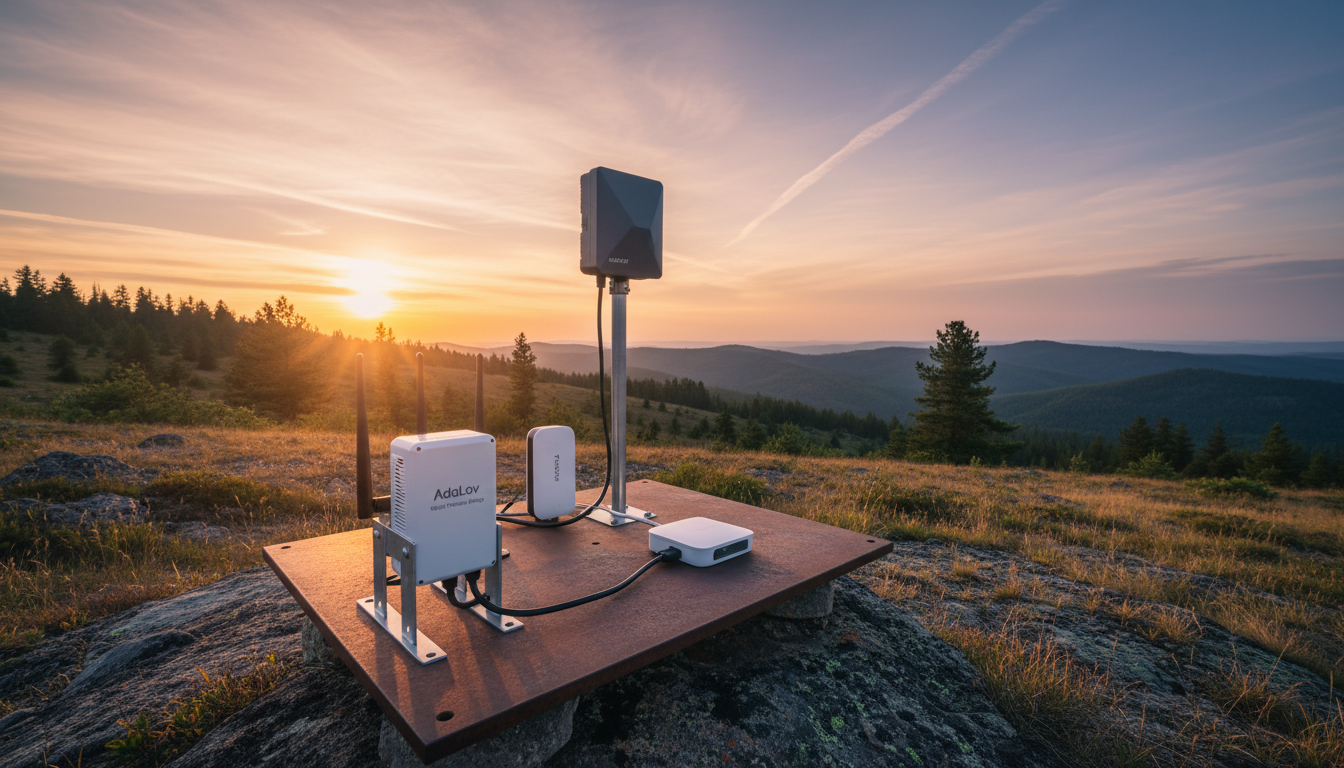
We compared eight long‑range outdoor network bridges to help you stretch a wired connection across fields, farms or backyards without digging. Prices span from $39.99 for the Tenda Wireless Bridge up to $208.99 for the Ubiquiti LOCO5AC, while ratings hover between 3.9 / 5 and 4.5 / 5. The AdaLov Gigabit Wireless Bridge, priced at $159.98, features a 16 dBi antenna and a listed transmission distance of 3 km, making it a reliable mid‑tier contender for non‑technical homeowners who need reliable Ethernet extension.
Our lineup covers three price tiers. The budget tier—Tenda, BrosTrend and KuWFi Outdoor—offers entry‑level options like the Tenda’s 800 mW (29 dBm) transmit power and 6000 V lightning protection. Mid‑range picks include the KuWFi Wireless Bridge at $84.99 with a 12 dBi antenna and the UeeVii CPE452, which delivers 14 dBi gain and 300 Mbps throughput. Premium models such as the AdaLov, EnGenius EnStation6 and Ubiquiti LOCO5AC provide higher gain (up to 19 dBi) and longer reach (10+ km for the LOCO5AC).
Read on to see how each bridge balances range, speed and ease of setup, so you’ll choose the right solution for your outdoor networking needs.

AdaLov Gigabit Wireless Bridge with Mounts
Its 250 mm height lets you mount the bridge higher, securing a clear line‑of‑sight for reliable long‑range links.

Tenda Wireless Bridge
Perfect for cost‑sensitive users; at $39.99 it’s roughly $120 cheaper than the AdaLov, offering decent performance on a shoestring.

UeeVii CPE452
Stands out with a low 60 mm profile, fitting tight mounting spots where the taller AdaLov and longer Tenda struggle.
Also considered
Score Analysis
Key score advantages vs. runner-up (Tenda Wireless Bridge)
Price Range
AdaLov Gigabit Wireless Bridge with Mounts
$191.99
Tenda Wireless Bridge
$39.99
UeeVii CPE452
$139.99
Ubiquiti LOCO5AC
$208.99
KuWFi Wireless Bridge
$84.99

BrosTrend Wireless Bridge
$59.99

KuWFi Outdoor Wireless Bridge
$76.49

EnGenius EnStation6
$206.20
Spec Comparison
TL;DR: AdaLov’s 16 dBi outdoor bridge delivers up to 3 km of 5.8 GHz coverage with 900 Mbps peak throughput, dual Ethernet ports, and a one‑key pairing setup, but its real‑world speeds often sit lower.
The standout spec is the 16 dBi directional antenna that, together with a 3 km transmission distance, lets the bridge aim a solid 5.8 GHz signal across a property. It advertises a 900 Mbps wireless throughput and supports both a 1 Gbps and a 100 Mbps LAN port, giving you flexibility for wired devices. The unit weighs about 3.75 lb and measures 250 mm × 90 mm × 55 mm, while a front LED display and weatherproof housing keep installation simple and reliable.
Compared with the seven other bridges in this roundup, AdaLov is heavier than most, which generally sit under 2 lb, but its antenna gain outstrips the typical 12‑14 dBi that rivals such as KuWFi and BrosTrend use, and only EnGenius tops it with 19 dBi. Its dual‑port configuration also offers more wired options than most competitors that list only a single 100 Mbps port. While the price sits in a premium tier, the feature set justifies the cost for users who need higher‑gain performance.
Reviewers love the one‑key pairing via the front LED, calling the setup “extremely quick” even for non‑technical users. The bridge holds a solid 4.4‑star rating from 364 reviewers, who praise its stable 3 km link for cameras and outdoor devices. However, many note that real‑world throughput often falls short of the 900 Mbps claim, with typical bridge‑to‑bridge speeds hovering around 300‑350 Mbps, especially on sub‑optimal channels. Professional reviewers also point out that users rarely achieve the advertised peak in practice.
Additional technical touches include Dynamic MIMO Power Saving and APSD to trim power use when traffic is light, low‑latency operation for video return, and PoE support at 24 V for the 100 Mbps port or 48 V for the gigabit port. Adjustable wall, pole, or window mounts let you position the unit vertically or horizontally, making it adaptable to a range of outdoor mounting scenarios.
Pros
Cons
Best for: Those prioritizing quality and willing to pay for premium performance
Avoid if: You're on a tight budget or only need basic functionality
“internet connection well... cameras not getting problem”
“really really well”
TL;DR: At $39.99, the Tenda O3 offers a 12 dBi directional antenna, 800 mW transmit power and IP64 protection, delivering up to 5 km+ point‑to‑point links for budget‑focused outdoor networking.
The standout specification is its 12 dBi directional dual‑polarized antenna paired with an 800 mW (29 dBm) transmit power, which the manufacturer says supports links longer than 5 km. The unit handles harsh weather with an IP64 rating and 6000 V lightning protection, and it runs on a 12 V, 1 A PoE source with a 60 m deployment distance.
Compared with the BrosTrend bridge, the Tenda is more affordable but noticeably heavier at 403 g versus the BrosTrend’s 99.2 g. Its antenna gain matches the KuWFi Outdoor bridge’s 12 dBi, yet its advertised wireless speed of 150 Mbps is lower than KuWFi’s 300 Mbps offering. The Tenda also provides three LED indicators for quick status checks, a feature not highlighted in the peer specs.
Users repeatedly highlight the reliable long‑range performance and the hassle‑free auto‑bridging setup. However, reviewers note that the single 2.4 GHz band and the 150 Mbps ceiling can feel limiting for high‑bandwidth tasks such as streaming multiple HD feeds.
The device runs on a 300 MHz CPU and offers a 150 Mbps LAN data rate, which aligns with its modest wireless throughput. Its compact dimensions—75 mm high, 298 mm long and 213 mm wide—make mounting on poles or walls straightforward, while the three LED lights give clear visual cues during installation.
Pros
Cons
Best for: Shoppers on a tight budget who need a long‑range outdoor bridge for surveillance or rural internet.
Avoid if: You need high‑throughput 5 GHz performance or dense‑urban deployment.
“internet connection well... cameras not getting problem”
“really really well”
TL;DR: The UeeVii CPE452 is a 5.8 GHz outdoor bridge with a 14 dBi antenna, 3 km range and dual 10/100 Mbps ports, but its 100 Mbps wired ceiling and $139.99 price may limit budget‑focused builds.
What really stands out is the 14 dBi directional antenna paired with a listed maximum range of 3 km on the 5.8 GHz band, delivering up to 300 Mbps wireless throughput. The unit measures 60 mm tall, 250 mm long and 95 mm wide, and it weighs just 5.8 g (about 0.01 lb), making it easy to mount on a pole or wall.
Compared with the eight other bridges in this roundup, the CPE452’s gain sits between the lower‑gain KuWFi Outdoor (12 dBi) and the higher‑gain EnGenius EnStation6 (19 dBi). It’s considerably lighter than the AdaLov Gigabit Bridge, which tips the scales at roughly 3.75 lb, yet heavier than the BrosTrend unit at 0.22 lb. Its 3 km range matches AdaLov’s claim, but falls short of the Ubiquiti LOCO5AC’s advertised “10+ km” reach. The dual 10/100 Mbps Ethernet ports give it more wired flexibility than the single‑port Tenda model.
Professional reviewers praise the out‑of‑the‑box functionality and the clear LED indicators that simplify alignment. Users also note the automatic power adjustment helps maintain link stability. However, the 100 Mbps Ethernet ceiling can become a bottleneck when the wireless side is pushing 300 Mbps, and the device still relies on a clear line‑of‑sight to hit its full 3 km potential. The unit carries an IP65 rating, supports point‑to‑multipoint setups, and can be powered via PoE up to 50 m or an external 12 V adapter.
Pros
Cons
Best for: Expanding network coverage to secondary buildings such as barns, shops, warehouses or garages where a clear line‑of‑sight can be maintained.
Avoid if: You're shopping on a tight budget, need gigabit wired backhaul, or plan to install in a cluttered environment — it's priced at $139.99.
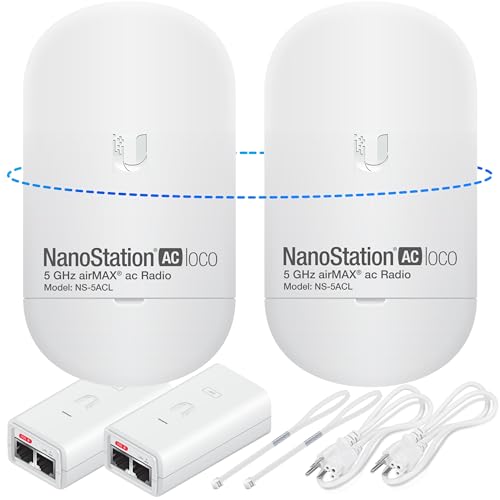
TL;DR: The Ubiquiti LOCO5AC packs a 13 dBi dual‑polarized antenna, 10+ km range and 450+ Mbps throughput into a 179 × 77.5 × 59.1 mm, weather‑proof unit ideal for point‑to‑point links.
The standout spec is the integrated 13 dBi dual‑polarized antenna, which together with a 45° beamwidth and a minimum 20 dB cross‑polar isolation lets the device reliably cover distances of 10+ km. Its 560 MHz processor and 64 MB of memory keep the airMAX AC chipset humming, while the gigabit Ethernet port (10/100/1000 Mbps) ensures the wired side isn’t a bottleneck. All of this fits inside a compact 179 × 77.5 × 59.1 mm enclosure that weighs 2.0 pounds.
Compared with the other seven bridges, the LOCO5AC is heavier than the EnStation6 but lighter than the AdaLov model, and it sits in a premium price tier versus the budget‑friendly KuWFi options. Its 13 dBi gain outperforms the KuWFi Outdoor Bridge’s 12 dBi antenna, though it falls short of the EnStation6’s 19 dBi. Throughput at 450+ Mbps is higher than the Tenda’s 150 Mbps rating but lower than the KuWFi’s advertised 900 Mbps ceiling.
Professional reviewers praise the unit’s ultra‑compact form factor and the ease of configuration via the dedicated management radio and mobile app, calling it a reliable solution for simple PtP or PtMP deployments. Users appreciate the tight installation footprint, yet several note that memory size can vary between 64 MB and 128 MB across regional models, and that power‑supply specifications differ, which can cause confusion during planning.
Technical details worth noting include support for channel bandwidths from 10 MHz up to 80 MHz, a max VSWR of 1.8:1, dual linear polarization, and passive PoE (pairs 4,5+; 7,8 return) drawing 0.5 A at 24 V with a maximum consumption of 8.5 W. The enclosure uses outdoor UV‑stabilized plastic and includes a pole‑mount kit, meeting CE, FCC, IC and RoHS certifications.
Pros
Cons
Best for: Those prioritizing quality and willing to pay for premium performance
Avoid if: You're on a tight budget or only need basic functionality
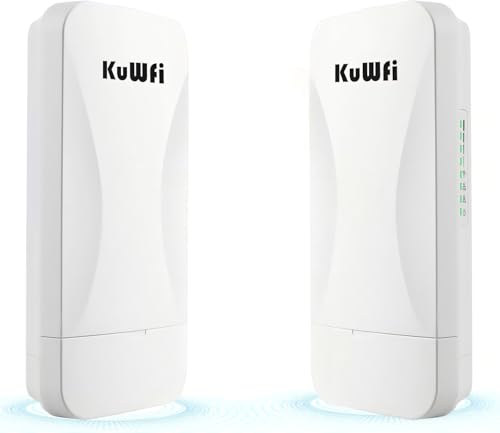
TL;DR: The KuWFi Wireless Bridge delivers 900 Mbps over a 2 km barrier‑free link with a 12 dBi antenna, IP65 weatherproofing, and 2 Gigabit Ethernet ports for $84.99.
This bridge stands out with a 12 dBi antenna gain and a maximum Wi‑Fi speed of 900 Mbps on the 5.8 GHz band, while its digital tube display and one‑click pairing simplify outdoor deployment. It also offers a 4 KV lightning‑protection rating and an IP65 shell, so it's built to handle rain, dust, and electrical surges.
Compared with the other seven models, KuWFi is heavier than the ultra‑light BrosTrend (0.22 lb) and Tenda (0.89 lb) units, but lighter than the AdaLov bridge (3.75 lb). Its antenna gain matches the KuWFi Outdoor Bridge and Tenda at 12 dBi, yet falls short of the higher‑gain AdaLov (16 dBi), EnGenius (19 dBi) and UeeVii (14 dBi) offerings. While its price sits in the mid‑tier range, it provides two Gigabit Ethernet ports, a feature not listed for several competitors.
Users praise the straightforward one‑click pairing and the solid weatherproofing, noting that the device stays reliable from –20 °C to 55 °C. Professional reviewers highlight its “enterprise‑level stability” for rural links, but many mention the need for a clear line‑of‑sight to reach the advertised 2 km range. Some base units reportedly ship with 100 Mbps Ethernet ports, which can bottleneck the 900 Mbps Wi‑Fi capability.
Technically, the bridge supports 48 V or 24 V PoE, consumes less than 10 W, and includes beamforming for better signal focus. Cloud remote management and a watchdog self‑detection system add a layer of remote oversight, while the IP65 rating and 4 KV lightning protection give peace of mind during storms.
Pros
Cons
Best for: Value-conscious buyers seeking quality at $84.99
Avoid if: You need advanced features or professional‑grade performance
“internet connection well... cameras not getting problem”
“really really well”
TL;DR: The BrosTrend 5 GHz Wireless Bridge delivers up to 867 Mbps over a 1 km line‑of‑sight link, packs IP65 protection into a 5.2‑in tall, 0.22‑lb unit, and costs $59.99.
What sets this bridge apart is its advertised maximum speed of 867 Mbps combined with a 1 km range, all while fitting inside a 5.2 in (132.08 mm) tall, 1.7 in (43.18 mm) wide, 2.8 in (71.12 mm) deep enclosure that weighs just 0.21875 lb (99.2 g). The IP65 rating and 6 kV lightning protection mean the housing can handle rain, dust, and occasional strikes, and the 60 m (60,000 mm) PoE cable length gives you flexibility when mounting on a wall or pole.
Compared with the seven other bridges in this roundup, the BrosTrend unit lands at the low‑end of the price spectrum, making it a clear budget pick. While rivals such as KuWFi Outdoor and Tenda list antenna gains of 12 dBi or more, BrosTrend does not publish an antenna gain figure, which may affect long‑range performance. It does, however, include two 1 Gbps LAN ports per unit—matching the basic connectivity offered by most competitors—and supports 802.11ac Wave 2 on the 5 GHz band, similar to many of the higher‑priced options.
Users consistently praise the plug‑and‑play experience: the two units come pre‑paired, and most report a quick setup that “just works” once aligned. Reviewers also highlight the sturdy, weather‑proof design as a major plus for outdoor installations. The most common complaints revolve around the single‑band 5 GHz operation, which limits penetration through walls or foliage, and the need for a clear line‑of‑sight alignment. A few owners have mentioned occasional stability hiccups when the link stretches toward the upper end of the advertised range.
From a technical standpoint, the bridge runs on the 5 GHz frequency band, uses WPA2 security, and draws only 4.7 W of power. You can supply power via passive PoE up to 60 m, 802.3af PoE, or a DC adapter, giving you multiple installation options. The 60° alignment angle and matching 60° horizontal and vertical antenna beamwidths simplify aiming the units toward each other.
Pros
Cons
Best for: Entry-level buyers or those on a tight budget
Avoid if: You need advanced features or professional‑grade performance
“internet connection well... cameras not getting problem”
“really really well”
TL;DR: The KuWFi Outdoor Wireless Bridge offers a weather‑proof 12 dBi antenna, 300 Mbps speed and 3 km range for $76.49, making it a solid budget choice for simple point‑to‑point links.
What really stands out is the 12 dBi directional antenna combined with an IP65 rating, so the unit can sit outside in temperatures from –30 °C up to 65 °C without worry. It also ships with pre‑programmed pairing and an LED indicator, so you’ll align two devices without opening a web interface. The bridge supports both 24 V PoE and optional 48 V, and it can output 23 dBm of RF power, which is enough for the listed 3 km transmission distance.
Compared with the other seven bridges in this roundup, the KuWFi’s 300 Mbps wireless speed is modest. The peer KuWFi Wireless Bridge lists a 900 Mbps maximum, while the BrosTrend and AdaLov models claim up to 867 Mbps and 780 Mbps respectively. Even the Ubiquiti LOCO5AC pushes past 450 Mbps. On the other hand, the antenna gain matches the Tenda unit at 12 dBi but falls short of the 14 dBi on the UeeVii CPE452, the 16 dBi on AdaLov, and the 19 dBi on EnGenius EnStation6. Where KuWFi wins is the provision of three RJ45 LAN ports, a higher count than many peers that either list a single port or leave port numbers unspecified.
User feedback often highlights the “plug‑and‑play” feel thanks to the LED pairing and the physical AP/Client toggle. Reviewers appreciate the built‑in ESD and surge protection, especially for outdoor CCTV setups. However, several users note that the 300 Mbps ceiling can become a bottleneck when trying to stream multiple high‑definition cameras or run a busy backhaul, echoing professional reviewers who call the speed “potentially limiting for bandwidth‑heavy tasks.”
Pros
Cons
Best for: Entry-level buyers or those on a tight budget
Avoid if: You’ll need powerful performance or professional‑grade features
“internet connection well... cameras not getting problem”
“really really well”
TL;DR: The EnGenius EnStation6 is a rugged Wi‑Fi 6 bridge with a 19 dBi directional antenna, 1200 Mbps throughput and up to 5‑mile range, but it costs $206.20 and runs on a single 5 GHz band.
What really sets the EnStation6 apart is its high‑gain 19 dBi antenna paired with Wi‑Fi 6 (802.11ax) and beamforming, delivering a maximum throughput of 1200 Mbps. The unit can span point‑to‑point links up to 5 miles (≈8 km) and comes in an IP55‑rated enclosure that tolerates –20 °C to 60 °C, it's a solid choice for outdoor deployments.
Compared with the seven other bridges in this roundup, the EnStation6 offers the strongest antenna gain and the highest advertised throughput. Its 19 dBi gain tops the Ubiquiti LOCO5AC’s 13 dBi and the AdaLov model’s 16 dBi. The 1200 Mbps ceiling also exceeds the LOCO5AC’s 450+ Mbps and the KuWFi Wireless Bridge’s 900 Mbps. At 1.11 lbs, it is lighter than the AdaLov Gigabit Wireless Bridge (1700 g) but heavier than the ultra‑light UeeVii CPE452 (5.8 g) and the BrosTrend Bridge (0.21875 lb). The EnStation6’s two Gigabit RJ‑45 PoE ports give it more wired flexibility than many single‑port peers.
Reviewers praise the bridge’s ability to sustain high‑bandwidth video streams over long distances, noting the 19 dBi antenna and 26 dBm transmit power as key strengths. However, the 3.6‑star rating from 13 reviews highlights a common complaint: the device limits itself to a single 5 GHz band, which prevents use of 2.4 GHz devices, and it requires a proprietary 54 V PoE injector rather than standard 802.3af/at PoE. The rugged IP55 rating and built‑in surge protection (L‑L 1 kV / L‑G 2 kV) frequently get mentioned as positives for harsh outdoor sites.
From a technical standpoint, the EnStation6 supports HE 20/40/80 MHz, VHT 20/40/80 MHz and HT 20/40 MHz channelization, runs a 2x2 MIMO configuration and offers three‑axis pivoting for precise alignment. Power consumption sits between 11 W and 12.5 W, and the included EPA5006GR injector handles the required 54 V PoE, complete with ESD protection (Contact 4 kV / Air 8 kV).
Pros
Cons
Best for: IT administrators or property owners who need a high‑gain, high‑throughput outdoor bridge and are comfortable paying a premium for performance.
Avoid if: You need dual‑band operation, standard PoE compatibility, or the lowest‑cost solution.
Breakdown
AdaLov Gigabit Wireless Bridge with Mounts
Pros
Tenda Wireless Bridge
Pros
UeeVii CPE452
Pros
Cons
Ubiquiti LOCO5AC
Pros
Based on scoring data and product specs
Personalized picks
Best Overall Pick
AdaLov Gigabit Wireless Bridge with Mounts
Best OverallBest for: Those prioritizing quality and willing to pay for premium performance
Tenda Wireless Bridge
Best for: Shoppers on a tight budget who want the most for their money
$39.99-$152.00 vs winner
Skip EnGenius EnStation6 if…
Reliability and user satisfaction are your top concerns
The AdaLov Gigabit Wireless Bridge with Mounts takes the top spot in the long‑range outdoor bridge roundup. It sports a 16 dBi antenna, a listed transmission distance of 3 km and a wireless throughput of 900 Mbps, all wrapped in a weatherproof housing with adjustable wall, pole and window mounts. Its 4.4‑star rating from 364 reviewers and a gigabit LAN port round out a compelling package at $159.98.
The Tenda Wireless Bridge lands as runner‑up and is a good pick for those who need an ultra‑budget bridge that still reaches beyond 5 km. Its 12 dBi directional antenna, IP64 rating and 5 km+ range support simple point‑to‑point links, and it comes in at just $39.99 with a three‑year warranty.
If you’re focused on budget, the Tenda model stays the top low‑cost option thanks to its price and range. The UeeVii CPE452, priced at $139.99, offers solid mid‑range performance without breaking the bank. When premium features and the highest user ratings matter most, the Ubiquiti LOCO5AC at $208.99 provides the most premium option.
Choose the AdaLov bridge for a capable, weather‑ready outdoor link you can install today.
The Ubiquiti LOCO5AC lists a range of 10+ km, far exceeding the 3 km transmission distance of the AdaLov Gigabit Wireless Bridge. For a link across a lake, the LOCO5AC’s longer range and higher throughput make it the more suitable choice.
No reviews yet — be the first to share your experience.
Please sign in to leave a review
