Rankings
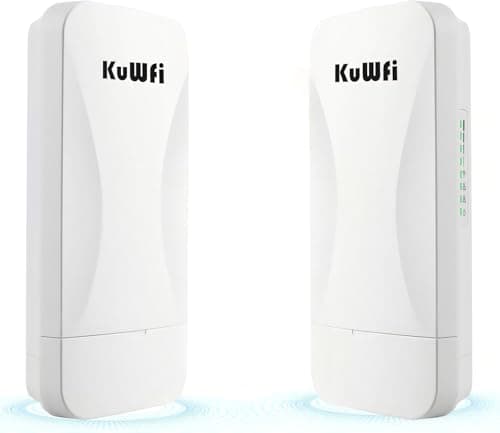
The KuWFi Gigabit Wireless Bridge delivers 900 Mbps speed, gigabit Ethernet, and beamforming for reliable 2 km outdoor links. Its reliance on PoE and the need for unobstructed line-of-sight limit flexibility in dense or power-constrained sites. Best suited for farms or small businesses extending a gigabit network over short distances.
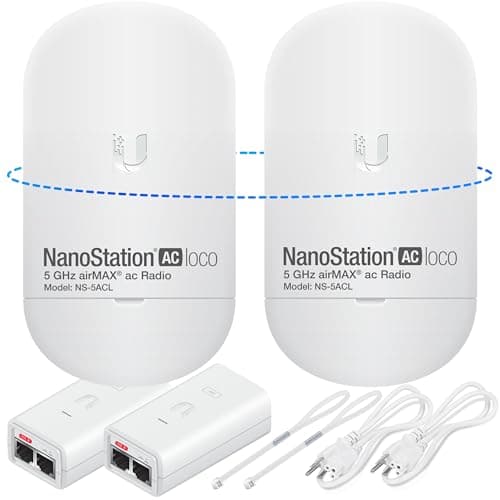
The Good Story bundle of Ubiquiti NanoStation LOCO5AC devices provides a compact 5 GHz bridge with a 13 dBi dual-polarized antenna, delivering 450+ Mbps over distances beyond 10 km using passive PoE. With only a single gigabit Ethernet port and varying power supply options, installation can be less straightforward. Best for installers needing a small-footprint, long-range PtP link.
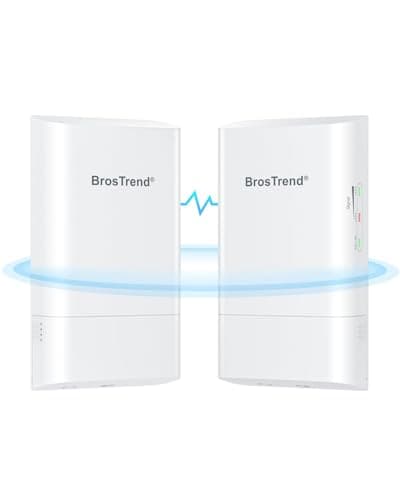
The BrosTrend 5 GHz 867 Mbps WiFi Bridge offers high-speed point-to-point connectivity with a rugged IP65 enclosure and dual Gigabit ports. Its single-band operation and need for precise line-of-sight limit flexibility. Ideal for homeowners or small property owners needing a simple, budget-friendly link up to about 1 km.
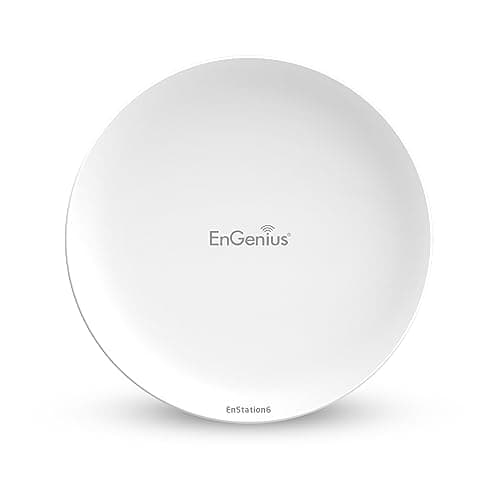
The EnGenius EnStation6 is a rugged outdoor Wi-Fi 6 bridge delivering up to 1200 Mbps and 8 km point-to-point range with a 19 dBi antenna. Its reliance on a proprietary 54 V PoE injector and single-band operation limit flexibility and standard PoE integration. Best suited for campus-wide or rural point-to-point links where high throughput and weather resistance are paramount.
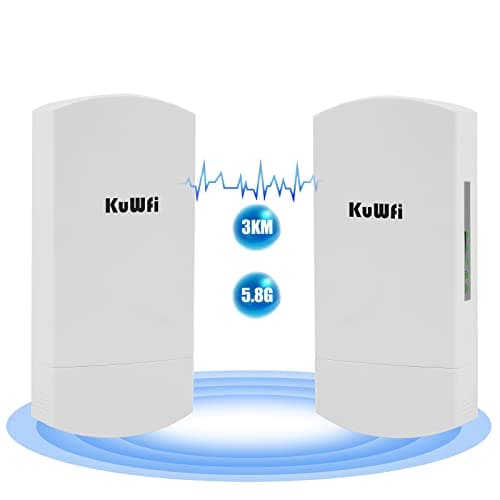
The KuWFi Outdoor Wireless Bridge provides easy LED-based setup and a high-gain 12 dBi antenna for reliable 3 km point-to-point links. Its 300 Mbps ceiling and single-band design limit bandwidth-intensive uses. Ideal for rural CCTV or simple Wi-Fi extensions where cost and quick deployment matter.
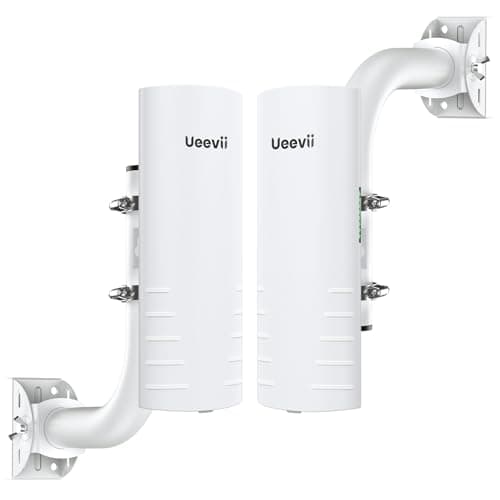
The UeeVii CPE452 is an outdoor 5.8 GHz bridge with a 14 dBi high-gain antenna and IP65 weatherproof housing. Its main trade-offs are a 100 Mbps wired limit and the need for clear line-of-sight. Best suited for farms, barns or garages where long-range point-to-point links are required.
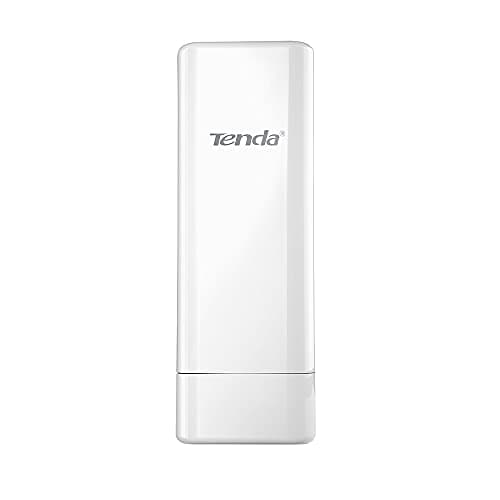
The Tenda O3 is a budget outdoor CPE that provides 12 dBi gain and up to 5 km+ range on the 2.4 GHz band, protected by an IP64 case and lightning suppression. Its drawbacks are the single-band operation and modest 150 Mbps throughput. It fits well for low-cost, long-range point-to-point links in rural or off-grid settings.
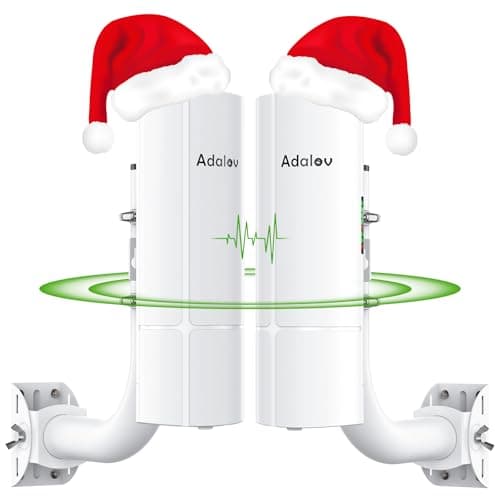
AdaLov's Gigabit Wireless Bridge provides a 16 dBi directional antenna with one-key pairing, delivering up to 900 Mbps over distances up to 3 km and includes PoE and weatherproofing. Real-world throughput often falls short of the headline speed and initial setup can encounter glitches. It fits well for farms, warehouses, and remote outbuildings requiring cable-free Ethernet.
| Attribute | | | | | | | | |
|---|---|---|---|---|---|---|---|---|
900 Mbps | 150 Mbps | 300 Mbps | 450 Mbps | 900 Mbps | 867 Mbps | 300 Mbps | 1,200 Mbpsbest | |
2 | — | 2 | 1 | 2 | 2 | 3best | 2 | |
| ↓ lower better | 1,700 g | 403 g | 5.8 gbest | 907 g | 929.86 g | 99.2 g | — | 503.5 g |
3,000 m | 5,000 m | 3,000 m | 10,000 mbest | 2,000 m | 1,000 m | 3,000 m | 8,000 m | |
| ↓ lower better | — | 12 W | — | 8.5 W | — | 4.7 Wbest | — | 12 W |
16 dBi | 12 dBi | 14 dBi | 13 dBi | 12 dBi | — | 12 dBi | 19 dBibest | |
— | 12 V | — | 24 V | 48 V | — | 24 V | 54 Vbest | |
— | — | — | — | — | — | — | 90 %best |
Click an attribute name to sort · Green = best, red = worst (relative to this comparison)
| Attribute | | | | | | | | |
|---|---|---|---|---|---|---|---|---|
Connectivity(2) | ||||||||
Supported Wi‑Fi Standards | — | 802.11n | 802.11a/n | 802.11ac | 802.11a/n/ac | 802.11ac | 802.11a/n | 802.11ax |
Frequency Bands (GHz) | 5.8 | 2.4 | 5.8 | 5 | 5.8 | 5 | 5.8 | 5 |
Ports(2) | ||||||||
Number of Ethernet Ports | 2 | — | 2 | 1 | 2 | 2 | 3 | 2 |
Ethernet Port Speed | 1000/100 | — | 10/100Mbps | 10/100/1000 | Gigabit | 1000 Mbps | 10/100Mbps | Gigabit |
Performance(3) | ||||||||
Maximum Data Rate (Mbps) | 900 Mbps | 150 Mbps | 300 Mbps | 450 Mbps | 900 Mbps | 867 Mbps | 300 Mbps | 1200 Mbps |
Effective Range (m) | 3000 m | 5000 m | 3000 m | 10000 m | 2000 m | 1000 m | 3000 m | 8000 m |
Antenna Gain (dBi) | 16 dBi | 12 dBi | 14 dBi | 13 dBi | 12 dBi | — | 12 dBi | 19 dBi |
Battery & Power(2) | ||||||||
Power Consumption (W) | — | 12 W | — | 8.5 W | <10 W | 4.7 W | — | 12 W |
Input Voltage (V) | 24/48 V | 12 V | — | 24 V | 48 V | — | 24 V | 54 V |
Build & Design(4) | ||||||||
Weight (g) | 1700 g | 403 g | 5.8 g | 907 g | 929.86 g | 99.2 g | — | 503.5 g |
Dimensions (L×W×H) (mm) | 250x55x90 mm | 298x213x75 mm | 250x95x60 mm | 179x77.5x59.1 mm | 88.9 x 254 x 203.2 mm mm | 132.08 x 43.18 x 71.12 mm | — | 190x190x38 mm |
Ingress Protection (IP) Rating | — | IP64 | IP65 | — | IP65 | IP65 | IP65 | IP55 |
Mounting Options | Adjustable | — | Bracket | Pole mount | — | Wall, Pole | — | Pole/wall |
General(3) | ||||||||
Certifications | — | — | FCC | CE, FCC, IC, RoHS | — | — | — | FCC, CE, IC |
Operating Temperature (°C) | — | — | — | -40 to 70 °C | — | — | — | -20 to 60 °C |
Operating Humidity (%) | — | — | — | 5-95 % | — | — | — | 90 % |
Products in the top-left offer the best value (high score, low price).
Professional reviewers commend the AdaLov bridge for its ultra-simple one-key pairing, robust long-range performance and ability to deliver ISP-grade speeds beyond a mile, effectively replacing trench-cable solutions. However, they caution that channel interference can reduce throughput and that the 900 Mbps headline speed is rarely reached in real-world conditions.
Everyday users love how quickly the bridge works out of the box and value its stable 3 km link for cameras and other devices, especially in outdoor or industrial settings. Recurring frustrations center on initial connection glitches and the need to fine-tune Wi-Fi channels to unlock higher speeds.
“internet connection well... cameras not getting problem”
“really really well”
“crazy awesome”
Professional sources are limited, but manufacturer and retailer specifications emphasize the O3's suitability for budget‑friendly, long‑range outdoor links, highlighting its auto‑bridge capability, robust IP64 enclosure, and 6000 V lightning protection as key strengths for WISP and surveillance use cases.
Professional reviewers, exemplified by Thomas Simonin's YouTube demonstration, praise the CPE452 for its plug-and-play operation, straightforward pairing process, clear status LEDs, and ability to maintain throughput despite moderate vegetation.
No everyday user reviews or consumer feedback were included in the provided sources, so broader consumer sentiment cannot be assessed.
Professional sources praise the LOCO5AC as an excellent, ultra-compact solution for point-to-point and point-to-multipoint deployments, noting its high gain, updated airMAX AC chipset, dedicated management radio, and cost-effective PoE power delivery, making it a versatile choice for installers seeking performance in a small footprint.
No specific consumer reviews were found; product descriptions imply reliability and ease of deployment, but real‑world user testimonials are absent from the available sources.
Professional commentary notes that while KuWFi lacks independent benchmark reviews, its own documentation stresses enterprise-level stability, affordable pricing, and ease of deployment, making it attractive for cost-sensitive rural or industrial scenarios despite limited third-party validation.
User-focused commentary, though not directly quoted, suggests appreciation for the simple one-click pairing and solid weatherproofing, while recurring concerns revolve around the need for clear line-of-sight and the requirement for PoE infrastructure.
Professional reviewers and editors have not published detailed analyses of the BrosTrend EAP2; product pages and YouTube overviews emphasize its plug-and-play simplicity, 1 km stable transmission, and positioning as a budget-friendly outdoor PtP solution.
Everyday users consistently praise the bridge for its effortless setup, reliable high-speed performance over several hundred feet, and robust weather-proof design, while recurring complaints focus on the single-band limitation, the need for precise line-of-sight alignment, and the lack of outdoor-rated PoE injectors.
