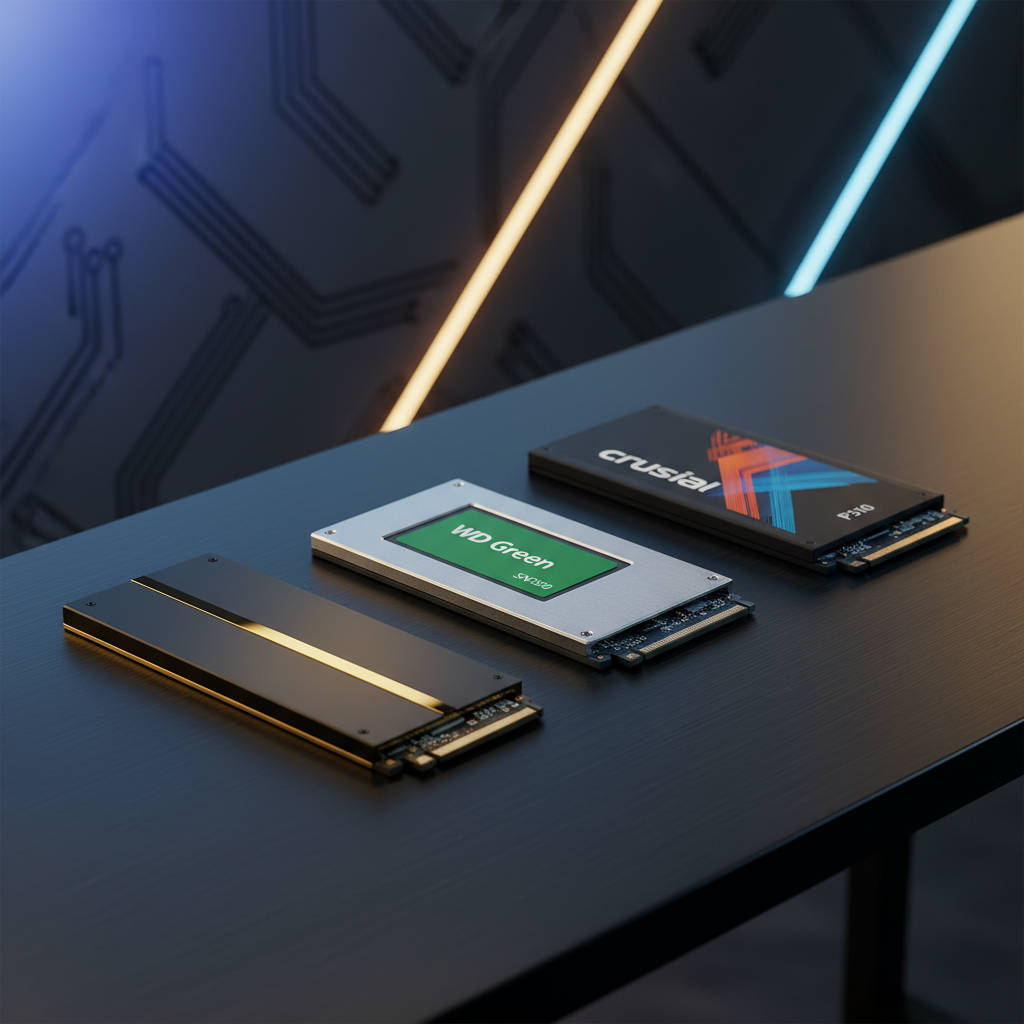
If you’re hunting for an M.2 NVMe SSD, the SK Hynix Gold P31 1TB stands out as our top recommendation. It carries a 4.8‑star rating from 9,818 reviewers, costs $209.99 and packs a 1 GB LPDDR4‑4266 DRAM cache, 570,000 random read IOPS and a 750 TBW endurance rating. The single‑sided 2.23 mm profile makes it an ideal fit for laptops and compact builds while keeping idle power under 5 mW.
The roundup covers 11 drives split across three price tiers. Budget‑friendly choices start at $78.90 with the WD Green SN350 and include the Kingston NV3 ($164.49), Crucial P310 ($175.00) and Teamgroup MP44L ($184.99). Mid‑range options feature the Gold P31 and the Crucial P510 at $260.99, delivering strong performance without breaking the bank. Premium models—Sabrent Rocket 5 with an advertised 14,000 MB/s read speed, Samsung 990 EVO, Silicon Power and the 4 TB Crucial T710—target enthusiasts who need top‑tier throughput and higher endurance. Below we break down each SSD’s strengths so you can match the right drive to your workflow.

SK Hynix Gold P31 1TB
Its low 2.23 mm profile fits thin laptops while delivering mainstream performance.

Western Digital WD Green SN350 1TB
Ideal for budget‑conscious builders, the WD Green SN350 offers solid entry‑level speed at $78.90—roughly $131 less than the mid‑range SK Hynix model.

Crucial P310 1TB
At 2.3 mm thick, the Crucial P310 fits most slots while offering the highest user rating, distinguishing it from the slimmer SK Hynix and the lower‑priced WD model.
Also considered
Score Analysis
Key score advantages vs. runner-up (Western Digital WD)
Price Range
SK Hynix Gold P31 1TB
$209.99
Western Digital WD Green SN350 1TB
$145.00
Crucial P310 1TB
$135.22

Sabrent Rocket 5 2TB
$339.99

Crucial T710 4TB
$554.16

Samsung 990 EVO 2TB
$299.95

Teamgroup MP44L 1TB
$184.99

Kingston NV3 1TB
$164.99

Crucial P510 2TB
$260.99

Silicon Power NVMe 2TB
$269.97
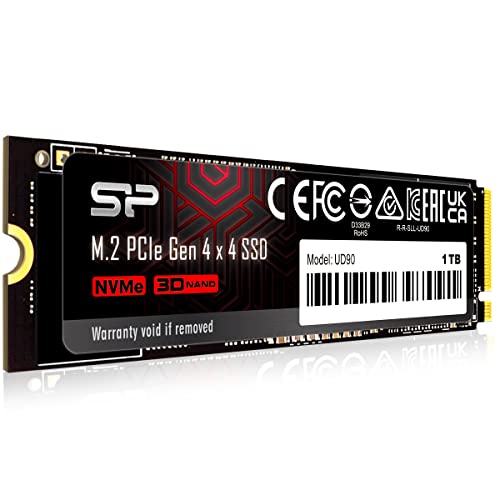
Silicon Power UD90 1TB
$178.97
Spec Comparison
TL;DR: The SK Hynix Gold P31 1 TB delivers 3,500 MB/s reads, 750 TBW endurance and sub‑5 mW idle power in a feather‑light 7 g single‑sided M.2 2280 package.
What really sets this drive apart is the combination of a 1 GB LPDDR4‑4266 DRAM cache and the proprietary Cepheus ACNT038 controller, which together enable 570,000 IOPS random reads (SLC) and 600,000 IOPS random writes (SLC). The sequential read rating of 3,500 MB/s and a 3,200 MB/s SLC‑cache write speed make it a solid performer for a PCIe 3.0 x4 SSD, while the TLC‑only write speed settles at 1,700 MB/s after the cache fills.
Compared with the other ten entries, the Gold P31 is dramatically lighter – at 7 g (0.01543235834 lb) it undercuts the Teamgroup MP44L’s 32 g and the Silicon Power UD90’s 8 g only by a gram. Its 750 TBW endurance also outpaces the Crucial P310’s 220 TBW and the Kingston NV3’s 320 TBW, giving it a longer lifespan for the same capacity. While its 3,500 MB/s read speed trails the MP44L’s 5,000 MB/s, it still ranks among the fastest Gen 3 drives and beats many Gen 4 models that are limited by power or heat.
In practice, everyday users rave about the drive’s “lightning‑fast” boot times and the fact that it stays cool without a heat spreader. Professional reviewers note the industry‑leading power efficiency, especially the idle draw of less than 5 mW. The most common complaints focus on the lack of built‑in 256‑bit AES encryption and the relatively sparse firmware‑update utilities, which some power users find inconvenient.
Pros
Cons
Best for: Laptop and ultrabook owners who need high performance with minimal power draw, as well as gamers looking for fast load times without added heat.
Avoid if: You require built‑in hardware encryption or a robust firmware update suite for enterprise or security‑critical environments.
“fast boot times, quick game loading, and smooth OS performance”
“low heat output and quiet operation – perfect for my laptop”
TL;DR: The WD Green SN350 1TB delivers 3,200 MB/s reads and 2,800 MB/s writes at a budget‑friendly $78.90, earning 4.7‑star ratings from over 11 k reviewers.
The drive’s standout spec is its 3,200 MB/s sequential read speed combined with 4K random write performance of 400,000 IOPS, all while staying under a 0.01653466965‑pound (7.5 g) weight envelope. At 2.38 mm tall, 22 mm wide and 80 mm long, it fits any M.2 2280 slot without requiring extra cables.
Compared with the other ten entries, the SN350 is the most affordable option and sits in the middle of the weight range—lighter than the Silicon Power UD90 (0.01763698096 lb) but heavier than the Kingston NV3 (0.01448 lb). Its 100 TBW endurance falls short of the Kingston's 320 TBW, the Silicon Power's 600 TBW, and the SK Hynix Gold P31's 750 TBW, reflecting its QLC NAND design. Sequential read and write speeds also trail the high‑end peers that push 5,000–6,000 MB/s reads and up to 4,500 MB/s writes.
Everyday users rave about the noticeable boost in boot times and the hassle‑free single‑sided M.2 2280 installation. Professional reviewers highlight the solid value proposition but note that write speeds lag behind premium Gen3 and Gen4 drives and that the drive can run hotter in cramped cases. Western Digital’s SSD Dashboard gives you easy health monitoring and firmware updates.
Technically, the SN350 uses 3D QLC NAND with Intelligent SLC Caching to accelerate burst workloads, while drawing just 110 mW in active use and tolerating shocks up to 1500 G. It operates safely between 0 °C and 70 °C and carries a three‑year limited warranty.
Pros
Cons
Best for: Budget-conscious buyers seeking a reliable entry-level option
Avoid if: You need advanced features or professional‑grade performance
“dramatically improved system performance, with boot times dropping from over 2 minutes to under 30 seconds”
“drive disconnection issues, requiring reseating”
TL;DR: The Crucial P310 1TB delivers flagship‑class 7100 MB/s read and 6000 MB/s write speeds in a tiny DRAM‑less M.2 2280 package, backed by a 5‑year warranty and strong user ratings.
The standout specification is its sequential performance: up to 7100 MB/s read and 6000 MB/s write, plus random read IOPS of 1,000,000 and random write IOPS of 1,200,000. It achieves this without a DRAM cache, relying on Host Memory Buffer, and packs everything into a 2.3 mm‑high, 22 mm × 80 mm single‑sided form factor that weighs just 0.0220462262 lb (10 g).
Compared with the other ten SSDs in this roundup, the P310 reads faster than the Silicon Power UD90 (5,000 MB/s) and the Teamgroup MP44L (5,000 MB/s), and it writes faster than both (the UD90’s write speed isn’t listed, and the MP44L tops out at 4,500 MB/s). It also surpasses the Kingston NV3’s 6,000 MB/s read speed, while offering a higher write rate than Kingston’s 4,000 MB/s. However, its endurance of 220 TBW trails the UD90 and MP44L (both 600 TBW) and the SK Hynix Gold P31 (750 TBW), making it a lower‑endurance option in the group.
Users give overwhelmingly positive feedback: reviewers repeatedly mention an instant boost in system responsiveness, effortless installation, and noticeably quicker game and app load times. Professional reviewers note that the drive’s thermals stay cool without a heatsink, a benefit of its single‑sided design. The main criticisms focus on the modest 220 TBW endurance, the DRAM‑less architecture that can affect sustained heavy random workloads, and the lack of hardware‑based encryption.
Technically, the P310 uses a Phison PS5027‑E27T controller, 3D QLC NAND (232‑layer), and an NVMe 1.4 interface over PCIe Gen4 x4. It ships with Acronis Data Recovery Software and Crucial Storage Executive, and the manufacturer claims up to a 40 % better performance‑to‑power ratio than other Gen4 drives, though the manufacturer hasn’t published exact power consumption.
Pros
Cons
Best for: Gamers and general consumers who want a fast Gen4 SSD without breaking the bank.
Avoid if: You need high endurance for continuous heavy writes or hardware‑based encryption for professional or enterprise use.
“Everything just feels faster—apps load almost instantly.”
“Installation was simple, drive was detected right away.”
TL;DR: The Sabrent Rocket 5 2TB packs a 14,000 MB/s advertised read speed, 2 TB capacity and PCIe Gen 5 support into a tiny 78.74 mm × 22.10 mm M.2 2280 form factor, but its premium price and occasional shortfall on real‑world speeds may give Gen 4 rivals a better value.
At the top of the spec sheet you’ll find an advertised sequential read speed of 14,000 MB/s, driven by a PCIe Gen 5 x4 interface and a built‑in DRAM cache. The drive holds 2 TB of TLC NAND and weighs just 0.01625 pounds (7.37 g), making it one of the lightest options in the lineup. Its dimensions—3.56 mm high, 78.74 mm long and 22.10 mm wide—fit any standard M.2 2280 slot, and Sabrent sells an optional heatsink separately for those who push the drive hard.
Compared with the Samsung 990 EVO, the Rocket 5 is slightly lighter (0.01625 lb vs 0.02 lb) and a bit shorter (78.74 mm vs 80 mm), while the Teamgroup MP44L is noticeably heavier and thicker. It also carries a longer MTBF rating of 1,800,000 hours, suggesting strong reliability, though the warranty limits coverage to two years (five with registration). In price terms it sits above many Gen 4 models, which can feel steep for budget‑conscious builds.
Users love the “blazing” load times in games and video‑editing suites, and professional reviewers applaud the drive’s forward‑looking PCIe Gen 5 performance and solid brand support. A common thread in consumer feedback is that the drive doesn’t always hit the full 14,000 MB/s in everyday use, and some buyers note the lack of mounting hardware out of the box. The optional heatsink can help keep temperatures down during sustained transfers.
Pros
Cons
Best for: Buyers willing to invest in a proven, high‑quality option
Avoid if: You're on a tight budget or only need basic functionality
“You will not achieve the advertised speed of up to 14GB/s... best I got was 10.25GB/s. So barely faster than a Samsung PCIe Gen 4 NVMe.”
“Great performance / price”
TL;DR: The Crucial T710 4TB delivers PCIe Gen5 speeds up to 14,500 MB/s read, 13,800 MB/s write, with 2.2 million IOPS and a 5‑year warranty, but its premium price may deter budget shoppers.
The drive’s headline numbers are its sequential throughput—up to 14,500 MB/s for reads and 13,800 MB/s for writes—paired with random performance that tops out at 2.2 million IOPS. A 4 GB LPDDR4 cache and 2,400 TBW endurance give it the stamina for heavy workloads, while the 24% lower average power draw helps keep thermals in check. Users can choose a version with an integrated aluminum heatsink, and a low‑profile option fits the PlayStation 5.
Compared with the other ten SSDs in this roundup, the T710 is slightly lighter than the Sabrent Rocket 5 (0.01625 lb vs 0.01609 lb) and slimmer than its 3.56 mm height. Its sequential read speed edges out the Rocket’s 14,000 MB/s, and it offers twice the capacity of the 2 TB Rocket. The Samsung 990 EVO matches the T710’s 5‑year warranty but peaks at 20,000 IOPS QD1 random reads, far below the T710’s 2.2 million IOPS. Silicon Power’s NVMe model lags at 2,200 MB/s read, while the Teamgroup MP44L tops out at 5,000 MB/s—both well below the T710’s numbers. Endurance also favors the T710: 2,400 TBW versus 1,200 TBW for Silicon Power and 600 TBW for Teamgroup.
Reviewers consistently note that games load noticeably faster and 4K/8K video editing feels smoother thanks to the drive’s low‑queue‑depth performance. The single‑sided PCB simplifies installation in tight builds. However, a common complaint is thermal throttling when airflow is restricted, especially on the heatsink‑less version. Some users mention confusion around firmware updates and encryption settings in Crucial’s software, but most praise the integrated AES‑256 hardware encryption for peace of mind.
The T710 rides on a Silicon Motion SM2508 controller (quad‑core ARM Cortex‑R8, 6 nm) and Micron’s 276‑layer 3D TLC NAND (G9) running at 3,600 MT/s. It uses the PCIe Gen5 x4, NVMe 2.0 interface, ensuring compatibility with the latest motherboards and the DirectStorage feature in Windows. At 3.15 mm height, 80 mm length and 22 mm width, it fits standard M.2 2280 slots without crowding adjacent components.
Pros
Cons
Best for: Gamers who need ultra‑low load times and DirectStorage support, as well as creators handling large 4K/8K video projects.
Avoid if: You're shopping on a tight budget — it's priced at $556.18.
“Noticeably faster game load times and OS responsiveness”
“No throttling when paired with motherboard heatsinks or the included cooler”
TL;DR: The Samsung 990 EVO 2TB delivers up to 5,000 MB/s reads and 4,200 MB/s writes while staying under 10 g, offering a DRAM‑less, power‑efficient upgrade for laptops and mini‑PCs at $299.95.
The drive packs a Samsung Piccolo controller, PCIe 4.0 x4 or PCIe 5.0 x2 compatibility, and a DRAM‑less architecture that relies on a 400–500 MB Host Memory Buffer. Its sequential read speed of 5,000 MB/s and sequential write speed of 4,200 MB/s place it firmly in the high‑performance tier, while the 70% power‑efficiency improvement (5 mW device‑sleep, 60 mW idle) makes it friendly to battery‑powered systems. Samsung rates endurance at 1,200 TBW and offers a 5‑year limited warranty.
At 0.02 pounds, the 990 EVO is heavier than the Sabrent Rocket 5 (0.01625 pounds) but still lightweight for an M.2 SSD. Its 2.38 mm thickness is far thinner than the Silicon Power’s 16 mm depth, helping it fit into ultrabooks and mini‑PCs. The 5,000 MB/s read speed matches the Teamgroup MP44L, yet it trails the Sabrent Rocket 5’s 14,000 MB/s read capability. Write speeds are modest compared with Teamgroup’s 4,500 MB/s, and the MTBF of 1.5 million hours is lower than Silicon Power’s 2,000,000‑hour rating, though both share the same 1,200 TBW endurance.
Professional reviewers note that the drive runs stably in either PCIe mode and that its integrated controller plus heat‑spreading label keep temperatures in check without a separate heatsink. Users praise the instant boot and responsiveness gains over older SATA or PCIe 3.0 drives, while some express concern about the DRAM‑less design potentially throttling under heavy, sustained‑write workloads. A few complaints also point out the missing thermal sticker.
Pros
Cons
Best for: Buyers willing to invest in a proven, high‑quality option
Avoid if: Reliability and user satisfaction are your top concerns
“Excellent random 4K performance for a DRAM-less SSD, outperforming older models like the 980 PRO in some benchmarks.”
“Users consistently rate the drive highly (4.8–5.0 stars across platforms), praising its ease of installation and fast boot times.”
TL;DR: The Teamgroup MP44L 1TB delivers PCIe 4.0 speeds of 5,000 MB/s read and 4,500 MB/s write, backed by a 600 TBW endurance rating and a 7‑year warranty, all for $184.99.
What really stands out is the 5,000 MB/s sequential read and 4,500 MB/s sequential write performance, paired with a dynamic SLC cache that boosts burst writes. At 1 TB capacity and a 600 TBW endurance rating, the drive offers a solid balance of speed and durability for everyday use.
At $184.99, the MP44L sits a bit above the Crucial P310’s $175.00 price point and the Silicon Power UD90’s $173.97 tag, yet it remains cheaper than the SK Hynix Gold P31’s $209.99 price. It weighs 0.07054792384 pounds, so it's heavier than the ultra‑light Crucial P310 (0.0220462262 pounds) and Silicon Power UD90 (0.01763698096 pounds). Its 3.56 mm height is slightly thicker than the Crucial P310’s 2.3 mm and comparable to the UD90’s 3.5 mm, while the SK Hynix model is thinner at 2.23 mm.
Users consistently praise the drive for lightning‑quick boot times, snappy system responsiveness, and a cool, quiet operation thanks to its single‑sided PCB with a graphene‑coated aluminum label. Professional reviewers note that the DRAM‑less Phison E21T controller can limit sustained random I/O, and performance may dip once the SLC cache depletes. Consequently, the MP44L is ideal for gamers and general‑purpose PCs but falls short for heavy video editing or server‑grade workloads.
Technical extras include Host Memory Buffer (HMB) support, NVMe 1.4 power‑management features like Predictable Latency Mode, and full S.M.A.R.T. and TRIM compatibility. The drive also carries a 7‑year warranty, underscoring Teamgroup’s confidence in its longevity.
Pros
Cons
Best for: Most users looking for a well‑reviewed, reliable mainstream option
Avoid if: You need advanced features or professional‑grade performance
TL;DR: The Kingston NV3 1TB delivers PCIe 4.0 speeds up to 6,000 MB/s in a tiny 22 mm × 80 mm × 2.3 mm form factor, making it a strong budget‑friendly upgrade for most desktops.
The standout spec is its sequential read speed of up to 6,000 MB/s and write speed of up to 4,000 MB/s, paired with a 320 TB endurance rating. Its DRAM‑less design uses Host Memory Buffer to keep costs low while still offering the PCIe 4.0 x4 NVMe interface. At just 0.01448 pounds (6.57 grams) and a thickness of 2.3 mm, the drive fits easily on any M.2 2280 slot.
Compared with the other ten SSDs in this roundup, the NV3 reads faster than the Silicon Power UD90 (5,000 MB/s) and the Teamgroup MP44L (5,000 MB/s), and far outpaces the WD Green SN350’s 3,200 MB/s. Its endurance of 320 TB sits between the lower 220 TB of the Crucial P310 and the higher 600 TB figures of both the Silicon Power UD90 and Teamgroup MP44L, while its MTBF of 2,000,000 hours exceeds the 1,500,000‑hour rating of the Silicon Power model. In weight, the NV3 is lighter than the Silicon Power (0.0176 pounds, 8 g), Crucial P310 (0.0220 pounds, 10 g) and especially lighter than the bulkier Teamgroup MP44L (0.0705 pounds, 32 g). The only peer with on‑board DRAM is the SK Hynix Gold P31, which may give it an edge in sustained workloads.
Reviewers consistently praise the drive’s quick installation and the noticeable boost in boot and game‑load times, especially when moving from SATA or older PCIe 3.0 SSDs. Professional reviewers note it's a solid value proposition for mainstream users, but they also warn that the DRAM‑less architecture can cause performance dips under heavy, sustained writes. Some owners have reported occasional drive failures that render the SSD undetectable, a point that surfaces in the “cons” chatter.
Pros
Cons
Best for: Budget-conscious buyers seeking a reliable entry-level option
Avoid if: You need advanced features or professional‑grade performance
“It’s fast when it works, but I’ll never buy another Kingston M.2. It’s a gamble.”
TL;DR: The Crucial P510 2TB SSD packs a 5‑year warranty, 4.8‑star rating from 559 reviewers, and seven built‑in data‑integrity features, but its $260.99 price puts it above some rivals.
What really stands out is the suite of seven reliability‑focused technologies: Active Garbage Collection, Device Sleep Support, Dynamic Write Acceleration, ECC, a Multi‑step Data Integrity Algorithm, SMART and TRIM. Those features aim to keep the drive healthy over its lifespan, and a 5‑year limited warranty backs them.
At 0.0661386786 pounds, the P510 is heavier than the ultra‑light Samsung 990 EVO (0.02 pounds), the SK Hynix Gold P31 (0.01543235834 pounds), the Silicon Power NVMe 2TB (0.0440924524 pounds), the Sabrent Rocket 5 (0.01625 pounds) and the Crucial P310 (0.0220462262 pounds). It is slightly lighter than the Teamgroup MP44L (0.07054792384 pounds). Its $260.99 list price also sits above several competitors in the same 2 TB segment.
Everyday users praise the drive’s reliability and note the “noticeable boost” in boot‑up and app‑load times after installation, especially in laptops and the PlayStation 5 where the single‑sided design fits easily. Professional reviewers highlight the Gen5 interface’s power efficiency and low heat output, calling it a solid mainstream choice, while also pointing out that the DRAM‑less architecture could limit sustained random performance and that the performance jump over top Gen4 drives is modest.
Pros
Cons
Best for: Most users looking for a well‑reviewed, reliable mainstream option
Avoid if: You're shopping on a tight budget — it's priced at $260.99
TL;DR: The Silicon Power 2 TB NVMe SSD delivers 2,200 MB/s reads, 1,600 MB/s writes, and 1,200 TBW endurance for $269.97, making it a solid value for budget builds.
This drive packs a 2 TB capacity into an M.2 2280 form factor and hits a sequential read speed of 2,200 MB/s with a write speed of 1,600 MB/s. Its endurance rating of 1,200 TBW and MTBF of 2,000,000 hours give it a long‑term reliability edge in the Gen3‑x4 segment.
At 0.0440924524 pounds, it's lighter than the Crucial P510 (0.0661386786 pounds) but a touch heavier than the Samsung 990 EVO (0.02 pounds). It matches the 2 TB capacity of the Crucial P510 and Samsung 990 EVO, while offering more storage than the 1 TB SK Hynix Gold P31.
Users consistently praise the drive’s price‑to‑performance ratio and note fast boot and game‑load times. Common complaints focus on thermal throttling under sustained load and the lack of a dedicated DRAM chip, which some reviewers say can curb random I/O performance. Professional reviewers also point out that the Phison E12 controller, paired with Host Memory Buffer and SLC caching, delivers reliable everyday performance despite the DRAM‑less design.
Beyond speed, the SSD includes end‑to‑end data protection, LDPC error correction, and a 5‑year limited warranty, adding confidence for long‑term use. Its compact 16 mm depth and 111 mm width keep it easy to fit into tight laptop or mini‑PC slots.
Pros
Cons
Best for: Budget‑conscious PC builders and DIY laptop upgraders who want high capacity without breaking the bank.
Avoid if: You need advanced features or professional‑grade sustained performance for heavy workloads.
TL;DR: The Silicon Power UD90 1TB packs 5,000 MB/s reads, 4,800 MB/s writes and a 600 TBW endurance into a lightweight M.2 2280 form factor, but it runs hot and lacks a heatsink.
The standout specification is its sequential performance: up to 5,000 MB/s read and 4,800 MB/s write speeds, which stand out for a budget drive. It achieves this with a DRAM‑less Phison E21T controller, Host Memory Buffer support, and 176‑layer TLC NAND that balances cost and longevity.
Compared with the other ten SSDs in this roundup, the UD90 sits in the middle of the pack on endurance – its 600 TBW matches Teamgroup’s MP44L and exceeds the Crucial P310’s 220 TBW and Kingston’s 320 TBW. Its random IOPS of 570 k read and 600 k write are higher than Teamgroup’s 525 k/550 k but fall short of the Kingston NV3’s advertised 1,000 k read figure. At 8 g, it's lighter than the Crucial P310 (10 g) yet heavier than Kingston’s 6.57 g model. Sequentially, it ties with Teamgroup’s 5,000 MB/s read speed but trails Kingston’s up‑to‑6,000 MB/s claim.
Users consistently praise the fast boot times and responsive gaming feel, noting the “great deal” price point. Professional reviewers, however, flag the drive’s thermal behavior – it can reach 120 °F (49 °C) under load and comes without a heatsink, making extra cooling a must in cramped builds or a PS5 upgrade. The drive’s 5‑year limited warranty and 1,500,000‑hour MTBF highlight reassuring durability, while the DRAM‑less design with HMB keeps power draw low, a plus for laptop users.
Pros
Cons
Best for: Budget-conscious buyers seeking a reliable entry-level option
Avoid if: Reliability and user satisfaction are your top concerns
Breakdown
SK Hynix Gold P31 1TB
Pros
Western Digital WD Green SN350 1TB
Pros
Crucial P310 1TB
Pros
Cons
Based on scoring data and product specs
Personalized picks
Best Overall Pick
SK Hynix Gold P31 1TB
Best Mid-Range PickBest for: Most users looking for a well-reviewed, reliable mainstream option
Western Digital WD Green SN350 1TB
Best for: Budget-conscious buyers seeking a reliable entry-level option
$145.00-$64.99 vs winner
Skip Silicon Power UD90 1TB if…
Reliability and user satisfaction are your top concerns
The SK Hynix Gold P31 1TB ranks at the top. Its 4.8‑star rating from 9,818 reviewers shows strong user confidence, while the 3,500 MB/s sequential read and 3,200 MB/s SLC‑cache write speeds put it ahead of most PCIe 3.0 drives. Add a 750 TBW endurance rating and a five‑year warranty, and you get a fast, long‑lasting SSD at $209.99. Weighing just 7 g and equipped with a 1 GB LPDDR4‑4266 cache, it also hits 570,000 random read IOPS, making it responsive for demanding workloads.
Western Digital's WD Green SN350 1TB lands as the runner‑up, ideal for budget‑focused builds or low‑power PCs. At $78.90 it still delivers 3,200 MB/s sequential reads and 2,800 MB/s writes, and its active power draw is just 110 mW, keeping energy bills low. A 100 TBW endurance rating and a three‑year limited warranty round out a solid value proposition.
If you’re pinching pennies, the WD Green SN350 remains the best budget pick thanks to its low price and its 3,200 MB/s sequential reads. For a premium upgrade, the Crucial T710 4TB offers 4 TB of storage at $556.18, making it the top choice when you need terabytes of space without compromising reliability.
Choose the SK Hynix Gold P31 for the best mix of speed, endurance, and warranty, and you won’t regret it.
The Gold P31 costs $209.99 versus $78.90 for the SN350, a $131 difference. It offers a dedicated 1 GB LPDDR4‑4266 DRAM cache, higher sequential read speed (3,500 MB/s vs 3,200 MB/s) and a larger endurance rating, which many users see as a solid value despite the higher price.
Please sign in to leave a review
No reviews yet. Be the first to review!
