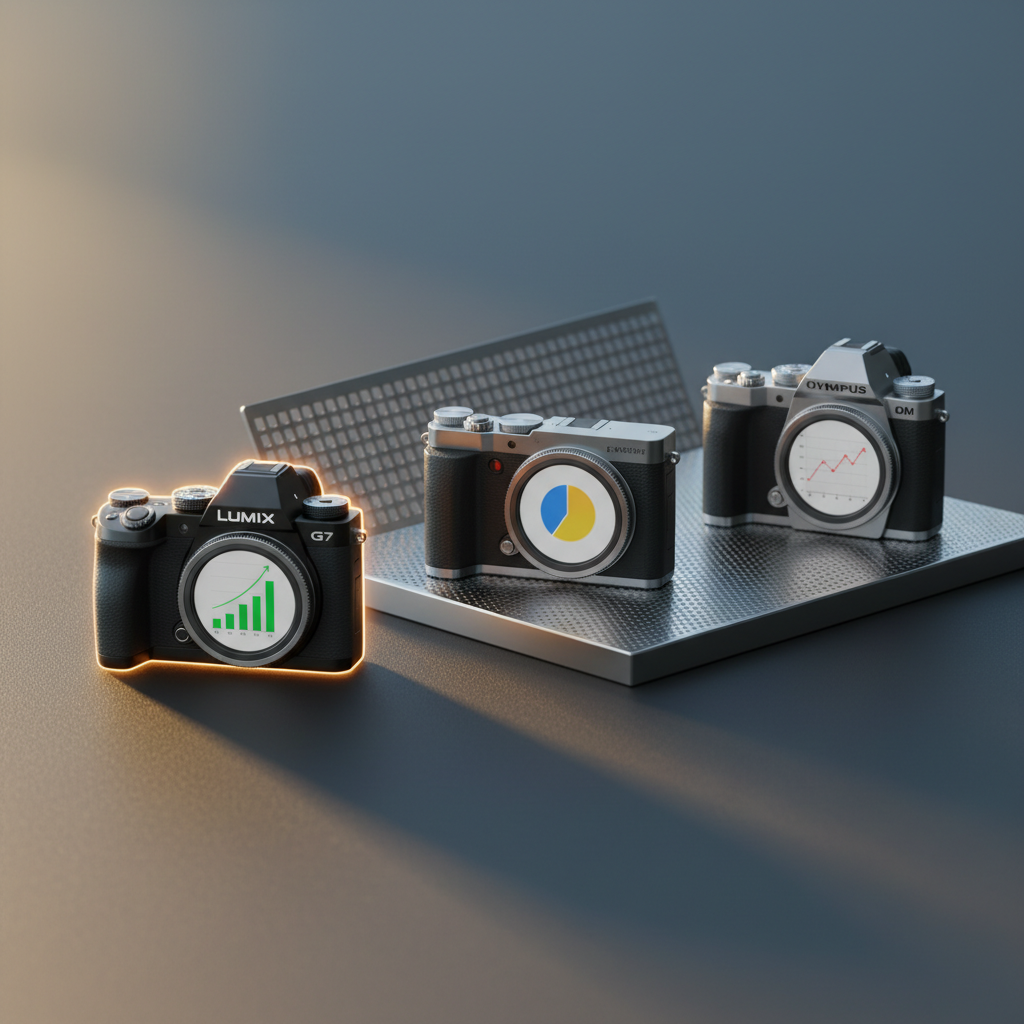
If you’re hunting for the most well‑rounded Micro Four Thirds mirrorless camera, the Panasonic LUMIX G7 lands at the top of our list. Priced at $547.99, it carries a 4.5‑star rating from 1,997 reviewers and packs 49‑point contrast‑detection AF, 4.6 fps continuous shooting and a 1200 mAh battery that delivers solid endurance. Its 4K video up to 30p, 3‑inch fully articulating touchscreen and high‑resolution OLED EVF give you the flexibility to shoot both stills and video without breaking the bank. For creators who need a compact system that won’t compromise on image quality or usability, the G7 is an all‑around pick.
Seven models span three price tiers. The budget tier houses the Panasonic LUMIX G7, the OM System E‑M10 Mark IV and the Panasonic LUMIX G100, all under $800 and geared toward beginners or vloggers. The mid‑range slot features the Panasonic LUMIX G97, which adds weather‑sealing and unlimited 4K recording. At the premium end, the OM System OM‑5 Mark II, OM SYSTEM Olympus OM and OM System OM‑3 deliver flagship autofocus, up to 120 fps bursts and robust in‑body stabilization for demanding sports or wildlife work. Read on to see how each camera performs in its sweet spot.

Panasonic LUMIX G7
Its 49‑point contrast‑detection autofocus gives reliable focus coverage at entry‑level pricing.

OM System E-M10 Mark IV
Great for photography enthusiasts who want in‑body stabilization and are okay paying roughly $152 more than the G7.

OM SYSTEM Olympus OM
Stands out with 1,053‑point Cross Quad Pixel AF, delivering premium focus precision at a $1,999.99 price tag.
Score Analysis
Key score advantages vs. runner-up (OM System E-M10)
Price Range
Panasonic LUMIX G7
$713.71
OM System E-M10 Mark IV
$699.99
OM SYSTEM Olympus OM
$1,999.99

OM System OM-5 Mark II
$1,099.99

Panasonic LUMIX G97
$847.99

OM System OM-3
$1,999.99

Panasonic LUMIX G100
$747.99
Spec Comparison
TL;DR: The Panasonic LUMIX G7 delivers 4K video, a 2.36 M‑dot OLED viewfinder, and a vari‑angle touchscreen at a budget‑friendly $547.99, making it a solid entry‑level MFT mirrorless option.
The G7’s standout feature is its 4K/UHD video capability, recording up to 30p in MP4 format, and its 2,360,000‑dot OLED electronic viewfinder paired with a 0.70× magnification. Its 49-point contrast‑detection AF system (DFD) and a fully articulating 3.0‑inch touchscreen (1,040,000‑dot resolution) give you precise framing and focus control.
At 0.9Pounds, the G7 is heavier than the OM System E‑M10 Mark IV (0.84pounds) but lighter than the Panasonic LUMIX G100 (1.3007Pounds), the Panasonic LUMIX G97 (2.54Pounds), and the OM System OM‑3 (3.34Pounds). Its depth of 125 mm and width of 77 mm make it more compact than the G97’s 276 mm depth and 147 mm width, while its height of 86 mm is comparable to the E‑M10 Mark IV’s 84.4 mm and the G100’s 82.5 mm.
Reviewers praise the camera’s excellent 4K video quality and the innovative 4K Photo and Post Focus modes that pull stills from video bursts. Users love the vari‑angle touchscreen for vlogging, but many note the plastic body feels cheap and the lack of a headphone jack limits audio monitoring. Autofocus performance can slow down in low‑light situations, and the continuous AF burst tops out at 4.6 fps (JPEG, continuous AF) or 8.6 fps (JPEG, focus locked), which may fall short for fast‑moving subjects.
The G7 houses a 16.0 MP MOS sensor (17.3 × 13.0 mm) with no low‑pass filter, delivering sharp stills and solid low‑light handling within its ISO 100–6400 standard range. The kit’s 14–42 mm (3× optical zoom) lens features a 46 mm filter thread and 7 diaphragm blades, while the built‑in pop‑up flash offers a guide number of ~5.8 at ISO 100.
Pros
Cons
Best for: Content creators, vloggers, and hybrid shooters who want affordable 4K video and flexible controls.
Avoid if: You need professional‑grade audio monitoring, high‑speed burst shooting, or robust low‑light autofocus performance.
TL;DR: The OM System E-M10 Mark IV packs a 20.3 MP Micro Four Thirds sensor, 5‑axis 4.5‑stop IBIS and a fully articulating 3‑inch touchscreen into a 0.84‑lb body for $699.99.
The camera’s most striking feature is its 5‑axis sensor‑shift in‑body stabilization, rated at up to 4.5 stops, which helps keep handheld shots sharp even in low light. Weighing just 0.84 pounds (383 g with battery and card) and measuring only 49 mm deep, it’s one of the most portable options in the lineup.
Compared with the six other cameras in this roundup, the E‑M10 Mark IV is lighter than the Panasonic LUMIX G100 (≈1.30 lb) and far lighter than the G97, OM‑5 Mark II, and OM‑3, all of which tip the scales at 2 lb or more. Its depth of 49 mm is also shallower than the G100’s 54.2 mm, the G7’s 125 mm, and the G97’s 276 mm, making it easier to slip into a small travel bag. While the E‑M10’s EVF resolution isn’t listed, the G100 advertises an EVF of roughly 3.68 million dots, indicating a higher‑resolution viewfinder on that model.
Users consistently praise the camera’s compact retro styling and the fun of its 31 art filters, while professional reviewers note the 20.3 MP Live MOS sensor delivers sharp stills and the 121‑point contrast‑detection AF provides reliable focus for everyday subjects. The camera shoots at 8.7 fps without AF and 5 fps with AF tracking, and it records 4K UHD video at 24/25/30 p, satisfying most hobbyist video needs.
Pros
Cons
Best for: Budget-conscious buyers seeking a reliable entry-level option
Avoid if: You want the best value‑per‑dollar in its price range
TL;DR: The OM‑System Olympus OM‑1 Mark II packs a 22.9 MP stacked sensor, 1,053 AF points and 8.5‑stop IBIS, delivering ultra‑fast 120 fps bursts for wildlife, sports and astrophotography, but its premium price and modest resolution may deter budget shooters.
The standout spec is the 22.9 MP stacked BSI Live MOS sensor paired with the TruePic X processor, which the manufacturer says processes images three times faster than previous generations. With 1,053 cross‑quad phase‑detection AF points and an electronic burst rate of 120 fps, the camera can track fast subjects while maintaining focus. Its 5‑axis IBIS delivers up to 8.5 stops of shake correction, and the 5.76 million‑dot EVF offers crystal‑clear framing.
At 511 g, the OM‑1 Mark II is lighter than the OM‑3 (3.34 pounds) but heavier than the OM‑5 Mark II (0.9 pounds) and the E‑M10 Mark IV (0.84 pounds). Battery life matches the OM‑5 Mark II at 520 shots per charge and exceeds the OM‑3’s roughly 420‑shot claim. The 1,053 AF points match those of the OM‑3 and OM‑5, far surpassing the 49‑point contrast system on the Panasonic LUMIX G7. Its EVF resolution of 5.76 million dots is notably higher than the G100’s approx 3.68 million, while the 1.62 million‑dot LCD sits a touch below the G97’s 1.84 million‑dot screen.
User feedback praises the lightning‑fast 120 fps burst and the 8.5‑stop stabilization, especially for handheld wildlife and astrophotography where the Starry Sky AF and Live Composite mode shine. Professional reviewers highlight the advanced AI subject detection for birds and animals. On the downside, several owners note that the 20.4 MP effective resolution can feel limiting for very large prints, and many owners describe the flush‑mounted button layout and left‑side power switch as ergonomically awkward. Low‑light performance is solid up to ISO 6400, but noise becomes noticeable beyond that point.
Pros
Cons
Best for: Those prioritizing quality and willing to pay for premium performance
Avoid if: You're on a tight budget or only need basic functionality
TL;DR: The OM System OM‑5 Mark II packs 1,053 cross‑type AF points, 120 fps burst with a 213‑frame RAW buffer, and 5‑axis IBIS into a 0.9‑lb, weather‑sealed body for serious MFT shooters.
What really sets the OM‑5 Mark II apart is its autofocus system – 1,053 cross‑type phase‑detection points paired with TTL phase‑difference and contrast detection, plus subject‑recognition for birds, vehicles, dogs and more. The camera can fire at 120 fps with continuous focus, and its buffer holds 213 RAW frames at that speed, giving you plenty of room for fast‑moving action.
At 0.9 pounds the OM‑5 is lighter than the Panasonic LUMIX G97 (2.54 pounds) and the G100 (about 1.30 pounds), while matching the Panasonic G7’s weight. Its 5‑axis IBIS delivers up to 8.0 EV steps body‑only and 8.5 EV with a lens, nearly double the 4.5‑stop stabilization listed for the OM E‑M10 Mark IV. Battery life stands at 520 CIPA shots, which is solid for its class but lower than the 360‑shot rating of the E‑M10 Mark IV, and the camera lacks the larger capacity of some larger‑sensor rivals.
Reviewers love the ultra‑fast AF and the 120 fps blackout‑free burst, calling the autofocus “excellent” for wildlife and sports. The compact size and light weight earn praise for handheld comfort, especially with telephoto lenses. On the flip side, users note a steep learning curve – the menu holds over 100 items – and the absence of a built‑in flash can be a hassle for on‑the‑go fill light. The camera’s 20.4 MP stacked BSI Live MOS sensor (17.3 × 13.0 mm) and IP53 dust‑proof, splash‑proof rating round out a well‑rounded package for demanding shooters.
Pros
Cons
Best for: Professional wildlife and sports photographers who need ultra‑fast AF, high‑speed burst and rugged portability.
Avoid if: You’re a beginner overwhelmed by extensive menus, need long battery endurance, or prioritize low‑light performance over size.
TL;DR: The Panasonic LUMIX G97 packs a 20.3 MP Micro Four Thirds sensor, unlimited 4K 30p video, and 5‑axis Dual I.S. 2 (up to 5 stops) into a weather‑sealed body that weighs 2.54 lb for $847.99.
The standout feature is its unlimited 4K 30p recording at a solid 100 Mbps bitrate, meaning you can capture long takes without hitting a time limit. Coupled with 5‑axis Dual I.S. 2 that delivers up to 5 stops of shake reduction, the G97 stays steady whether you’re filming handheld or on a gimbal.
Compared with the other six cameras in this roundup, the G97 sits at the higher end of the price band and weighs noticeably more than the Panasonic LUMIX G100 and the OM System E‑M10 Mark IV, both of which weigh under 1 lb. It also outpaces the G7’s burst capability: the G97 offers 9 fps mechanical/EFC shooting versus the G7’s 4.6–8.6 fps depending on mode. However, the G100’s EVF resolution lists at roughly 3.68 million dots, edging out the G97’s 2,360,000‑dot viewfinder.
In practice, reviewers praise the camera’s ability to run 4K video without a recording ceiling and the professional‑grade V‑Log L profile that provides 12 stops of dynamic range. The same feedback notes the 4.2/5 star average—below the 4.5 star marks of several rivals—suggesting some users find the ergonomics or battery life (about 290–300 shots per charge) less than ideal.
Technical context adds that the G97’s 20.3 MP CMOS sensor (17.3 × 13.0 mm) supports ISO 100–25,600 for stills and ISO 100–6,400 for video, while the 3.0‑inch vari‑angle touchscreen delivers 1,840,000‑dot resolution. The EVF offers 0.74× magnification and a 20 mm eye point, and the camera includes a 3.5 mm headphone jack and a 3.5 mm mic input for audio control.
Pros
Cons
Best for: Most users seeking a balanced, mainstream option
Avoid if: Reliability and user satisfaction are your top concerns
TL;DR: The OM System OM‑3 delivers flagship‑level focus, 5‑axis stabilization and a stacked 20.4 MP sensor in a rugged, all‑metal body, but its single card slot and premium $1999.99 price place it at the high end of the MFT lineup.
What really sets the OM‑3 apart is its dual‑mode autofocus system with 1,053 contrast points and 1,053 cross‑type phase points, paired with a stacked 20.4 MP Live MOS sensor and the TruePic X processor. The camera also offers up to 7.5 stops of Sync IS compensation and 6.5 stops of standard IBIS, giving you shake‑free results even at slower shutter speeds.
At 3.34 Pounds, the OM‑3 is heavier than the OM‑5 Mark II (0.9 pounds) and the E‑M10 Mark IV (0.84 pounds), and even heavier than the Panasonic G97 (2.54 pounds). It also carries the highest price tag in the seven‑camera set, sitting at $1999.99, which makes it pricier than the rest of the roundup. While many of the other models use a single SD slot, the OM‑3’s single UHS‑II slot limits redundancy for professionals who need it.
Reviewers consistently praise the camera’s premium feel, the “best‑in‑class” 5‑axis stabilization and the creative dial plus rear‑mounted CP button that unlock computational features like Live ND and Handheld High‑Res. However, users frequently mention the desire for a second card slot and a higher‑resolution EVF; the OM‑3’s 2.36 million‑dot OLED viewfinder has lower resolution than the 3.68 million‑dot EVF of the Panasonic G100. Video‑focused users also note the lack of a microphone input.
Additional technical highlights include a 3.0‑inch vari‑angle electrostatic touch screen with 1.62 million dots, up to 420 shots per battery charge, and low‑light AF sensitivity down to –5.5 EV (ISO 100, f/2.8). Continuous shooting reaches 50 fps with contrast‑AF and 120 fps with phase‑AF, while a supersonic wave filter keeps the camera dust‑protected.
Pros
Cons
Best for: Those prioritizing quality and willing to pay for premium performance
Avoid if: You're shopping on a tight budget — it's priced at $1999.99
TL;DR: The Panasonic LUMIX G100 packs a 20.3 MP sensor, 3‑mic OZO audio and a 3.68‑million‑dot EVF into a 303 g, fully‑articulating body, but its 4K clips stop at ten minutes.
The standout feature is the three‑microphone OZO audio system with face‑aware tracking, letting you capture clear directional sound without an external recorder. Pair that with an electronic viewfinder that offers approximately 3.68 million dots, and you get a vivid preview even in bright sunlight. The camera’s 20.3 MP Live MOS sensor delivers stills up to ISO 25,600, while the 4K video runs at a 100 Mbps bitrate.
At 590 g overall, the G100 is heavier than the OM System E‑M10 Mark IV’s 383 g package and the Panasonic LUMIX G7’s 0.9‑pound body, but it’s lighter than the Panasonic LUMIX G97, which tips the scales at 2.54 pounds. Battery life yields 250–270 CIPA shots per charge, fewer than the E‑M10 Mark IV’s 360‑shot rating and far below the OM‑5 Mark II’s 520‑shot capacity. Its 49‑area contrast AF system is solid for a vlog‑focused camera, yet it offers far fewer focus points than the OM‑5 Mark II’s 1,053 cross‑type points. On the burst front, the G100 shoots 10 fps with the electronic shutter, outpacing the G7’s 4.6 fps JPEG burst.
Reviewers consistently praise the built‑in OZO microphones and the side‑hinged touchscreen that flips fully forward for selfie framing. The compact 303 g body makes handheld shooting comfortable for long vlogging sessions. However, users note the absence of a headphone jack, which means you can’t monitor audio in real time, and the 10‑minute 4K limit can interrupt longer projects. Professional testers also highlight the lack of in‑body image stabilization for stills, so you’ll rely on lens‑based stabilization or steady hands for sharp photos.
Pros
Cons
Best for: Vloggers, social‑media creators, and hybrid shooters who need a lightweight camera with strong built‑in audio.
Avoid if: You need advanced in‑body stabilization, long continuous 4K recordings, or professional‑grade video features.
Breakdown
Panasonic LUMIX G7
Pros
OM System E-M10 Mark IV
Cons
OM SYSTEM Olympus OM
Pros
OM System OM-5 Mark II
Pros
Based on scoring data and product specs
Personalized picks
Best Overall Pick
Panasonic LUMIX G7
Best OverallBest for: Budget-conscious buyers seeking a reliable entry-level option
OM System E-M10 Mark IV
Best for: Budget-conscious buyers seeking a reliable entry-level option
$699.99-$13.72 vs winner
Skip Panasonic LUMIX G100 if…
You need advanced features or professional-grade performance
The Panasonic LUMIX G7 takes the top spot as the best Micro Four Thirds mirrorless camera. It delivers 4K/UHD video at up to 30 p, a 3.0‑inch fully articulating touchscreen with 1,040,000‑dot resolution, and a 49‑point contrast‑detection AF system that can shoot 4.6 fps with continuous AF. At $547.99 it also carries a solid 4.5‑star rating from 1,997 reviewers.
The OM System E‑M10 Mark IV lands as the runner‑up, perfect for creators who value compact in‑body stabilization and selfie‑friendly ergonomics. Its 5‑axis sensor‑shift IBIS provides up to 4.5 stops of shake correction, and the flip‑down monitor makes framing yourself a breeze. With a 121‑point contrast‑detection AF and Bluetooth 4.2 always‑on connection, it’s a strong choice for vloggers and travel shooters at $699.99.
For those looking beyond the winner, the Panasonic LUMIX G97 is the best mid‑range option, offering a solid step up in features while staying under $850. If you need a premium, pro‑grade tool, the OM System OM‑3 stands out with top‑tier build quality and performance for $1,999.99.
Pick up the Panasonic LUMIX G7 today and start capturing your moments.
The Panasonic LUMIX G7 offers a fully articulating 3‑inch touchscreen and a 3.5 mm stereo mic input, plus 4K video up to 30 p, making it ideal for on‑the‑go vlogging. Its compact body (about 410 g with battery and card) and pop‑up flash add extra convenience for travel shooting.
Please sign in to leave a review
No reviews yet. Be the first to review!
Also considered
$699.99
