⚡ Quick Answer
Choosing a mini drone for a youngster or a first‑time pilot can feel overwhelming, especially with seven options on the table. Our roundup spans three price tiers: budget picks like the Redrie Mini Drone at $29.98, the Syma X20 Mini Pocket Drone also at $29.98, and the 4DRC V18 Mini Drone for $29.99; a mid‑range choice, the Holy Stone HS180 at $37.99; and premium contenders such as the Holy Stone HS210 Green for $39.99, the Simrex X300C at $39.99, and the Deerc D20 Silver at $49.99. This spread lets you match a drone to both your wallet and the level of features you want.
All seven models carry solid user feedback, with ratings ranging from 3.7/5 to a high of 4.7/5. The Redrie Mini Drone leads with a 4.5/5 rating from 316 reviewers and features a 1200 mAh battery for up to 25 minutes of total flight time, while the ultra‑light Holy Stone HS210 Green (4.2/5 from 15,450 reviews) offers three 250 mAh batteries for 21 minutes combined. If a camera matters, the Deerc D20 Silver includes a 720p FPV lens, whereas the 4DRC V18 focuses on crash‑proof play with a 500 mAh pack and 6–12 minute flights.
Next, the guide breaks down each drone’s strengths, quirks, and ideal use‑cases so you can find the perfect match for your family.

Redrie Mini Drone
Offers a 25‑minute battery life, the longest among the contenders, delivering good value and solid performance for beginners.

Holy Stone HS210 Green
Ideal for kids who want a brand‑trusted, feature‑rich drone; at $39.99 it’s about $10 more than the Redrie, reflecting its premium build and popularity.

Holy Stone HS180
Stands out with a 4.7 rating and a total 21‑minute flight time, offering a balanced experience that differs from the longer‑lasting Redrie and the shorter‑run HS210.
Also considered
Score Analysis
Key score advantages vs. runner-up (Holy Stone HS210)
Price Range
Redrie Mini Drone
$29.98
Holy Stone HS210 Green
$39.99
Holy Stone HS180
$39.99
Syma X20 Mini Pocket Drone
$26.98

Simrex X300C
$39.99
Deerc D20 Silver
$49.99

4DRC V18 Mini Drone
$29.99
Spec Comparison
TL;DR: The Redrie Mini Drone offers a foldable frame, 1200 mAh battery for up to 25 minutes of flight, and a 1080p adjustable‑angle FPV camera, all for $29.98, making it a solid starter choice.
What really sets this drone apart is its 1200 mAh battery, which the manufacturer says can keep the quadcopter aloft for about 25 minutes. Coupled with a compact folded height of 38.1 mm and an unfolded height of 54.9 mm, the device folds down to a size that fits easily in a backpack while still delivering a 480 g weight for stability.
Compared with the other six entries in the roundup, the Redrie carries a much larger power pack than the Syma X20 Mini Pocket Drone (180 mAh) and the 4DRC V18 Mini Drone (500 mAh). It is also heavier than the Syma X20, which weighs roughly 0.220462262 pounds, but that extra mass can help keep it steadier in calm indoor environments. While many budget mini‑drones list only basic flight modes, the Redrie bundles one‑key takeoff/landing, altitude hold, headless mode, 3‑speed options, gesture selfie, waypoint fly, 3D flips, auto‑follow, and gravity control.
Users consistently praise the one‑key controls and the sheer convenience of the foldable design. Professional reviewers note that the extensive feature set, especially the app‑based FPV and waypoint drawing, adds real value for beginners. On the flip side, everyday owners report that the 1080p footage can be noticeably shaky because the camera lacks stabilization, and the 480 g frame is fragile—crashes may bend propellers or dent the body. Wind‑sensitivity also shows up in several complaints, with the drone drifting in breezy conditions.
Pros
Cons
Best for: Kids, beginners, and casual family users who want an easy‑to‑fly, portable drone with basic video capability.
Avoid if: You need professional‑grade video quality, GPS‑assisted stability, or strong performance in windy conditions.
“perfect for first drone”
“fun stunt modes and camera selfies”
TL;DR: The Holy Stone HS210 Green is a feather‑light 38 g indoor trainer that packs three 250 mAh batteries for up to 21 minutes of total flight, but each charge only lasts about 9 minutes.
What really stands out is the drone’s ultra‑lightweight build – at just 38 g (0.08377565956 pounds) it’s easy to carry in a pocket and gentle enough for kids to handle without fear of injury. The three included 250 mAh Li‑Polymer batteries give a combined flight time of 21 minutes, while each individual battery powers the craft for roughly 9 minutes of flight.
Compared with the six other mini‑drones in this roundup, the HS210 is lighter than the Simrex X300C (0.440924524 pounds) and the Holy Stone HS180 (0.0992080179 pounds). Its 50 m transmission range outpaces the Syma X20’s 20 m range, yet falls short of the 4DRC V18’s 60‑150 m capability. In terms of endurance, the HS210’s total 21 minute flight window matches the HS180’s overall time, but its per‑battery flight of 9 minutes exceeds the HS180’s 7‑minute per‑battery run.
Professional reviewers highlight the drone’s “lag‑free” response and quick acceleration, making it feel more agile than its size suggests. Users love the instant control and the beginner‑friendly modes – altitude hold, headless mode, circle fly and toss‑to‑launch – which help new pilots stay aloft. However, owners repeatedly note the short 9‑minute flight per charge and the 40‑60 minute charging cycle, which can interrupt play sessions. The lack of any camera also means the HS210 is purely a flight‑training tool.
Pros
Cons
Best for: Absolute beginners, children aged 8+, and anyone who wants a compact, easy‑to‑fly indoor trainer.
Avoid if: You need aerial photography, long outdoor range, or extended flight endurance; experienced pilots will find it too basic.
TL;DR: The Holy Stone HS180 is a lightweight 45 g mini‑drone with three batteries that together give up to 21 minutes of indoor flight, bright LEDs and beginner‑friendly controls for kids.
The standout spec is the three modular batteries that each provide about 7 minutes of hover, adding up to a total of 21 minutes before you need to recharge. At just 45 g and a compact 110 mm × 110 mm × 30 mm frame, the HS180 feels sturdy yet easy to carry, and its eye‑friendly low‑glare LEDs cycle through 7 colors in 6 modes for a fun visual cue during flight.
Compared with the six other drones in this roundup, the HS180 sits in the middle of the price band and offers more total flight minutes than many of its peers, though its per‑battery runtime is shorter than some higher‑end models. It's lighter than the Simrex X300C and heavier than the Syma X20, placing it comfortably for indoor use without the bulk of larger hobby drones. Its high‑speed setting of 2.5 m/s and low‑speed mode of 1.7 m/s are modest but adequate for beginners, while features like altitude hold, headless mode and one‑key takeoff/landing keep the learning curve gentle.
Professional reviewers praise the HS180 for its stability and simple controls, noting that altitude hold lets the drone hover without constant trimming. Users love the bright LED patterns and the durability of the full‑cover prop guards, but many mention the noticeable noise during indoor flights and the limited range that makes windy days a challenge. The lack of a stated control range reinforces the recommendation to keep it in calm indoor or backyard environments.
Pros
Cons
Best for: Kids, families and absolute beginners who want a safe, lightweight drone for indoor play and short backyard sessions.
Avoid if: You need a drone for windy outdoor flying, long‑range control or advanced hobbyist features.
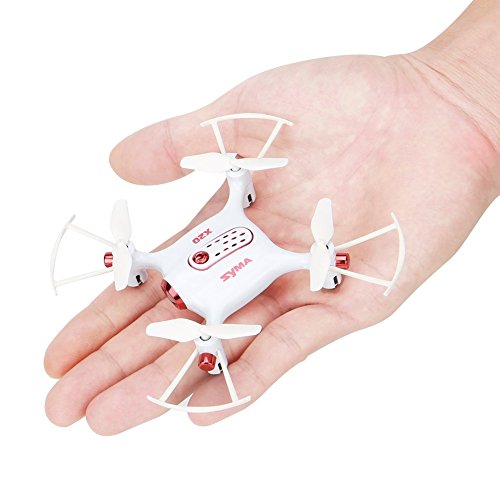
TL;DR: The Syma X20 Mini Pocket Drone packs a 180 mAh battery, 20‑meter range and 0.22 lb weight into a 105 mm frame, making it a solid starter for indoor fun despite a short 5‑7‑minute flight time.
The X20’s most eye‑catching spec is its ultra‑compact footprint – just 105 mm long, 105 mm wide and 25 mm tall, weighing only 0.22 lb (100 g). It runs on a 180 mAh Li‑ion/Li‑po battery that charges in roughly 50–110 minutes and delivers about 5–7 minutes of flight per charge. Built‑in altitude hold, auto‑hover and LED lights add a polished feel for beginners.
Compared with the other six drones in this roundup, the X20’s battery capacity is modest next to the Redrie Mini Drone’s 1200 mAh pack, and its 20‑meter control range is shorter than the 4DRC V18’s 60–150 meter range. It is heavier than the Holy Stone HS180 (45 g) but lighter than the Deerc D20 Silver, which tips the scales at 0.15 lb. The X20 also includes prop guards and a 6‑axis gyroscope, features that some peers either omit or do not list.
Professional reviewers praise the pocket‑size design and the reliable one‑key takeoff/landing and auto‑hover functions, noting that the drone hovers steadily indoors. Everyday users echo this sentiment, especially enjoying the responsive 360° and 3D flips. The most common complaints focus on the brief 5‑minute flight window, the limited 20‑meter range that hampers outdoor use, and the lack of a built‑in camera.
Under the hood, the X20 communicates on a 2.4 GHz frequency and offers headless mode, low‑battery protection, over‑current protection and an auto power‑off when stuck. The 6‑axis gyroscope helps keep the quadcopter stable, while LED lights add a fun visual cue during low‑light flights.
Pros
Cons
Best for: Entry‑level buyers or those on a tight budget
Avoid if: You need advanced features or professional‑grade performance
“Fits in palm, stable hover, quick yaw response”
“good battery feel for size”
TL;DR: The Simrex X300C is a fold‑able mini quadcopter with a 720P (1280×720) camera, dual‑battery support and 45 m control range, but it feels heavier and its hover stability and battery life disappoint.
The X300C’s most eye‑catching spec is its foldable frame that collapses to a compact 50 mm height, while the full length measures 230 mm and the drone weighs 0.440924524 pounds. It ships with two Li‑polymer 3.7 V batteries, a 60‑minute charging time and a combined flight time of 18 minutes, plus a 720P HD camera that streams via Wi‑Fi FPV to a smartphone.
Compared with the six other mini drones in this roundup, the X300C is noticeably heavier than the Holy Stone HS210 (≈0.084 lb), the Holy Stone HS180 (≈0.099 lb), the Deerc D20 (≈0.152 lb) and the Syma X20 (≈0.220 lb). Its price tag sits at the premium end of the group, so it costs more than many of its peers. Feature‑wise, however, it out‑classes several rivals with a foldable design, dual‑battery swapping, Wi‑Fi FPV streaming and a full set of beginner‑friendly controls such as altitude hold, headless mode and one‑key takeoff/landing.
Professional reviewers praise the X300C’s solid build quality, the protective packaging that includes extra propellers, and the ease of learning basic maneuvers thanks to its 6‑axis gyro stabilization. Everyday users love the compact travel‑ready shape and the responsive controls, but they repeatedly note that the drone struggles to hold its position for more than a few seconds and the battery drains faster than expected, often delivering less than the advertised 8‑10 minute per‑battery flight time. The camera, while rated at 720P, frequently drops to 480P, limiting video clarity.
Pros
Cons
Best for: Beginners and children who value a compact, feature‑rich drone and don’t need long outdoor flight times.
Avoid if: You need extended hover stability, longer battery life, or high‑quality aerial footage, and you’re shopping on a tight budget — it’s priced at $39.99.
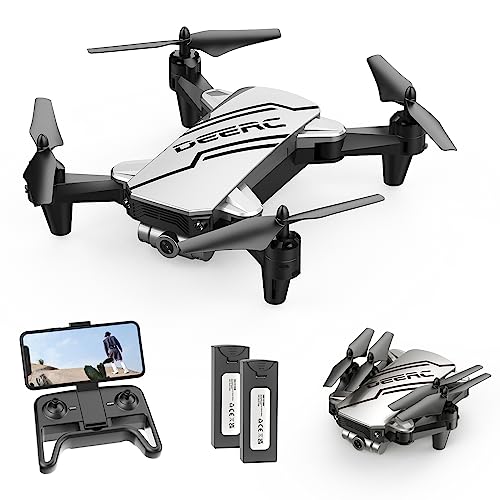
TL;DR: The Deerc D20 Silver packs a 720p Wi‑Fi FPV camera, 10‑minute per‑battery flight and crash‑resistant propellers into a 69 g frame, but its $49.99 price and 40 m range make it a premium starter drone.
The standout spec is the 0.51 Wh lithium‑polymer battery that delivers about 10 minutes of flight per charge, and the drone ships with two of them for roughly 20 minutes of combined airtime. At 69 g (≈0.15 lb) the D20 feels solid enough for indoor play, while the built‑in 720p HD FPV camera (1280 × 720 pixels) streams live video to your phone.
Compared with the other six drones in this roundup, the D20 sits at the higher end of the price spectrum. It's heavier than the Holy Stone HS210 (38 g) and the Syma X20 (100 g) but lighter than the Simrex X300C (200 g). Its 40 m transmission range is shorter than the HS210’s 50 m and the 4DRC V18’s 60‑150 m range, yet longer than the Syma X20’s 20 m range. Flight time per battery exceeds the HS210’s 9‑minute claim by a minute, and the combined 20‑plus minutes outlast the Simrex’s 18‑minute total.
Professional reviewers describe the D20 as a “fun little drone,” noting the flexible, damage‑resistant propellers that survive crashes. Everyday users praise the altitude hold, one‑key takeoff/landing and three speed modes for making the learning curve gentle. The built‑in LED lights and voice control add a playful touch, while the waypoint flight feature lets beginners draw simple paths on the app. However, reviewers also point out the lack of a micro‑SD slot, meaning video can only be viewed live, and some users experience intermittent app connectivity.
Pros
Cons
Best for: Kids aged 14+ and absolute beginners who want a sturdy, feature‑rich mini drone with live‑view video.
Avoid if: You need long flight times, onboard video storage, or a drone that can handle strong wind and advanced hobbyist features.
“great for kids, easy to fly”
“high-quality footage and safe for beginners”
TL;DR: The 4DRC V18 Mini Drone packs a 500 mAh battery, up to 150 m control range and a 360° protective grid into a 101.6 mm, $29.99 package that’s ideal for indoor beginners, though its real‑world flight time stays under ten minutes.
The V18’s standout spec is its 500 mAh battery, which pairs with a maximum control range of 150 m, giving kids plenty of room to practice without leaving the room. Its compact footprint—101.6 mm in length, width and 50.8 mm in height—means it fits in the palm of a hand, and the brushless hollow‑cup 7016 motors keep the weight between 22 g and 30 g. One‑key takeoff/landing, altitude hold and headless mode further simplify piloting for absolute beginners.
Compared with the six other drones in this roundup, the V18 is noticeably lighter than the Redrie Mini Drone (which weighs 480 g) and smaller than the Syma X20 Mini Pocket Drone (105 mm length). Its 150 m range outstretches the Syma’s 20 m range and the Holy Stone HS210’s 50 m range, while its price point sits below the Holy Stone HS180 and HS210, making it the most budget‑friendly option.
Everyday users praise the crash‑proof 360° grid frame and the intuitive one‑click launch, calling the drone “fun for indoor stunts” and “easy for kids to learn”. Professional reviewers note the same protective frame as a safety win, but they also point out that the advertised 6‑12 minute flight time often drops to 6‑8 minutes in practice. The drone’s wind resistance of less than 10 km/h limits outdoor play, and the 40‑120 minute charging window can feel long for impatient flyers.
Technical extras include three adjustable speed settings, colorful LED lights for night‑time fun, and a 2.4 GHz remote that runs on three AAA batteries (not included). The V18 also supports 360° flips and a throw‑to‑fly mode, adding a bit of flair without complicating the learning curve.
Pros
Cons
Best for: Entry‑level buyers or those on a tight budget
Avoid if: Reliability and user satisfaction are your top concerns
“perfect for first drone”
“fun stunt modes and camera selfies”
Breakdown
Redrie Mini Drone
Pros
Holy Stone HS210 Green
Pros
Holy Stone HS180
Pros
Syma X20 Mini Pocket Drone
Pros
Based on scoring data and product specs
Personalized picks
Best Overall Pick
Redrie Mini Drone
Best OverallBest for: Users with specific technical requirements or compatibility needs
Holy Stone HS210 Green
Best for: Those prioritizing quality and willing to pay for premium performance
$39.99+$10.01 vs winner
Skip 4DRC V18 Mini Drone if…
Reliability and user satisfaction are your top concerns
The Redrie Mini Drone claims the top spot as the best mini drone. It costs $29.98, carries a solid 4.5‑star rating from 316 reviews, and offers a 25‑minute flight window thanks to its two 1200 mAh lithium‑ion batteries. The drone also packs a 1080p adjustable‑angle FPV camera and a foldable ABS frame with five selectable LED lighting modes, giving beginners both visual fun and easy storage.
The Holy Stone HS210 Green comes in as the runner‑up, ideal if you need a compact indoor flyer that can pull off 3‑D flips and a toss‑to‑launch start. It sells for $39.99 and holds a 4.2‑star rating from 15,450 reviewers. Each flight lasts about 9 minutes (21 minutes total across its three batteries), and the drone includes altitude hold, circle‑fly mode, and a 50‑meter transmission range for reliable control.
For those looking beyond the winner, the Holy Stone HS180 serves as a solid mid‑range option at $37.99, delivering a balanced feature set without stretching the budget. If you’re willing to spend a bit more for premium touches, the Deerc D20 Silver at $49.99 offers higher‑end components for a smoother flying experience.
Pick the Redrie Mini Drone today and give a young pilot a confident start in the world of aerial fun.
The Redrie Mini Drone lists a battery life of 25 minutes, which is far longer than the 9 minutes of the Holy Stone HS210, the 7 minutes per battery of the HS180, the 5‑7 minutes of the Syma X20, the 8‑10 minutes of the Simrex X300C, the 10 minutes of the Deerc D20, and the 6‑12 minutes of the 4DRC V18. That extra endurance makes it the best choice for kids who want more flying time between charges.
No reviews yet — be the first to share your experience.
Please sign in to leave a review