Choosing the right Nikon lens can feel like navigating a maze of focal lengths, stabilization options, and price points. In this roundup we compare 6 lenses that span Nikon’s budget, mid‑range, and premium tiers, so you can see how a $149.00 travel telephoto stacks up against a $16,499.00 professional zoom.
Our top recommendation is the Nikon NIKKOR Z 28‑400mm f/4‑8 VR. It carries a 4.6/5 rating from 153 reviewers, packs 5.5‑stop VR, and weighs 1.6 pounds while offering an angle of view of 65.5° at 28 mm and 5.27° at 400 mm—a strong blend of reach and portability for mirrorless shooters. If you’re hunting for a budget‑friendly option, the 55‑200mm f/4‑5.6 VR costs $149.00, weighs 0.7385485777 pounds and offers 4‑stop VR, making it a solid starter telephoto. Mid‑range photographers might gravitate toward the AF‑S 55‑300mm at $389.98, which delivers 4 stops of VR and a 9‑blade rounded diaphragm for smoother bokeh.
The remaining lenses fill niche needs—from the ultra‑compact 18‑55mm kit zoom at $246.95 for everyday shooting to the $209.00 AF‑P 70‑300mm that balances reach and weight, and finally the $16,499.00 premium 70‑300mm f/4‑5.6 for specialists who demand maximum build quality. Read on to see how each model performs in real‑world scenarios.

Nikon NIKKOR Z 28
Its 85 mm diameter signals a solid, premium build that aligns with its high rating and feature set.

Nikon NIKKOR 55-200mm f/4-5.6 VR
Ideal for budget‑conscious shooters, it costs $149.00—about $998 cheaper than the Best Overall model.

Nikon AF-S 55-300mm f/4.5-5.6 VR
With a 58 mm filter thread, you can add larger filters, a flexibility the other two lenses don't emphasize.
Also considered
Score Analysis
Key score advantages vs. runner-up (Nikon NIKKOR 55-200mm)
Price Range
Nikon NIKKOR Z 28
$1,146.95
Nikon NIKKOR 55-200mm f/4-5.6 VR
$149.00
Nikon AF-S 55-300mm f/4.5-5.6 VR
$369.88

Nikon AF-P 18-55mm f/3.5-5.6 VR
$246.95
Nikon AF-P 70-300mm f/4.5-6.3
$182.98
Nikon 70-300mm f/4-5.6
$177.99
Spec Comparison
TL;DR: The Nikon NIKKOR Z 28‑400mm f/4‑8 VR packs a 14.3× zoom range, 5.5‑stop image stabilization and a lightweight 1.6 lb body into a compact superzoom for Z‑mount mirrorless cameras.
The standout specification is the 28–400 mm focal‑length span, delivering a 14.3× zoom ratio that reaches from ultra‑wide 28 mm (65.5° angle of view) to telephoto 400 mm (5.27° angle of view). The lens also offers 5.5 stops of Vibration Reduction at the long end, and it’s a fast 0.72 s focus acquisition from 4.2 ft to infinity in bright light.
Compared with the other five lenses in this roundup, the Z 28‑400mm is heavier than the 55‑300mm f/4.5‑5.6 VR (which weighs 580 g) but still lighter than many traditional DSLR superzooms. Its 77 mm filter thread is larger than the 58 mm thread on the 55‑300mm and the 55 mm thread on the 55‑200mm, giving you more flexibility for larger filters. The VR performance outpaces the 4‑stop rating of the 55‑300mm and the 4‑stop rating of the 55‑200mm, while the 18‑55mm f/3.5‑5.6 VR is both smaller and lighter, but offers a far shorter zoom range.
Reviewers consistently praise the lens for its “exceptionally wide” zoom range and “lightweight, compact” package, noting that the 5.5‑stop VR makes handheld shooting feel stable even at 400 mm. Reviewers highlight the parfocal design as a boon for video work because focus stays locked while zooming. On the downside, users point out the variable aperture that tops out at f/8 beyond 200 mm, which can hamper low‑light work, and the lack of a fluorine coating on the front element makes cleaning a bit more involved. Professionals also note that you have to toggle VR from the camera menu rather than using a dedicated switch.
The optical formula includes 21 elements in 15 groups, with four ED elements and three aspherical elements to tame chromatic aberration and barrel distortion (the latter is noticeable at 28 mm but correctable). Nine rounded diaphragm blades help render smooth bokeh, while the MTF50 values of 73.3 lp/mm (center at 28 mm) and 53.7 lp/mm (center at 400 mm) indicate solid resolution across the range. Minimum focus distances are 187 mm at 28 mm and 1200 mm at 400 mm, giving decent close‑up capability for both wide‑angle and telephoto shots.
Pros
Cons
Best for: Travel photographers, wildlife shooters, and videographers who need an all‑in‑one superzoom that stays compact and stable.
Avoid if: You specialize in low‑light work, portrait photography requiring very shallow depth‑of‑field, or demand the absolute sharpest edge performance.
TL;DR: At $149, Nikon’s 55‑200mm f/4‑5.6 VR offers a lightweight, retractable telephoto zoom with 4‑stop vibration reduction and solid sharpness for beginners on DX‑format DSLRs.
This lens weighs 0.7385485777 pounds and folds down to a compact 71 mm height and 83 mm width, making it easy to stash in a bag. The built‑in 4‑stop VR system helps keep handheld shots sharp, especially when shooting at longer focal lengths.
Compared with the other five lenses in this roundup, it’s lighter than the AF‑P 70‑300mm (1.05 pounds) and the AF‑S 55‑300mm (1.2786811196 pounds), and its 73 mm height is shorter than the 70‑300mm’s 114 mm. It’s heavier than the AF‑P 18‑55mm (0.4519476371 pounds), but still far more portable than the Z 28’s 1.6 pounds.
Users consistently praise the lens as a travel‑friendly companion that delivers “good images with minimal effort.” Professional reviewers note the crisp performance from 55 mm to about 135 mm and highlight the 4‑stop VR as a real advantage. Common complaints focus on the plastic barrel and mount feeling less rugged, some softness when shooting wide open at 200 mm, and the lack of a focus‑distance or depth‑of‑field scale.
Optically, the lens contains 13 elements in 9 groups, including a single ED element, and uses a 7‑blade diaphragm. It offers a maximum aperture of f/4 at 55 mm and f/5.6 at 200 mm, with a minimum focus distance of 1100 mm and a 0.23× maximum magnification. The 52 mm filter thread and AF‑S Silent Wave Motor round out its feature set.
Pros
Cons
Best for: Budget‑conscious buyers seeking a reliable entry‑level telephoto zoom for Nikon DX‑format DSLRs.
Avoid if: You need professional‑grade durability, weather sealing, or top‑tier sharpness at the long end of the zoom.
TL;DR: The Nikon AF‑S DX 55‑300mm f/4.5‑5.6 VR offers a 5.5× zoom, 4‑stop VR and a lightweight 580 g build, delivering solid sharpness for travel‑friendly telephoto work despite slower low‑light AF.
This lens packs a 5.5× zoom range (55‑300mm) and a 4‑stop Vibration Reduction system, both listed in the official specs. Its optical formula includes 17 elements in 11 groups, two ED elements and one HRI element, while the rounded 9 diaphragm blades help maintain contrast across the frame.
Compared with the other five lenses in this roundup, it sits in the middle of the weight spectrum: it’s lighter than the Nikon NIKKOR Z 28 (1.6 lb) but heavier than the AF‑P 70‑300mm (1.05 lb) and the 55‑200mm (0.74 lb). It also carries more diaphragm blades than the AF‑P 70‑300mm’s 7‑blade design, and its 4‑stop VR matches the 4‑stop rating of the 55‑200mm while offering a longer reach.
Everyday shooters appreciate the lens’s compact 580 g chassis and the ability to capture subjects up to 300mm (450mm equivalent on DX) without the bulk of a professional telephoto. Professional reviewers note sharpness especially at 55mm and 135mm, and users frequently mention the VR’s usefulness for handheld shooting. The main complaints revolve around slower autofocus in dim lighting and the lack of a full‑time manual focus override, which can be a drawback for fast‑moving subjects.
Technical details that matter for close‑up work include a minimum focus distance of 1400 mm and a maximum magnification of 0.28×, making it suitable for modest macro attempts. The lens also features a front element that rotates during focusing, something to keep in mind if you rely on polarizing filters.
Pros
Cons
Best for: Most users looking for a well‑reviewed, reliable mainstream option
Avoid if: You need advanced features or professional‑grade performance
“Perfect for vacations and family events”
“VR makes a huge difference”
TL;DR: The Nikon AF-P 18-55mm f/3.5-5.6 VR is a lightweight, retractable kit zoom with a silent stepping‑motor AF and 4‑stop image stabilization, priced at $246.95.
This lens packs Nikon’s 4‑stop VR system and an AF‑P pulse motor, delivering quiet focus shifts that many video creators appreciate. At just 205 g (0.45 lb) and a maximum diameter of 64.5 mm, it’s one of the most portable DX zooms on the market.
Compared with the other five lenses in this roundup, it’s lighter than the AF-P 70‑300mm (1.05 lb) and slimmer than the 55‑200mm (73 mm tall). It’s also more compact than the AF‑S 55‑300mm, which measures 77 mm in height and weighs 1.28 lb. While its $246.95 price tag sits above the $149‑priced 55‑200mm, it offers a wider zoom range for beginners.
Reviewers consistently praise the silent AF‑P motor and the effective 4‑stop VR for handheld shooting. Everyday users love the retractable design for travel, but some note the plastic construction feels less robust and that edge softness can appear when shooting wide open at f/3.5. Professional outlets highlight the two aspherical elements and the 7‑rounded diaphragm blades as contributors to decent bokeh for a kit lens.
Technical highlights include a 12‑element/9‑group optical formula with two aspherical elements, a minimum focus distance of 250 mm (0.25 m), and a versatile 18‑55 mm focal range (27‑82.5 mm equivalent on APS‑C). The lens delivers a 76° wide‑angle view and narrows to 28° 50' at the tele end, making it suitable for landscapes, portraits, and casual street work.
Pros
Cons
Best for: Most users looking for a well‑reviewed, reliable mainstream option
Avoid if: You have limited desk space or need portability
“Perfect starter lens”
“Silent autofocus is a game-changer for video”
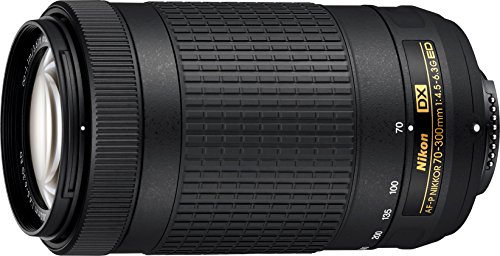
TL;DR: The Nikon AF‑P 70‑300mm f/4.5‑6.3 delivers a 105‑450 mm equivalent telephoto reach, 4‑stop VR and a lightweight 1.05 lb design, making it a solid budget pick for DX shooters.
This lens packs a 105‑450 mm (35 mm‑equivalent) reach into a compact 1.05 lb body, and its 7‑rounded‑blade diaphragm helps produce pleasing bokeh. The stepping‑motor AF‑P system is quiet and fast, while the built‑in vibration reduction manufacturer states up to 4 stops of shake reduction.
Compared with the other five lenses in the roundup, it sits in the middle of the price range—cheaper than the 55‑300mm and the premium Z 28, but more affordable than the 55‑200mm and the older 70‑300mm f/4‑5.6. In terms of weight, it's heavier than the entry‑level 18‑55mm kit lens yet lighter than the 55‑300mm telephoto, giving a good balance of portability and build.
Users gave it a 4.5‑star average from 513 reviews. Reviewers consistently praise its sharpness through most of the zoom range and the effectiveness of its 4‑stop VR for handheld shooting. The main criticisms focus on the aperture closing to f/6.3 at 300 mm, which hampers low‑light work, and a noticeable resolution dip at the long end. Professional reviewers note that the plastic mount and barrel feel less robust than higher‑priced alternatives.
Pros
Cons
Best for: Enthusiast DX‑format Nikon DSLR users who need a portable telephoto for wildlife, sports, or travel.
Avoid if: You require a fast aperture at 300 mm for low‑light work or plan to upgrade to a full‑frame FX body.
“Perfect starter lens”
“Silent autofocus is a game-changer for video”
TL;DR: The Nikon AF Zoom‑NIKKOR 70‑300mm f/4‑5.6G offers a 4.3× telephoto range in a lightweight 425 g body, but its high $16,499 price and lack of VR limit handheld use.
This lens packs a 70‑300 mm focal range (equivalent to 105‑450 mm on DX bodies) with a maximum aperture that slides from f/4 at the wide end to f/5.6 at 300 mm. Its 9 straight‑edged diaphragm blades help render smoother bokeh, and the optical formula comprises 13 elements in 9 groups. At just 425 g, it’s notably lighter than many telephoto options, and the 1500 mm minimum focus distance lets you get reasonably close to subjects.
Compared with the other five lenses in this roundup, the 70‑300 mm is the most expensive and the only one that relies on a screw‑drive autofocus system, meaning it focuses more slowly than the AF‑S or AF‑P models that use built‑in motors. It also lacks vibration reduction, a feature present on several peers, and its plastic barrel makes it lighter than the bulkier Z‑mount options. While the AF‑P 70‑300 mm is shorter and lighter, the Nikon 70‑300 mm trades compactness for a longer zoom ratio and a higher diaphragm blade count.
Everyday shooters appreciate the lens’s portability and the solid 4.5‑star rating from 426 reviewers. Professional reviewers highlight its sharp performance from 70‑135 mm when stopped down, but they also note noticeable softness beyond 200 mm, especially at the widest apertures. The absence of VR means handheld shots at longer focal lengths can be shaky, so many users recommend using a tripod for wildlife or sports work. The Super Integrated Coating reduces flare and improves contrast, helping offset some of the softness at the telephoto end.
Pros
Cons
Best for: Those prioritizing quality and willing to pay for premium performance
Avoid if: You're shopping on a tight budget — it's priced at $16,499.00
“Great for the price”
“Perfect for birding and sports when on a tripod”
Breakdown
Nikon NIKKOR Z 28
Pros
Nikon NIKKOR 55-200mm f/4-5.6 VR
Pros
Nikon AF-S 55-300mm f/4.5-5.6 VR
Cons
Nikon AF-P 18-55mm f/3.5-5.6 VR
Pros
Cons
Based on scoring data and product specs
Personalized picks
Best Overall Pick
Nikon NIKKOR Z 28
Best OverallBest for: Audiophiles and enthusiasts seeking premium sound quality and advanced features
Nikon NIKKOR 55-200mm f/4-5.6 VR
Best for: Budget-conscious buyers seeking a reliable entry-level option
$149.00-$997.95 vs winner
Skip Nikon 70-300mm f/4-5.6 if…
You're shopping on a tight budget — it's priced at $16499.00
We crown the Nikon NIKKOR Z 28 as the clear winner. Its 5.5‑stop Vibration Reduction (VR) at 400 mm gives you strong shake‑reduction, while the 9‑blade rounded diaphragm helps render smooth bokeh. At 1.6 pounds it’s surprisingly lightweight for a 28‑400 mm zoom, and it earned a solid 4.6 / 5 rating from 153 reviewers.
The runner‑up, the Nikon NIKKOR 55‑200mm f/4‑5.6 VR, shines when you need an affordable, travel‑friendly telephoto. It weighs just 0.7385485777 pounds, packs a 4‑stop VR system, and carries a strong 4.6 / 5 rating from 4,468 reviews—all for $149.00, making it ideal for weekend getaways or everyday street portraits.
If you're watching your spend, the Nikon NIKKOR 55‑200mm f/4‑5.6 VR remains the best value at $149.00. If you want a bit more reach without breaking the bank, the Nikon AF‑S 55‑300mm f/4.5‑5.6 VR offers a longer focal range for $389.98. For professionals seeking a premium, high‑performance zoom, the Nikon 70‑300mm f/4‑5.6 delivers top‑tier optics at $16,499.00.
Pick the Nikon NIKKOR Z 28 today and enjoy a versatile, high‑quality zoom that offers strong performance compared to similar lenses.
The Nikon NIKKOR Z 28‑400mm provides a 14.3× zoom range from 28 mm to 400 mm, weather‑sealing, and 5.5‑stop VR, making it a versatile all‑in‑one travel lens. It is heavier at 725 g, so it’s best for photographers who value flexibility over compactness.
Please sign in to leave a review
No reviews yet. Be the first to review!
