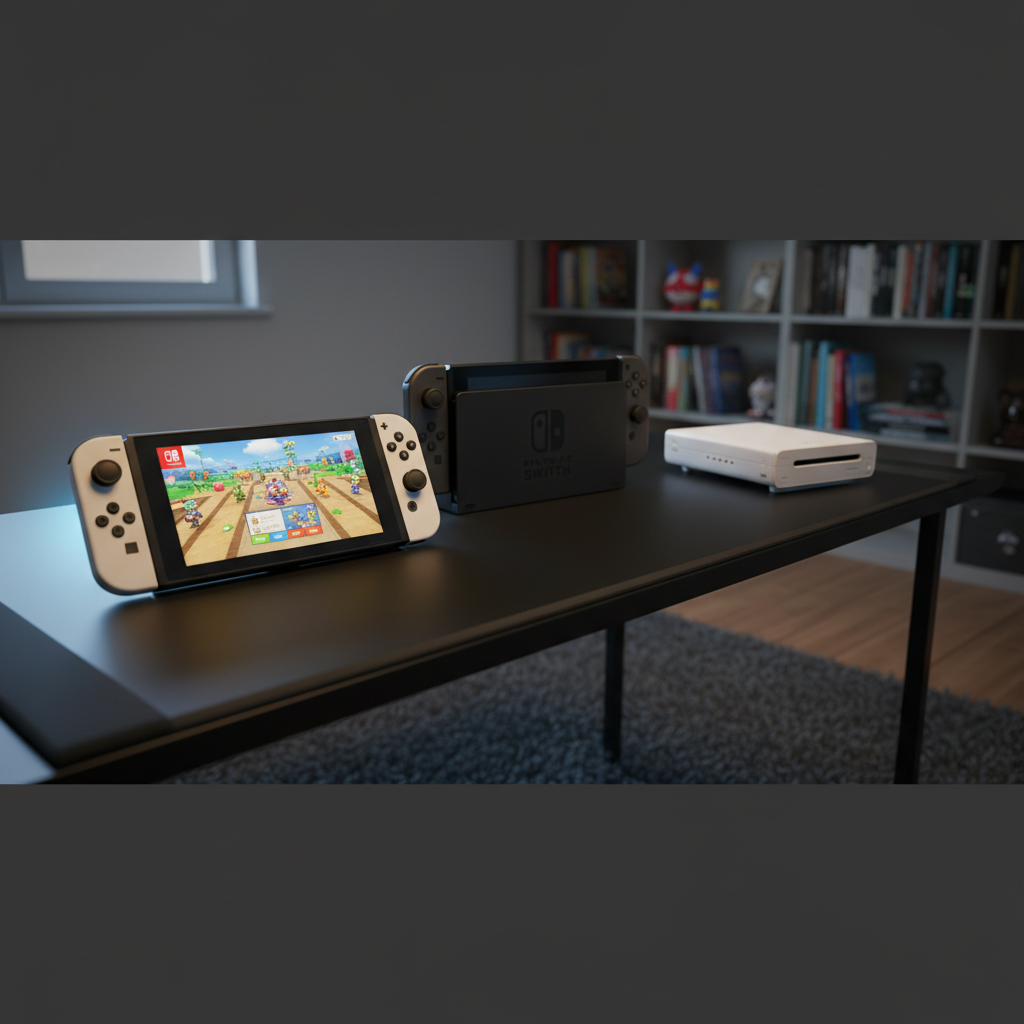
Choosing a Nintendo system can feel like stepping through decades of gaming history, so we lined up four options to help you pinpoint the right fit. Our comparison spans the $144.95 Nintendo Wii White Premium at the budget end, the $326.14 Nintendo Switch in the mid‑range slot, the $364.90 Switch OLED as the premium offering, and the classic Nintendo NES Vintage, which doesn’t list a price.
The Wii White Premium bundles original OEM controllers and a 4.9‑lb console for $144.95, earning a 3.7/5 rating from 1,695 reviewers—an entry point for families or casual players. The standard Switch delivers a 6.2” LCD screen, 9‑hour maximum battery life and the same 4.7/5 score from 10,179 users, making it a solid all‑rounder at $326.14. The OLED model upgrades to a vivid 7‑inch OLED display, 64 GB storage and a 3‑hour charge time, while holding a 4.7/5 rating across 39,612 reviews for $364.90. The NES Vintage receives a 4.1/5 rating from 105 reviewers and brings 791 classic games plus a 5‑channel mono audio setup for retro enthusiasts.
Below we break down how each console’s specs, strengths and user feedback stack up so you can decide which Nintendo experience fits your lifestyle.

Nintendo Switch OLED
Its 4310 mAh battery gives longer play sessions, supporting up to 5.5 hours of Zelda, which underpins its top rating and feature set.

Nintendo Switch
Ideal for mainstream gamers who want a reliable handheld, it costs $38.76 less than the OLED model, making it a solid, well‑reviewed alternative.

Nintendo Wii White Premium
Supports up to four Wii Remotes and a compact 4.0 in height, offering a classic experience at a fraction of the Switch price.
Score Analysis
Key score advantages vs. runner-up (Nintendo Switch)
Price Range
Nintendo Switch OLED
$364.64
Nintendo Switch
$326.50
Nintendo Wii White Premium
$139.28

Nintendo NES Vintage
-$0.01
Spec Comparison
TL;DR: The Nintendo Switch OLED delivers a vivid 7‑inch OLED display, 4,310 mAh battery, and 64 GB of internal storage, making it the most premium hybrid console in the lineup.
The standout feature is the 7.0‑inch OLED screen with a native 1280 × 720 resolution, which reviewers praise for bright colors and deep blacks that outshine the LCD of earlier models. Paired with a 4,310 mAh battery, the console can run up to 9 hours on a single charge, while a typical Zelda session lasts about 5.5 hours.
Compared with the standard Nintendo Switch, the OLED model is slightly heavier at 3.00049138582 pounds versus 2.78 pounds, but it offers a larger battery capacity (4,310 mAh vs 3,570 mAh). Both share the same maximum battery life of 9 hours and the same Bluetooth version (4.1). The Wii White Premium is considerably heavier at 4.9 lb, and the vintage NES tips the scales at 3,000 g, making the Switch OLED the lightest of the three modern Nintendo systems when you include Joy‑Cons (420 g total). Storage jumps from the original’s modest size to 64 GB internally, with expansion up to 2 TB, a leap that the older consoles don’t provide.
Consumers rave about the OLED screen’s brightness and the new wide, metal kickstand that stabilizes tabletop play. Professional reviewers also highlight the improved stereo speakers, noting clearer handheld audio. Many point out the lack of a CPU/GPU upgrade, so performance mirrors the original Switch, and Joy‑Con drift remains a reported issue. Consider these trade‑offs if you already own a Switch.
Beyond the display, the console packs 64 GB of internal storage, a 4.1 Bluetooth module, and a dock with a wired LAN port for stable online sessions. Each Joy‑Con holds a 525 mAh battery that can last up to 20 hours and recharges in about 3.5 hours, complementing the console’s 3‑hour charging window.
Pros
Cons
Best for: New Switch buyers, families, and tabletop gamers who want the best handheld display and extra storage.
Avoid if: You already own a Switch and are satisfied with its performance, or you need higher frame rates and resolution for demanding games.
“The screen is amazing—much brighter and more colorful.”
“Great mobile gaming device.”
TL;DR: The Nintendo Switch offers a 6.2‑inch LCD screen, 3570 mAh battery for up to 9 hours of play, and three interchangeable modes, making it a solid, well‑reviewed hybrid console for families and casual gamers.
The standout spec is its 3570 mAh battery, which the manufacturer says can sustain up to 9 hours of gameplay on lighter titles and still delivers at least 4.5 hours on demanding games such as Zelda. Coupled with a 6.2‑inch multi‑touch capacitive LCD that runs at 720p, the system balances portability and on‑the‑go entertainment, and it doesn't sacrifice the ability to dock to a TV for 1080p output.
When stacked against the other three consoles in this roundup, the Switch is lighter than the OLED sibling (which tips the scales at about 3 pounds) and slimmer than the Wii White Premium, which weighs roughly 4.9 lb. The OLED model also carries a larger 4310 mAh battery, but the original Switch still matches its 9‑hour maximum runtime. Both the Wii and the vintage NES are considerably heavier and lack the hybrid flexibility that defines the Switch.
User sentiment repeatedly praises the console’s instant two‑player setup via detachable Joy‑Cons and its large library of first‑party titles. Professional reviewers highlight the seamless transition between handheld, tabletop, and TV modes as a core strength. The most common drawbacks mentioned are Joy‑Con analog stick drift, the LCD’s modest 720p resolution compared with newer OLED screens, and the modest 32 GB internal flash storage (≈24 GB usable), which often necessitates a microSD card for larger game libraries.
The hardware includes 4 GB of LPDDR4 RAM, a custom NVIDIA Tegra X1‑based SoC, and Bluetooth 4.1 for wireless headphones. Storage can be expanded up to 2 TB via microSD, and the console supports local wireless multiplayer for up to eight devices, making it a versatile hub for group play.
Pros
Cons
Best for: Most users looking for a well‑reviewed, reliable mainstream option
Avoid if: You need advanced features or professional‑grade performance
“The screen is amazing—much brighter and more colorful.”
“Great mobile gaming device.”
TL;DR: The Nintendo Wii White Premium bundle delivers original motion‑control gaming, GameCube compatibility, and expandable storage for $144.95, making it a budget‑friendly entry point for casual play.
The console’s most distinctive hardware spec is its four USB 2.0 ports, giving you plenty of room for accessories while the system runs on a modest 17 W power draw. Its dimensions—12.0 in long, 9.0 in wide, and 4.0 in high—fit comfortably on a TV stand, and the unit weighs 4.9 lbs, a solid middle ground between the lighter Switch (2.78 lb) and the heavier NES Vintage (3000 g).
Compared with the other three consoles in this roundup, the Wii is the most affordable option; the Switch and Switch OLED list higher price points. In terms of weight, the Wii sits above the Switch (2.78 lb) and Switch OLED (≈3.0 lb) but below the NES Vintage, which weighs 3000 g. Feature‑wise, the Wii offers four USB ports and full GameCube compatibility—specs that the Switch models don’t list—while all three competitors lack native HDMI output, a limitation the Wii shares.
User sentiment highlights the Wii’s intuitive motion controls and family‑friendly library of over 1,000 titles. Reviewers praise the original OEM Wii Remote and Nunchuk the bundle includes, noting they “feel brand‑new.” Common complaints revolve around the finicky sensor bar and the need to replace the remote’s two AA batteries regularly. Professional reviewers also point out the lack of native HD output, meaning you’ll need an external HDMI converter for modern TVs.
Technical context adds that the Wii reads 12 cm DVD‑ROM discs, supports Wii optical discs and GameCube Game Discs, and offers expandable storage via SD/SDHC cards up to 32 GB alongside 512 MB of internal flash memory. Wi‑Fi connectivity follows the IEEE 802.11b/g standard, and the system can host up to four Wii Remotes simultaneously.
Pros
Cons
Best for: Entry-level buyers or those on a tight budget
Avoid if: Reliability and user satisfaction are your top concerns
“Perfect for family game nights”
“Feels like new”
TL;DR: The Nintendo NES Vintage delivers classic 8‑bit gaming with a 791‑title library, 56‑color palette and detachable controllers, but its front‑loading slot and mono audio can feel dated today.
The console’s most eye‑catching spec is its massive library of 791 games, paired with a 56‑color palette (48 colors plus 5 grays) and a 5‑channel mono audio output. It runs on a Ricoh 2A03 CPU at 1.79 MHz (NTSC) and draws 850 mA at 9 V, all housed in a unit that measures 203 mm deep, 89 mm high, and weighs 3000 g.
Compared with the other three entries, the NES is bulkier than the Nintendo Wii, which tips the scales at a lighter weight, and its depth is shorter than the Wii’s 12.0 in chassis. Unlike the Switch models, it offers no battery power, Bluetooth connectivity, or portable form factor, it's the most stationary option in the lineup.
Fans rave about the nostalgic feel of the iconic 8‑way D‑pad and the durability of the detachable controllers—professional reviewers even gave the controller an “A” for comfort. Common complaints focus on the front‑loading ZIF cartridge slot, which users report can corrode and cause connection issues, and the mono audio, which lacks the stereo depth of modern consoles. The NES‑101 variant’s RF‑only video output also limits compatibility with today’s flat‑screen TVs.
Pros
Cons
Best for: Retro gaming enthusiasts who want an authentic 8‑bit experience with a huge library of classic games.
Avoid if: You prefer products with extensive real‑world feedback and proven track records
Breakdown
Nintendo Switch OLED
Pros
Nintendo Switch
Pros
Nintendo Wii White Premium
Pros
Cons
Based on scoring data and product specs
Personalized picks
Best Overall Pick
Nintendo Switch OLED
Best OverallBest for: Audiophiles and enthusiasts seeking premium sound quality and advanced features
Nintendo Switch
Best for: Most users looking for a well-reviewed, reliable mainstream option
$326.50-$38.14 vs winner
Skip Nintendo NES Vintage if…
You prefer products with extensive real-world feedback and proven track records
The Nintendo Switch OLED takes the top spot with its vibrant 7.0‑inch OLED display, 64 GB of internal storage, and a battery that can stretch up to 9 hours of play. It also carries a strong 4.7/5 rating from 39,612 reviewers, and its list price of $364.90 reflects the premium features it adds over the base model.
If you need a capable hybrid at a lower cost, the standard Nintendo Switch is the clear runner‑up. It sports a 6.2‑inch LCD screen, 32 GB of storage, the same 9‑hour maximum battery life, and a solid 4.7/5 rating from 10,179 reviewers, all for $326.14.
For tighter budgets, the Wii White Premium at $144.95 offers a nostalgic library and the cheapest entry into Nintendo’s ecosystem. The mid‑range Nintendo Switch (the runner‑up) provides a full hybrid experience for less than $364.90, offering a balance of price and performance.
Pick the Switch OLED now to enjoy the most complete Nintendo experience.
The OLED model costs $364.90 versus $326.14 for the standard Switch, a $38.76 premium that brings a 7.0‑inch OLED display and 64 GB of internal storage. It keeps the same battery life range (up to 9 hours) and Joy‑Con performance, so the upgrade mainly adds visual flair and extra space.
Please sign in to leave a review
No reviews yet. Be the first to review!
