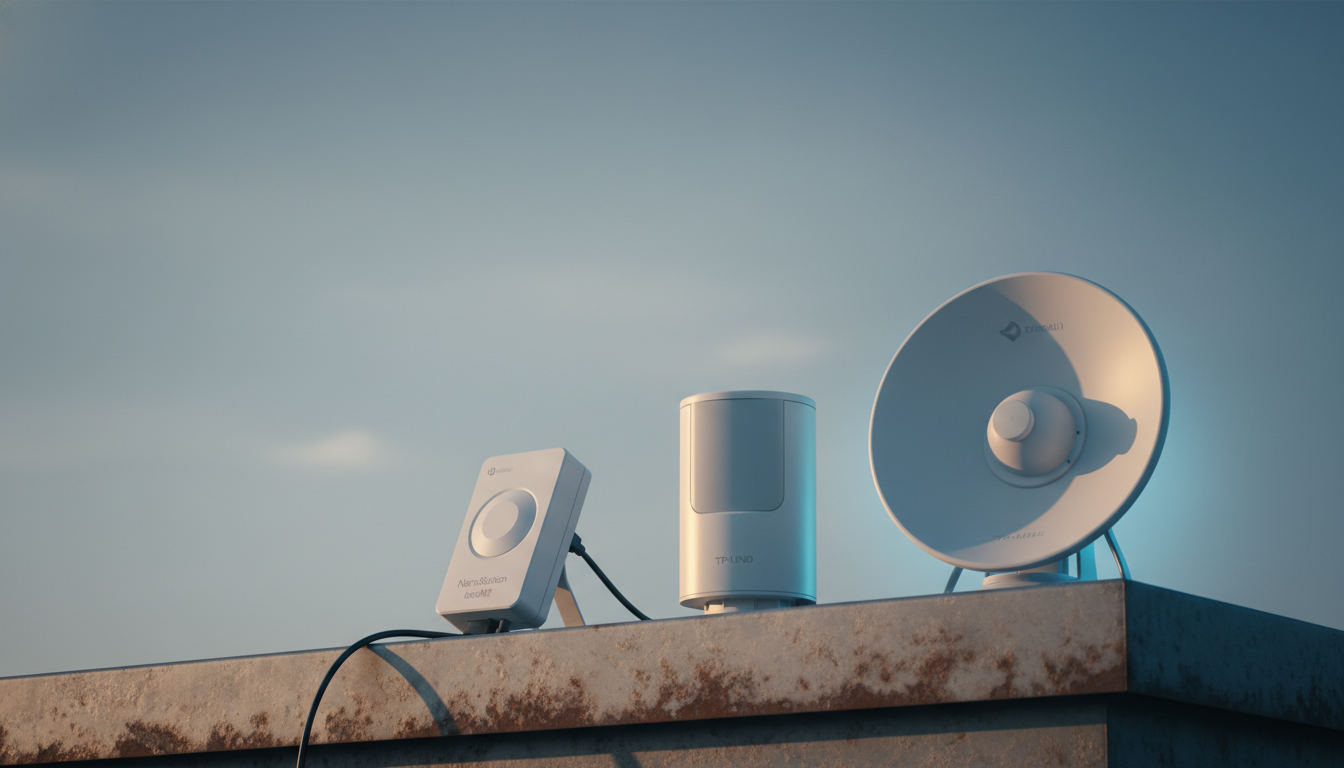
Finding a reliable PoE‑powered bridge can be tricky, especially when you need outdoor durability and solid throughput. We examined 7 network bridges that cover the whole price spectrum, from entry‑level kits to enterprise‑grade gear. We split the selection into budget, mid‑range and premium tiers so you can match performance to your wallet.
On the budget side, the Ubiquiti NanoStation locoM2 starts at $45.85, carries a 4.4‑star rating and promises 150+ Mbps throughput on 2.4 GHz, while the BrosTrend bridge retails for $59.99 and tops out at 867 Mbps. The TP‑Link CPE710 sits at $74.99 and offers a 23 dBi antenna with up to 400 Mbps on a 40 MHz channel. Moving up, the KuWFi Outdoor Wireless Bridge costs $76.49, features a 12 dBi antenna and 300 Mbps speed. The Ubiquiti NanoBeam ac Gen2 is priced at $95.99, earns a 4.6‑star rating and delivers 450 Mbps on 5 GHz; the TRENDnet TEW‑740AP lists for $159.99 with a 10 dBi gain, and the EnGenius EnStation6 commands $206.20 while advertising up to 1200 Mbps throughput.
Below we break down each tier, highlight the specs that matter most for point‑to‑point or point‑to‑multipoint links, and point out which environments each device shines in. Keep reading to see how the numbers translate into real‑world choices.

Ubiquiti NanoStation locoM2
Its 2.4 GHz operating frequency delivers reliable connectivity for entry‑level setups, earning top value and strong brand confidence.

Ubiquiti NanoBeam ac Gen2
Ideal for users ready to spend about $50 more for a proven, high‑quality bridge, the NanoBeam ac Gen2 targets buyers who value premium features and stronger performance.

TP-Link CPE710
The CPE710’s compact 207 mm height and 366 mm length let it fit tighter mounting spots where the bulkier Ubiquiti units can’t, offering a distinct space‑saving option.
Also considered
Score Analysis
Key score advantages vs. runner-up (Ubiquiti NanoBeam ac)
Price Range
Ubiquiti NanoStation locoM2
$45.85
Ubiquiti NanoBeam ac Gen2
$95.99
TP-Link CPE710
$74.99

KuWFi Outdoor Wireless Bridge
$76.49

TRENDnet TEW-740AP
$159.99

EnGenius EnStation6
$206.20

BrosTrend Wireless Bridge
$59.99
Spec Comparison
TL;DR: The NanoStation locoM2 delivers up to 150 Mbps on a lightweight 0.40 lb, 30 mm‑high, passive‑PoE bridge that’s easy to mount but offers only a 10/100 Mbps Ethernet port.
This bridge packs an 8‑8.5 dBi dual‑polarized antenna with a 60° beamwidth and 20 dB cross‑polar isolation into a compact 30 mm × 80 mm × 180 mm chassis that weighs just 0.40 lb. It runs on passive PoE (24 V, 0.5 A) and draws 5.5‑6 W, while the built‑in 10/100 Mbps RJ45 port handles the wired side.
Compared with the six other bridges in the roundup, the locoM2 weighs less than the TP‑Link CPE710 (2.20 lb) and the NanoBeam ac Gen2 (2.0 lb), though it weighs a touch more than the BrosTrend Bridge (0.22 lb). Its 30 mm height gives it a smaller vertical profile than the TP‑Link’s 207 mm height, and its 180 mm length exceeds the BrosTrend’s 71 mm. In throughput, its 150+ Mbps ceiling trails the BrosTrend’s 867 Mbps and the NanoBeam’s 450 Mbps. Its 8‑8.5 dBi antenna gain also falls below the TP‑Link’s 23 dBi and the NanoBeam’s 19 dBi, while its 5.5‑6 W power draw sits between the BrosTrend’s 4.7 W and the TRENDnet’s 6.6 W.
Users repeatedly praise the device’s plug‑and‑play setup, its lightweight form factor, and the low power draw that works well for solar‑powered sites. Professional reviewers note the AirMAX TDMA protocol’s low‑latency performance for video surveillance, but they’ve also flagged the 2.4 GHz band’s susceptibility to interference and the older 400 MHz CPU with 32 MB RAM as potential limits for future features.
Technically, the locoM2 runs Ubiquiti’s airOS on a 400 MHz Atheros MIPS 24Kc/24KC processor, with 32 MB SDRAM and 8 MB flash storage. It offers a VSWR of 1.4:1, runs from –30 °C to 75 °C, and tolerates 5‑95 % non‑condensing humidity. A remote reset function simplifies maintenance, and the three‑year warranty adds peace of mind.
Pros
Cons
Best for: Budget‑conscious small‑to‑medium WISPs, rural broadband projects, or surveillance setups that need a reliable, low‑power outdoor bridge.
Avoid if: You require gigabit Ethernet, high‑throughput links, or deployment in dense urban areas where 2.4 GHz interference is severe.
TL;DR: The Ubiquiti NanoBeam ac Gen2 packs a 19 dBi directional antenna, 450 Mbps 5 GHz radio and two Gigabit Ethernet ports into a 96.52 mm‑high, weather‑rated unit, ideal for point‑to‑point backhaul.
The standout spec is the integrated 19 dBi antenna, which delivers a tight, high‑gain beam while the whole device measures just 96.52 mm in height, 226.06 mm in length and 241.30 mm in width. Combined with a 450 Mbps 5 GHz radio and a 720 MHz processor, it offers strong throughput in a remarkably compact footprint.
Compared with the other six bridges, its gain sits between the 12 dBi of the KuWFi Outdoor Bridge and the 23 dBi of the TP‑Link CPE710, matching the 19 dBi of the EnGenius EnStation6. It draws 8.5 W, which is higher than the 4.7 W of the BrosTrend Bridge and the 6.6 W of the TRENDnet TEW‑740AP, but still reasonable for a device of its class. At 907.18 g it's lighter than the TP‑Link CPE710 (about 1 kg) yet heavier than the ultra‑light BrosTrend model (≈0.22 lb).
Users repeatedly praise the NanoBeam’s “compact and lightweight design with the highest gain‑to‑footprint ratio” and the 3‑axis ball‑joint mount that makes alignment straightforward. Professional reviewers highlight the directional beam’s “excellent noise immunity” in RF‑congested sites, while the same reviewers note that the directional antenna makes it unsuitable for omnidirectional coverage. The unit also survives winds up to 200 km/h (125 mph) and includes a PoE adapter and pole‑mount kit right out of the box.
Pros
Cons
Best for: Buyers willing to invest in a proven, high‑quality option
Avoid if: You need advanced features or professional‑grade performance
TL;DR: The TP‑Link CPE710 offers a 23 dBi directional antenna, up to 867 Mbps throughput, and IP65 weatherproofing for under $75, making it a solid budget bridge for long‑range outdoor links.
The standout spec is its 23 dBi high‑gain directional antenna, which pairs with an 80 MHz channel to reach a theoretical 867 Mbps data rate. TP‑Link built the unit for tough environments with an IP65 rating, a rugged outdoor‑grade plastic housing, and a three‑axis snap‑lock alignment mechanism that helps keep it steady in windy conditions. At 2.20462262 pounds (1000 g) it’s sturdy enough for pole mounting while still being manageable.
Compared with the other six bridges, the CPE710’s antenna gain outstrips the KuWFi’s 12 dBi and the Ubiquiti NanoBeam’s 19 dBi, giving it a clear edge for distance‑focused links. Its 867 Mbps ceiling matches the BrosTrend model but falls short of the EnGenius unit’s 1200 Mbps ceiling. Power draw sits at 7.3 W, a shade higher than the TRENDnet’s 6.6 W, and its single Gigabit PoE/LAN port mirrors the simplicity of the other devices. At roughly 2.2 lb it’s heavier than the lightweight BrosTrend unit (about 0.22 lb) yet comparable to the Ubiquiti NanoBeam’s 2.0 lb chassis.
Professional reviewers note the “cut‑through noise” performance that the 23 dBi antenna and 2×2 MIMO bring to point‑to‑point scenarios, and both TP‑Link and CDW tout the “blazing speed” of up to 867 Mbps. Users appreciate the included PoE injector, which eliminates the need for a separate power source, and the integrated SPI firewall and bandwidth‑control features that simplify traffic shaping. While direct consumer feedback is limited, the consensus highlights the device’s reliability for rural ISP backhauls and enterprise outdoor links.
Pros
Cons
Best for: Budget-conscious buyers seeking a reliable entry-level option
Avoid if: You want the best value-per-dollar in its price range
TL;DR: For $76.49, the KuWFi Outdoor Wireless Bridge delivers a 12 dBi antenna, 300 Mbps throughput and IP65 weatherproofing, making it a solid mid‑range choice for rural point‑to‑point links.
The bridge’s standout spec is its 12 dBi directional antenna paired with a rated wireless speed of 300 Mbps, and an IP65‑rated enclosure houses it to survive –30 °C to 65 °C. It runs on 24 V PoE (optional 48 V) and outputs 23 dBm of RF power, while offering three 10/100 Mbps LAN ports for wired devices.
Compared with the other six units in this roundup, KuWFi’s antenna gain is lower than the TP‑Link CPE710’s 23 dBi and the Ubiquiti NanoBeam’s 19 dBi, yet it tops the TRENDnet TEW‑740AP’s 10 dBi. Its 300 Mbps speed sits between the BrosTrend Bridge’s 867 Mbps peak and the TP‑Link’s 173 Mbps (20 MHz) to 400 Mbps (40 MHz) offerings, and it outpaces the NanoStation’s 150+ Mbps throughput. Price‑wise, KuWFi lands in the mid tier—cheaper than the high‑end Ubiquiti models but a bit pricier than the entry‑level BrosTrend unit.
User feedback repeatedly praises the integrated LED pairing indicator and the pre‑programmed 2‑pack pairing, which let installers get the bridge online without a web UI. Reviewers also note the convenience of the physical AP/Client toggle switch and the built‑in ESD/surge protection. The main criticism is the 300 Mbps ceiling, which can become a bottleneck for applications that demand true gigabit backhaul. Additionally, the manufacturer doesn’t list dimensions or weight, leaving installers without those details.
Technical notes include a 3 km transmission distance, a Qualcomm AR9344 chipset with external PA, 64 MB DDR2 RAM and 8 MB flash storage, plus dual 12 V DC output jacks for powering peripheral devices. The device supports bridge, gateway, point‑to‑point, point‑to‑multipoint and AP/Client modes, giving flexibility for small‑scale outdoor networks.
Pros
Cons
Best for: Rural homeowners, farms or small businesses that need a straightforward, weather‑proof point‑to‑point or point‑to‑multipoint link.
Avoid if: You need multi‑gigabit throughput, the highest possible antenna gain, or detailed dimension specs for precise mounting.
TL;DR: The TRENDnet TEW-740AP is a pre‑configured 2.4 GHz point‑to‑point bridge with a 10 dBi directional antenna, IP56 weatherproof housing and up to 60 m PoE reach, but its 300 Mbps ceiling and premium $159.99 price make it best for users who value rugged simplicity over raw speed.
The kit’s most distinctive spec is the built‑in 10 dBi directional antenna, which, together with the 2.4 GHz IEEE 802.11b/g/n radio, delivers a theoretical maximum of 300 Mbps. The units measure 60.96 mm in height, 193.04 mm in length and 116.84 mm in width, and they weigh about 1.00 lb (454 g) each. Power comes from a 0.5 A PoE input and the devices consume up to 6.6 W, while the PoE injector can push the signal up to 60 m (197 ft). Real‑time logs and QoS support round out the feature set.
Compared with the six other bridges in this roundup, the TEW‑740AP’s 10 dBi gain is lower than the 19 dBi found on the EnGenius EnStation6 and the Ubiquiti NanoBeam ac Gen2, and well below the 23 dBi of the TP‑Link CPE710. At roughly 1.00 lb, it is lighter than the EnStation6’s 1.11 lb but heavier than the ultra‑light BrosTrend bridge at 0.22 lb. Its $159.99 list price also places it in the premium tier, so you’ll be paying more than the budget‑focused options that sit under $100.
Reviewers consistently praise the IP56‑rated enclosure, noting that it stands up to rain and dust without additional housing. Reviewers highlight the plug‑and‑play nature of the two‑unit kit as a time‑saver for small‑business or hobbyist deployments. The main complaints focus on the single‑band 2.4 GHz operation, which can be crowded in dense Wi‑Fi areas, and the 300 Mbps ceiling that limits high‑throughput tasks like large‑file transfers or 4K streaming.
Pros
Cons
Best for: Those prioritizing rugged, pre‑configured outdoor links and willing to pay a premium for simplicity and durability.
Avoid if: You're shopping on a tight budget — it's priced at $159.99.
TL;DR: The EnGenius EnStation6 delivers up to 1200 Mbps on a 19 dBi directional antenna with IP55 protection, but its single‑band design and premium price make it a niche, high‑performance bridge.
What really stands out is the 19 dBi antenna gain paired with Wi‑Fi 6 (802.11ax) and a claimed maximum throughput of 1200 Mbps, enough for high‑definition video streams over point‑to‑point links up to 5 miles (≈8 km). The unit packs two Gigabit RJ‑45 PoE ports, supports beamforming, and runs on a proprietary 54 V PoE injector that the box includes.
Compared with the six other bridges in this roundup, the EnStation6 is heavier than the ultra‑light BrosTrend model (0.22 lb) but lighter than the TP‑Link CPE710 (2.20 lb). Its 19 dBi gain tops the Trendnet TEW‑740AP (10 dBi) and KuWFi Outdoor Bridge (12 dBi) while matching the Ubiquiti NanoBeam ac Gen2, though it falls short of TP‑Link’s 23 dBi. In raw speed, its 1200 Mbps ceiling outpaces the NanoBeam’s 450 Mbps, KuWFi’s 300 Mbps, and the BrosTrend’s 867 Mbps, making it the fastest option listed. The trade‑off is a higher price tag of $206.20 and a modest 3.6/5 star rating, which sits below many peers.
User feedback frequently praises the bridge’s ability to maintain a stable link over long distances, especially when handling video surveillance or back‑haul traffic. Reviewers also note the sturdy IP55 enclosure and the convenience of the included PoE injector. On the downside, customers point out that the device operates only on a single 5 GHz band, preventing use of the 2.4 GHz spectrum for older devices, and that the need for a proprietary injector can complicate deployments that rely on standard 802.3af/at PoE.
Technically, the EnStation6 runs a 2×2 MIMO configuration with beamforming support and channelization options across HE, VHT, and HT bands (20/40/80 MHz). Its transmit power lists at 26 dBm, while power draw stays between 11 W and 12.5 W. The unit survives outdoor conditions, boasting an IP55 rating, operating temperatures from –20 °C to 60 °C, and humidity tolerance up to 90 % non‑condensing.
Pros
Cons
Best for: Those prioritizing quality and willing to pay for premium performance in long‑range outdoor point‑point links.
Avoid if: Reliability and user satisfaction are your top concerns, or you need dual‑dual‑band operation and standard PoE compatibility.
TL;DR: The BrosTrend 5 GHz Wireless Bridge delivers up to 867 Mbps over a 1 km line‑of‑sight link, runs on 4.7 W PoE, and packs a weather‑proof, plug‑and‑play design for just $59.99.
What sets this bridge apart is its advertised maximum throughput of 867 Mbps, which tops the 150+ Mbps of the Ubiquiti NanoStation locoM2 and the 400 Mbps ceiling of the TP‑Link CPE710. It also supports a 60 m (60,000 mm) PoE cable run, matching the distance offered by the TRENDnet TEW‑740AP while consuming only 4.7 W of power.
In a side‑by‑side look, the BrosTrend unit weighs just 0.21875 lb (99.2 g), noticeably lighter than the 0.3968‑lb Ubiquiti model and far lighter than the 2.2046‑lb TP‑Link CPE710. Its 5.2 in × 2.8 in × 1.7 in footprint fits easily on a wall or pole, and the IP65 rating puts it on par with the KuWFi bridge’s weather protection while offering a higher data rate. However, its 3.9‑star rating from 319 reviewers falls short of the 4.4‑star scores seen on several competitors.
Customers repeatedly highlight the “plug‑and‑play” experience: the two units arrive pre‑paired, the LED indicators walk you through signal strength and pairing, and most users report stable high‑speed links across several hundred feet. The sturdy white housing and 6 kV lightning protection reinforce its outdoor suitability. A downside is that reviewers note the single‑band 5 GHz operation limits penetration through walls and foliage, and the strict line‑of‑sight alignment can be tricky for non‑technical installers.
Pros
Cons
Best for: Entry‑level buyers or those on a tight budget
Avoid if: You need powerful performance or professional‑grade features
Breakdown
Ubiquiti NanoStation locoM2
Pros
Ubiquiti NanoBeam ac Gen2
Pros
TP-Link CPE710
Pros
Cons
KuWFi Outdoor Wireless Bridge
Pros
Based on scoring data and product specs
Personalized picks
Best Overall Pick
Ubiquiti NanoStation locoM2
Best OverallBest for: Budget-conscious buyers seeking a reliable entry-level option
Ubiquiti NanoBeam ac Gen2
Best for: Buyers willing to invest in a proven, high-quality option
$95.99+$50.14 vs winner
Skip BrosTrend Wireless Bridge if…
You need powerful performance or professional-grade features
Ubiquiti’s NanoStation locoM2 takes the top spot thanks to its rock‑solid value: it ships for just $45.85, carries a 4.4‑star rating from 2,022 reviewers, and delivers more than 150 Mbps of throughput on a modest 5.5‑6 W PoE budget. Its 8‑8.5 dBi dual‑linear antenna and 60° beamwidth keep the link stable without breaking the bank.
The runner‑up, the NanoBeam ac Gen2, shines when you need longer range and higher speeds – its 19 dBi antenna and 450 Mbps 5 GHz data rate make it ideal for point‑to‑point backhauls. With two Gigabit Ethernet ports and a rugged UV‑stabilized enclosure, it handles demanding outdoor deployments, albeit at a higher price of $95.99.
For those who prefer a different price tier, the KuWFi Outdoor Wireless Bridge offers the best mid‑range choice at $76.49, balancing cost and performance for typical home‑office links. If premium features and top‑tier capacity are your priority, the EnGenius EnStation6 stands out as the high‑end option at $206.20.
Pick the NanoStation locoM2 today and you’ll get reliable PoE‑powered bridging without overpaying.
The Ubiquiti NanoStation locoM2, priced at $45.85, offers a compact 8‑8.5 dBi antenna, 2.4 GHz operation and a rated throughput of over 150 Mbps while drawing only about 5.5‑6 W. Its included pole‑mount kit and three‑year warranty make it a solid low‑cost choice for short‑range links.
No reviews yet — be the first to share your experience.
Please sign in to leave a review
