⚡ Quick Answer
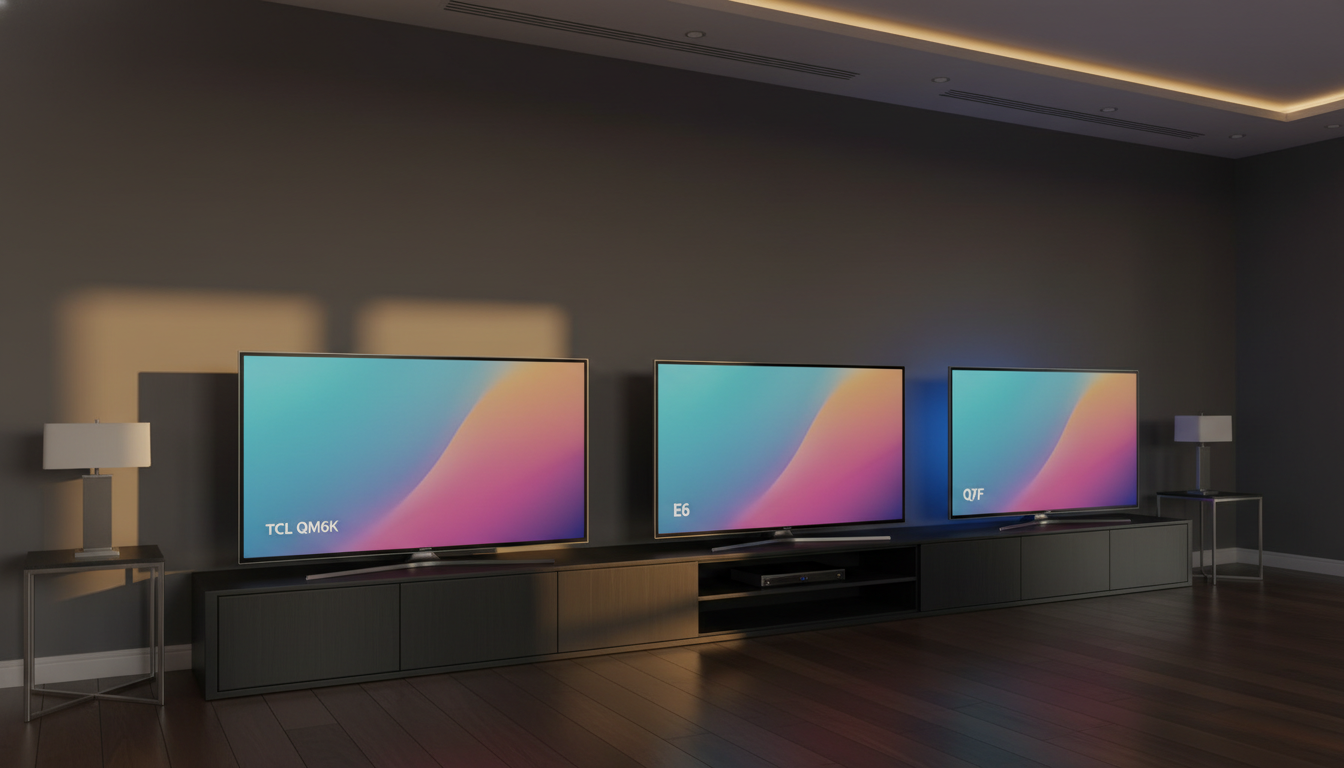
Ten QLED and Mini‑LED TVs were compared to map out the sweet spots across today’s price spectrum. The lineup stretches from the Hisense E6 at $276.99 up to the Sony XR70 at $1598.00, covering budget, mid‑range and premium tiers. Budget‑friendly choices include the Hisense E6, Samsung Q7F, Samsung Q8F and Hisense U6, while the TCL QM6K and Hisense U7 sit in the mid‑range bracket. Premium options feature the Samsung QN70F, Hisense QD7, Samsung QN90F and Sony XR70.
Ratings hover in the 4.2‑4.5 range, with the Hisense U7 earning the highest at 4.5/5 from 537 reviewers and the TCL QM6K close behind at 4.4/5 with 1,409 reviews. Key specs vary widely: the TCL QM6K features a 144 Hz native refresh rate and 240 Hz Game Accelerator, the Hisense QD7 delivers a 600‑nit peak brightness, and the Samsung QN90F offers a 165 Hz motion rate. Whether you need a bright‑room performer, a smooth‑gaming panel, or a cinema‑grade experience, the upcoming sections will break down which models fit each scenario.

TCL QM6K 55-inch
Its slim 11.6‑inch depth keeps it low‑profile for most living rooms.
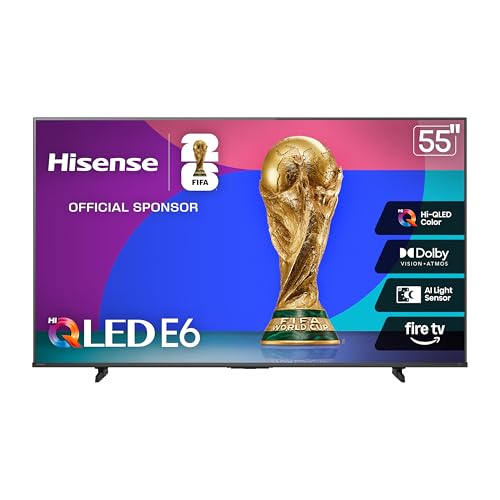
Hisense E6 55-inch
Ideal for entry‑level buyers, it comes in at $276.99 – roughly $201 cheaper than the TCL mid‑range pick.

Samsung Q7F 55-inch
Stands out with a taller 792 mm height, fitting larger wall mounts where the other two models sit lower.
Also considered
Score Analysis
Key score advantages vs. runner-up (Hisense E6 55-inch)
Price Range
TCL QM6K 55-inch
$447.99
Hisense E6 55-inch
$299.99
Samsung Q7F 55-inch
$347.99

Samsung Q8F 43-inch
$397.99

Hisense QD7 85-inch
$797.96

Samsung QN70F 65-inch
$699.99

Sony XR70 65-inch
$1,598.00
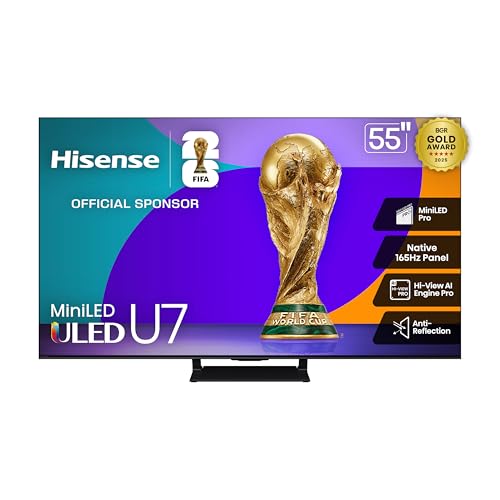
Hisense U7 55-inch
$578.00

Hisense U6 55-inch
$398.96

Samsung QN90F 65-inch
$1,597.99
Spec Comparison
TL;DR: The TCL QM6K 55‑inch QLED Mini‑LED TV packs a 54.6‑inch 4K panel, native 144 Hz refresh (240 Hz Game Accelerator), and solid 4.4‑star rating for $478.
The standout spec is its 144 Hz native refresh rate paired with a 240 Hz Game Accelerator, which lets you push 4K gaming up to 144 Hz with low input lag. Its Mini‑LED backlight and QLED colour layer deliver a 6000:1 contrast ratio on a 54.6‑inch screen, while the AIPQ PRO AI processor runs Google TV for smooth smart‑TV navigation.
At 27.3 pounds, the QM6K's lighter than the 43‑pound Hisense U6 and the 33.3‑pound Hisense U7, but heavier than the 20.5‑pound Hisense E6 and the 24.5‑pound Samsung Q7F. Its 11.6‑inch depth is deeper than the 3‑inch depths of the Hisense U6 and U7, yet comparable to the deeper Hisense E6. The native 144 Hz refresh matches the Hisense U6 and outpaces the 60 Hz panels of the Samsung Q8F and Hisense E6, placing it near the top of the mid‑range lineup.
Everyday owners praise the vivid colours and ultra‑smooth gameplay, especially on next‑gen consoles. Professional reviewers note the TV’s strong gaming performance and bright, vivid visuals, while also pointing out that peak brightness and black uniformity fall short of premium flagship models. Some users report motion‑processing artifacts in Dolby Vision and mention the 27.3‑pound weight can make wall‑mounting a bit of a chore.
Beyond gaming, the TV includes an Onkyo 2.1 speaker system with Dolby Atmos and DTS Virtual:X, and supports Dolby Vision IQ, HDR10+, HDR10 and HLG. Gaming‑specific features such as Auto Game Mode (ALLM), AMD FreeSync Premium Pro and VRR up to 144 Hz round out a well‑equipped package for its price point.
Pros
Cons
Best for: Budget‑conscious gamers and mixed‑use viewers who want bright‑room performance and smooth 4K@144 Hz gaming.
Avoid if: You are a dark‑room cinephile seeking flagship‑level HDR brightness and perfect black uniformity, or need a lightweight TV for easy mounting.
“65-inch no regrets, PS5 and movies great.”
TL;DR: The Hisense E6 55‑inch delivers over a billion QLED colors, Dolby Vision HDR and a voice‑enabled Alexa remote for just $276.99, making it a strong budget pick despite its 60 Hz panel.
The standout feature is the Hi‑QLED panel that delivers “over one billion colors,” paired with a full HDR suite—Dolby Vision, HDR10+ Adaptive, HDR10 and HLG. At a screen size of 1397 mm, the TV offers 4K resolution on a 60 Hz native refresh, and the built‑in AI 4K Upscaler promises sharper upscaled content.
Compared with the other nine entries, the E6 is lighter than the Samsung Q7F 55‑inch (which tips the scales at 24.5 pounds) but heavier than the Samsung Q8F 43‑inch (18.1 pounds). Its 60 Hz refresh rate is modest next to the Q7F’s 200 Hz panel, and it sits below the U6’s 144 Hz native refresh. Pricing-wise, the E6 lands well under the Hisense U6 and the TCL QM6K, making it one of the most affordable options in the lineup.
Consumer sentiment praises the vivid color accuracy and the convenience of the Alexa‑enabled remote. Professional reviewers highlight the “strong QLED color performance” and note that Game Mode Plus delivers low input lag that feels responsive on modern consoles. The AI Light Sensor automatically adjusts brightness to match ambient lighting, a feature many users find helpful for both movies and daytime viewing.
Additional technical touches include HDMI 2.1 connectivity, Wi‑Fi 6, Dolby Atmos sound, and a voice‑enabled remote that runs on two AAA batteries. Variable Refresh Rate and MEMC technology (Motion Rate 120) aim to smooth motion during fast‑action scenes, while Filmmaker Mode preserves creator intent.
Pros
Cons
Best for: Entry-level buyers or those on a tight budget
Avoid if: You need powerful performance or professional‑grade features
“colors are more vivid and accurate”
“fluid and immersive”
TL;DR: The Samsung Q7F 55‑inch QLED delivers a 200 Hz refresh rate, 100 % DCI‑P3 color gamut and sub‑7 ms VRR input lag for $377.99, making it a bright, gamer‑friendly budget pick.
The standout spec on the Q7F is its 200 Hz refresh rate combined with a 6.8 ms input lag in VRR mode, which is unusually fast for a TV in this price tier. Its Quantum Dot panel covers 100 % of the DCI‑P3 color space, and the 10‑bit depth helps render over a billion hues. At 55 inches, the screen sits on a 236 mm deep chassis and weighs 24.5 pounds, while the Vision AI quad‑core processor handles 4K upscaling.
Compared with the other nine models, the Q7F tops the refresh‑rate column—most peers sit at 60 Hz (Samsung Q8F, Hisense E6) or 144 Hz (Hisense U6, TCL QM6K). It’s heavier than the 18.1‑pound Samsung Q8F but lighter than the 43‑pound Hisense U6 and far lighter than the 117.7‑lb Hisense QD7. Its 55‑inch panel matches the size of the Hisense U6, TCL QM6K, Hisense E6 and Hisense U7, yet it remains slimmer than the 65‑inch Samsung QN70F, which also carries a higher weight of 48.1 pounds.
Professional reviewers praise the Q7F’s vibrant Quantum Dot colors and the Vision AI processor for delivering sharp upscaled 4K content. Gamers appreciate the Auto Game Mode and VRR/FreeSync support, especially the sub‑7 ms lag. Everyday users like the built‑in Alexa and Bixby voice assistants and the sleek bezel‑less design, but several note backlight uniformity issues typical of edge‑lit panels and point out that the Energy Efficiency Class 5 is modest, lacking ENERGY STAR certification.
Beyond gaming, the TV runs Samsung’s Knox triple‑layer security and offers Object Tracking Sound Lite for a more immersive audio experience. The Tizen OS with Vision AI provides a wide range of streaming apps, and the recommended viewing distance of 1700 mm aligns well with typical living‑room setups.
Pros
Cons
Best for: Budget-conscious buyers seeking a reliable entry-level option
Avoid if: You have limited desk space or need portability
TL;DR: The Samsung Q8F 43‑inch QLED delivers vivid colors and glare‑free viewing at a modest price, but its 60 Hz panel and limited HDMI ports keep it in the entry‑level camp.
At the heart of the Q8F is Samsung’s QLED panel paired with Dual LED backlighting and Quantum HDR+. The 42.5‑inch screen shows 3840 × 2160 resolution and more than 1 billion Pantone‑certified shades, while the 60 Hz refresh rate keeps motion smooth for everyday content. Weighing just 18.1 pounds, the unit stays light enough for you to move between rooms, and its max power draw of 115 W stays modest for a 4K TV.
Compared with the 55‑inch Hisense U6, which tips the scales at 43.0 pounds, the Q8F is considerably lighter. It also undercuts the Samsung Q7F 55‑inch’s 24.5‑pound weight, making it a good pick for smaller spaces. While many of the larger models in this roundup sport 55‑inch or bigger screens, the Q8F’s 42.5‑inch panel keeps it compact and typically priced below the 65‑inch Samsung QN70F and the 65‑inch QN90F.
Everyday owners rave about the razor‑sharp, responsive image and the glare‑free surface, calling it perfect for movies, sports and casual 1080p gaming in bedrooms or kitchens. Professional reviewers highlight Quantum HDR+ for boosted contrast and the Dual LED system for uniform brightness, noting the picture looks richer than many budget LEDs.
Samsung equips the TV with Tizen OS and includes Vision AI, which continuously tweaks picture and sound based on ambient lighting. An Eco Sensor further fine‑tunes brightness to save energy, while the built‑in Zigbee/Thread hub and Alexa integration turn the set into a smart‑home controller. Knox security adds a layer of protection for apps and personal data.
Pros
Cons
Best for: Budget-conscious buyers seeking a reliable entry-level option
Avoid if: You need advanced features or professional-grade performance
“Super sharp/responsive image like images coming out of the TV”
TL;DR: The Hisense QD7 85‑inch offers a massive Mini‑LED QLED panel with 144 Hz refresh, AI upscaling and Google TV, but its 20 W two‑channel speakers feel modest and the unit is very heavy.
The standout spec is the 85‑inch LCD panel backed by Full Array Local Dimming Mini‑LED and a Quantum Dot color gamut that delivers over a billion shades. With a peak brightness of 600 nits and a native 144 Hz refresh rate, it handles HDR content and fast‑action gaming smoothly. The TV also packs a 20 W 2.0‑channel speaker system and supports Dolby Atmos, DTS and Multi‑Channel audio.
Compared with the nine other models in this roundup, the QD7 is the largest screen – the Samsung QN70F tops out at 65 inches and the next biggest is the Samsung QN90F at 65 inches. At 81.8 lb with its stand, it’s heavier than the Samsung QN70F (48.1 lb) and the Hisense U6 (43.0 lb), but comparable to the Samsung QN90F’s 60.6 lb. Its 144 Hz panel matches the refresh rates of the Hisense U6, TCL QM6K and Samsung Q7F, and exceeds the Samsung QN70F’s 100 Hz base rate. However, its 600 nits peak falls short of the Hisense U7’s 3000 nits and the U6’s 1000 nits, and its 330 W power draw exceeds the QN90F’s typical 137 W consumption.
Professional reviewers praise the deep blacks and vivid HDR that the Mini‑LED and Quantum Dot combo provides, and they note the low input lag and VRR support as a boon for gamers. Everyday buyers echo the picture quality praise, especially for movies and sports, while many point out that the built‑in audio feels under‑powered for Dolby Atmos and that haloing can appear around bright objects due to the entry‑level local dimming. The MediaTek MT9618 processor powers AI Noise Reduction, a 4K AI Upscaler and the Google TV interface, while Alexa, Apple HomeKit and two HDMI 2.1 ports keep it future‑ready for consoles and streaming devices.
Pros
Cons
Best for: Those prioritizing quality and willing to pay for premium performance
Avoid if: you need powerful built‑in audio or a lighter, easier‑to‑move TV
TL;DR: The Samsung QN70F 65‑inch Neo QLED delivers Pantone‑accurate colors, 100 Hz (up to 144 Hz) refresh, and a solar‑charged remote for $699.99, but its Tizen UI can feel clunky.
The QN70F’s standout feature is its Neo QLED panel with Mini LED backlight and Quantum Matrix Slim technology, paired with Pantone‑validated color accuracy. At 65 inches, it offers 4K resolution (3840 × 2160) and a native refresh rate of 100 Hz that can push to 144 Hz for fast action. It draws 141.0 W in typical use and only 0.5 W on standby, and it weighs 48.1 lb.
Compared with the other nine models, the QN70F is lighter than the Hisense QD7 85‑inch (117.7 lb shipping weight) and the Samsung QN90F 65‑inch (60.6 lb). Its depth with stand measures 279.4 mm, which is thicker than the Hisense QD7’s 4.0‑inch profile but still slimmer than many full‑array competitors. The 100 Hz native refresh sits between the Hisense QD7’s 144 Hz and the Samsung Q8F’s 60 Hz, giving it solid gaming performance without the highest‑end rate.
User feedback praises the vivid colors, deep blacks, and smooth gaming experience, especially the FreeSync Premium Pro support. Professional reviewers highlight the Mini LED backlight’s precise brightness control and the Vision AI that automatically personalizes picture and sound. However, several owners note that the Tizen interface can be unintuitive, and there’s some confusion in reviews about whether the backlight is edge‑lit or full‑array.
Technical extras include AI‑enhanced 4K upscaling that uses 20 neural networks, a built‑in Zigbee/Thread hub for SmartThings, Knox security, and a SolarCell One Remote that charges from ambient light—eliminating the need for batteries. The TV also supports Alexa voice control and offers over 2,700 free channels through Samsung TV Plus.
Pros
Cons
Best for: Gamers who need up to 144 Hz refresh rates and movie or sports fans who want vibrant Neo QLED picture quality.
Avoid if: You prioritize absolute black levels of OLED panels or need an ultra‑intuitive smart‑TV interface.
“Vibrant colors, deep blacks, outstanding sharpness for movies/sports, high brightness/contrast, easy smart features, quick app loading, premium home theater feel, and battery-free solar remote”
TL;DR: The Sony XR70 65‑inch delivers Mini‑LED QLED brilliance, 120 Hz refresh and Google TV smart features, but its 62.4‑lb weight and premium $1598.00 price place it at the high end of the lineup.
The standout hardware is the Mini LED QLED panel with XR Backlight Master Drive and XR Triluminos Pro, paired with a 120 Hz refresh rate and four HDMI 2.1 inputs that support VRR, ALLM and 4K @ 120 fps. These specs make fast‑action gaming and HDR cinema look smooth and vibrant, and the Cognitive Processor XR continuously optimizes picture quality.
Compared with the other nine TVs, the XR70 is heavier than the Samsung QN90F (60.6 pounds) and noticeably heavier than the Samsung QN70F (48.1 pounds). Its 65‑inch screen is larger than the 55‑inch and 43‑inch models in the group, and its price tag sits above most rivals, positioning it as a premium alternative.
User sentiment highlights the vivid HDR performance and the ease of using Google TV’s app ecosystem, especially for PlayStation 5 owners who appreciate the built‑in VRR and 4K 120 fps support. Professional reviewers praise the XR Backlight Master Drive for delivering Sony’s brightest 4K output and the XR Motion Clarity for handling fast sports scenes. Common complaints focus on the TV’s 62.4‑lb weight making wall‑mounting a chore and Sony does not disclose peak brightness or local‑dimming zone details, leaving some performance questions unanswered.
Pros
Cons
Best for: Those prioritizing high‑end picture quality, strong gaming features, and a rich smart‑TV ecosystem and are willing to invest in a premium 65‑inch experience.
Avoid if: You're shopping on a tight budget — it's priced at $1598.00.
TL;DR: The Hisense U7 55‑inch delivers a blinding 3000‑nit peak brightness, 144‑165 Hz refresh, and Google TV features, but its $578 price and 33‑lb weight put it above many mid‑range rivals.
The standout spec is the 3000 nit peak brightness, backed by a 1500 nit full‑array backlight, which lets HDR content stay vivid even in well‑lit rooms. Coupled with a 144‑165 Hz native refresh rate and AMD FreeSync Premium Pro, the panel promises smooth motion for fast‑action scenes and gaming.
Compared with the Hisense U6’s 1000‑nit peak, the U7 is three times brighter, while its 33.3 lb weight lands between the lightweight TCL QM6K at 27.3 lb and the bulkier Samsung QN70F at 48.1 lb. The TV also offers four HDMI 2.1 ports, including one eARC, which is more than many of the other nine models in this roundup.
Reviewers consistently highlight the vibrant colors and low‑lag gaming experience, noting the “refined multi‑angle” Dolby Atmos sound as a pleasant surprise for a TV‑only setup. A few users point out that weight listings vary across sources, making mounting decisions a bit confusing, but the 2‑year manufacturer warranty eases that concern.
Under the hood, the U7 uses a Mini‑LED Pro QLED VA panel with over 1 billion quantum‑dot shades, runs Google TV for a broad app library, supports Wi‑Fi 6E, and includes an ATSC 3.0 NextGen tuner for future‑proof broadcast reception. Gaming‑focused features like Game Boost 288, Low‑Latency MEMC, and a 48‑165 Hz VRR range round out the package.
Pros
Cons
Best for: Enthusiastic gamers and bright‑room viewers who want a well‑reviewed, high‑brightness TV with solid smart features.
Avoid if: You need OLED‑level contrast, precise weight data for a tight mounting scenario, or guaranteed high‑bandwidth HDMI eARC support everywhere.
TL;DR: The Hisense U6 55‑inch delivers a true 144 Hz Mini‑LED QLED panel with 1000 nits brightness and Dolby Vision IQ for $429.99, but its modest 20 W speakers may need a soundbar.
The standout feature is the native 144 Hz refresh rate combined with a Mini‑LED QLED VA panel that reaches up to 1000 nits of peak brightness. With 600 full‑array local dimming zones, the TV can push vibrant colors across its 55‑inch screen while keeping blacks deep enough for most dark‑room viewing. Dolby Vision IQ, HDR10+, HDR10, HLG and Advanced HDR by Technicolor round out a full HDR suite, and Dolby Atmos adds immersive audio‑track support.
At 43.0 pounds, the U6 is heavier than the 18.1‑pound Samsung Q8F 43‑inch and the 27.3‑pound TCL QM6K 55‑inch, yet lighter than the 117.7‑pound Hisense QD7 85‑inch. Its 3.0‑inch depth is much slimmer than the 11.6‑inch depth of the TCL model, while still deeper than the 3‑inch depth of the Hisense U7 (which shares the same chassis dimensions). Refresh‑rate wise, the U6 matches the TCL’s 144 Hz native panel and beats the Samsung Q8F’s 60 Hz, though the Samsung Q7F claims a 200 Hz panel.
Reviewers consistently praise the buttery‑smooth motion for fast‑action games and sports, noting that the Game Mode Pro delivers low input lag that satisfies next‑gen consoles. Reviewers highlight the AI‑driven Hi‑View engine for its dynamic tone‑mapping and upscaling, while everyday users love the bright panel’s ability to handle sunny rooms. The main complaints focus on the built‑in 20 W 2.0‑channel speakers, which many find underwhelming, and occasional uniformity or blooming issues that surface in non‑gaming modes.
Pros
Cons
Best for: Entry‑level buyers or those on a tight budget
Avoid if: You want the best value‑per‑dollar in its price range
TL;DR: The Samsung QN90F 65‑inch Neo QLED delivers brilliant 4K visuals with a 720‑zone Mini‑LED backlight, 165 Hz gaming refresh and solid built‑in audio, but it carries a premium $1,377.95 price tag.
What sets the QN90F apart is its Neo QLED Mini LED panel that uses Quantum Matrix Technology Plus with 720 dimming zones, paired with a native 100 Hz refresh that can be boosted to 165 Hz for smooth motion. The TV also packs a 60W 4.2.2‑channel speaker system with Object Tracking Sound+ and Dolby Atmos, giving you immersive sound without a separate soundbar.
At $1,377.95, the QN90F sits above most of the other ten contenders – it’s pricier than the Hisense U7 ($578.00) and the Samsung QN70F ($699.99), yet still cheaper than Sony’s XR70 ($1,598.00). It weighs 60.6 pounds, making it heavier than the QN70F’s 48.1 pounds but a touch lighter than Sony’s 62.4 pounds. All nine rivals list four HDMI 2.1 ports or fewer, while the QN90F confirms four HDMI 2.1 connections, providing future‑proof connectivity.
Consumers consistently praise the QN90F for its “breathtaking 4K visuals” and deep contrast, noting that the Glare Free anti‑reflection coating keeps reflections at bay in bright rooms. Professional reviewers highlight the NQ4 AI Gen3 processor and AI‑enhanced upscaling as key to its vivid colors and detail. However, users also flag the lack of Dolby Vision support and the typical power draw of 137 W, which can raise electricity costs during long viewing sessions.
Technically, the TV runs Samsung’s Vision AI Smart platform with Alexa built‑in, and it supports Neo Quantum HDR+ (HDR10+ Adaptive/Gaming). The 4K AI Upscaling Pro and AI Motion Enhancer Pro further refine picture quality, while the 4 HDMI 2.1 ports enable 4K‑120 gaming on next‑gen consoles. With an annual EU energy consumption of 308.79 kWh and a standby draw of just 0.5 W, it balances performance with modest idle power use.
Pros
Cons
Best for: Those prioritizing quality and willing to pay for premium performance
Avoid if: You need advanced features or professional‑grade performance
“breathtaking 4K visuals, jaw‑dropping contrast (bright highlights/deep blacks even in sports/daytime)”
“Stunning resolution/brightness/contrast, great for high‑demand gaming/movies, reliable Samsung build.”
Breakdown
TCL QM6K 55-inch
Pros
Hisense E6 55-inch
Pros
Cons
Samsung Q7F 55-inch
Pros
Samsung Q8F 43-inch
Pros
Cons
Based on scoring data and product specs
Personalized picks
Best Overall Pick
TCL QM6K 55-inch
Best Mid-Range PickBest for: Most users looking for a well-reviewed, reliable mainstream option
Hisense E6 55-inch
Best for: Entry-level buyers or those on a tight budget
$299.99-$148.00 vs winner
Skip Samsung QN90F 65-inch if…
You need advanced features or professional-grade performance
The TCL QM6K 55‑inch takes the top spot thanks to its Mini LED backlight, true QLED color tech and a 6000:1 contrast ratio that delivers deep blacks. It runs a 144 Hz native refresh rate and supports VRR up to 144 Hz, making fast‑action content look smooth. With a 4.4‑star rating from 1,409 reviewers and a list price of $478.00, it balances performance and price nicely.
Hisense’s E6 55‑inch lands as the runner‑up, especially if you need an affordable TV that still handles gaming and HDR streaming well. Priced at $276.99, it offers Dolby Vision, HDR10+ Adaptive and a voice‑enabled Alexa remote, plus HDMI 2.1, Variable Refresh Rate and Game Mode Plus for a smoother gaming experience. Its 4.2‑star rating from 1,907 reviewers shows solid satisfaction at a budget‑friendly price.
For those focused on price, the Hisense E6 remains the best budget option, delivering strong HDR support and modern connectivity for under $300. If you’re chasing top‑tier performance, the Sony XR70 65‑inch stands out as the premium pick at $1,598.00, offering the highest‑end experience in this lineup.
Pick the TCL QM6K 55‑inch today for top QLED TV value.
The TCL QM6K costs about $478, roughly $200 more than the $276.99 Hisense E6. It leads with a higher overall rating, Mini‑LED backlight, 144 Hz native refresh (up to 240 Hz in game mode) and Dolby Vision IQ, which many buyers consider a worthwhile upgrade over the E6’s 60 Hz panel.
No reviews yet — be the first to share your experience.
Please sign in to leave a review