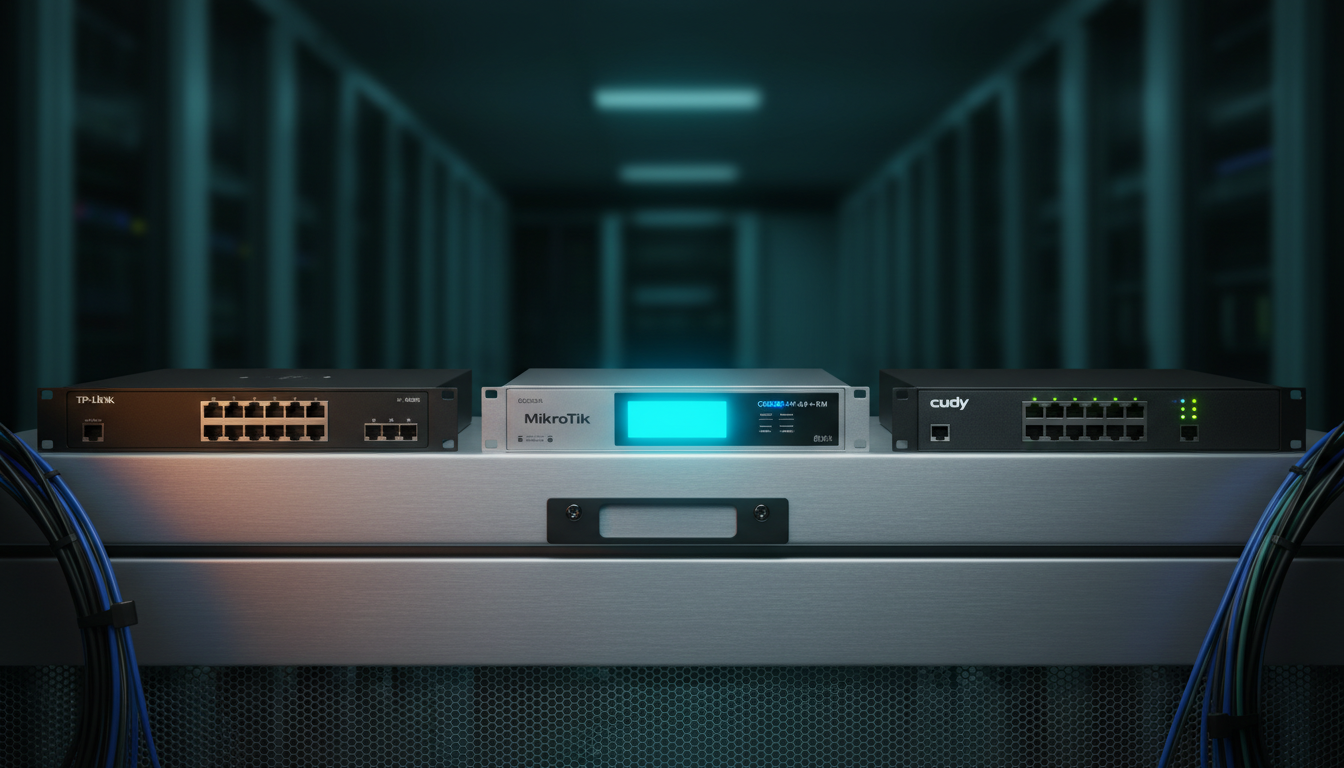
We've compared 10 rack‑mount switches spanning budget, mid‑range, and premium tiers. The lineup includes ultra‑cheap options like the Netgear GS308E at $23.99 and the Tenda TEG1016D at $54.99, solid mid‑range choices such as the TP‑Link TL‑SG1024DE for $99.99, and high‑end models like the MikroTik CRS328‑24P‑4S+RM priced at $475.00. Across the board, ratings hover between 4.5 and 4.8 stars, with the Cudy GS1024L even pulling a 4.8‑star average from 64 reviewers.
Performance metrics vary widely: the premium MikroTik CRS328 delivers a 128 Gbps switching capacity and 95.2 Mpps forwarding rate, while the budget‑friendly Netgear GS308E offers a modest 16 Gbps bandwidth and just 0 dBA acoustic noise. If silent operation matters, the fanless TP‑Link TL‑SG1024DE has a 48 Gbps capacity and a 4.7‑star rating from 1,338 users, making it a strong contender for noise‑sensitive rack rooms.
Below, we'll break down each model’s strengths, ideal use cases, and any drawbacks, so you can match the right switch to your network’s needs.

TP-Link TL-SG1024DE Black
It's compact 11.6 in depth keeps rack space usage low, fitting tight installations while delivering strong value and a high rating.

MikroTik CRS328-24P-4S+RM
Ideal for network pros who need premium features, this model justifies its $475 price—roughly $375 more than the mid‑range pick—by offering advanced performance.

Cudy GS1024L
Stands out with the shallowest 270 mm depth and a $59.99 price tag, delivering the highest 4.8 rating—perfect for tight budgets and limited rack space.
Also considered
Score Analysis
Key score advantages vs. runner-up (MikroTik CRS328-24P-4S+RM)
Price Range
TP-Link TL-SG1024DE Black
$99.99
MikroTik CRS328-24P-4S+RM
$475.00
Cudy GS1024L
$59.99
Ubiquiti UniFi 16-Port PoE
$299.00

TRENDnet 16-Port Switch 5gb Black
$259.99

Tenda TEG1016D
$54.99

Netgear GS308E
$23.99
TP-Link TL-SG1024S
$64.99

Zyxel GS1900-48
$264.00

MikroTik CRS309-1G-8S+in
$245.00
Spec Comparison
TL;DR: The TP‑Link TL‑SG1024DE delivers 48 Gbps of non‑blocking switching across 24 gigabit ports, offers silent fanless operation, and includes basic Layer‑2 management at a solid $99.99 price point.
This 1U rack‑mountable switch packs a 48 Gbps switching capacity and a 35.7 Mpps packet‑forwarding rate, backed by a 4.1 Mbit buffer and 8K MAC address table. All 24 RJ45 ports auto‑negotiate 10/100/1000 Mbps, and the fanless chassis measures 11.6 in deep, 1.7 in high and 7.1 in wide, weighing 3.7475 lbs.
Compared with peers, the TL‑SG1024DE is heavier than the Netgear GS308E’s 500 g chassis but lighter than the Zyxel GS1900‑48 at 8.74 pounds. Its 11.6 in depth exceeds the Cudy GS1024L’s 270 mm depth, while staying shallower than the Tenda TEG1016D’s 345 mm depth. In weight terms it sits between the MikroTik CRS309‑1G‑8S+in’s 1.10231131 pounds and the Trendnet 16‑Port Switch’s 2.16 pounds.
Professional reviewers applaud the completely silent operation and the “green” architecture that trims power use by up to 25 %. Users echo this sentiment, noting the plug‑and‑play setup and reliable gigabit performance. The main criticisms focus on the lack of Power over Ethernet and a management suite that stops at Easy‑Smart features, plus occasional heat buildup in the fanless design under sustained load.
Power consumption ranges from 13.1 W to 14.6 W, and the unit dissipates 48.39 BTU/h. The switch supports jumbo frames up to 10 KB, which can help reduce overhead in storage‑oriented traffic. It also offers IGMP snooping, static link aggregation, port mirroring and storm control, giving small‑to‑medium networks a solid feature set without the complexity of full‑layer‑3 devices.
Pros
Cons
Best for: Most users looking for a well‑reviewed, reliable mainstream option
Avoid if: You need advanced features or professional‑grade performance
TL;DR: The MikroTik CRS328‑24P‑4S+RM packs 24 PoE‑enabled Gigabit ports, four 10 Gbps SFP+ uplinks, a 450 W PoE budget and 128 Gbps switching capacity in a 1U chassis, but it comes at a premium price.
The standout specification is the combination of 24 PoE‑capable Gigabit Ethernet ports delivering up to 30 W per port and a total PoE budget of 450 W, plus four 10 Gbps SFP+ uplink ports for fiber connectivity. Under the hood, an 800 MHz ARM CPU, 512 MB RAM and a non‑blocking 128 Gbps switching capacity give wire‑speed performance, while the forwarding rate of 95.2 Mpps ensures low‑latency traffic handling.
Compared with the other nine switches in this roundup, the CRS328‑24P‑4S+RM weighs 10.01 lb, out‑weighing the Zyxel GS1900‑48 (8.74 lb) and the Ubiquiti UniFi 16‑Port PoE (6.17 lb). Its forwarding rate of 95.2 Mpps surpasses the Ubiquiti’s 27 Mpps, Zyxel’s 74 Mpps and TRENDnet’s 59.52 Mpps, while its 128 Gbps switching capacity tops the TP‑Link TL‑SG1024DE’s 48 Gbps and matches the higher‑end MikroTik CRS309‑1G‑8S+in’s 162 Gbps non‑blocking layer‑1 rating. The switch also costs more than most alternatives, placing it in the premium tier.
User feedback consistently highlights the flexibility of the dual‑boot SwOS/RouterOS platform, allowing administrators to switch between pure Layer 2 switching and full routing features without additional hardware. Reviewers also appreciate the auto‑sensing PoE that simplifies powering IP cameras, VoIP phones and Wi‑Fi APs. The only recurring criticism points to the $475.00 price tag, which many consider steep for a 1U unit, especially when budget‑oriented models are available.
Additional technical context includes an ARM 32‑bit CPU architecture, 16 MB flash storage, and built‑in monitoring sensors for CPU temperature, PCB temperature, voltage and current. The device operates from 100‑240 V AC, draws up to 44 W when no PoE devices are attached, and supports a maximum current output of 20 A. Its MTBF of approximately 200,000 hours at 25 °C and operating temperature range of –20 °C to 60 °C underline its suitability for enterprise environments.
Pros
Cons
Best for: Those prioritizing quality and willing to pay for premium performance
Avoid if: You're shopping on a tight budget — it's priced at $475.00
TL;DR: The Cudy GS1024L offers 24 unmanaged gigabit ports, a fanless metal case, and a non‑blocking 48 Gbps switching capacity at $59.99, making it a quiet, plug‑and‑play choice for budget‑conscious small networks.
The GS1024L packs 24 × 10/100/1000 Mbps RJ45 ports into a 270 mm deep, 44 mm high metal enclosure that runs completely fanless. It delivers a non‑blocking 48 Gbps switching capacity and a forwarding rate of 35.71 Mpps, while a 4 MB packet buffer helps smooth traffic bursts. Power draw tops out at 15 W, and the switch supports IEEE 802.3X flow control, auto‑MDI/MDIX and auto‑negotiation for truly plug‑and‑play deployment.
Compared with the other nine switches in this roundup, the Cudy is lighter than the Netgear GS308E (500 g) but heavier than the TP‑Link TL‑SG1024S, which weighs about 3.44 lb. Its 270 mm depth sits between the compact Netgear (101 mm) and the deeper Tenda TEG1016D (345 mm). Height matches the TP‑Link TL‑SG1024S at 44 mm, while its 182 mm width is similar to most peers. Like the TP‑Link TL‑SG1024DE, it also offers a 48 Gbps switching capacity, but unlike many rivals it does not provide PoE or SFP uplinks.
Users consistently praise the switch’s silent operation and how easy it is to set up— you don’t need a configuration wizard thanks to its unmanaged design. Reviewers also note the solid build of the metal case. The most common complaints revolve around the lack of PoE, which means you can’t power cameras or phones directly, and the “extend mode” that caps bandwidth to 10 Mbps on ports 1‑22, limiting long‑run performance. Additionally, the absence of any management interface or fiber ports can be a deal‑breaker for more advanced setups.
From a technical standpoint, the 8 K‑entry MAC address table (8192 entries) provides ample capacity for small‑to‑medium office environments, and the non‑blocking architecture guarantees each port can use the full 1 Gbps when needed. The built‑in VLAN isolation on ports 1‑22 offers a simple way to segment traffic without any configuration, while the wide operating temperature range (0‑40 °C) and humidity tolerance (10‑85 % non‑condensing) suit typical office climates.
Pros
Cons
Best for: Entry-level buyers or those on a tight budget
Avoid if: You want the best value‑per‑dollar in its price range
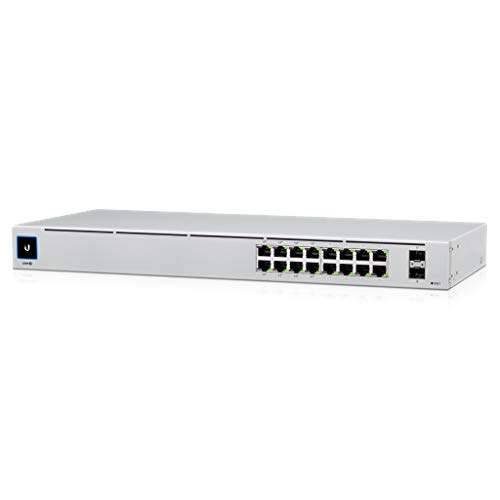
TL;DR: The Ubiquiti UniFi 16‑Port PoE offers eight 32 W PoE+ ports, a 36 Gbps switching capacity and a silent 1U fanless design for small‑office networks, but its total PoE budget and throughput sit below higher‑end rivals.
This switch’s headline feature is the eight PoE+ RJ45 ports, each capable of delivering up to 32 W. With a total PoE power budget of 42 W, you can power access points, cameras or phones without needing a separate injector. The unit also packs a 36 Gbps switching capacity and a forwarding rate of 27 Mpps, all inside a 1U rack‑mount chassis that measures 7.9 in deep, 1.7 in high and 17.4 in wide.
Compared with the other nine switches in this roundup, the UniFi is heavier than the 2.16‑lb TRENDnet 16‑Port Switch 5 Gb but lighter than the 8.74‑lb Zyxel GS1900‑48. Like Zyxel and TRENDnet, it uses a fanless design, so you’ll get silent operation in a rack. However, its 36 Gbps switching capacity trails Zyxel’s 100 Gbps and TRENDnet’s 80 Gbps, and the 27 Mpps forwarding rate is lower than the 74 Mpps Zyxel and 59.52 Mpps TRENDnet models.
User feedback frequently praises the silent operation and the convenience of eight PoE+ ports for powering a small office’s devices. Reviewers also note the solid 4.5‑star rating from 284 reviewers, while some point out that the total PoE budget of 42 W may feel limiting for larger deployments. The switch’s ESD protection (air ±16 kV, contact ±12 kV) and heat dissipation of 61.4 BTU/hr help it stay reliable within an operating temperature range of –5 °C to 40 °C.
Pros
Cons
Best for: Small office or home office setups that need managed PoE, silent rack operation and a compact 1U footprint.
Avoid if: You require a high total PoE budget or core‑level throughput for large‑scale deployments.
TL;DR: The TRENDnet TEG‑S3160 delivers 16 fanless 2.5 GbE ports with 80 Gbps switching capacity in a compact 2.16‑lb metal case, but it lacks VLAN support.
At the core of the TEG‑S3160 is a 16‑port 2.5 GBASE‑T RJ‑45 array, each running at 2.5 Gbps and adding up to an 80 Gbps switching capacity. The unit forwards traffic at 59.52 Mpps, and its fanless metal enclosure keeps it silent even under load. With a height of just 26.9 mm, a length of 285.8 mm and a width of 127.5 mm, the switch weighs 2.16 pounds, making it easy to mount in tight rack or wall spaces.
When you line it up against the other nine contenders, the TRENDnet feels notably lighter than Zyxel’s 8.74‑pound GS1900‑48 and far slimmer than Zyxel’s 43.18 mm height. Its 80 Gbps switching capacity sits between Zyxel’s 100 Gbps and the TP‑Link TL‑SG1024DE’s 48 Gbps, while the forwarding rate of 59.52 Mpps outpaces Ubiquiti’s 27 Mpps and TP‑Link’s 35.7 Mpps, though it trails Zyxel’s 74 Mpps. Compared with MikroTik’s CRS309‑1G‑8S+in, the TRENDnet is heavier (2.16 lb vs 1.10 lb) but offers a higher switching capacity than the MikroTik’s 81 Gbps throughput figure.
Reviewers consistently highlight the silent, fanless design and the plug‑and‑play experience – “no moving parts, just plug in and go.” Users also appreciate the solid metal chassis and the straightforward setup. On the flip side, several users have reported occasional network drops after a device reboot, and the lack of VLAN (802.1p) support means the switch can’t handle tagged traffic in managed environments.
The switch runs from an external power adapter (wattage not listed) and accepts Cat5e or better cables. It carries a lifetime warranty and offers both rack‑mountable (1U) and wall‑mountable options, giving small offices flexibility in placement.
Pros
Cons
Best for: Those prioritizing quality and willing to pay for premium performance
Avoid if: You need advanced features or professional‑grade performance
“flawless operation after initial setup”
“network drops on restarts”
TL;DR: The Tenda TEG1016D is a 16‑port, fanless 1U steel switch offering 32 Gbps capacity, 6 kV lightning protection, and plug‑and‑play simplicity at a budget‑friendly $54.99 price.
The switch’s most eye‑catching feature is its fanless full‑steel housing with 6 kV common‑mode lightning protection on all ports and the power supply, keeping it silent while guarding video‑surveillance rigs from surges. It packs 16 auto‑negotiating 10/100/1000 Mbps ports, a 32 Gbps switching capacity, an 8 K‑entry MAC address table, and a 2M buffer, all while drawing a maximum of 12 W at 220 V.
Physically, the TEG1016D is deeper (345 mm) than the Cudy GS1024L’s 270 mm depth and the TP‑Link TL‑SG1024S’s 294 mm depth, and its 254 mm height dwarfs the typical 44 mm height of most rack‑mount peers. Its 32 Gbps switching capacity also trails the 48 Gbps offered by the Cudy, TP‑Link, and TP‑Link TL‑SG1024DE Black models, and falls well below the 80 Gbps of the TRENDnet 16‑Port Switch 5gb and the 100 Gbps of the Zyxel GS1900‑48.
Customers praise the device’s plug‑and‑play setup and the quiet, steel enclosure, which the solid 4.7‑star rating from 1,268 reviewers reflects. Reviewers also note the value of the built‑in lightning protection for surveillance setups. The unmanaged design, however, means there are no VLAN, QoS, or PoE capabilities, which some users find limiting for larger or more complex networks.
Pros
Cons
Best for: Budget‑conscious buyers seeking a reliable entry‑level option
Avoid if: You have limited desk space or need portability
TL;DR: The Netgear GS308E delivers eight gigabit ports, 16 Gbps non‑blocking bandwidth and a fanless 0 dBA design while sipping just 3.7 W, making it a quiet, low‑power entry‑level switch.
The GS308E’s core is an eight‑port Gigabit Ethernet layout backed by a 16 Gbps switching bandwidth and a non‑blocking architecture. The chassis measures only 101 mm deep, 29 mm high and 158 mm wide, and it weighs 500 g, so it fits easily on a desk, wall mount or into a rack. With a maximum power draw of 3.7 W and an acoustic noise level of 0 dBA, the unit runs silently and stays energy‑efficient thanks to IEEE 802.3az compliance.
Compared with the other nine switches in this roundup, the GS308E measures notably more compact than the Tenda TEG1016D’s 345 mm depth and is slimmer than the Cudy GS1024L’s 44 mm height. It also weighs less than the Cudy model’s 1057 g, while still offering a full eight‑port gigabit lineup that many of the larger 16‑ and 24‑port peers lack. Though its 16 Gbps switching capacity trails the 32 Gbps and 48 Gbps figures seen on some rivals, the GS308E’s price point positions it as the most budget‑friendly option.
Users consistently praise the switch’s silent operation and ultra‑low power draw, noting that it can stay on 24/7 without adding to electricity bills or office noise. Reviewers also highlight the easy‑to‑use “Easy Smart Managed Essentials” software for basic VLAN and QoS setup. The main criticisms focus on the absence of Power over Ethernet and the lack of 10 Gbps uplink ports, which some buyers see as limiting for future‑proofing.
Beyond the basics, the GS308E offers 4 K MAC address table entries, 64 VLANs, and QoS options such as IEEE 802.1p, DSCP and WRR. Jumbo frames up to 9,000 bytes and a 192 kB buffer help smooth traffic spikes, while a mean‑time‑between‑failures rating of 1.6 million hours signals long‑term reliability for small office or home setups.
Pros
Cons
Best for: Budget-conscious buyers seeking a reliable entry-level option
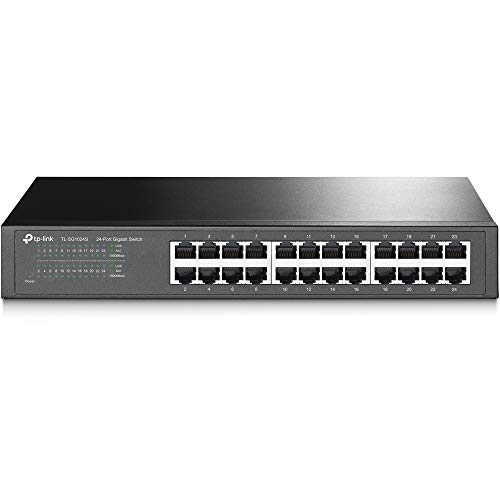
TL;DR: The TP‑Link TL‑SG1024S delivers 24 unmanaged Gigabit ports, a 48 Gbps non‑blocking switch, fanless metal design, and a lifetime warranty for just $64.99, making it a solid, silent workhorse for small networks.
At the core of this switch is a 48 Gbps non‑blocking switching capacity paired with a 35.7 Mpps packet‑forwarding rate, ensuring every one of the 24 RJ45 ports runs at full 10/100/1000 Mbps speed. The metal chassis measures 294 mm deep, 44 mm high and 180 mm wide, and the fanless design keeps noise down while the energy‑efficient technology helps keep power draw between 13.1 W and 20.2 W.
Compared with the other nine entries, the TL‑SG1024S is heavier than the Cudy GS1024L (which weighs 1057 g) but lighter than the TL‑SG1024DE (about 1700 g). Its 180 mm rackmount depth is shallower than the Tenda TEG1016D’s 345 mm depth, while its 44 mm height matches many 1U rackmount units. It also carries more ports than the Netgear GS308E, which only offers eight ports, and it provides a higher switching capacity than the 16‑port Netgear model’s 16 Gbps bandwidth.
Reviewers consistently praise the plug‑and‑play setup, silent operation, and reliable Gigabit performance for home offices or small businesses. Professional observers note the 8 K MAC address table and support for IEEE 802.3x flow control as solid fundamentals. The main complaints revolve around the lack of VLAN or QoS controls and the fact that power consumption can climb to 20.2 W under full load, which some users find higher than they'd expect for an unmanaged unit.
Pros
Cons
Best for: Budget-conscious buyers seeking a reliable entry-level option
Avoid if: You need advanced features or professional‑grade performance
“ultra fast data transfer speeds”
TL;DR: The Zyxel GS1900-48 delivers 48 GbE ports, 100 Gbps switching capacity and a fanless silent design for $264.91, but its lack of PoE and heavier chassis may limit some SMB use cases.
The standout spec is the 100 Gbps switching capacity paired with a 74 Mpps forwarding rate, which lets the switch handle full‑duplex Gigabit traffic across all 48 RJ‑45 ports and two 1 Gbps SFP uplinks without bottlenecking. Its 1U rackmount form factor measures 200.66 mm deep, 43.18 mm high and 203.2 mm wide, fitting standard 19‑inch racks while staying compact enough for cramped network closets.
Compared with the nine other switches in this roundup, the GS1900‑48 is noticeably heavier at 8.74 lb, outclassing the TRENDnet 16‑port (2.16 lb), MikroTik CRS309 (≈1.10 lb) and the TP‑Link TL‑SG1024DE (≈3.75 lb). It’s also wider than the TL‑SG1024DE’s roughly 180 mm chassis, though its depth is shorter than that model’s 294 mm. In terms of raw throughput, its 100 Gbps capacity sits above the TRENDnet’s 80 Gbps and the TP‑Link models’ 48 Gbps, though it trails the MikroTik CRS309’s 162 Gbps and the CRS328‑24P‑4S+RM’s 128 Gbps.
User feedback highlights the silent, fanless operation and the intuitive web‑based setup wizard, which many reviewers say makes initial configuration a breeze. Professionals note the Energy Efficient Ethernet and dual‑firmware images as valuable for power savings and safe upgrades. However, customers repeatedly mention the absence of PoE as a drawback when trying to power Wi‑Fi access points or security cameras directly from the switch.
Pros
Cons
Best for: Small‑to‑medium businesses that need a silent, high‑capacity 48‑port Gigabit switch and are willing to invest in a premium, non‑PoE solution.
Avoid if: Your deployment relies heavily on PoE devices or you prioritize the lightest possible rackmount hardware.
TL;DR: The MikroTik CRS309‑1G‑8S+IN packs eight 10 GbE SFP+ ports, a fanless chassis, and 162 Gbps switching capacity into a 500 g, rack‑mountable unit for a $245 price.
The standout feature is its eight 10 GbE SFP+ ports plus a single 1 GbE management port, delivering a non‑blocking 162 Gbps switching capacity. The unit runs fanlessly, drawing a maximum of 23 W, and its chassis weighs just 500 g (1.10231131 pounds) with a 28 mm height, making it easy to fit into tight rack spaces.
Compared with the other nine switches in this roundup, the CRS309 is notably lighter than the TRENDnet 16‑Port Switch (2.16 pounds) and the Zyxel GS1900‑48 (8.74 pounds), matching the Netgear GS308E at 500 g. Its 162 Gbps capacity dwarfs the 80 Gbps of the TRENDnet and the 48 Gbps found in most 24‑port peers, while the eight 10 GbE ports far outpace the 2.5 Gbps ports on the TRENDnet. However, its $245 price tag sits above the sub‑$100 options like the TP‑Link TL‑SG1024DE.
Professional reviewers praise the ultra‑compact, fanless chassis for quiet, reliable operation, and they note the inclusion of RouterOS level 5 licensing, which unlocks advanced L3 features not common in unmanaged switches. Users do point out the lack of a native 10 GbE RJ45 uplink, meaning any copper 10 GbE connection requires an SFP+ module, and the single 1 GbE management port can feel limiting for larger deployments.
The switch also supports PoE‑in (802.3af/at, 18‑57 V) and a DC jack (12‑57 V), giving flexibility for power sourcing. With 512 MB of RAM and 16 MB of flash storage, it has enough headroom for routing and switching tasks in SMB or homelab environments, and it operates from –40 °C to +70 °C, covering most indoor data‑center temperatures.
Pros
Cons
Best for: Network administrators, ISPs, SMBs, and homelab enthusiasts who need dense 10 GbE SFP+ switching in a compact, fanless package.
Avoid if: You need multiple native 10 GbE RJ45 ports or plan to run the switch in high‑ambient temperature environments without extra cooling.
Breakdown
TP-Link TL-SG1024DE Black
Pros
MikroTik CRS328-24P-4S+RM
Pros
Cons
Cudy GS1024L
Pros
Cons
Ubiquiti UniFi 16-Port PoE
Pros
Cons
Based on scoring data and product specs
Personalized picks
Best Overall Pick
TP-Link TL-SG1024DE Black
Best Mid-Range PickBest for: Most users looking for a well-reviewed, reliable mainstream option
MikroTik CRS328-24P-4S+RM
Best for: Those prioritizing quality and willing to pay for premium performance
$475.00+$375.01 vs winner
Skip MikroTik CRS309-1G-8S+in if…
You have limited desk space or need portability
Winner: The TP‑Link TL‑SG1024DE Black takes the top spot thanks to its solid 24 × 10/100/1000 Mbps ports, a 48 Gbps switching capacity and a 4.7‑star rating from 1,338 reviewers. Its fanless 1U design (11.6 in depth, 1.7 in height) and a limited‑lifetime warranty make it a reliable, low‑maintenance choice for most rack‑mount environments.
Runner‑up: The MikroTik CRS328‑24P‑4S+RM makes the best pick if you need advanced PoE and high‑speed uplinks. It offers 24 Ethernet ports plus four 10 Gbps SFP+ ports, a 450 W PoE budget and a 128 Gbps switching capacity, delivering the flexibility that demanding small‑to‑medium business networks need.
Budget alternative: Netgear GS308E – at $23.99 it provides a simple, plug‑and‑play 8‑port solution for tight budgets.
Premium alternative: MikroTik CRS328‑24P‑4S+RM – priced at $475.00, it delivers enterprise‑grade PoE and 10 Gbps uplinks for users who need top‑tier performance.
Pick the TP‑Link TL‑SG1024DE Black today and you’ll get a dependable, feature‑rich switch that fits most rack setups without breaking the bank.
The MikroTik CRS328-24P-4S+RM includes built‑in PoE with a 450 W budget and supports 802.3af/at, making it suitable for powering cameras, while the TP‑Link TL‑SG1024DE has no PoE capability. If you only need basic networking without PoE, the TL‑SG1024DE is a quieter, lower‑cost option.
No reviews yet — be the first to share your experience.
Please sign in to leave a review
