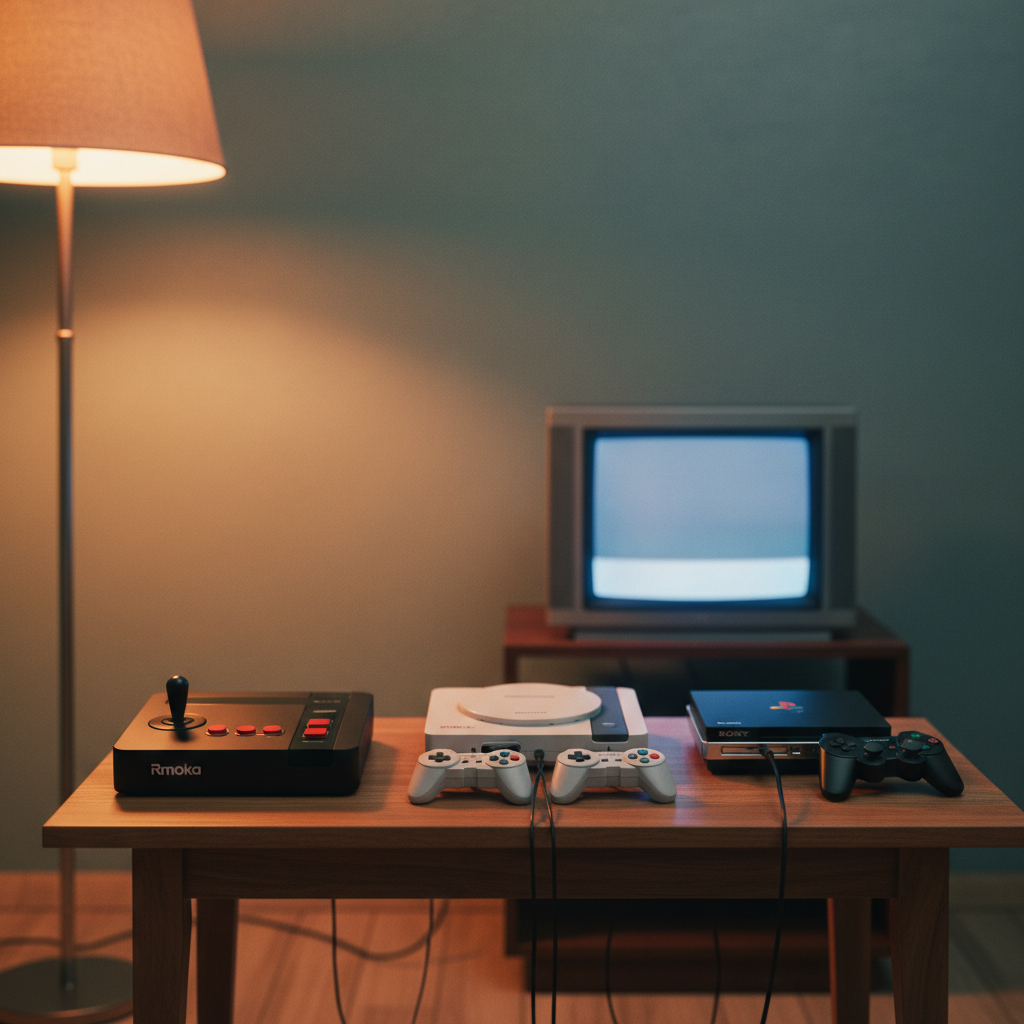
Out of the six consoles we compared, the Rmoka Retro Gaming Console takes the top spot. Priced at $49.99, it ships with more than 20,000 classic titles across 23 emulators, 4K‑upscaled HDMI output and two 2.4 GHz wireless controllers that reach a 40‑foot range. Its compact 76.2 mm depth and 500 g weight make it easy to slip into a dorm room or bring to a friend’s living room for instant multiplayer fun.
The lineup spans three price tiers: budget options like the Latimand M8 ($42.99) and Fanyooge Retro Gaming Console ($43.99) give you 20,000+ games on a 64 GB card; mid‑range picks include the Rmoka ($49.99) and Generic Retro Gaming Console ($69.99, rated 4.7/5 from 24 reviews) with reliable HDMI performance; premium choices are the Sony PlayStation Classic ($123.90, 4.1/5 from 2,193 reviews) offering a curated 20‑game library, and the Doc and Pies Classic Green arcade cabinet ($749.00, 4.8/5 from 18 reviews) that delivers a full‑size arcade feel.
Next, we’ll break down each system’s strengths, quirks and ideal use‑cases so you can pick the retro console that fits your space and nostalgia cravings.
Rmoka Retro Gaming Console
Its 12.2 m (40 ft) wireless range delivers solid connectivity for a mid‑range price.
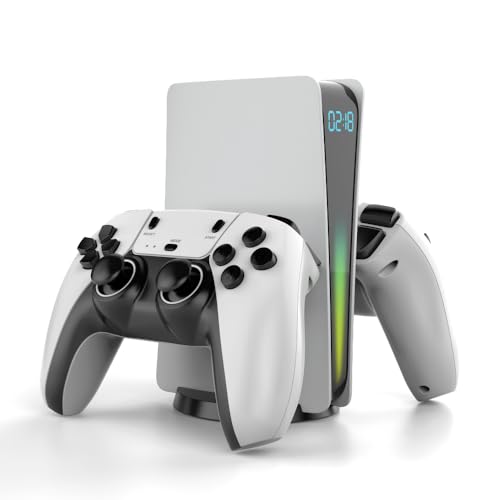
Generic Retro Gaming Console
Ideal for gamers who want a 2.4 GHz controller and are willing to spend about $20 more than the Rmoka for a slightly longer 32.8 ft range.
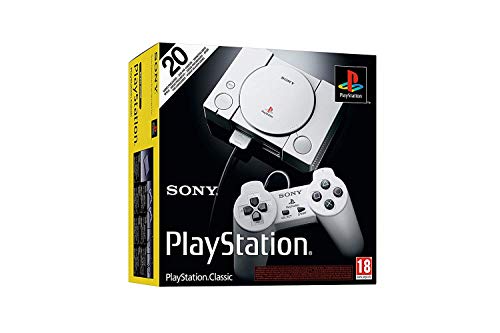
Sony PlayStation Classic
Featuring a 170.1 g lightweight design and a 1.5 m controller cable, the Sony PlayStation Classic lets you keep the console portable and wired, a setup the other two lack.
Also considered
Score Analysis
Key score advantages vs. runner-up (Generic Retro Gaming)
Price Range
Rmoka Retro Gaming Console
$49.99
Generic Retro Gaming Console
$69.99
Sony PlayStation Classic
$123.90
Latimand M8
$42.99
Fanyooge Retro Gaming Console
$43.99

Doc and Pies Classic Green
$749.00
Spec Comparison
TL;DR: The Rmoka Retro Gaming Console packs over 20,000 games across 23 emulators on a 64 GB card, offers 4K upscaling and two 12.2 m‑range wireless controllers for $49.99.
What sets this box apart is the sheer size of its library: more than 20,000 titles are pre‑installed on a 64 GB TF card, and the system supports 23 built‑in emulators. The HDMI output can upscale to 4K while the native resolution stays at 1080p, giving classic pixels a modern boost. Two wireless controllers work up to 12.2 m (40 ft) away, so you can game from across the living room.
Compared with the five other consoles in the roundup, the Rmoka sits in the middle of the size and weight spectrum. At 500 g it's heavier than the Fanyooge’s 422.4 g and the Latimand’s 390 g, but lighter than the Generic’s 668 g and far lighter than the Doc and Pies unit that tips the scales at 22.7 kg. Its height of 177.8 mm exceeds the Fanyooge’s 112.01 mm and the Sony Classic’s 101.6 mm, yet it's shorter than the Generic’s 142.9 mm. Storage‑wise, it matches the Fanyooge and Latimand with 64 GB, while offering far more emulators than the Latimand’s nine.
Users love the instant‑plug‑and‑play feel and the massive catalog; many mention the “instant nostalgia” of dropping the console into a TV and diving straight into a favorite arcade title. However, reviewers note that a handful of games only show static screens or freeze, and the controllers require four AA batteries each, which adds an ongoing cost. Professional reviewers point out the lack of a disclosed SoC, meaning performance can vary, and they warn that purists seeking cycle‑accurate emulation may be disappointed.
Pros
Cons
Best for: Nostalgic adults and families who want a quick, all‑in‑one way to revisit 80s‑90s games without fiddling with downloads.
Avoid if: You prefer products with extensive real‑world feedback, rechargeable controllers, or cycle‑accurate emulation for competitive retro gaming.
“Brings back childhood memories—my kids love playing Mario and Sonic with me.”
“Half the games don’t work—just show a ‘press start’ screen or freeze.”
TL;DR: The Generic 2025 Upgraded Mini delivers over 10,000 pre‑installed games, 12 emulators and 1080p HDMI output with 4K upscaling for $69.99, offering a plug‑and‑play retro experience for casual gamers.
This console’s standout spec is its massive library: it includes more than 10,000 classic titles and the system supports 12 different emulators. It outputs native 1080p video and can upscale to 4K (3840×2160), so it looks sharp on modern TVs. The two included 2.4 GHz wireless controllers reach up to 32.8 ft, and the unit runs on a modest 5 W of power via a USB‑C 5 V/1 A input.
Compared with the other five entries, the Generic Mini offers fewer pre‑installed games than the Rmoka and Fanyooge models, which list 20,000+ titles, but it matches their 64 GB internal storage. Its 12 emulators sit between Rmoka’s 23 and Latimand M8’s 9, giving a middle‑ground variety. In terms of weight, it weighs more than the 390 g Latimand M8 yet far less than the Doc and Pies Classic Green, which weigh over 22 kg. All six consoles include two wireless controllers, so the Mini’s controller count is on par with its peers.
Reviewers consistently praise the hassle‑free setup – just plug the USB‑C power cable, connect the HDMI, insert the wireless receiver and you’re ready to play. Users love the sheer volume of games for family gatherings, but they often note the plastic build feels cheap and the controller D‑pads are stiff. Professional reviewers also highlight the lack of an SD card slot, meaning you can’t add your own ROMs, and some mention occasional input lag on the wireless controllers.
Beyond the library, the console’s technical details are straightforward: it draws 5 W typical power, runs on a 5 V/1 A USB‑C supply, and the wireless receiver operates on a 2.4 GHz band. The included extended HDMI cable ensures you can reach most TV setups without needing extra accessories. With a compact footprint of 142.9 mm × 207.3 mm × 188.2 mm and a weight of 668 g, it fits nicely on a shelf or bedside table.
Pros
Cons
Best for: Casual gamers, families, and gift‑givers who want a simple, portable retro console for quick multiplayer sessions.
Avoid if: You prefer extensive customization, official ROM support, or premium build quality.
“Brings back childhood memories—my kids love playing Mario and Sonic with me.”
“Half the games don’t work—just show a ‘press start’ screen or freeze.”
TL;DR: The Sony PlayStation Classic is a compact replica of the original PS1 that ships with 20 pre‑installed games, two wired controllers and HDMI output for modern TVs, but its limited library and PAL speed quirks may disappoint power users.
The standout feature is the inclusion of 20 preloaded classic titles, letting you jump straight into nostalgia without any downloads. The console also comes with two replica wired controllers, a 1.5 m controller cable, an HDMI cable and a USB power cable, so setup's truly plug‑and‑play. Under the hood sits a 1.5 GHz MediaTek quad‑core CPU, 1 GB DDR3 RAM and 16 GB of eMMC flash storage, which's enough for the bundled games.
Compared with the other five entries, the PlayStation Classic sits at the higher price tier and offers fewer built‑in emulators – it runs the PCSX ReARMed PS1 emulator only, while the Rmoka and Fanyooge consoles each list 23 emulators and the Latimand M8 provides nine. Storage is also modest at 16 GB, versus the 64 GB in Rmoka, Fanyooge and Latimand. The PlayStation Classic tops out at 720p, while the Generic Retro Gaming Console supports up to 1080p. Sony sticks with wired replicas for controllers, while the peer devices all ship with wireless controllers. Physically, the PlayStation Classic’s 170.1 g weight and 228.6 mm square footprint make it far more compact than the massive Doc and Pies Classic Green arcade cabinet.
Reviewers consistently praise the faithful miniature design and the hassle‑free HDMI connection, noting that the virtual memory cards with save‑state support add a modern convenience to classic games. However, many users lament the limited selection – notable franchises like Crash Bandicoot and Spyro are absent – and report that PAL‑region titles run slower on NTSC TVs. The wired controllers lack analog sticks and vibration, and the 1.5 m cable length is often called short. Professional outlets also point out the lack of upscaling, which can make the image look softer on high‑definition displays.
Pros
Cons
Best for: Nostalgic adult gamers who want an authentic PlayStation look and a ready‑to‑play collection of classic titles.
Avoid if: You need a huge game library, analog‑stick controls, parental‑control features, or are on a tight budget.
TL;DR: The Latimand M8 packs over 20,000 classic titles onto a 64 GB card, delivers 4K HDMI output, and runs on two 2.4 GHz wireless controllers for just $42.99.
The standout spec is its 4K Ultra HD HDMI output (3840 × 2160) combined with a built‑in 64 GB SD card that holds more than 20,000 vintage games across nine emulators. The console also supports save states and includes an extended HDMI cable, so you can hook it up to any modern TV without extra downloads.
At 13.76 oz (390 g) and a footprint of 5.5 × 3.9 × 2.7 in, the M8 weighs noticeably less than the Fanyooge’s 422.4 g chassis and is shorter than the Rmoka’s 177.8 mm height. However, it includes fewer emulators—nine versus the 23 found in both the Fanyooge and Rmoka models—while matching their 64 GB internal storage capacity. Unlike some rivals that ship with a power brick, the M8 requires an external USB power adapter, which isn’t included.
Users praise the plug‑and‑play simplicity: just connect HDMI, insert the pre‑loaded TF card, and power it up. Families love the massive library and the ability to play together on two wireless controllers. Professional reviewers note the convenience of 4K output and the breadth of supported systems. On the downside, several owners mention occasional lag or freezing when the power source is weak, and the omission of batteries and a power adapter forces extra purchases. Build‑quality concerns and the unclear licensing status of the ROM collection also surface in criticism.
Pros
Cons
Best for: Casual retro gamers, families looking for shared entertainment, and gift‑givers who want a ready‑to‑play console without the hassle of downloading games.
Avoid if: You need a high‑precision controller for competitive play, prefer a fully licensed ROM library, or want a system that includes every possible emulator out of the box.
TL;DR: The $43.99 Fanyooge Retro Gaming Console packs 20,000+ preloaded games, 23 emulators, and two wireless controllers into a compact 4K‑ready box, offering instant retro fun for casual gamers.
What sets this console apart is its massive library: it preloads more than 20,000 games, and 23 built‑in emulators let you tackle a wide range of classic systems. It stores everything on a 64 GB internal drive and outputs up to 4K via HDMI, so modern TVs can display retro titles with surprising clarity. The package also includes two 2.4 GHz wireless controllers with 360° joysticks, and the unit measures 112.01 mm in height, 165.1 mm in length, and 122.94 mm in width.
Against the other five consoles in this roundup, the Fanyooge holds its own. The Latimand M8 only supports 9 emulators, so the Fanyooge’s 23‑emulator count is a clear step up. Both the Latimand M8 and the Rmoka Retro Gaming Console list 64 GB of storage, matching the Fanyooge’s capacity, while the Rmoka also offers 23 emulators and 20,000+ games, putting the two on equal footing there. In size, the Fanyooge’s 112.01 mm height sits between the compact Latimand M8 (68.58 mm) and the larger Generic Retro Gaming Console (142.9 mm).
User feedback highlights the sheer number of games and the plug‑and‑play setup as major wins. Buyers love that they can power the unit with a standard USB source, connect via HDMI, and start playing within seconds. Professional reviewers note the affordable entry point and the convenience of bundled controllers, but they also point out that the build feels less solid than higher‑priced rivals and that the internal storage may not hold up over time. The lack of Wi‑Fi or Bluetooth means you’ll need extra dongles for any wireless audio or online features.
Under the hood, the console runs an Android‑based operating system (likely Android 10) and is marketed as a Nintendo 3DS‑style device, even though the hardware is a generic Android stick. Its 2.4 GHz wireless frequency and 360° joystick design aim to reduce input lag, while the HDMI 4K upscaling ensures the retro graphics look as crisp as possible on modern displays.
Pros
Cons
Best for: Casual retro gamers, parents buying for children, and beginners who want a simple, ready‑to‑play console.
Avoid if: You want the best value‑per‑dollar in its price range or need premium build quality and advanced connectivity.
“Brings back childhood memories—my kids love playing Mario and Sonic with me.”
“Half the games don’t work—just show a ‘press start’ screen or freeze.”
TL;DR: The Doc and Pies Classic Green is a hand‑assembled, wood‑cased arcade cabinet with a 19‑inch LCD and 412 built‑in games, but it carries a premium $749.00 price tag.
This model’s standout feature is its full‑size arcade joystick and buttons paired with a 19‑inch fixed‑resolution LCD that preserves the classic 4:3 aspect ratio. With 412 pre‑installed titles, it offers a far richer library than the Sony PlayStation Classic’s 20 games or the Generic Retro Gaming Console’s modest selection.
In size and heft, the Classic Green dwarfs the Sony PlayStation Classic, which weighs just 170.1 g, and the Generic Retro Gaming Console at 668 g. Even the Rmoka Retro Gaming Console, at 500 g, is a fraction of the 22.7 kg weight of this cabinet. Those smaller units also cost less, but they lack the large screen and arcade‑style controls that define the Doc and Pies experience.
Reviewers consistently praise the authentic arcade feel that the full‑size joystick and buttons deliver, calling the wood‑based cabinet a “centerpiece” for game rooms. Professional reviewers highlight the handcrafted construction and lifetime technical support as strong selling points. However, users frequently mention low‑quality inkjet decals that fade over time and occasional dead or blown‑out pixels on the LCD, which can detract from the nostalgic vibe.
Additional technical notes: the unit plugs into a standard AC wall outlet, offers free technical support for the life of the machine, and comes with a 2‑year warranty. It doesn't support ROM expansion, and the manufacturer doesn't list internal storage capacity or emulator count.
Pros
Cons
Best for: Retro gaming enthusiasts, home game‑room owners, or bar/lounge operators who value authentic arcade controls and a sizable built‑in game library.
Avoid if: You’re shopping on a tight budget or expect museum‑grade finish quality — the unit is priced at $749.00 and has reported decal and screen issues.
“Love it! It’s a big hit in my home.”
“Fantastic product, exactly as described. Great customer service.”
Breakdown
Rmoka Retro Gaming Console
Pros
Generic Retro Gaming Console
Pros
Sony PlayStation Classic
Pros
Cons
Latimand M8
Pros
Based on scoring data and product specs
Personalized picks
Best Overall Pick
Rmoka Retro Gaming Console
Best Mid-Range PickBest for: Home and office users seeking a balance of features and value
Generic Retro Gaming Console
Best for: Home and office users seeking a balance of features and value
$69.99+$20.00 vs winner
Skip Doc and Pies Classic Green if…
You're shopping on a tight budget — it's priced at $749.00
The Rmoka Retro Gaming Console takes the top spot thanks to its massive library of over 20,000 pre‑installed games, a built‑in 64 GB TF card and 4K upscaling that delivers crisp 1080p visuals on modern TVs. It also ships with two 2.4 GHz wireless controllers that work up to 12.2 m (40 ft) away, so you can game comfortably from across the room. At $49.99 it offers a solid feature set without breaking the bank.
Coming in as the runner‑up, the Generic Retro Gaming Console is ideal if you prefer a console that includes a USB‑C power cable and an extended HDMI cable right out of the box. It includes more than 10,000 classic titles, 4K upscaled output and a wireless range of 32.8 ft (10 m), which can be handy for larger living rooms. Priced at $69.99, it’s a good choice for anyone who wants those extra accessories without needing to purchase them separately.
For shoppers looking beyond the top two, the Latimand M8 delivers the best budget option at $42.99, giving you a functional retro experience at the lowest price point. The Rmoka console already serves as the mid‑range champion, so there’s no need to repeat it here. If you’re after a premium, museum‑grade piece, the Doc and Pies Classic Green stands out at $749.00, offering a high‑end collector’s item for serious enthusiasts.
Pick the Rmoka Retro Gaming Console today and start playing instantly.
The Rmoka Retro Gaming Console and the Fanyooge Retro Gaming Console both list 4K upscaling and come with two wireless controllers. Rmoka also supports native 1080p and upscales to 4K, while Fanyooge offers 4K upscaling from its 4K resolution output.
Please sign in to leave a review
No reviews yet. Be the first to review!
