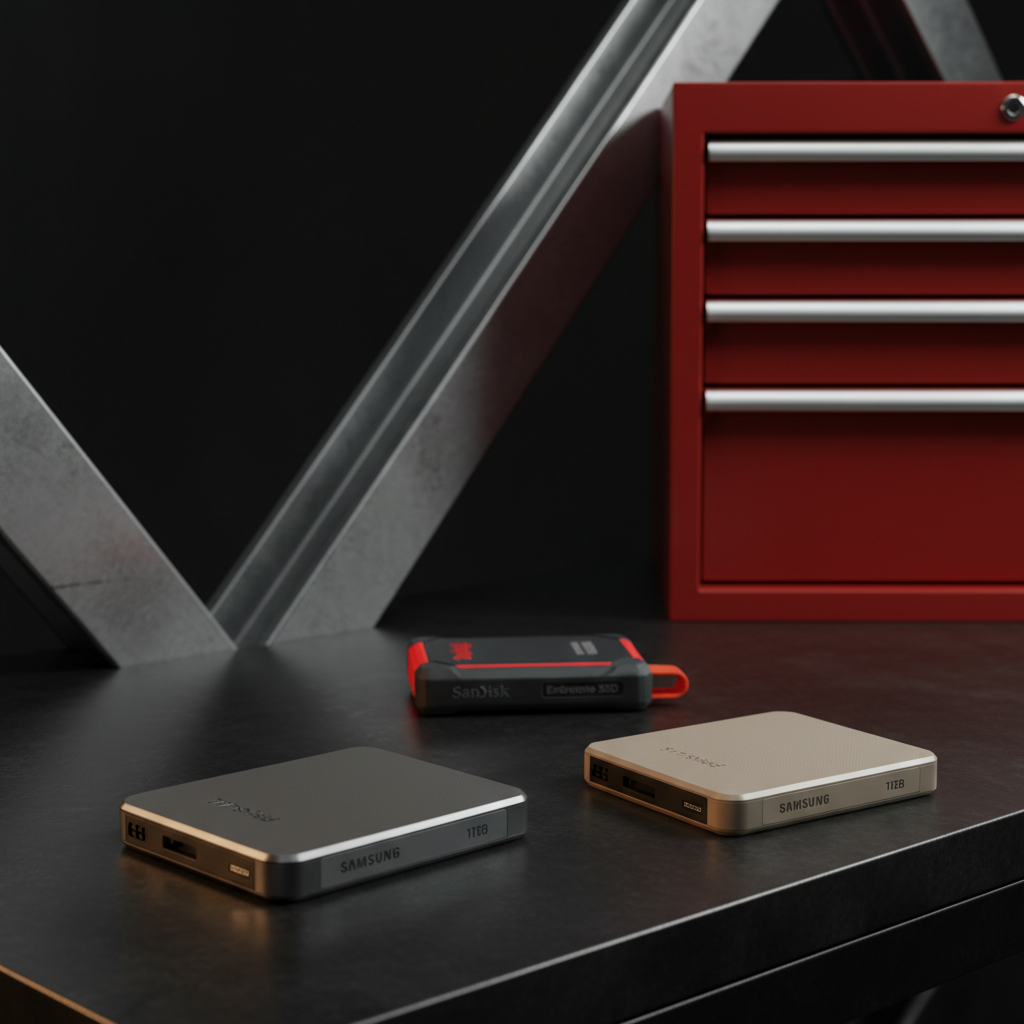
When you need an external SSD that can survive a tumble, a splash, or a dusty field day, you’re not alone. We’ve compared 13 rugged drives, ranging from compact 500 GB units to hefty 2 TB workhorses, and each one promises shock‑proof performance. The lineup includes fan favorites like the Samsung T7 Shield 1TB, which carries a 4.7‑star rating from 16,039 reviewers, and the SanDisk Extreme Portable SSD that advertises up to 1050 MB/s read speeds while shrugging off 3 m drops.
To make sense of the options, we’ve grouped them into three price tiers. The budget tier features the Samsung T7 Shield 1TB (list price $224.99) and the SanDisk Extreme Portable SSD 1TB ($189.59), both delivering IP65 water‑dust resistance and 3 m drop protection. Mid‑range picks like the LaCie Rugged SSD 1TB ($279.99) and Samsung T5 1TB ($299.99) balance solid performance with a 5‑year warranty. Premium choices—such as the Samsung T7 Shield 2TB ($399.99) and G‑Technology ArmorLock 2TB ($299.99)—add higher capacities, IP65 shells, and enterprise‑grade encryption.
Below we break down each model’s durability, speed, and value so you can pick the right rugged SSD for your needs.

Samsung T7 Shield 1TB
Its slim 13 mm height makes it easy to slip into pockets while staying rugged enough for shock‑proof use.

Samsung T7 Shield 1TB Beige
Perfect for style‑conscious creators who want the same rugged performance as the standard T7 Shield, and it costs the same $224.99 as the top mid‑range pick.
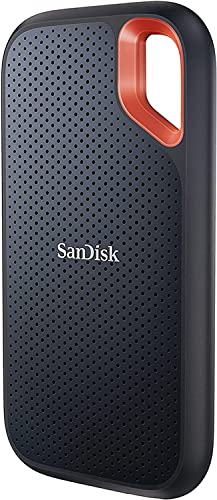
SanDisk Extreme Portable SSD 1TB
With an ultra‑compact 9.7 mm length, you can stash it in tight spaces—a dimension the Samsung models lack.
Also considered
Score Analysis
Key score advantages vs. runner-up (Samsung T7 Shield)
Price Range
Samsung T7 Shield 1TB
$224.99
Samsung T7 Shield 1TB Beige
$224.99
SanDisk Extreme Portable SSD 1TB
$182.00
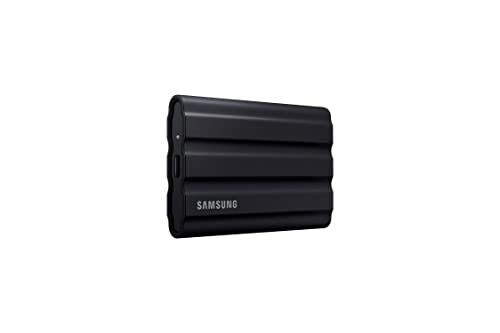
Samsung T7 Shield 2TB Portable SSD
$399.99
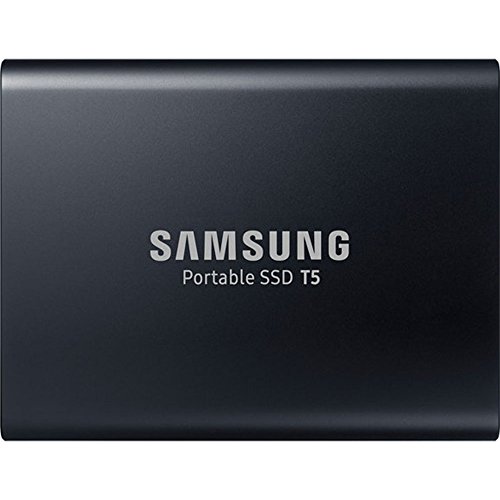
Samsung T5 1TB
$299.99
G-Technology ArmorLock 2TB
$299.99

Samsung T5 Portable SSD 500GB
$224.00

Transcend ESD410 2TB SSD
$489.99

Transcend 2TB External SSD
$397.99

LaCie Rugged SSD 1TB
$279.99

SanDisk Fortnite 1TB
$189.99
Buffalo SSD-SAO1.0U3B
$119.99

Kootion KT-X1max-1TB
$119.99
Spec Comparison
TL;DR: The Samsung T7 Shield 1TB packs 1,050 MB/s reads, 1,000 MB/s writes, IP65 dust‑ and water‑jet protection and 3 m drop resistance into a 98 g, 13 mm‑tall, 1 TB portable SSD for $224.99.
The standout spec is its ruggedness: an IP65 rating guards against fine dust and low‑pressure water jets, while the chassis survives drops up to 3 m (9.8 ft) onto hard surfaces. Under the hood, the drive delivers up to 1,050 MB/s sequential reads, 1,000 MB/s writes and sustained performance of 900 MB/s via a USB 3.2 Gen 2 (10 Gbps) Type‑C interface, all in a compact 13 mm × 88 mm × 59 mm form factor that weighs just 98 g.
Compared with its peers, the T7 Shield is marginally larger than the beige T7 Shield (12.5 mm tall, 86 mm long) but shares the same weight class. It outpaces the Samsung T5 1TB, which lists 540 MB/s read and 515 MB/s write speeds, and matches the SanDisk Extreme Portable SSD’s 1,050/1,000 MB/s figures while offering identical 3 m drop protection. The LaCie Rugged SSD 1TB is slightly heavier at 99.2 g and carries the same read/write speeds, whereas the 500 GB Samsung T5 Portable SSD is notably lighter at about 45 g but lacks the T7 Shield’s drop and water‑jet resistance.
Users consistently praise the drive’s durability in field conditions, noting that the IP65 rating and 3 m drop resistance give confidence when shooting outdoors or traveling. Reviewers also highlight the AES‑256‑bit hardware encryption and Dynamic Thermal Guard for reliable data security and heat management. On the downside, some owners mention the price feels premium, the included USB‑C cables feel flimsy, and prolonged writes can generate noticeable warmth. Professional reviewers point out that, while fast for a rugged SSD, the T7 Shield lags behind Thunder‑bolt or USB‑3.2 Gen 2x2 solutions and lacks an IP68 immersion rating or a fingerprint sensor.
Pros
Cons
Best for: Outdoor photographers, videographers and travelers who need a fast, 1 TB SSD that can handle dust, water jets and drops.
Avoid if: You require full submersion waterproofing (IP68) or the absolute fastest Thunderbolt‑class performance.
“4.8/5 stars based on over 1,270 reviews”
TL;DR: The Samsung T7 Shield 1TB Beige delivers 1 TB of fast, USB 3.2 Gen 2 storage with an IP65 rating and 3 m drop resistance, all in a compact, well‑reviewed package for $224.99.
What really sets this drive apart is its ruggedness: it features an IP65 dust‑and‑water‑jet rating and can survive drops from up to 3 meters (9.8 ft). On the speed side, Samsung lists sequential reads of up to 1,050 MB/s and writes of up to 1,000 MB/s, putting it in the same league as premium portable SSDs while keeping the 1 TB (1,000 GB) capacity you need for large media files.
Compared with other SSDs in the roundup, the T7 Shield is heavier than the ultra‑light Samsung T5 1TB (which weighs about 0.1125 pounds) and the SanDisk Extreme Portable SSD 1TB (around 0.11 pounds), but it’s a touch lighter than the LaCie Rugged SSD 1TB (roughly 0.22 pounds). It also carries more listed specifications than the Samsung T5 1TB, giving buyers a richer feature set to evaluate.
Professional reviewers praise the drive’s “high durability” and “fast sequential read/write speeds,” while everyday users repeatedly note the confidence it gives them on outdoor shoots and fieldwork. A common complaint is the rubber outer shell can become sticky or collect lint after heavy use, and the lack of an IP68 rating means it won’t survive full submersion. The device also omits a fingerprint sensor, which some competitors include for biometric security.
Beyond durability, the T7 Shield includes AES‑256‑bit hardware encryption for strong data protection, Dynamic Thermal Guard technology to keep temperatures in check, and UASP support for optimized performance on compatible systems. Samsung bundles Magician and Portable SSD software, making drive health monitoring and firmware updates straightforward. The drive works with Windows 7+, macOS 10.10+, Android 5.1+, and major gaming consoles, and it carries a 3‑year manufacturer warranty.
Pros
Cons
Best for: Outdoor professionals, field journalists, and content creators who need fast, reliable storage that can survive drops and dust.
Avoid if: You require full submersion (IP68) protection, biometric fingerprint security, or the lightest possible weight for ultra‑portable setups.
“4.8/5 stars based on over 1,270 reviews”
TL;DR: The SanDisk Extreme Portable SSD 1TB delivers 1050 MB/s reads, 1000 MB/s writes, IP65 dust‑and‑water resistance and 3 m drop protection in a feather‑light 0.11‑lb package for under $190.
The drive’s headline spec is its NVMe‑class performance: up to 1050 MB/s read and 1000 MB/s write speeds, which puts it on par with the Samsung T7 Shield 1TB and far ahead of the Samsung T5’s 540 MB/s read and 520 MB/s write figures. At 0.11 pounds (49.9 g), it's only slightly heavier than the T5’s 0.1‑pound body but considerably lighter than the T7 Shield’s roughly 0.21‑pound chassis.
Durability is where the SanDisk really shines. It offers a full 3‑meter drop protection rating, matching the T7 Shield and LaCie Rugged SSD, and surpasses the T5’s 2‑meter claim. The IP65 ingress rating adds water‑resistance that most peers don’t list, making it a solid choice for outdoor shoots or dusty environments. Reviewers consistently praise the built‑in carabiner loop for securing the drive to a belt or backpack, and the 256‑bit AES hardware encryption earns frequent mentions for keeping sensitive footage safe.
On the software side, the included SanDisk Memory Zone app lets you manage files and free up space automatically, a convenience highlighted by professional reviewers. Compatibility spans Windows, macOS 10.9+ and Android, and the USB‑C (USB 3.2 Gen 2) interface comes with both a USB‑C‑to‑USB‑C cable and a USB‑C‑to‑USB‑A adapter—though some users note the adapter can feel a bit loose after heavy use. The drive ships with a 5‑year limited warranty, reinforcing SanDisk’s confidence in its rugged design.
Pros
Cons
Best for: Content creators and travelers who need fast, rugged storage without breaking the bank.
Avoid if: You cannot tolerate any early hardware failures or prefer a drive without an external adapter.
“Transfers my 50GB video projects in under a minute.”
“Survived a rainstorm during a shoot—still works perfectly.”
TL;DR: The Samsung T7 Shield 2TB Portable SSD packs 2 TB of storage, IP65 dust‑and‑water protection and 3 m drop resistance into a 12.5 mm‑thin, 0.21384839414‑pound drive that hits up to 1,050 MB/s read and 1,000 MB/s write.
What really sets this SSD apart is its rugged envelope: an IP65‑rated rubberized shell guards the drive against dust, water jets and drops from up to 3 m (9.8 ft). Inside, Samsung delivers 2 TB (2000 GB) of capacity and sequential performance of up to 1,050 MB/s read and 1,000 MB/s write via a USB‑C 3.2 Gen 2 (10 Gbps) interface. The drive measures just 12.5 mm in height, 86 mm in length and 57 mm in width, and it weighs 0.21384839414 pounds (98 g), making it easy to slip into a pocket or camera bag.
Compared with the other 12 contenders, the T7 Shield sits near the top of the durability ladder—its IP65 rating outmatches the Transcend 2TB’s IPX5 and rivals the LaCie Rugged SSD’s 3 m drop rating, while remaining lighter than the Transcend 2TB (0.3968320716 pounds) and far lighter than the G‑Technology ArmorLock (2.0 kg). Speed‑wise, it trails the Transcend 2TB’s 2,000 MB/s claim but still outpaces the Samsung T5’s 540 MB/s read and the LaCie Rugged’s 1,050 MB/s ceiling. Its price point is higher than the budget‑focused models, reflecting its premium build and Samsung branding.
Users consistently applaud the drive’s ruggedness and plug‑and‑play convenience, noting that the included USB‑C to USB‑C and USB‑C to USB‑A cables make it ready for laptops, consoles and mobile devices right out of the box. Professional reviewers highlight the solid write performance and the 256‑bit AES hardware encryption for data security. On the downside, many report real‑world read speeds hovering around 835 MB/s, below the advertised 1,050 MB/s, and some find the cable length a bit short for longer workstations. A few also mention that the SSD can become noticeably warm during extended transfers.
Under the hood, the T7 Shield runs on Samsung’s Pablo controller with a 128‑layer 3D TLC V‑NAND chip and relies on Host Memory Buffer (no dedicated DRAM). Dynamic Thermal Guard technology helps keep temperatures in check, and the drive draws power directly from the USB port, eliminating the need for an external adapter. With a 3‑year limited warranty and 256‑bit AES encryption, Samsung builds it for field workers, outdoor photographers and anyone who needs a fast, secure storage solution that can survive the elements.
Pros
Cons
Best for: Buyers willing to invest in a proven, high-quality option
Avoid if: You're on a tight budget or only need basic functionality
“4.8/5 stars based on over 1,270 reviews”
TL;DR: The Samsung T5 1 TB delivers 540 MB/s read speeds in a feather‑light 51‑gram aluminum shell, offers 256‑bit AES encryption, and survives drops up to 2 m, all backed by a 3‑year warranty.
The drive packs a 1 TB (≈1,000 GB) capacity into a compact 57.4 mm × 73.9 mm × 10.4 mm aluminum unibody that weighs just 51 grams (0.1125 lb). Samsung rates sequential read at 540 MB/s and write at 515 MB/s, and lists a 10 GB transfer speed of around 212 MB/s. The device also includes 45 cm (18‑inch) USB‑C to‑C and USB‑C to‑A cables, so you can plug straight into PCs, Macs, or compatible smartphones.
Compared with the LaCie Rugged SSD, the T5 is roughly half the weight (51 g vs 99.2 g) but its drop resistance of 2 m falls short of LaCie's 3 m rating and the 1050 MB/s read/write speeds those models claim. The G‑Technology ArmorLock weighs 2.0 kg and survives 3 m drops, placing the T5 in the ultra‑portable, budget‑friendly tier. Its 3‑year limited warranty is shorter than the 5‑year coverage offered by several rivals.
Users consistently praise the T5’s “lightning‑quick” file transfers and the confidence of hardware‑based 256‑bit AES encryption with optional password protection. Professional reviewers note the solid‑state design, dynamic thermal guard protection, and the convenience of both USB‑C and USB‑A cables in the box. Common complaints include macOS read quirks out of the box, the inability to recover data after a forgotten password, and the exFAT format limiting Time Machine backups without reformatting.
Pros
Cons
Best for: Buyers willing to invest in a proven, high‑quality option
Avoid if: You need advanced features or professional‑grade performance
TL;DR: The G‑Technology ArmorLock 2TB packs 256‑bit hardware encryption, IP67 waterproofing and up to 1000 MB/s USB‑C speeds into a rugged 2 kg portable SSD for $299.99.
What really sets this drive apart is its built‑in 256‑bit AES‑XTS hardware encryption, which pairs with password‑less biometric unlocking via Face ID or fingerprint, and the ArmorLock app manages it. The manufacturer also lists a crush resistance of 1000 lb (≈450 kg) and an IP67 rating, meaning it can survive immersion in water and drops from 3 meters.
In the context of the 13‑product roundup, the ArmorLock is considerably heavier than the Samsung T5 (about 0.11 lb) and the Samsung T7 Shield (under 0.22 lb), and its dimensions (18.5 mm × 134.4 mm × 81.5 mm) are bulkier than those sub‑centimeter drives. Its sequential read and write speeds of up to 1000 MB/s sit alongside the Samsung T7 Shield’s 1050 MB/s read and 1000 MB/s write, while the Transcend 2TB claims up to 2000 MB/s—but the ArmorLock’s listed IOMeter read of 999.4 MB/s and write of 957 MB/s still place it firmly in the high‑performance camp.
Users consistently praise the “peace of mind” from the zero‑knowledge encryption model, with professional reviewers highlighting the security architecture as “innovative” and “enterprise‑grade.” Everyday owners also note the straightforward app setup and the drive’s ability to keep up with large media files. On the flip side, the lack of Android app support at launch and the absence of a built‑in GPS tracker are frequent complaints, and the single 2 TB capacity limits flexibility for those who need multiple size options.
Pros
Cons
Best for: Media and entertainment professionals, government or defense field agents, and anyone who values top‑tier encryption and rugged durability.
Avoid if: You need Android app support, built‑in GPS tracking, or a broader range of storage capacities.
“solves the problem of secure devices being too cumbersome to use”
“a plug-and-play 2TB in the palm of your hand the size of a KitKat”
TL;DR: The Samsung T5 Portable SSD 500 GB delivers 540 MB/s read, 520 MB/s write speeds in a 45 g aluminum shell that survives 2‑meter drops, making it a solid entry‑level rugged drive.
The drive’s standout spec is its maximum sequential read speed of 540 MB/s and write speed of 520 MB/s, paired with a 500 GB capacity that fits easily in a pocket. Its aluminum unibody weighs only 0.1 pounds (45 g) and can survive drops from up to 2 meters, offering a blend of speed and durability for on‑the‑go creators.
Compared with the other rugged SSDs in this roundup, the T5 is noticeably lighter than the Samsung T7 Shield 1TB, which tips the scales at about 0.2138 pounds. However, its 2‑meter drop resistance falls short of the 3‑meter rating that the T7 Shield and the SanDisk Extreme Portable SSD have. In terms of raw performance, the T5’s 540 MB/s read speed is slower than the 1,050 MB/s reads those same models advertise, but it still outpaces many older portable drives.
Users consistently praise the T5 for its “lightning‑quick” transfers and the confidence that AES‑256‑bit hardware encryption provides. Professional reviewers note the compact aluminum body as a durability win, while some consumers mention the 3‑year limited warranty feels brief compared with the longer warranties of certain rivals. The lack of a published endurance (TBW) rating also shows up in a few complaints.
Pros
Cons
Best for: Budget-conscious buyers seeking a reliable entry-level option
Avoid if: You need advanced features or professional‑grade performance
“Transfers my 50GB video projects in under a minute.”
“Survived a rainstorm during a shoot—still works perfectly.”
TL;DR: The Transcend ESD410 2TB SSD delivers up to 2000 MB/s read/write, 3 m drop resistance, IPX5 water protection, and a 64 GB cache in a lightweight 0.1433004703 lb, 14.5 mm thin package.
This drive’s headline spec is the 2000 MB/s maximum read and write speed, paired with a 64 GB pSLC cache that keeps sustained writes around 1128 MB/s. It survives drops from three meters, meets an IPX5 ingress rating, and fits in a pocket‑sized chassis measuring 14.5 mm high, 79 mm long, and 42 mm wide.
Compared with the other contenders, the ESD410 is lighter than the Samsung T7 Shield 2TB (0.21384839414 lb vs 0.1433004703 lb) and only slightly thicker than its 12.5 mm profile. It is dramatically slimmer than the Transcend 2TB External SSD’s 96.5 mm height, though a bit heavier than the Samsung T5 1TB’s 0.1125 lb. Its three‑meter drop rating matches the Samsung T7 Shield, LaCie Rugged, and G‑Technology ArmorLock models, while the IPX5 rating sits below the Samsung T7 Shield’s IP65 but still offers water‑jet resistance. Speed‑wise, its 2000 MB/s ceiling outpaces the up‑to‑1,050 MB/s read and 1,000 MB/s write of the Samsung T7 Shield and the 1,050 MB/s read/write of the LaCie Rugged SSD.
Users consistently praise the lightning‑quick off‑loading of 4K/8K footage and the rugged feel that survives field work. Professional reviewers note the near‑maximum USB 3.2 Gen 2x2 throughput (≈1910 MB/s read, ≈1687 MB/s write) and the MIL‑STD‑810G construction. The most common complaint is noticeable heat during prolonged high‑speed transfers, and many mention the need for a USB‑C to USB‑C cable to hit full speed—USB‑A connections will throttle performance. The drive also lacks an LED indicator, which some users miss for transfer status.
Under the hood, the SSD uses 3D NAND flash and a USB 3.2 Gen 2x2 (20 Gbps) interface, powered by a 5 V supply. A five‑year limited warranty backs the unit, and the 4.5‑star rating from 442 reviewers reflects solid satisfaction.
Pros
Cons
Best for: Those prioritizing quality and willing to pay for premium performance
Avoid if: You're shopping on a tight budget — it's priced at $489.99
TL;DR: The Transcend 2TB External SSD delivers up to 2000 MB/s read/write speeds, IPX5 water resistance, and MIL‑STD‑810G 3 m drop protection, but it carries a premium $397.99 price tag.
What really stands out is the “up to 2000 MB/s” sequential read and write performance, which sits at the top end of portable SSD speeds. Transcend builds the drive to survive the field with an IPX5 water‑resistance rating and MIL‑STD‑810G certification for drops up to 3 meters. Weighing 0.3968 lb (180 g) and measuring just 12.5 mm thick, it’s light enough to slip into a camera bag.
Compared with the other 12 entries in this roundup, the Transcend is noticeably faster than the Samsung T7 Shield 2TB (which tops out at 1,050 MB/s) and the Samsung T5 1TB (540 MB/s read, 515 MB/s write). Its drop rating matches the Samsung T7 Shield’s 3 m survivability, but the Transcend is heavier than the T7 Shield (0.2138 lb) and the LaCie Rugged SSD (0.2205 lb). It remains far lighter than the G‑Technology ArmorLock, which tips the scales at 2.0 kg. In short, you get premium speed at the cost of a bit more heft.
Users consistently praise the “blazing‑fast transfers” and the ability to record Apple ProRes 4K 60 fps directly from an iPhone, a feature highlighted by professional reviewers. Its 0.3968 lb weight and bus‑powered operation also earn frequent compliments. Reviewers note the lack of built‑in 256‑bit AES hardware encryption—security relies on software OTP via Transcend Elite—and the absence of a bundled protective case. Reviewers say the dark‑green finish shows scratches more readily, and they consider the limited color palette a minor complaint.
Technically, the SSD connects via USB‑C using a USB 3.2 Gen 2 (20 Gbps) interface and ships with a USB‑C to USB‑C cable, so no external power brick is needed. It ships pre‑formatted in exFAT and includes Transcend Elite software for one‑time‑pad encryption. The 5‑year warranty adds peace of mind for creators who need a reliable, rugged storage solution.
Pros
Cons
Best for: Those prioritizing quality and willing to pay for premium performance
Avoid if: You're shopping on a tight budget — it's priced at $397.99
“Users appreciate the blazing‑fast transfer speeds, especially when moving large video files.”
“Many iPhone users praise the ability to record ProRes video directly to the drive.”
TL;DR: The LaCie Rugged SSD 1TB delivers 1050 MB/s read/write speeds, IP67 water‑dust protection, and a 5‑year warranty, but its short USB‑C cable and port durability concerns may deter power users.
The standout spec is the advertised 1050 MB/s sequential read and write speed, matching the top‑end performance of the Samsung T7 Shield 1TB. Coupled with an IP67 ingress rating and a 3‑meter drop resistance, LaCie builds the drive for harsh field conditions while keeping it bus‑powered via a single USB‑C connector.
Compared with other rugged drives in the roundup, the LaCie weighs 0.220462262 pounds, making it heavier than the Samsung T5 1TB at 0.1125 pounds but far lighter than the G‑Technology ArmorLock 2TB, which tips the scales at 2.0 kilograms. Its 3‑meter drop resistance lines up with both the Samsung T7 Shield and the G‑Technology ArmorLock, while none of the listed competitors mention an IP67 rating, giving LaCie a durability edge.
Users consistently praise the drive’s reliability for on‑location 4K video editing, describing it as “perfect for on‑location editing” and “reliable as hell.” Professional reviewers highlight the strong durability package—IP67, 2000 kg crush resistance, and a 5‑year limited warranty with Rescue Data Recovery Services. On the flip side, several owners report USB‑C port failures after moderate use, note that the silicone coating can become sticky and collect lint, and wish the included cable was longer.
Beyond speed and toughness, the SSD offers hardware‑based 256‑bit AES encryption via Seagate Secure and ships with the LaCie Toolkit for backup and sync. The drive uses an NVMe FireCuda M.2 module and connects through USB 3.2 Gen 2, ensuring compatibility with Windows 7+ and macOS 10.12+ without needing external power.
Pros
Cons
Best for: Videographers, filmmakers, and photojournalists who need fast 4K raw footage handling in rugged, on‑location settings.
Avoid if: You require Thunderbolt 3 speeds or are highly sensitive to potential USB‑C port reliability concerns.
“Transfers my 50GB video projects in under a minute.”
“Survived a rainstorm during a shoot—still works perfectly.”
TL;DR: The SanDisk Fortnite 1TB Portable SSD packs 1 TB of storage, up to 800 MB/s read speed and 2‑meter drop protection into a bright, gamer‑themed shell for $152.99.
This limited‑edition drive offers a full terabyte (1 TB / 1000 GB) of space in a compact 2.07 in × 3.97 in × 0.38 in package that weighs just 0.220462262 lb (about 100 g). The USB‑C host port runs on a USB 3.2 Gen 2 interface, delivering sequential read speeds of up to 800 MB/s. Its rubberized hook and rated drop protection of up to 2 meters give it a rugged edge for on‑the‑go gaming sessions.
Compared with other SSDs in this roundup, the Fortnite model is heavier than the SanDisk Extreme Portable SSD (0.11 lb) and the Kootion KT‑X1max (0.08 lb), yet still lighter than many bulkier options. Its 2‑meter drop rating is modest next to the Extreme’s 3‑meter protection, but it beats the Samsung T5’s 2‑meter claim and rivals the durability of other budget‑tier drives. Priced at $152.99, it lands in the budget tier, making it less expensive than premium shields while offering a unique aesthetic.
Professional reviewers praise the fast 800 MB/s read performance for game installs and highlight the sturdy rubberized casing. Everyday users love the exclusive Fortnite pickaxe that comes with the drive, calling the bright banana‑yellow design a fun conversation starter. The most common complaint is the absence of a USB‑C‑to‑USB‑C cable, meaning you’ll need an extra purchase for full USB‑C convenience. Some gamers also note that the bright color can attract unwanted attention in public spaces.
Pros
Cons
Best for: Fortnite fans, young gamers, and content creators who want a portable, fast SSD with exclusive game content.
Avoid if: You need the highest possible read/write performance, a neutral design for business use, or a USB‑C‑to‑USB‑C cable included out of the box.
“Users appreciate the fun, eye‑catching design and the included in‑game pickaxe.”
“The absence of a USB‑C to USB‑C cable is frustrating.”
TL;DR: The Buffalo SSD‑PUT 1TB packs 600 MB/s reads, MIL‑STD‑810G shock protection, and a retractable USB‑A design into a 23 mm × 69 mm, 18 g thumb drive for just $81.99.
Buffalo’s SSD‑PUT 1TB stands out because it delivers up to 600 MB/s sequential reads and 500 MB/s writes through a USB 3.2 Gen 2 (10 Gbps) interface, all while fitting in a 23 mm × 69 mm × 10 mm chassis that weighs only 18 g. Buffalo officially licenses the device for PS5/PS4 storage expansion, so you can boost console game libraries without external enclosures.
Compared with the other twelve contenders, the Buffalo drive feels noticeably lighter than the Kootion KT‑X1max (which tips the scales at 36.3 g) and shorter than the SanDisk Extreme Portable SSD (which measures 100.8 mm in height). Its compact thumb‑drive form factor also makes it smaller than most rugged SSDs that resemble traditional external drives. Pricing-wise, it lands in the budget tier, meaning it’s more affordable than many of the higher‑priced options in the roundup.
Reviewers appreciate the pocket‑size convenience and the status LED that signals transfer activity. However, you need to apply a firmware update before the drive reaches its advertised 600 MB/s read speed, and the lack of a DRAM cache can curb sustained performance on heavy workloads. The drive lists a lower PCMark 10 storage score compared with peers, which aligns with its focus on portability rather than raw throughput.
Beyond speed, the SSD‑PUT offers a retractable USB‑A connector with an included USB‑A‑to‑USB‑C adapter, making it compatible with Windows, macOS, Chrome OS, PS4, PS5, and Xbox Series X/S. The MIL‑STD‑810G 516.6 Procedure IV rating guarantees survival after a 4‑ft drop, adding confidence for users who toss it into a bag or pocket.
Pros
Cons
Best for: Shoppers on a tight budget who want the most for their money
Avoid if: You need advanced features or professional‑grade performance, such as the highest sequential speeds or sustained throughput for heavy video editing
“Users love the ultra‑portable design, often comparing it favorably to carrying a regular flash drive.”
TL;DR: The Kootion KT‑X1max 1TB delivers up to 2000 MB/s read speeds in a lightweight, aluminum‑alloy shell that’s both drop‑proof and waterproof, but you’ll need a USB 3.2 Gen 2x2 port to unlock its full potential.
The standout spec is the advertised 2000 MB/s maximum read speed and 1800 MB/s write speed over a USB 3.2 Gen 2x2 interface, paired with a full 1 TB (1000 GB) of A+ grade NAND flash. At just 36.3 g (0.08 pounds) and measuring 93.4 mm × 51.5 mm × 11 mm, the drive feels almost weightless in a pocket while still offering a solid aluminum alloy body and a removable silicone protective case.
Compared with the other 12 entries in this roundup, the KT‑X1max reads far faster than the Buffalo SSD‑SAO1.0U3B’s 600 MB/s sequential read and outpaces the Samsung T7 Shield’s 1050 MB/s limit. It’s heavier than the 0.11‑pound SanDisk Extreme Portable SSD, yet still lighter than many bulkier rivals. Its 1‑year manufacturer warranty is shorter than Buffalo’s two‑year standard coverage, so you’re trading a bit of warranty length for higher speed.
Reviewers consistently praise the tiny footprint, plug‑and‑play convenience, and the rugged aluminum chassis with its silicone sleeve. Users love the included travel pouch and dual cables for both USB‑C and USB‑A connections. On the downside, many note that the advertised top speeds appear only when you pair it with a USB 3.2 Gen 2x2 host—a port that’s still uncommon on many laptops. The silicone case, while protective, can attract dust and become sticky over time, and the lack of built‑in encryption is a frequent complaint for security‑focused buyers.
Technical highlights include an all‑metal heat‑dissipating design, drop‑proof and shock‑proof construction, and waterproof protection when the silicone case is attached. It works with Windows 7‑11, macOS, Linux, Android, and a range of devices from PCs to gaming consoles, making it a versatile choice for creators on the move.
Pros
Cons
Best for: Entry-level buyers or those on a tight budget
Avoid if: Reliability and user satisfaction are your top concerns
“I keep it on my backpack! ... It is small, but stores my big files!!”
Breakdown
Samsung T7 Shield 1TB
Pros
Samsung T7 Shield 1TB Beige
Pros
SanDisk Extreme Portable SSD 1TB
Pros
Samsung T7 Shield 2TB Portable SSD
Pros
Based on scoring data and product specs
Personalized picks
Best Overall Pick
Samsung T7 Shield 1TB
Best Mid-Range PickBest for: Most users looking for a well-reviewed, reliable mainstream option
Samsung T7 Shield 1TB Beige
Best for: Most users looking for a well-reviewed, reliable mainstream option
$224.99
Skip Kootion KT-X1max-1TB if…
Reliability and user satisfaction are your top concerns
The Samsung T7 Shield 1TB wins the round‑up, thanks to its 4.7‑star rating from 16,039 reviewers, an IP65 rating that blocks water jets and fine dust, and a drop‑resistance rating of up to 3 m (9.8 ft). It also delivers up to 1,050 MB/s read and 1,000 MB/s write speeds while weighing just 98 g, making it fast and feather‑light for on‑the‑go shock‑proof storage.
If you’re after a rugged SSD that blends into a minimalist or professional workspace, the Samsung T7 Shield 1TB Beige is the runner‑up. It matches the blue model’s 3‑meter drop protection, IP65 dust‑and‑water resistance, and 1,050/1,000 MB/s read/write performance, while its slimmer 12.5 mm height and 97 g weight give it a slightly more discreet profile.
If you’re on a tighter budget, the Buffalo SSD‑SAO1.0U3B at $81.99 offers basic ruggedness at a fraction of the cost, while the Transcend ESD410 2TB SSD at $489.99 provides a premium, high‑capacity option for users who want extra storage and top‑tier durability.
Pick the Samsung T7 Shield 1TB today and you’ll get the most reliable, high‑speed shock‑proof SSD on the market.
The Samsung T7 Shield 1TB (both the blue and beige versions) is rated IP65, meaning it is completely dust‑tight and can withstand low‑pressure water jets, and it also survives drops from 3 m. This combination of dust‑tight sealing, water‑jet resistance, and 3 m drop protection makes it the most robust choice for harsh environments.
Please sign in to leave a review
No reviews yet. Be the first to review!
