⚡ Quick Answer
Choosing a Mini LED or QLED TV can feel overwhelming, especially when the market now offers everything from a $159.99 Hisense QD4 budget unit to a $1300.99 Hisense S7N CanvasTV flagship. The review covers 11 models, grouped into clear price tiers: budget picks like the Samsung Q7F (priced at $357.95) and Hisense E6 Cinema (at $376.99), mid‑range options such as the TCL QM6K ($478.00) and Hisense U6 ($429.99), and premium contenders including the Samsung Q8F ($697.99) and LG QNED85A ($896.99). This spread lets you match a TV to your wallet without guessing where the sweet spot lies.
Beyond price, the lineup varies in performance specs that matter to real‑world use. The Hisense S7N CanvasTV features a 144 Hz native refresh rate and a 4.6‑star rating from 613 reviewers, which makes it a strong candidate for gamers seeking low‑latency action. Meanwhile, the Samsung Q8F offers immersive AI‑driven color with a 65‑inch screen at a modest $697.99, and the TCL T7 delivers a 120 Hz panel for just $399.99. Whether you need a wall‑mountable art canvas, a bright living‑room centerpiece, or a compact bedroom screen, the specs above give you a concrete starting point.
Read on to see how each model stacks up in picture quality, gaming performance, and total value.

Hisense S7N CanvasTV 75-inch
Its ultra‑thin 1.4‑inch depth delivers a sleek, cinema‑style profile that sets it apart.

Samsung Q8F 65-inch
Ideal for audiophiles who want premium sound without the premium price—at $697.99 it’s roughly $603 less than the top‑pick model.

TCL QM6K 55-inch
Stands out with a compact 30.5‑inch height, letting the 55‑inch panel fit comfortably in tighter spaces where the larger models wouldn’t.
Also considered
Score Analysis
Key score advantages vs. runner-up (Samsung Q8F 65-inch)
Price Range
Hisense S7N CanvasTV 75-inch
$1,299.99
Samsung Q8F 65-inch
Out of Stock
TCL QM6K 55-inch
$447.99
TCL T7 55-inch
$399.99

Samsung Q7F 50-inch
Out of Stock

Samsung QN70F 65-inch
Out of Stock

Hisense E6 Cinema 65-inch
$399.99

Hisense QD4 40-inch
Out of Stock

Hisense U6 55-inch
$398.96

LG QNED85A 75-inch
$1,099.99

Hisense QD7 65-inch
$437.99
Spec Comparison
TL;DR: The Hisense S7N CanvasTV delivers a 75‑inch QLED panel with a 144 Hz native refresh rate, Google TV, and an ultra‑slim 1.4‑inch depth, but its premium $1300.99 price and edge‑lit backlight may not suit every budget or cinema‑lover.
What really stands out is the 144 Hz native refresh rate paired with a VRR range of 48‑144 Hz and AMD FreeSync Premium, making fast‑action gaming feel smooth. The screen measures 75 inches (actual diagonal 74.5 inches) and sits in a sleek 1.4‑inch depth, while the UltraSlim flush wall mount comes included. Four HDMI ports—two of them HDMI 2.1—give plenty of bandwidth for next‑gen consoles, and the TV weighs 76.7 pounds.
Compared with the other ten models, this Hisense is heavier than the LG QNED85A’s 75.0‑pound chassis and considerably heavier than the Samsung QN70F’s 48.1‑pound unit. Its 144 Hz panel outpaces the LG’s 120 Hz native and Samsung QN70F’s 100 Hz, matching the 144 Hz of the TCL QM6K and Hisense U6. In size, the 75‑inch canvas eclipses the 65‑inch Samsung Q8F and the 55‑inch TCL and Hisense U6, and it rivals only the LG’s 75.1‑inch offering.
Reviewers consistently praise the Hi‑Matte anti‑glare coating for cutting reflections, turning bright rooms into a painting‑like viewing experience. Gamers appreciate the low‑latency MEMC and 144 Hz Game Mode PRO, while professional reviewers note the inclusion of Dolby Vision and HDR10+ for vibrant HDR content. Reviewers, however, cite the edge‑lit backlight as a drawback because its limited zones can lead to less uniform contrast compared with full‑array solutions.
Beyond picture performance, the S7N offers Art Mode with a motion‑detecting sensor that pauses the digital‑art slideshow when nobody’s around, and an Ambient Adaptive RGB sensor that tweaks brightness and colour temperature in real time. Built‑in 2.0.2‑channel speakers provide surround sound, and the Google TV platform delivers a broad app ecosystem and voice control.
Pros
Cons
Best for: Gaming enthusiasts and art‑oriented users who want a large 75‑inch display with Google TV and high‑refresh‑rate performance.
Avoid if: You’re shopping on a tight budget, prioritize deep blacks and uniform HDR contrast, or need a lightweight panel for easy mounting—it's priced at $1300.99.
TL;DR: The Samsung Q8F 65‑inch QLED TV offers a 200 Hz refresh rate, four HDMI inputs, 100% DCI‑P3 color gamut and AI‑driven upscaling at $697.99, delivering vivid 4K visuals for living‑room use.
At the heart of the Q8F is a 65‑inch QLED panel with a 200 Hz variable refresh rate and Quantum HDR+ support, giving smooth motion and bright, detailed highlights. The TV packs four HDMI inputs, a Q4 AI Processor and 10‑bit colour depth, while the One UI Tizen OS with Vision AI handles 4K AI upscaling and immersive sound personalization.
Compared with the other ten models in this roundup, the Q8F’s 200 Hz refresh sits above the Samsung QN70F’s 100 Hz‑144 Hz range and the LG QNED85A’s 120 Hz native rate, though the TCL QM6K lists a 240 Hz game mode. Its weight of 46.7 lb makes it heavier than the TCL T7 (24.25 lb) and Hisense U6 (43.0 lb) but lighter than the LG QNED85A (75.0 lb). The four HDMI ports match the only other model that lists the same count, giving ample connectivity for consoles and soundbars.
Consumers repeatedly praise the TV’s colour accuracy, noting the 100% DCI‑P3 coverage and over one‑billion colour shades as “lifelike” and “cinema‑like.” Professional reviewers highlight the Vision AI personalisation and precise HDR detail, while also pointing out that the LED dimming can’t match OLEDs for absolute black levels. Reviewers note the lack of a One Connect Box as a downside for those who prefer a single‑cable solution.
The Q8F has an Energy Efficiency rating of A, with a typical power draw of 122 W, a max of 250 W and only 0.5 W on standby, translating to an estimated 178 kWh yearly consumption. Built‑in Zigbee/Thread and Alexa voice control add smart‑home convenience, and the included remote (TM2360E) completes the out‑of‑the‑box experience.
Pros
Cons
Best for: Mainstream households that want vibrant 4K QLED colour, strong smart‑home integration and solid gaming performance.
Avoid if: You prioritise absolute black levels from OLEDs or need a lower‑price entry‑level TV.
“Favorite out of 6 TVs”
“Solid all around system, I would recommend”
TL;DR: The TCL 55QM6K packs a 54.6‑inch Mini LED QLED panel with a 144 Hz native (240 Hz Game Accelerator) refresh rate, Google TV, and a solid Onkyo 2.1 sound system for bright‑room gaming at a mid‑range price.
The standout spec is its Mini LED backlight paired with QLED colour technology, delivering a 6000:1 contrast ratio on a 54.6‑inch screen while supporting a 144 Hz native refresh rate and a 240 Hz Game Accelerator for ultra‑smooth gameplay.
Weighing 27.3 pounds, the TV is lighter than the Hisense QD7’s 33.1 pounds yet heavier than the Samsung Q7F’s 20.9 pounds. Its 11.6‑inch depth is considerably deeper than the 3.0‑inch depth of both the Hisense QD7 and Hisense U6, and also deeper than the 2.7‑inch depth of the TCL T7. Regarding refresh rates, it matches the Hisense U6’s 144 Hz native panel while outpacing the Hisense E6’s 60 Hz and the Samsung Q7F’s 50 Hz native refresh.
Owners rave about the TV’s vibrant colours and the buttery‑smooth 4K@144 Hz gaming experience, especially on current consoles. Professional reviewers note the low input lag and strong VRR support, but they also point out that peak brightness and black‑uniformity fall short of premium flagships, leading to modest HDR punch. A recurring complaint is the occasional motion‑processing artifact in Dolby Vision, which many users disable.
Beyond the panel, the set includes an Onkyo 2.1 speaker system with Dolby Atmos and DTS Virtual:X, delivering an immersive audio backdrop without the need for a separate soundbar. The Google TV platform, powered by the AIPQ PRO AI processor, offers a smooth smart‑TV experience with voice control via the included remote’s two alkaline batteries.
Pros
Cons
Best for: Budget‑conscious gamers and mixed‑use viewers who want bright‑room performance and smooth 4K@144 Hz gameplay.
Avoid if: You prioritize peak HDR brightness for dark‑room cinema, demand audiophile‑grade sound, or need a lightweight TV for easy mounting.
“65-inch no regrets, PS5 and movies great.”
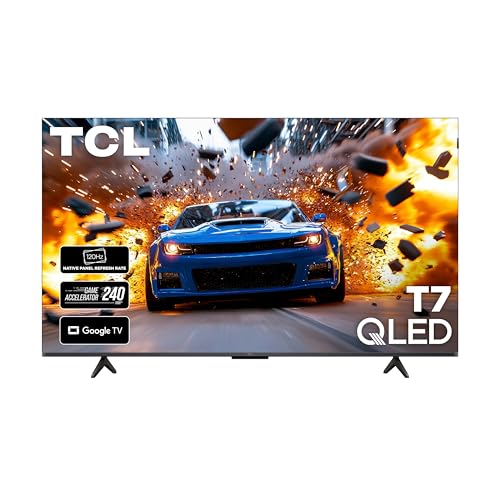
TL;DR: The TCL 55‑inch T7 delivers vibrant QLED colors, a 120 Hz native refresh rate and four HDMI 2.1 ports at a $399.99 price, making it a solid budget gaming TV with solid audio.
The T7’s QLED panel covers nearly the entire DCI‑P3 gamut and peaks at 450 nits, while the 120 Hz native refresh rate (with HDMI 2.1 support) keeps fast action smooth. A 60 W ONKYO 2.1 speaker array with Dolby Atmos provides immersive sound, and Google TV with a voice‑enabled remote makes streaming straightforward.
At 24.25 lb, the TV is lighter than the Hisense E6 (28.9 lb), Hisense U6 (43.0 lb) and Hisense QD7 (33.1 lb), but it’s a bit heavier than the Samsung Q7F (20.9 lb). Its 120 Hz refresh rate outpaces the 60 Hz of the Hisense E6 and Hisense QD4, though the Hisense U6 and TCL QM6K push 144 Hz. With four HDMI ports—including two 4K @ 144 Hz inputs—the T7 offers more connectivity than many peers that list fewer HDMI connections. The 55‑inch screen sits between the 50‑inch Samsung and the 65‑inch Hisense models, and its 450‑nit brightness falls short of the 1000 nits of the Hisense U6 and the up‑to‑600 nits of the Hisense QD7.
Reviewers consistently praise the vivid QLED colors and fluid motion, especially for sports and casual gaming. However, the limited 450‑nit peak brightness can make HDR highlights look muted in bright rooms, a point echoed by everyday users. The G‑class energy rating signals higher power draw than more efficient sets, and some owners have noted regional variations where a 60 Hz panel appears instead of the advertised 120 Hz.
Pros
Cons
Best for: Budget‑conscious gamers, sports enthusiasts, and casual viewers who want QLED color and smooth motion.
Avoid if: You want the best value‑per‑dollar in its price range or need top‑tier HDR performance for very bright rooms.
TL;DR: The Samsung Q7F 50‑inch QLED TV delivers vivid colors and AI‑enhanced 4K picture at a modest $357.95 price, but its 20 W speakers and 50/60 Hz refresh rate may fall short for gamers.
The standout feature is its QLED panel with over 1 billion Pantone‑certified colors and Quantum HDR with HDR10+, paired with a Q4 AI Processor that upscales content to 4K. The TV also packs a 20 W two‑channel speaker system and supports Bluetooth audio, Object Tracking Sound, and three HDMI ports (all with ALLM and eARC). Its physical footprint measures 237 mm deep, 694 mm high, and 1120.3 mm wide, while weighing just 9.5 kg (20.9 pounds).
Compared with the other ten entries, the Q7F is lighter than the Hisense E6 Cinema (28.9 pounds) and far lighter than the Hisense U6 (43 pounds). Its depth of 237 mm is thicker than the 2.8‑inch depth of the Hisense E6 and the 2.7‑inch depth of the TCL T7. At 50 inches, the screen is smaller than the 55‑inch and 65‑inch models in the lineup, and its native 50 Hz refresh (60 Hz max with Motion Xcelerator) is lower than the 120 Hz of the TCL T7 and the 144 Hz of the Hisense U6, which may affect fast‑action gaming.
Consumer sentiment repeatedly praises the TV’s bright, colorful picture and sleek thin‑bezel design. Reviewers note the built‑in speakers feel under‑powered, often prompting buyers to add a soundbar. Professional reviewers highlight the vibrant QLED colors and the smooth Tizen interface, while also pointing out the limited refresh rate and mid‑range dimming compared with higher‑end models. Vision AI automatically optimizes picture and sound, and the TV supports Alexa, Google Assistant, and Bixby for voice control.
Pros
Cons
Best for: Budget‑conscious buyers seeking a reliable entry‑level option
Avoid if: you're after the best value‑per‑dollar in its price range
“colors are vibrant, bright scenes fantastic, perfect for living rooms”
“Immersive size, day‑bright QLED, smart features”
TL;DR: The Samsung QN70F 65‑inch Neo QLED blends a Mini LED panel, Pantone‑validated colors and up to 144 Hz refresh for vivid picture quality and smooth gaming, all wrapped in a sleek, solar‑charged remote.
At the heart of the QN70F, Samsung’s Neo QLED Mini LED panel pairs with Quantum Matrix Slim backlighting and Supreme UHD Dimming. The 65‑inch screen delivers 4K resolution with HDR10+, HDR10 and HLG support, while the Pantone‑validated color engine ensures factory‑accurate hues. A refresh rate of 100 Hz that can push to 144 Hz, together with FreeSync Premium Pro, makes fast‑action scenes and gaming feel fluid. The TV weighs 48.1 pounds and draws a typical 141.0 W of power, with standby consumption as low as 0.5 W.
It's heavier than the Hisense QD7’s 33.1 pounds but lighter than the LG QNED85A’s 75.0 pounds, and only a shade heavier than the Samsung Q8F’s 46.7 pounds. Its typical power draw of 141.0 W is modest compared with the LG’s 143 W consumption, yet higher than the ultra‑efficient TCL T7’s 53 W. In terms of depth, the QN70F’s 25.7 mm without‑stand profile is slimmer than the Hisense U6’s 3.0‑inch (≈76 mm) depth, positioning it among the thinnest on the list.
Reviewers consistently praise the TV’s vivid colors, deep blacks and the smooth 144 Hz gaming experience. Professional reviewers highlight the Mini LED backlight’s precise brightness control and the Vision AI that automatically tailors picture and sound. Users also love the SolarCell One Remote, which never needs a battery change. However, the Tizen interface draws criticism for being unintuitive, and some owners are unsure whether the backlight is edge‑lit or full‑array, a point that has generated mixed expectations.
Beyond the core panel, the QN70F packs AI Upscaling with 20 neural networks, a NQ4 AI Gen2 processor and built‑in Alexa. The integrated Zigbee/Thread hub lets you control SmartThings devices without extra hardware, while Knox security adds an enterprise‑grade safeguard for your smart home.
Pros
Cons
Best for: Those prioritizing quality and willing to pay for premium performance
Avoid if: You're on a tight budget or only need basic functionality
“Vibrant colors, deep blacks, outstanding sharpness for movies/sports, high brightness/contrast, easy smart features, quick app loading, premium home theater feel, and battery-free solar remote”
TL;DR: The Hisense 65‑inch E6 Cinema offers a 65‑inch Hi‑QLED 4K display with Dolby Vision and Atmos at $376.99, delivering vibrant colors and solid smart features, though its 60 Hz panel may limit high‑end gaming.
The standout spec is the 65‑inch screen that uses Full‑array LED Hi‑QLED technology, and the manufacturer says it can render over one billion colors. At just 2.8 inches deep and weighing 28.9 pounds, the TV packs a large cinematic canvas into a relatively slim and manageable footprint.
Compared with the other ten models in this roundup, the E6 Cinema is larger than the Samsung Q7F 50‑inch (which weighs 20.9 pounds) and the TCL T7 55‑inch (24.25 pounds). It shares the same 60 Hz native refresh rate as the Samsung, but falls short of the TCL T7’s 120 Hz panel. In terms of depth, it sits just behind the TCL T7’s 2.7‑inch profile and is shallower than the Hisense QD7’s 3.0‑inch depth, while remaining lighter than the QD7’s 33.1‑pound chassis.
Reviewers consistently praise the vivid Hi‑QLED color reproduction and the combination of Dolby Vision HDR with Dolby Atmos sound, noting an immersive movie‑night experience. Professional reviewers also highlight the AI Smooth Motion feature for reducing blur in fast‑action scenes. The main criticism centers on the 60 Hz refresh rate, which some gamers find limiting for competitive play.
The TV includes an AI 4K Upscaler that boosts lower‑resolution content, an AI Light Sensor that adapts brightness to ambient light, and Game Mode Plus with Variable Refresh Rate and Auto Low Latency Mode for smoother gaming. eARC support on HDMI 3 enables high‑quality audio passthrough, and the built‑in Fire TV platform provides a wide app ecosystem plus Alexa and Google Assistant voice control.
Pros
Cons
Best for: Entry-level buyers or those on a tight budget
Avoid if: You want the best value-per-dollar in its price range
TL;DR: For $159.99, the Hisense QD4 40‑inch offers a Hi‑QLED panel with vibrant colors, Fire TV built‑in, and a low 16 ms game‑mode lag, making it a solid budget smart TV.
The standout spec is its 16 ms input lag in Game Mode, which is unusually low for a TV at this price point, and the Hi‑QLED panel promises over a billion shades of color on a 40‑inch 1080p screen. It runs at a 60 Hz refresh rate and includes three HDMI 1.4 ports for connecting consoles, streaming sticks, or a sound bar.
At 10.4 pounds, it’s considerably lighter than the Samsung Q7F’s 20.9 pounds and far lighter than the 28.9‑pound Hisense E6 Cinema. Its 40‑inch display is also smaller than the 50‑inch Samsung, the 55‑inch TCL and Hisense models, and the 65‑inch options in this roundup. The depth of 3.1 inches is notably shallower than Samsung’s 237 mm chassis, making the Hisense a good fit for tight spaces.
Reviewers praise the vivid Quantum‑Dot colors and the immersive DTS Virtual:X audio, noting that the Fire TV OS with Alexa voice remote makes streaming feel effortless. Users also like the AI Sports Mode and Noise Reduction for clearer motion during fast‑action content. The common complaints focus on the 1080p resolution, which looks less detailed than 4K rivals, and the 60 Hz panel plus lack of local dimming that can make high‑motion scenes appear less smooth. Many view the HDMI 1.4 inputs as a limitation for newer devices that benefit from higher‑bandwidth HDMI standards.
Pros
Cons
Best for: Entry‑level buyers or those on a tight budget
Avoid if: You need powerful performance or professional‑grade features
TL;DR: The Hisense U6 55‑inch delivers a true 144 Hz Mini‑LED QLED panel with 1000 nits peak brightness, making it a bright, ultra‑smooth option for gamers at a mid‑range price.
The standout spec is the native 144 Hz refresh rate paired with a 1000 nits peak brightness. Combined with Full Array Local Dimming Pro and a Quantum Dot color gamut of over 1 billion shades, the TV offers vivid HDR performance that rivals higher‑priced models.
Compared with the other ten entries, the U6 is heavier at 43.0 pounds—significantly more than the 24.25‑pound TCL T7, the 33.1‑pound Hisense QD7, and the 20.9‑pound Samsung Q7F. Its depth of 3.0 inches matches the Hisense QD7, but it's deeper than the 2.7‑inch TCL T7 and shallower than the 11.6‑inch TCL QM6K. In terms of refresh speed, the U6’s 144 Hz tops the TCL T7’s 120 Hz native rate and matches the TCL QM6K’s 144 Hz, while far exceeding the 60 Hz of the Hisense E6 Cinema and the 50 Hz native of the Samsung Q7F.
Reviewers consistently praise the buttery‑smooth motion for fast‑action games and sports, crediting the 144 Hz panel and Motion Rate 480. Professional observers highlight the AI‑driven Hi‑View engine, Dolby Vision IQ, and HDR10+ as strong processing wins. The built‑in 20 W 2.0‑channel speakers, however, frequently get called out as underwhelming, prompting many users to add a soundbar for true immersion. Uniformity and occasional blooming appear as minor drawbacks in bright scenes.
Beyond gaming, the U6 packs a robust feature set: VRR ranges from 48‑144 Hz, multiple HDMI 2.1 ports support 4K @ 120 Hz, and the Fire TV/Google TV platform brings Alexa and Google Assistant integration. Dolby Atmos support and a 3.5 mm headphone jack round out the audio options, while Wi‑Fi 6 ensures a solid connection for streaming.
Pros
Cons
Best for: Budget‑conscious gamers who want a true 144 Hz panel and bright HDR performance.
Avoid if: You need premium built‑in audio or flawless uniformity for a cinema‑grade experience.
TL;DR: The LG 75QNED85A delivers a bright 75‑inch Mini LED panel with 120 Hz native refresh, AI‑enhanced picture and webOS 2025, but its price and size suit larger rooms and gaming setups.
LG’s 75QNED85A stands out with a Mini LED backlight and Dynamic QNED Color that provides 100% color volume across a 75.1‑inch 4K screen. The panel runs at a 120 Hz native refresh rate and can push VRR up to 144 Hz, while the α8 AI Processor 4K Gen2 handles AI Picture and AI Super Upscaling for sharper, genre‑specific images.
At 75.0 pounds, the TV is heavier than the Samsung QN70F (48.1 pounds) and Samsung Q8F (46.7 pounds) but a touch lighter than the Hisense S7N CanvasTV (76.7 pounds). Its 120 Hz native refresh is modest compared with the 144 Hz native panels of the Hisense S7N, TCL QM6K and Hisense QD7, yet the VRR ceiling of 144 Hz keeps it competitive for fast‑action gaming. With a 75‑inch diagonal, it’s also larger than the 65‑inch and 55‑inch models in the lineup.
Consumers repeatedly praise the TV’s “stunning, vibrant 4K picture” and the AI‑driven picture tweaks that keep colors vivid in bright rooms. Professional reviewers highlight the Dynamic QNED Color and Dimming Pro local dimming for deep blacks and strong contrast, while noting that the built‑in speakers feel thin and benefit from an external sound system. The Magic Remote MR25 and webOS 2025 with 5‑year Re:New support provide a smooth smart‑TV experience.
Additional technical details include AI Sound Pro with AI Clear Sound, light and motion sensors for auto‑brightness, four HDMI inputs that all support 4K, a power draw of 143 W (about 264 kWh per year), and a super‑slim design that measures 66.0 × 40.6 × 14.1 inches with the stand.
Pros
Cons
Best for: Those prioritizing quality and willing to pay for premium performance
Avoid if: You're on a tight budget or only need basic functionality
TL;DR: The Hisense QD7 65‑inch offers a 144 Hz native refresh rate, QLED color, and Mini‑LED brightness at a $437.99 price, but its modest 20 W speakers and average black uniformity keep it from being a premium pick.
The standout spec is the 144 Hz native refresh rate paired with a Mini‑LED backlight that can reach up to 600 nits. Combined with a 64.5‑inch QLED Quantum Dot panel and 178° viewing angles, the TV delivers smooth motion and vibrant colors for fast‑action content.
Compared with the other ten TVs in this roundup, the QD7 is lighter than the Hisense U6 55‑inch (43.0 lb) but heavier than the TCL T7 55‑inch (24.25 lb). Its 3.0‑inch depth matches the U6 and is slightly deeper than the 2.7‑inch depth of the TCL T7. The 64.5‑inch screen outclasses all 55‑inch models and rivals the 65‑inch Samsung Q8F, while its 600‑nit peak brightness sits below the U6’s 1000‑nit peak but above the TCL T7’s 450‑nit panel.
Everyday buyers praise the ultra‑smooth gaming experience enabled by the 144 Hz refresh rate, FreeSync Premium Pro, and Auto Low Latency Mode. Professional reviewers note the QLED panel’s wide color gamut and the Google TV/Fire TV interface’s ease of use, yet they also point out average contrast due to fewer local‑dimming zones and the thin 20 W 2.0‑channel speakers that struggle in larger rooms. Users frequently mention the bright, colorful picture in daytime viewing, while the blooming effect in dark scenes and modest audio are common criticisms.
The QD7 supports Dolby Vision, HDR10, HDR10+, and HLG, giving it a solid HDR toolkit. It also includes Dolby Atmos and DTS audio formats, an Alexa voice assistant, and a voice remote that doubles as a Chromecast controller. These software and feature bundles make it a well‑rounded entertainment hub despite its mid‑range price.
Pros
Cons
Best for: Budget‑conscious gamers, sports fans, and families who watch TV in bright rooms and value a large, colorful display.
Avoid if: You prioritize deep blacks for dark‑room movies or need powerful built‑in audio without external speakers.
Breakdown
Hisense S7N CanvasTV 75-inch
Pros
Cons
Samsung Q8F 65-inch
Pros
TCL QM6K 55-inch
Pros
TCL T7 55-inch
Pros
Cons
Based on scoring data and product specs
Personalized picks
Best Overall Pick
Hisense S7N CanvasTV 75-inch
Best OverallBest for: Audiophiles and enthusiasts seeking premium sound quality and advanced features
Samsung Q8F 65-inch
Best for: Audiophiles and enthusiasts seeking premium sound quality and advanced features
Out of Stock
Skip Hisense QD7 65-inch if…
You have limited desk space or need portability
The Hisense S7N CanvasTV 75‑inch takes the top spot thanks to its 4.6‑star rating from 613 reviewers, a native 144 Hz refresh rate and a high 5000:1 contrast ratio that enhances HDR content. Its QLED edge‑lit panel supports Dolby Vision and HDR10+, while the included UltraSlim flush wall mount keeps the setup sleek.
The Samsung Q8F 65‑inch earns runner‑up honors if you need a 65‑inch TV that balances gaming performance and smart‑home features without the flagship price tag. It offers a 200 Hz motion refresh rate, QLED Direct Full Array dimming and 4K AI Upscaling, backed by a solid 4.4‑star rating from 747 reviews and a list price of $697.99.
For tighter budgets, the Hisense QD4 40‑inch delivers solid QLED performance at $159.99, making it a top budget pick. If you want a step up without reaching the flagship tier, the TCL QM6K 55‑inch provides solid 4K QLED visuals at $478.00, making it a leading mid‑range choice.
Choose the Hisense S7N CanvasTV for the most well‑rounded mini‑LED/QLED experience available today.
The Hisense S7N costs $1,300.99, which is about $603 more than the Samsung Q8F’s $697.99 price tag. It compensates with a richer feature bundle—including Art Mode, a 144 Hz native refresh rate, and a more extensive HDR suite (Dolby Vision, HDR10+)—so buyers who value those extras may find the premium justified.
No reviews yet — be the first to share your experience.
Please sign in to leave a review