⚡ Quick Answer
We compared six Synology NAS models, spanning a price range from $120.40 for the compact BeeDrive up to $1,792.99 for the high‑end DS1823xs+. The lineup splits neatly into three tiers – budget options like the BeeDrive and DS223j, mid‑range choices such as the BeeStation and DS118, and premium powerhouses represented by the DS224+ and DS1823xs+.
The DS223j stands out in the budget tier with a 4.5‑star rating from 1,436 reviewers, a whisper‑quiet 18.2 dB(A) noise level and only 4 W power draw in HDD hibernation – ideal for a quiet home office. Moving up, the DS224+ carries the highest rating of 4.7 stars (788 reviews) and adds a 2 GHz quad‑core CPU, 2 GB DDR4 memory and 22 dB(A) operation for small‑office or remote‑work scenarios. At the premium end, the DS1823xs+ offers 8 GB ECC RAM, 23.6 dB(A) noise and a 4.1‑star rating (60 reviews), which delivers the performance needed for demanding business workloads.
Below we've broken down each model’s strengths, key specifications and ideal use cases so you can match a Synology NAS to your exact needs.
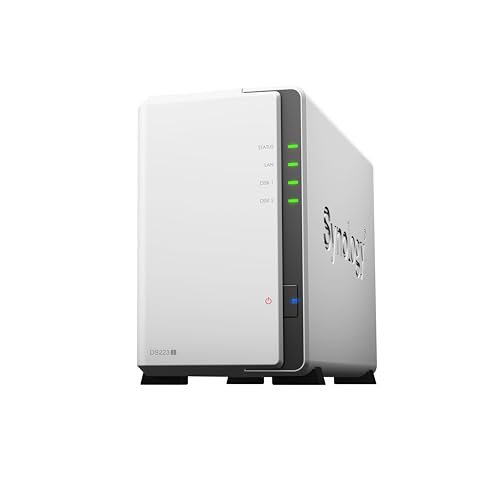
Synology DS223j
Its compact depth of 165 mm lets it slip into tight spaces, offering solid entry‑level performance at a budget‑friendly price.

Synology DS224+
Ideal for power users who need faster performance, it costs about $492 more than the DS223j, reflecting its higher‑end capabilities.

Synology DS1823xs+
With an expansive 14.57‑in depth and premium feature set, it caters to audiophiles and enthusiasts, offering capabilities the DS223j and DS224+ don’t provide.
Also considered
Score Analysis
Key score advantages vs. runner-up (Synology DS224+)
Price Range
Synology DS223j
$194.99
Synology DS224+
$676.00
Synology DS1823xs+
$2,049.99

Synology DS118
$329.00

Synology BeeStation
$309.99

Synology BeeDrive
$120.40
Spec Comparison
TL;TD: The Synology DS223j is a quiet, low‑power 2‑bay NAS with 108 TB capacity, 1 GB RAM and a 1.7 GHz CPU, ideal for home backups at a budget price.
At its core, the DS223j packs two drive bays that can hold up to 108 TB of storage and runs on a Realtek RTD1619B 4‑core 1.7 GHz processor with 1 GB DDR4 RAM. It measures 165 mm deep, 226 mm high and 100 mm wide, weighs 870 g (1.92 lb), and operates at a whisper‑quiet 18.2 dB(A). It draws a modest 16.31 W during active use and drops to just 4 W when the drives hibernate.
Compared with the other five models in this roundup, the DS223j sits in the middle of the size and weight spectrum. It’s considerably heavier than the ultra‑compact BeeDrive, which weighs only 0.09 lb and measures 15 mm × 65 mm × 65 mm, but lighter than the DS224+ (2.87 lb) and far lighter than the DS1823xs+ (16.53 lb). Its noise level of 18.2 dB(A) is quieter than the DS224+ (22 dB) and the DS1823xs+ (23.6 dB), yet a touch louder than the DS118’s 16.7 dB. Its power consumption exceeds the BeeStation’s 7.85 W active draw, yet the DS223j still offers more drive capacity than the single‑bay DS118.
Users consistently praise the near‑silent operation and the low energy use, noting that the unit fits neatly into a home office without adding to the ambient noise. Reviewers also highlight the intuitive DiskStation Manager software for straightforward backup and media sharing. On the flip side, the 1 GB of RAM and the single 1 GbE Ethernet port are frequent points of criticism, especially for anyone hoping to run multiple apps or stream 4K video simultaneously.
Beyond the basics, the DS223j supports Synology Hybrid RAID, basic RAID, JBOD, RAID 0 and RAID 1, and offers features like power recovery, scheduled power on/off, and Wake on LAN/WAN. It can handle up to 100 concurrent connections and supports up to 64 internal volumes, making it a flexible entry point into Synology’s ecosystem.
Pros
Cons
Best for: Budget‑conscious buyers seeking a reliable entry‑level option
Avoid if: You need high‑speed transfers, multiple concurrent users, or 4K video transcoding
TL;DR: The Synology DS224+ packs a quad‑core 2.0 GHz Celeron, 108 TB capacity and quiet 22 dB operation into a 2‑bay chassis, ideal for home or small‑office file sharing and surveillance.
The DS224+ houses an Intel Celeron J4125 processor with a 2.0 GHz base clock and a burst up to 2.7 GHz, backed by 2 GB DDR4 built‑in memory and a maximum of 6 GB RAM. Its compact footprint—232.2 mm deep, 165 mm high and 108 mm wide—and a fan size of 92 mm × 92 mm keep the unit at a whisper‑quiet 22 dB(A) while drawing just 15 W of power. You can fill the two drive bays with up to 108 TB in a single volume, and the device supports up to 2,048 local users, making it a solid all‑rounder for home or small‑team storage.
Compared with its peers, the DS224+ weighs more than the single‑bay DS118 (700 g) and the BeeStation (820 g), but it offers a more powerful CPU than the DS118’s 1.4 GHz processor and double the RAM capacity of both the DS118 and BeeStation’s 1 GB. It produces more noise than the DS118’s 16.7 dB(A) but remains comparable to the DS223j’s 18.2 dB(A). Power draw sits between the BeeStation’s 7.85 W access consumption and the DS223j’s 16.31 W, while its dual Gigabit Ethernet ports give better networking than the single‑port setups of some rivals. Unlike the massive DS1823xs+, which sports multiple drive bays and ECC memory, the DS224+ stays compact and energy‑efficient for modest setups.
User sentiment highlights the quiet operation and low energy use as major pluses, and professional reviewers note the Celeron’s noticeably faster file indexing in Synology Drive and Photos. However, reviewers also point out the limitation of only two bays and a maximum of 6 GB RAM, which can bottleneck heavy multitasking or larger virtualized workloads. Reviewers also mention the lack of 10 GbE networking and a single power supply without redundancy as trade‑offs for users needing high‑throughput or fail‑over protection.
Pros
Cons
Best for: Buyers willing to invest in a proven, high-quality option
Avoid if: You're on a tight budget or only need basic functionality
TL;DR: The Synology DS1823xs+ delivers enterprise‑grade speeds with >3,100 MB/s reads, 8 bays, and ECC memory, but its premium $1,792.99 price and single power supply make it a specialist’s choice.
The standout spec is its throughput: sequential reads exceed >3,100 MB/s and writes top >2,600 MB/s, powered by an AMD Ryzen V1780B CPU and 8 GB DDR4 ECC RAM (expandable to 32 GB). With eight hot‑swappable bays and two NVMe M.2 slots, the unit can scale to 18 bays via expansion modules, offering a theoretical 200 TB single volume when fully provisioned.
In the lineup, the DS1823xs+ is considerably heavier than the DS224+, which tips the scales at about 2.87 lb, and its 23.6 dB(A) noise level sits just above the DS224+’s 22 dB(A) and the DS223j’s 18.2 dB(A). It also carries a higher price tag than the entry‑level DS118, BeeStation and BeeDrive, placing it in the premium tier of this roundup.
Professional reviewers praise the >3,100 MB/s read speed and the flexible PCIe‑based networking upgrades for growing businesses. Users appreciate the low acoustic footprint and the DSM ecosystem’s strong data protection, but they flag the single 250 W non‑redundant power supply as a risk for 24/7 critical workloads. Power draw sits at 87.93 W during active use and drops to 28.37 W in HDD hibernation, which keeps operating costs reasonable.
Pros
Cons
Best for: Small‑to‑medium businesses, IT professionals, and content creators that need ultra‑fast file serving and scalable storage.
Avoid if: You're shopping on a tight budget — it's priced at $1792.99.
TL;DR: The Synology DS118's a compact single‑bay NAS with a 1.4 GHz quad‑core CPU, 1 GB DDR4 RAM, 113 MB/s read speed and quiet 16.7 dB operation, ideal for home or small‑office media storage.
What really sets the DS118 apart is its hardware‑accelerated 4K H.265 transcoding at 4096 × 2160 @ 60 FPS, powered by a Realtek RTD1296 quad‑core 1.4 GHz processor and 1 GB DDR4 memory. Sequential transfer hits 113 MB/s read and 112 MB/s write, while the unit draws only 9.4 W of power and runs at a whisper‑quiet 16.7 dB(A). Its 700 g chassis measures 224 mm × 166 mm × 71 mm, making it easy to slip onto a desk or shelf.
Compared with the other five Synology models in this roundup, the DS118 is lighter than the BeeStation (820 g) and quieter than the DS223j (18.2 dB(A)). It also consumes far less power than the DS223j’s 16.31 W access draw. However, its 113 MB/s read speed is modest next to the BeeDrive’s 1050 MB/s, and its 1 GB RAM matches the BeeStation and DS223j but falls short of the DS224+’s 2 GB and the DS1823xs+’s 8 GB. The DS118’s single drive bay limits capacity expansion, whereas the higher‑end DS224+ and DS1823xs+ support multiple bays and RAID.
Users consistently praise the DS118 for its easy setup, low noise floor, and reliable 4K streaming on modest hardware. Professional reviewers note the “excellent data transfer speed of >113 MB/s” for a single‑bay unit and commend the DSM ecosystem for backup, surveillance and file‑sharing apps. The main complaints revolve around the lack of RAID redundancy and the fixed 1 GB RAM, which can bottleneck heavy multitasking or multiple concurrent streams.
Pros
Cons
Best for: Most users seeking a balanced, mainstream option
Avoid if: You need advanced features or professional‑grade performance
TL;DR: The Synology BeeStation packs 4 TB of built‑in storage into a 820 g, 196.3 mm‑deep chassis, offering easy real‑time syncing but limited to basic NAS features.
The standout spec is the integrated 4 TB of storage paired with a Realtek RTD1619B processor and 1 GB DDR4 RAM, all fitting into a compact 196.3 mm‑deep chassis weighing 820 g. It’s a true “personal cloud” that fits on a desk without a separate drive bay.
At 820 g, the BeeStation is heavier than the entry‑level DS118 (700 g) yet noticeably lighter than the mid‑range DS224+ (about 1.3 kg). It shares the same 1 GB DDR4 memory as the DS118 and DS223j, but offers less RAM than the DS224+, which ships with 2 GB. All models feature a single 1 GbE Ethernet port, so network throughput is comparable across the lineup.
Users praise the unobtrusive black chassis and the plug‑and‑play setup via BeeStation Manager, noting that files from phones, tablets, computers and cloud services sync in real time without a subscription. Professional reviewers, however, point out the lack of advanced DSM apps and media‑streaming support, and the 3.9/5 star rating reflects mixed satisfaction.
Power consumption stays modest at 7.85 W during active use and drops to 1.65 W when the internal drive hibernates, with a 36 W adapter providing power.
The unit operates from 0 °C to 35 °C and a three‑year warranty covers it, giving peace of mind for home or small‑office use.
Pros
Cons
Best for: Individuals or small households that want a simple, subscription‑free way to centralize photos, documents and backups.
Avoid if: You need high‑performance multitasking, media streaming, or a richer app ecosystem for small‑business use.
TL;DR: The Synology BeeDrive delivers 1 TB of portable NVMe storage with 1050 MB/s USB‑C 3.2 Gen 2 speeds, wireless BeeDrop backup, and a feather‑light 43 g chassis for $120.40.
Its 1050 MB/s sequential read and write speed matches the top end of USB‑C 3.2 Gen 2 portable SSDs. At just 65 mm × 65 mm × 15 mm and 43 g (0.09 lb), the drive feels like a thick phone rather than a traditional NAS box. Its built‑in LED indicator and plug‑and‑play USB‑C connection let you start using it right out of the bag, while the BeeDrop app adds wireless photo and file transfers from up to five iOS or Android devices.
Compared with the other five Synology models in this roundup, the BeeDrive is dramatically smaller and lighter than the DS223j, which weighs about 1.92 lb and measures 165 mm deep. It also undercuts the BeeStation’s 820 g weight and deeper 196.3 mm chassis. The DS118, at 700 g, offers far slower sequential speeds of roughly 113 MB/s read and 112 MB/s write, making the BeeDrive’s 1050 MB/s a clear performance leap. The DS224+ and the enterprise‑grade DS1823xs+ both carry much larger footprints and higher power draws, targeting rack‑mount or data‑center use rather than portable convenience.
Users praise the effortless wireless backup: photographers love the ability to offload phone shots without a cloud subscription, and everyday users appreciate the drive’s low‑power USB bus operation. Reviewers note the AI‑driven automatic photo backup saves time, while also pointing out that the AI features require a Windows PC with an NVIDIA GPU of at least 6 GB VRAM and 16 GB RAM, which can limit accessibility. The drive operates between 0 °C and 45 °C and stores data safely from –40 °C to 85 °C, and it’s covered by a three‑year warranty.
Pros
Cons
Best for: Entry-level buyers or those on a tight budget
Avoid if: You need powerful performance or professional‑grade features
Breakdown
Synology DS223j
Pros
Synology DS224+
Pros
Synology DS1823xs+
Pros
Cons
Synology DS118
Pros
Cons
Based on scoring data and product specs
Personalized picks
Best Overall Pick
Synology DS223j
Best Budget PickBest for: Budget-conscious buyers seeking a reliable entry-level option
Synology DS224+
Best for: Buyers willing to invest in a proven, high-quality option
$676.00+$481.01 vs winner
Skip Synology BeeDrive if…
You need powerful performance or professional-grade features
The Synology DS223j ranks as the best Synology NAS. At $194.99 it offers a 2‑bay desktop design, 1 GbE networking, and a Realtek RTD1619B 4‑core 1.7 GHz CPU with 1 GB DDR4 RAM. Its 18.2 dB(A) noise level and 16.31 W power draw keep it quiet and efficient, while a 4.5‑star rating from 1,436 reviewers backs its reliability.
The runner‑up is the Synology DS224+, which delivers extra processing power and surveillance capability. Its Intel Celeron J4125 runs at 2.0 GHz (burst to 2.7 GHz) and includes 2 GB DDR4, two 1 GbE ports, and support for up to 25 HD‑1080p camera streams. At $686.86 it’s a solid choice for small‑office video monitoring or heavier multi‑user workloads.
If you’re looking beyond the winner, the BeeDrive remains the cheapest entry point at $120.40, while the DS118 at $329.00 offers a step up in performance for home users. For enterprises that demand maximum capacity, the DS1823xs+ at $1,792.99 delivers premium scalability and enterprise‑grade features.
Pick the DS223j now and get a reliable, budget‑friendly NAS that covers everyday storage needs.
The DS223j, priced at about $195, provides solid file sharing, backup to multiple destinations and a low noise level while staying well under $700. The DS224+ costs roughly $687, so the DS223j delivers far more value for most home‑office needs.
No reviews yet — be the first to share your experience.
Please sign in to leave a review