⚡ Quick Answer
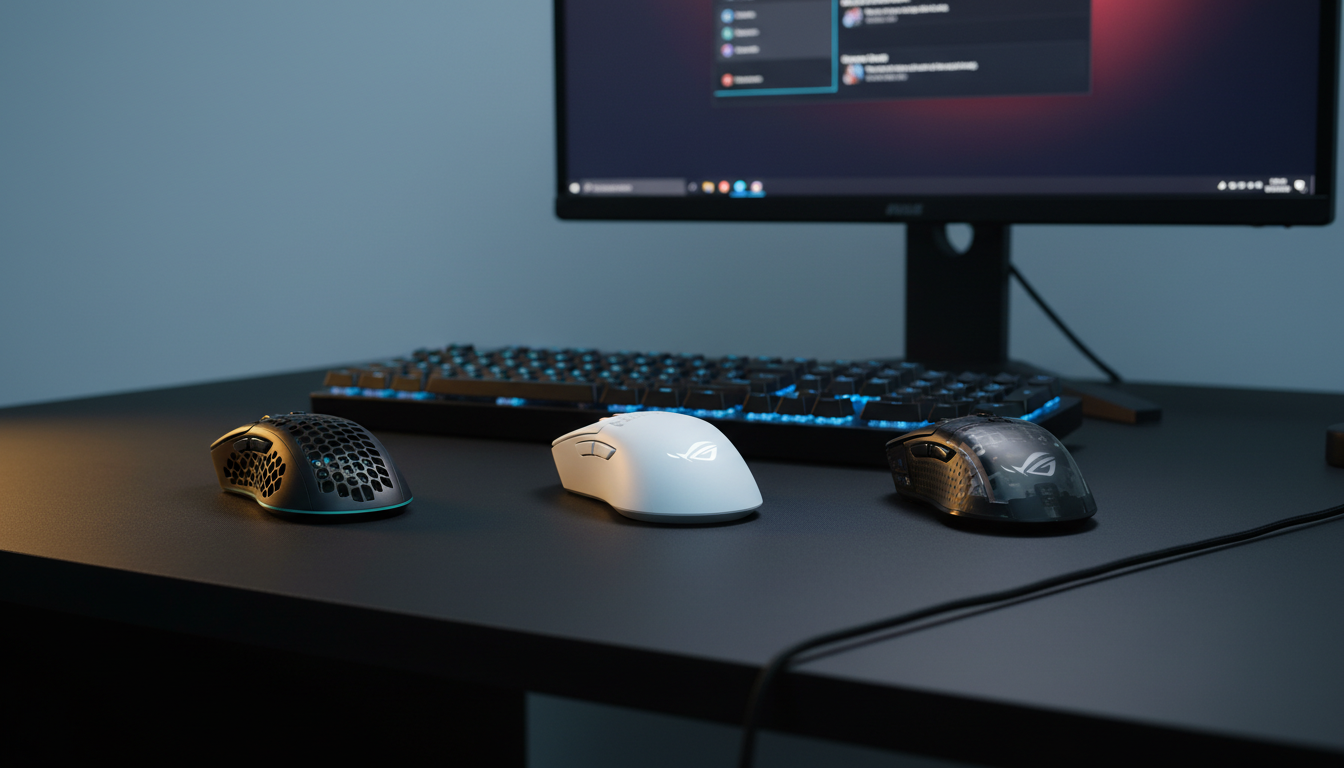
We pored over 11 ultralight gaming mice that tip the scales at 60 g or less, hunting for the sweet spot between feather‑weight agility and reliable performance. Prices stretch from a budget‑friendly $18.79 for the Redragon M617 Ultralight up to $79.99 for premium‑tier options like the Corsair Sabre v2 PRO. To keep things tidy, the lineup splits into three price tiers: budget picks (Redragon M617, ASUS TUF Gaming M3 Gen II, Razer Cobra, Magic‑refiner Attack Shark X11), mid‑range contenders (Attack Shark X3 White, HyperX Pulsefire Haste 2), and premium offerings (Cooler Master MM711, Attack Shark R6 Wireless, ASUS ROG Harpe Ace, Corsair Sabre v2 PRO).
Key specs vary as much as the price tags. The Magic‑refiner Attack Shark X11, priced at $31.99, packs a 42,000 DPI sensor and an 8000 Hz polling rate while staying at 59 g, earning a solid 4.5‑star rating from 369 reviewers. At the other extreme, the Corsair Sabre v2 PRO trims down to just 36 g, offers an 8000 Hz hyper‑polling rate, 33,000 DPI and up to 70 hours of wireless play, and holds a 4.3‑star score from 173 users. In the sections that follow we’ll break down how these specs translate to real‑world feel, so you can match a mouse to your grip style, game genre, and budget.

Magic-refiner Attack Shark X11
Its 65‑hour wireless battery life, powered by a 300 mAh cell, provides solid endurance for an ultralight gaming mouse.

Attack Shark X3 White
Designed for gamers who want a well‑reviewed, reliable mouse, it costs about $5.80 more than the Top Pick.

ASUS ROG Harpe Ace
It delivers up to 90 hours of battery life without lighting and adds RGB, giving enthusiasts up to 90 hours of playtime and RGB visuals.
Also considered
Score Analysis
Key score advantages vs. runner-up (Attack Shark X3)
Price Range
Magic-refiner Attack Shark X11
$30.39
Attack Shark X3 White
$41.99
ASUS ROG Harpe Ace
$99.99

Razer Cobra
$29.99
Cooler Master MM711
$53.69
Corsair Sabre v2 PRO
$79.99

HyperX Pulsefire Haste 2 Wired Black
$39.99

Redragon M617 Ultralight
$17.99

Attack Shark R6 Wireless
$55.99

ASUS TUF Gaming M3 Gen II
$27.99

Attack Shark R1
$24.74
Spec Comparison
TL;DR: The Magic‑Refiner Attack Shark X11 is a 59 g wireless gaming mouse with a 42,000 DPI PAW3950MAX sensor, 8000 Hz polling and 65‑hour battery, delivering ultra‑light performance at a $31.99 price.
Weighing just 0.13007273458 pounds (59 g), the X11 feels feather‑light in the hand, and its PAW3950MAX sensor pushes a maximum DPI of 42,000 while tracking up to 750 IPS. The mouse runs at an 8000 Hz polling rate in both wired and 2.4 GHz wireless modes, giving you the fastest response window the specs list.
Against the other ten entries, the X11 sits in the same weight class as the Razer Cobra (58 g) and the Attack Shark R1 (59 g), but it’s a touch heavier than the Attack Shark X3 White (49 g) and lighter than the HyperX Pulsefire Haste 2 (52 g) and the ASUS TUF Gaming M3 Gen II (118 g). Its 5 programmable buttons match the typical offering in this ultralight segment, and its wireless tri‑mode connectivity gives it more flexibility than the wired‑only peers.
Reviewers repeatedly praise the ultra‑light carbon‑fiber build and the “lightning‑fast moves” of the PAW3950MAX sensor, noting that the mouse feels solid with no creak. Users love the long 65‑hour wireless battery and the magnetic RGB charging dock that tops up quickly. However, several users mention that the edge pieces near the side buttons can catch fingers during high‑CPS games, and the scroll‑wheel button feels heavier than expected.
The X11 also includes a nano‑metal ice grip coating for a non‑slip feel, Omron optical microswitches rated for 100 million clicks, and a fast‑charge feature that reaches full charge after just 10 minutes of charging.
Pros
Cons
Best for: Competitive FPS gamers who need an ultra‑light, high‑DPI mouse with long wireless battery life.
Avoid if: You rely on high‑CPS clicking (e.g., Minecraft speed‑runs) or need a light, smooth scroll‑wheel.
“snappy... great construction for 63g... solid, no creak/bend,”
“lightning-fast moves... unmatched accuracy”
TL;DR: The Attack Shark X3 White delivers a 49 g ultra‑light frame, 26,000 DPI PixArt PAW3395 sensor and 1000 Hz polling, offering solid casual‑gaming performance at $37.79.
The X3 packs a PixArt PAW3395 sensor capable of up to 26,000 DPI, paired with a 1000 Hz polling rate that keeps motion data fresh for smooth tracking. At just 49 g (0.108 lb) and a compact 39.7 mm height, it feels nimble enough for fast flicks without sacrificing stability.
Compared with the HyperX Pulsefire Haste 2, the X3's a few grams lighter (49 g vs. 52 g) but its polling rate's lower (1000 Hz vs. 8000 Hz). It also undercuts the Magic‑refiner Attack Shark X11’s weight (59 g) while offering a lower DPI ceiling (26,000 vs. 42,000). Heavier rivals like the ASUS TUF Gaming M3 Gen II (118 g) and Cooler Master MM711 (149.69 g) sit well above the X3’s ultralight class.
Reviewers praise the solid build and crisp clicks from the Kailh Black Mamba switches, which rate for 80 million clicks and feature a 65 gf operating force with a 25 gf release. However, professional feedback notes that click latency can feel inconsistent for high‑level FPS play, and many users swap the stock PTFE skates for smoother aftermarket pads.
The mouse runs on a 300 mAh battery that the manufacturer says lasts up to 200 hours in wireless mode, and it supports tri‑mode connectivity: wired USB‑C, 2.4 GHz dongle, and Bluetooth 5.2. Onboard memory lets you store settings, while RGB lighting adds a splash of color without draining the battery.
Pros
Cons
Best for: Casual gamers, budget‑conscious FPS or MMO players, and hybrid work‑gaming users who want a lightweight, well‑reviewed mouse.
Avoid if: You need ultra‑low click latency or professional‑grade performance for high‑level esports competition.
“snappy... great construction for 63g... solid, no creak/bend,”
“lightning-fast moves... unmatched accuracy”
TL;DR: The ASUS ROG Harpe Ace is a 54 g ambidextrous wireless mouse with a 36,000 DPI ROG AimPoint sensor, 1000 Hz report rate, and up to 90 hours of battery life, aimed at competitive FPS and MOBA gamers.
The standout feature is the ROG AimPoint optical sensor, offering a DPI range of 100–36,000 and less than 1 % CPI deviation, which pairs with a 1000 Hz report rate for snappy input. At just 54 g, the mouse feels feather‑light enough for rapid flicks while still housing a full Li‑Ion rechargeable battery.
Compared with the other ten entries, the Harpe Ace sits in the middle of the weight spectrum: it’s heavier than the 36 g Corsair Sabre v2 PRO and the 39 g Attack Shark R6, but lighter than the honeycomb‑shell Cooler Master MM711 that tips the scales at 149.69 g. Its 1000 Hz report rate is lower than the 8000 Hz found in several rivals, and its maximum tracking speed of 650 IPS matches the HyperX Pulsefire Haste 2 while falling short of the 750 IPS offered by the Corsair and Attack Shark R6 models.
Reviewers consistently highlight the ultra‑light 54 g chassis for reduced hand fatigue during marathon sessions, and they appreciate the high‑precision 36,000 DPI sensor for pinpoint aiming. Users note the limited five‑button layout as a downside, which can feel restrictive for players who rely on extensive macros, and the ambidextrous shape that lacks a dedicated ergonomic contour for right‑hand‑only users.
Additional technical perks include Bluetooth 5.1 with multi‑device pairing for up to three peripherals, ROG SpeedNova’s low‑latency 2.4 GHz RF transmission, and NVIDIA Reflex compatibility for reduced system lag. The mouse ships with a ROG 70M mechanical switch rated for 70 million clicks, RGB Aura Sync lighting, and a suite of accessories such as a paracord extender cable, extra PTFE feet, and grip tape.
Pros
Cons
Best for: Competitive FPS and MOBA gamers who need an ultralight, low‑latency mouse with high‑precision sensor performance.
Avoid if: You're shopping on a tight budget — it's priced at $79.99
TL;DR: The Razer Cobra delivers a feather‑light 58 g build, 8500 DPI sensor and 0.2 ms optical switches, making it a budget‑friendly, wired option for competitive FPS gamers.
The standout spec is its 8500 DPI Razer optical sensor, paired with 0.2 ms actuation Gen‑3 switches and a 58 g chassis that feels almost weightless in the hand. With a 1.8 m Speedflex cable, the mouse stays low‑drag while giving you plenty of reach.
Compared with the other ten entries, the Cobra sits in the middle of the weight range: it’s lighter than the ASUS TUF Gaming M3 Gen II (118 g) and Redragon M617 Ultralight (168 g), but a touch heavier than the Attack Shark X3 (49 g). Its 6‑button layout matches most peers, while its cable length exceeds many wired rivals that list shorter leads. Polling rate isn’t listed in the available specs, so you’ll need to check Razer’s software for that detail.
User feedback praises the mouse’s “feather‑light feel” and the rapid 0.2 ms response, which professional reviewers call ideal for FPS titles. Reviewers frequently mention the PTFE feet and flexible cable for providing a friction‑free glide. A few owners note a slight flex in the plastic body during aggressive swings and that the overall size feels larger than expected for an ultra‑light mouse.
Additionally, the Cobra offers 50 DPI increments, onboard memory for profile storage, and a 16.8 million‑color Razer Chroma RGB underglow. Experts recommend its right‑handed symmetrical compact shape for fingertip or claw grips, and Razer rates the switch lifespan at 90 million clicks.
Pros
Cons
Best for: FPS and competitive gamers who favor claw or fingertip grips and want a wired, ultra‑light mouse without breaking the bank.
Avoid if: You need wireless freedom, a large palm‑style grip, or the absolute lightest mouse on the market.
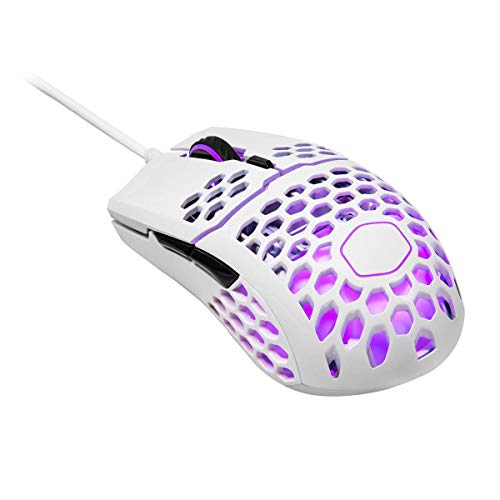
TL;DR: The Cooler Master MM711 offers a 16000 DPI sensor, ambidextrous honeycomb shell and Ultraweave cable at 149.69 g, earning 4.5‑star praise but sits heavier than many sub‑60 g competitors.
The MM711’s standout spec is its 16000 DPI maximum resolution, paired with a lightweight honeycomb shell that measures 45.72 mm in height, 142.24 mm in length and 134.62 mm in width. Weighing 149.69 g, it's still light enough for rapid flicks, and the Ultraweave cable receives praise for low drag during fast movements.
Compared to the other ten mice, the MM711 feels noticeably heavier than the sub‑50 g options such as the HyperX Pulsefire Haste 2 (52 g) and the Attack Shark R6 Wireless (39 g). Its 16000 DPI sits between the 42 000 DPI of the Attack Shark R6 and the 8500 DPI of the Razer Cobra, offering a middle‑ground balance of precision.
Reviewers consistently highlight the mouse’s rigid honeycomb construction and the smooth feel of the Ultraweave cable. Professional reviewers note the solid build quality for its weight class, while everyday users love the reduced wrist fatigue during long sessions. The main complaints revolve around a faint creaking noise when you press the left or right buttons firmly and a glossy white finish that attracts fingerprints.
Pros
Cons
Best for: Competitive players who value a high‑DPI sensor, solid build and a low‑drag cable, and don’t mind a few extra grams.
Avoid if: You need an ultra‑light sub‑60 g mouse, a fully wireless solution, or a matte finish that hides fingerprints.
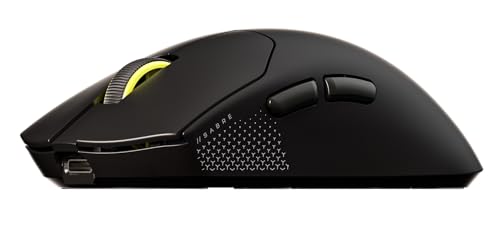
TL;DR: The Corsair Sabre v2 PRO delivers a feather‑light 36 g chassis, 8,000 Hz hyper‑polling and 33,000 DPI tracking, plus up to 70 hours of wireless play for $79.99.
The standout figure is the 36 g weight, which puts the Sabre v2 PRO among the lightest mice you can buy. Coupled with an 8,000 Hz polling rate and a 33,000 DPI CORSAIR MARKSMAN S sensor, it delivers low‑latency, high‑accuracy tracking that FPS enthusiasts crave. Its 210 mAh battery fuels up to 70 hours of wireless use, so you won’t be tethered to a charger during marathon sessions.
Compared with the other ten contenders, the Sabre v2 PRO is lighter than the ASUS ROG Harpe Ace (54 g), Attack Shark R6 (39 g), HyperX Pulsefire Haste 2 (52 g), Attack Shark X3 (49 g), Magic‑refiner Attack Shark X11 (59 g) and the much bulkier Cooler Master MM711 (149.69 g). Its 8,000 Hz polling matches the Attack Shark R6, HyperX, and Magic‑refiner, and far exceeds the 1,000 Hz rate of the ASUS model. DPI sits in the middle of the pack—higher than HyperX’s 26,000 DPI but below the 42,000 DPI of the Attack Shark R6 and X11.
User chatter highlights the “weightless” feel and the long battery life as major wins. Reviewers repeatedly note the mechanical switches, which are rated for 100 million clicks, and the virgin‑grade UPE mouse feet that glide smoothly. On the downside, several owners mention that the all‑plastic shell scratches easily, many consider the MARKSMAN S sensor mid‑tier compared to premium offerings, and the lack of RGB lighting or left‑handed support can be disappointing for some.
Pros
Cons
Best for: Elite FPS gamers on Windows PCs who need an ultra‑light, low‑latency wireless mouse with long battery life.
Avoid if: You require RGB lighting, left‑handed support, or a top‑tier sensor—and you’re watching the $79.99 price tag.
“LTT Labs measured it at 35.7 g, praising the full plastic shell for remarkable lightness in a wireless FPS mouse.”
“A MouseReview analysis called it "basically weightless" and a "great FPS option".”
TL;DR: The HyperX Pulsefire Haste 2 Wired offers a 52 g ultra‑light frame, 26000 DPI sensor and 8000 Hz polling for precise, low‑latency play at $39.99.
The mouse weighs just 52 g (about 0.11 lb) and measures 38.1 mm tall, 124.5 mm long and 66.0 mm wide, giving it a compact, feather‑light feel. Its HyperX 26K sensor tops out at 26000 DPI and runs at an 8000 Hz polling rate, which professional reviewers cite as delivering millisecond‑precision and minimal latency.
Compared with the other ten entries, the Pulsefire Haste 2 sits in the middle of the weight range: it’s a few grams heavier than the 49 g Attack Shark X3 but lighter than the 59 g Attack Shark X11, the 58 g Razer Cobra, and the 59 g Attack Shark R1. It’s also far lighter than the 149.69 g Cooler Master MM711 and the 118 g ASUS TUF M3. Pricing-wise, it lands above the budget‑friendly options in the lineup while still undercutting premium‑priced models.
User feedback repeatedly praises the ultra‑light build for reducing hand fatigue during marathon sessions, and many note the sensor’s accuracy as a standout feature. Professional reviewers highlight the 100 million‑click switch lifespan and the 2‑year warranty as solid value adds. Some users, however, mention that the solid‑shell construction feels less premium than perforated alternatives and that the weight sits a touch higher than the original wired Haste.
Pros
Cons
Best for: Competitive FPS gamers and esports athletes who need ultra‑responsive, low‑latency input.
Avoid if: You require multiple onboard profiles or prioritize a premium perforated shell feel.
“ultra-light 61g weight and smooth gliding for reduced hand strain”
TL;DR: The Redragon M617 Ultralight offers a 10,000 DPI sensor, six programmable buttons and a 2‑year warranty for $18.79, though at 168 g it’s heavier than many rivals in the sub‑60 g segment.
The standout spec is its maximum DPI of 10,000, which sits at the top end of the ultralight lineup and gives you plenty of sensitivity options for fast‑paced shooters. You also get five DPI presets and a paracord Type‑C cable that aims to stay out of the way while you game.
When you line it up against the other ten mice, the M617's the most affordable entry and carries a solid 4.4‑star rating from 829 reviewers. However, at 0.37 lb (168 g) it's noticeably heavier than the Attack Shark R1, Razer Cobra and HyperX Pulsefire Haste 2, all of which sit under 60 g. The ASUS TUF Gaming M3 Gen II's also lighter at roughly 0.26 lb, so the Redragon feels bulkier in comparison.
Users who have posted comments appreciate the honeycomb shell and the ergonomic medium shape, noting that the mouse feels comfortable for extended sessions. Review commentary does flag potential build‑quality concerns typical of budget ultralight models, and the lack of detailed sensor data beyond DPI leaves some uncertainty about tracking precision.
Pros
Cons
Best for: Budget‑focused gamers who want a wired mouse with high DPI and programmable buttons without breaking the bank.
Avoid if: You need a truly ultralight (<60 g) mouse or a wireless solution for a clutter‑free desk.
TL;DR: The Attack Shark R6 Wireless is a 39 g, 42000 DPI mouse with 0.125 ms latency and 8000 Hz polling, offering ultra‑light precision for competitive gamers at $59.99.
The R6 packs a PixArt PAW3950MAX sensor capable of up to 42000 DPI and a tracking speed of 750 IPS, while its 0.125 ms latency paired with an 8000 Hz polling rate promises near‑instant response. Weighing just 39 g and measuring 38 mm × 118 mm × 60 mm, the mouse feels almost weightless in the hand, and the Omron optical switches support 100 million clicks.
At 39 g, the R6 is lighter than the ASUS ROG Harpe Ace (0.12 lb) and the HyperX Pulsefire Haste 2 (0.11464037624 lb), but a few grams heavier than the Corsair Sabre v2 PRO (0.079 lb). It also undercuts the bulk of the Cooler Master MM711 (0.33 lb) and the Magic‑refiner Attack Shark X11 (0.13007273458 lb). While its $59.99 price sits above many ultralight rivals, the feature set—especially the 8000 Hz polling and high‑DPI sensor—places it among the premium options.
Reviewers consistently highlight the “very light” feel and the ice‑feel coating that adds a tactile grip without adding weight. The symmetrical ergonomic shape with a moderate back hump works well for claw or fingertip grips, though several users note the 118 mm length can feel cramped for larger hands. The web‑based driver receives praise for straightforward DPI, polling, and macro customization.
The mouse’s internal skeleton design keeps rigidity while shaving weight, and the F‑Switch encoder delivers precise scroll steps. Omron switches provide a crisp click, and the included Type‑C cable, 8K nano receiver, and grip tapes round out a well‑equipped wireless package.
Pros
Cons
Best for: Competitive FPS gamers with small‑to‑medium hands who prefer claw or fingertip grips and need ultra‑responsive wireless performance.
Avoid if: You have large hands, require detailed battery life specs, or are shopping on a tight budget — it's priced at $59.99.
“snappy... great construction for 63g... solid, no creak/bend,”
“lightning-fast moves... unmatched accuracy”
TL;DR: The ASUS TUF Gaming M3 Gen II is a wired, right‑handed mouse that weighs 118 g (0.26 lb), offers 8000 DPI and six programmable buttons for a budget‑friendly, durable gaming experience.
What really stands out is the ultralight chassis – at 118 g (0.26 lb) the mouse feels feather‑light in the hand, while its 8000 DPI PAW3318 optical sensor delivers precise tracking for fast‑paced FPS and MOBA titles. The body measures 154.94 mm in length, 104.14 mm in width and just 2.54 mm in height, giving it a low‑profile silhouette that fits comfortably on most right‑handed grips.
Compared with the other ten contenders, the M3 Gen II is heavier than the Attack Shark R1 (≈0.12 lb), the Razer Cobra (≈0.13 lb) and the HyperX Pulsefire Haste 2 (≈0.11 lb), but it's still lighter than the Redragon M617 (≈0.37 lb). Its price of $22.99 places it squarely in the budget tier, matching the cost range of most peers while providing six programmable buttons and an IP56 rating.
Reviewers consistently praise the mouse’s lightweight feel and the antibacterial guard that helps keep the surface clean during long sessions. Professional reviewers note the PAW3318 sensor’s accurate tracking and the PTFE mouse feet that glide smoothly across most mouse pads. The main complaints revolve around the wired‑only connection, which limits freedom of movement, and the 8000 DPI ceiling, which some power users find lower than premium alternatives.
Pros
Cons
Best for: Entry‑level buyers or those on a tight budget
Avoid if: You need powerful performance or professional‑grade features
TL;DR: The Attack Shark R1 packs a 59 g solid‑shell, 18,000 DPI PixArt sensor and 65‑hour battery into a $26.39 tri‑mode mouse that’s ideal for small‑hand competitive play.
The standout spec is its ultra‑light 59 g (≈0.12 lb) weight, which lets you flick across the pad with minimal fatigue. It also offers tri‑mode connectivity—wired USB‑C, 2.4 GHz dongle and Bluetooth 5.2—so you can switch between desk and mobile setups without swapping hardware.
Compared with the other ten mice in this ultralight roundup, the R1 sits near the middle of the weight spectrum. It’s lighter than the ASUS TUF Gaming M3 Gen II (≈0.26 lb) and the Redragon M617 Ultralight (≈0.37 lb), but a touch heavier than the Razer Cobra (≈0.13 lb), HyperX Pulsefire Haste 2 (≈0.11 lb) and the Attack Shark X3 White (≈0.11 lb). Its price of $26.39 places it below premium options while still offering a solid feature set.
Reviewers consistently praise the R1’s “super light” feel and the precision of its PixArt PAW3311 sensor, which delivers up to 18,000 DPI, 400 IPS maximum speed and a polling range of 125–1000 Hz. Users also like the included grip tape and skates that add comfort out of the box. On the downside, the solid, non‑honeycomb shell feels less premium than perforated rivals, and the single‑zone RGB backlight may feel sparse for those who love extensive lighting. The five programmable buttons plus scroll wheel are sufficient for most FPS and MOBA titles, though macro‑heavy gamers might crave more.
Technical details round out the package: the mouse measures 123 × 64 × 41 mm, supports acceleration up to 40 G, and offers a switch lifespan of 20 million clicks. Its 300 mAh battery promises 65 hours of wireless play, and the USB‑C charging voltage sits between 4.25 V and 5.25 V. Compatibility spans Windows and macOS, and the driver software includes multi‑device memory and smart sleep mode.
Pros
Cons
Best for: Small‑to‑medium hand gamers who want a budget‑friendly, high‑precision ultralight mouse.
Avoid if: You have large hands, need extensive RGB customization, or rely on a large button count for complex macros.
“snappy... great construction for 63g... solid, no creak/bend,”
“lightning-fast moves... unmatched accuracy”
Breakdown
Magic-refiner Attack Shark X11
Pros
Attack Shark X3 White
Pros
ASUS ROG Harpe Ace
Pros
Cons
Razer Cobra
Pros
Cons
Based on scoring data and product specs
Personalized picks
Best Overall Pick
Magic-refiner Attack Shark X11
Best OverallBest for: Home and office users seeking a balance of features and value
Attack Shark X3 White
Best for: Most users looking for a well-reviewed, reliable mainstream option
$41.99+$11.60 vs winner
Skip Attack Shark R1 if…
You need advanced features or professional-grade performance
The Magic‑refiner Attack Shark X11 takes the top spot as the best ultralight gaming mouse. At just 59 g it stays comfortably under the 60 g ceiling, while its PAW3950MAX sensor pushes a maximum DPI of 42,000 and a lightning‑fast 8000 Hz polling rate. You also get 65 hours of wireless play from a 300 mAh battery and five programmable buttons, all for $31.99.
Coming in second, the Attack Shark X3 White shines when you need marathon sessions. It weighs only 49 g and offers a 200‑hour battery life, so you can game wirelessly for days without recharging. Its PixArt PAW3395 sensor delivers up to 26,000 DPI, making it a solid choice for players who value long‑lasting power over raw DPI.
For those on a tighter budget, the Redragon M617 Ultralight offers an ultra‑light feel at just $18.79, delivering great value without breaking the bank. If you’re willing to splurge for premium features, the Corsair Sabre v2 PRO at $79.99 provides high‑end build quality and advanced performance for serious gamers.
Pick the Magic‑refiner Attack Shark X11 today and enjoy a feather‑weight mouse that doesn’t compromise on speed or battery life.
The Attack Shark X3 White is listed with a battery life of 200 hours, far outlasting the Attack Shark X11’s 65 hours and the ROG Harpe Ace’s 90 hours (79 hours with RGB). If you need the most endurance without recharging, the X3 White is the clear choice.
No reviews yet — be the first to share your experience.
Please sign in to leave a review