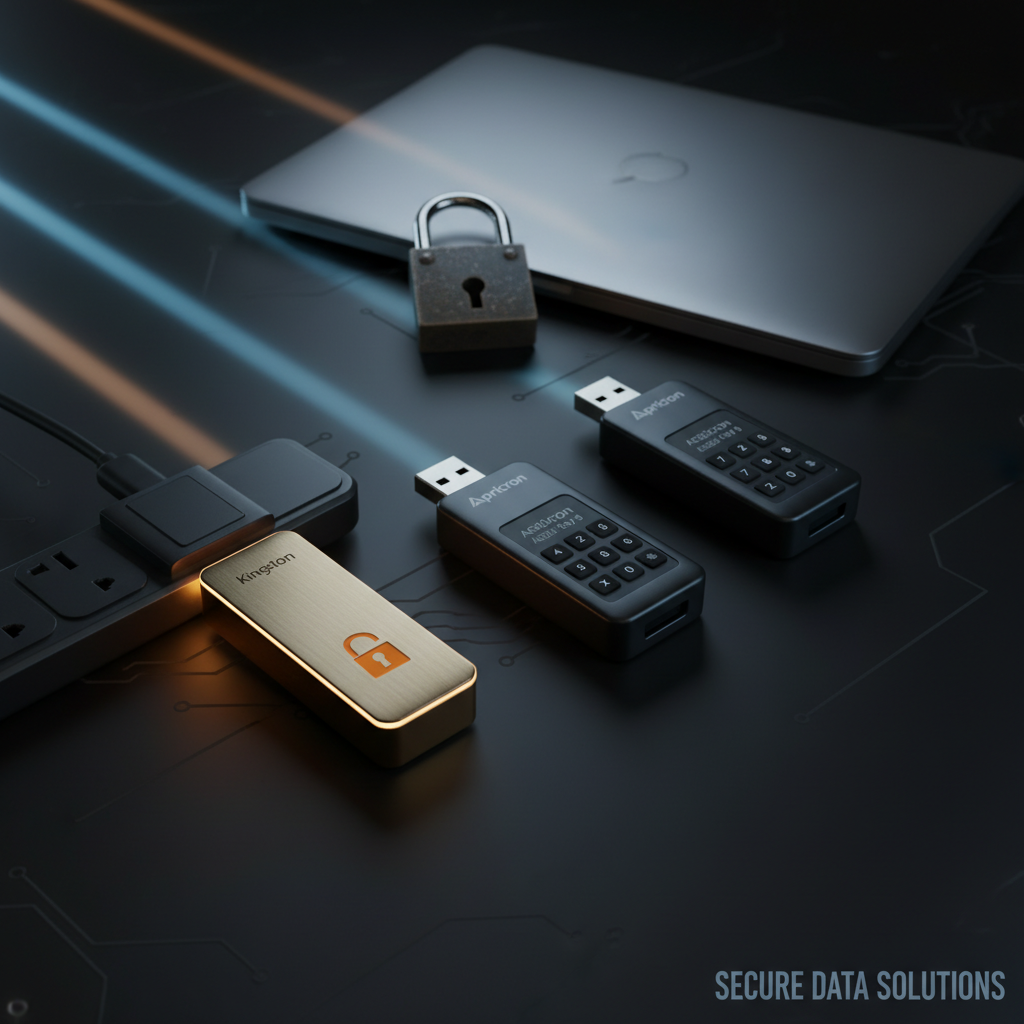
When confidential data must travel on a thumb drive, hardware encryption is the only reliable safeguard. The review considered ten USB flash drives that promise built‑in AES‑256 protection, with options ranging from $50.99 for the Kingston IronKey Locker+ 50 32 GB up to $226.17 for the Apricorn Aegis Key 3 240 GB. The selection divides into budget, mid‑range and premium tiers, so you can balance cost against speed and certification level.
The budget champion is the Kingston IronKey Locker+ 50 32 GB, priced at $50.99, earning 4.5 stars from 785 reviews and a 9.6 mm height that fits any pocket. It delivers 145 MB/s read speed on USB 3.2 Gen 1. In the mid‑range, iStorage’s datAshur Personal2 64 GB scores 4.3 stars, offers up to 170 MB/s read, and includes a rechargeable keypad. For premium security, Apricorn’s Aegis Key 3 NXC 128 GB costs $168.00, also rates 4.5 stars and provides FIPS‑140‑2 Level 3 validation with 171 MB/s read.
Next, the article examines each model’s encryption methods, durability specs and real‑world performance so you can decide which encrypted flash drive fits your workflow.

Kingston Ironkey Locker+ 50 32GB
Its compact 9.6 mm height and 60.56 mm length keep it easy to slip into any pocket, delivering solid value at $50.99.

Apricorn Aegis Key 3 NXC 128GB
Audiophiles and enthusiasts who need premium sound security choose it; it costs $168.00—about $117 more than the budget pick.

Apricorn Aegis Key 3 240GB
Stands out with a 3‑year warranty and up to 195 MB/s read speed, offering enterprise‑grade durability that the other two lack.
Also considered
Score Analysis
Key score advantages vs. runner-up (Apricorn Aegis Key)
Price Range
Kingston Ironkey Locker+ 50 32GB
$50.99
Apricorn Aegis Key 3 NXC 128GB
$168.00
Apricorn Aegis Key 3 240GB
$238.87
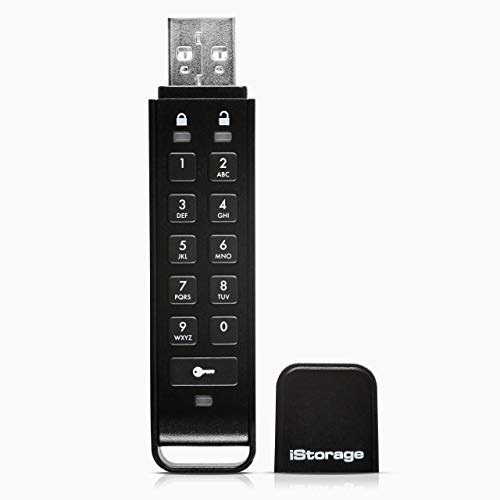
iStorage datAshur Personal2 64GB
$129.95

Apricorn Aegis Key 3Z 128GB
$164.99

Kingston Ironkey Locker+ 50 128GB
$88.99

Kanguru Defender Elite300 64GB
$181.99

iStorage datAshur PRO 8GB
$99.95
Corsair Padlock 3 256GB
$134.99

Kanguru Defender 3000 16GB
$95.19
Spec Comparison
TL;DR: The Kingston IronKey Locker+ 50 32 GB offers FIPS‑certified XTS‑AES‑256 hardware encryption, USB 3.2 speeds up to 145 MB/s read and 115 MB/s write, all in a lightweight metal case for $50.99.
What sets this drive apart is its enterprise‑grade security: it uses XTS‑AES‑256 encryption certified to FIPS 197, supports dual admin and user passwords, and locks out after 10 brute‑force attempts while also erasing the crypto key after 10 failed attempts. The drive stores 32 GB (about ≈29.8 GB usable) and delivers up to 145 MB/s read and 115 MB/s write on a USB 3.2 Gen 1 interface, with fallback USB 2.0 speeds of 30 MB/s read and 20 MB/s write.
Compared with its peers, the Locker+ 50 is lighter at 0.0440924524 pounds and shorter at 60.56 mm length, making it slimmer than the iStorage datAshur PRO 8GB (which weighs more and measures 80 mm long). Its read speed is respectable but slower than the iStorage’s claimed 169 MB/s, while its write speed trails the iStorage’s 135 MB/s claim. The metal casing and key loop give it a more rugged feel than the plastic‑capped Kanguru Defender 3000, which is heavier at 38 g.
Users appreciate the plug‑and‑play feel, the LED indicator, and the built‑in cloud‑backup license that works with major services like Google Drive and Dropbox. Professional reviewers note the virtual keyboard and the seamless USB‑to‑Cloud integration as usability wins. However, the requirement for two consecutive free drive letters on Windows often triggers allocation conflicts, and the lack of any password‑recovery mechanism means a forgotten passphrase results in permanent loss—a point that casual users frequently flag.
The drive operates between 0 °C and 50 °C and can be stored from –20 °C up to 85 °C, fitting most office environments. It's compatible with most computers via its USB Type‑A connector, and the five‑year warranty adds confidence for long‑term use.
Pros
Cons
Best for: Budget‑conscious professionals needing reliable hardware encryption without a premium price tag.
Avoid if: You need password recovery, advanced performance, or operate in environments with limited drive‑letter availability.
TL;DR: The Apricorn Aegis Key 3 NXC packs 128 GB of FIPS‑grade 256‑bit AES XTS hardware encryption, a built‑in keypad, and IP68 durability for $168, earning a 4.5‑star rating from 197 reviewers.
What sets this drive apart is its on‑device keypad and 256‑bit AES XTS encryption, validated to FIPS 140‑2 Level 3 (pending). The rugged aluminum shell meets an IP68 rating, and the internal battery powers the keypad even when the host is off. It stores 128 GB, reads up to 171 MB/s and writes up to 160 MB/s, and comes with a three‑year warranty.
Compared with the other nine flash drives in the roundup, the Aegis Key 3 NXC shares the same 0.05‑pound weight as the Apricorn Aegis Key 3Z 128GB, but its maximum read speed of 171 MB/s is lower than the 3Z’s 190 MB/s. It's lighter than the Kanguru Defender Elite300 (0.1 pounds) and slimmer than the Corsair Padlock 3 (14.0 mm height). While its $168 price is higher than the Kingston Ironkey Locker+ 128 GB, it offers a stronger encryption suite and tamper‑evident epoxy sealing.
Everyday users praise the compact, waterproof design and the confidence that the keypad eliminates keyloggers. Reviewers note a learning curve when first configuring PIN lengths (7‑16 digits) and occasional file‑corruption complaints if the auto‑lock disengages without proper ejection. Professional reviewers highlight the pending FIPS Level 3 validation as critical for government and healthcare environments, and they commend the drive’s multi‑mode access (Admin, User, Two Read‑Only) for flexible security policies.
Pros
Cons
Best for: Government, military, and healthcare professionals who need FIPS‑grade hardware encryption and rugged, tamper‑evident storage.
Avoid if: You need the fastest raw transfer speeds for video editing, or you need a drive that can be shipped to restricted markets such as China, Russia, Hong Kong, or Venezuela.
“It’s solid, works well and customer support, when I needed it, was prompt and helpful.”
TL;DR: The Apricorn Aegis Key 3 240 GB packs FIPS 140‑2 Level 3‑validated 256‑bit AES XTS encryption, a 7‑16‑digit keypad, and up to 195 MB/s read speed in a rugged aluminum case, but its internal battery and premium price may limit casual use.
This drive’s standout feature is its hardware‑only security: a 256‑bit AES XTS engine validated to FIPS 140‑2 Level 3, coupled with an onboard alphanumeric keypad that requires a 7‑16‑digit PIN. It offers 240 GB of capacity and delivers up to 195 MB/s read and up to 162 MB/s write speeds, all without needing any drivers or admin rights.
Compared with the other nine entries, the Aegis Key 3 is heavier at 0.2 Pounds versus the Kanguru Defender Elite300’s 0.1 Pounds, and its 12.6 mm depth makes it taller than the ultra‑slim Apricorn Aegis Key 3 NXC, which measures just 6.35 mm in height. Its 240 GB capacity also outstrips the 128 GB models from Apricorn’s own lineup, giving you more room for sensitive data. While several rivals rely on software‑based encryption, this unit needs no software at all, and its IP68 rating (dust‑proof and submersible to 1 meter for 30 minutes) adds a durability edge.
Users consistently praise the drive’s reliability across Windows, macOS, Linux, Android, and Chrome OS, noting that the keypad keeps keyloggers at bay. Professional reviewers highlight the FIPS 140‑2 Level 3 certification covering eleven security domains and the epoxy‑sealed aluminum chassis. On the downside, the internal rechargeable lithium‑polymer battery powers the keypad, so a dead battery renders the drive unusable—many consumer comments echo this point. Write performance caps at 162 MB/s and is moderate, and the lack of a visual PIN display can be inconvenient when typing on the go.
Additional technical details include a brute‑force safeguard that deletes the key and all data after 20 consecutive wrong PIN entries, a self‑destruct PIN option, and dual authentication roles for user and crypto‑officer. The drive also features auto‑lock after removal or inactivity, making it a solid choice for environments where physical security matters as much as data encryption.
Pros
Cons
Best for: Government, military, and healthcare professionals who need FIPS‑compliant, tamper‑evident storage with rugged durability.
Avoid if: You’re on a tight budget, need the fastest possible write performance, or prefer a battery‑free USB drive.
“It’s solid, works well and customer support, when I needed it, was prompt and helpful.”
TL;DR: The iStorage datAshur Personal2 64 GB offers AES‑XTS 256‑bit hardware encryption, a built‑in keypad and up to 170 MB/s read speed in a lightweight 14‑g USB‑A drive, though its write speed tops out at 133 MB/s.
The drive’s standout feature is its FIPS‑validated AES‑XTS 256‑bit full‑disk encryption, protected by a 7‑15 character alphanumeric PIN entered on an on‑device keypad. BadUSB immunity and a hardware‑only design mean you can plug it into any Windows, macOS, Linux, Chrome OS or Android device without installing drivers, and the 64 GB capacity gives you a decent amount of space for confidential files.
Compared with the other nine contenders, the Personal2 holds less capacity than the 256 GB Corsair Padlock 3 but more than the 16 GB Kanguru Defender 3000. At 14 g it is lighter than the Corsair (21.8 g), Kanguru Defender 3000 (38 g), and the Apricorn Aegis Key models (22.68 g each), making it one of the most portable options. However, it lacks a native USB‑C connector, so you’ll need an adapter for newer laptops—something the Ironkey Locker+ 50 128 GB and the Apricorn Aegis Key 3 NXC provide.
User feedback highlights the drive’s plug‑and‑play simplicity: you just type the PIN on the keypad and the encrypted volume appears. Professionals appreciate the admin/user PIN separation for business deployment. Reviewers note the downside: the internal rechargeable LiPo battery; once it degrades, keypad operation can fail. Write speeds feel slower than the advertised “up to 133 MB/s,” especially with large files.
Pros
Cons
Best for: Home and office users seeking a balance of features and value
Avoid if: You have limited desk space or need portability
TL;DR: The Apricorn Aegis Key 3Z 128 GB offers FIPS 140‑2 Level 3‑validated 256‑bit AES XTS hardware encryption, a rugged aluminum body with IP57 protection, and a built‑in keypad for PIN entry, all for $164.99.
The standout feature is its 256‑bit AES XTS hardware encryption, which carries FIPS 140‑2 Level 3 validation, and an embedded polymer‑coated numeric keypad that keeps your PIN off the host computer. The drive also carries an IP57 rating, meaning it can survive dust, water, and immersion up to 1 m for 30 minutes, and it runs on a rechargeable internal lithium battery.
Compared with the other nine entries, the 3Z’s maximum read speed of up to 190 MB/s outpaces the 171 MB/s listed for the Apricorn Aegis Key 3 NXC, while its write speed max of 80 MB/s is lower than the NXC’s 160 MB/s. It is lighter than the Kanguru Defender Elite300 (0.05 lb vs 0.1 lb) and more compact than the Corsair Padlock 3, whose height is 14 mm versus the 3Z’s 7.62 mm. The iStorage datAshur Personal2 is slimmer (5 mm) and lighter (≈0.031 lb) but offers a higher write speed claim of up to 133 MB/s, whereas the 3Z’s real‑world write speed settles around 72 MB/s. The Kingston Ironkey Locker+ 50 tips the scale at about 0.06 lb, making the 3Z marginally lighter.
Users consistently applaud the drive’s “just works” attitude across Windows, macOS, Linux, Android and Chrome OS, noting the absence of required software and the durability of the aluminum shell. Professional reviewers highlight the FIPS‑Level 3 certification and the keypad as strong defenses against compromised hosts. The most common complaints focus on the real‑world transfer speeds—77 MB/s read and 72 MB/s write—which fall short of the advertised maxima, and on the need to keep the internal battery charged, as a dead battery can lock the device.
Pros
Cons
Best for: Professionals in government, defense, healthcare, legal, finance or journalism who need FIPS‑validated hardware encryption and a rugged, keypad‑protected USB drive.
Avoid if: You need capacities above 128 GB, rely exclusively on USB‑C ports, or are looking for the fastest possible transfer speeds at a lower price point.
“It’s solid, works well and customer support, when I needed it, was prompt and helpful.”
TL;DR: The Kingston IronKey Locker+ 50 128 GB offers FIPS‑certified XTS‑AES 256‑bit hardware encryption, rugged metal construction, and fast USB 3.2 performance for $88.99, though its software quirks and premium price may deter budget shoppers.
This drive’s standout feature is its FIPS 197‑certified XTS‑AES 256‑bit hardware encryption, paired with brute‑force protection that locks after ten failed user attempts and crypto‑erases after ten admin failures. The metal case with an integrated key loop adds durability and a convenient attachment point.
At 0.05952481074Pounds, it’s a bit heavier than the Kanguru Defender 3000 (0.01Pounds) and the iStorage datAshur PRO (0.0551155655Pounds), and its 9.6 mm height sits between the Kanguru’s 8.92 mm and the iStorage’s 10.5 mm. The 60.6 mm length and 18.6 mm width keep it compact enough for a pocket while still feeling solid.
Users consistently praise the straightforward, driver‑free setup and the peace of mind from the hardware encryption. Professional reviewers note the drive’s performance exceeds its advertised USB 3.2 specs, rated at 158.6 MB/s read and 136.2 MB/s write. However, several customers report the IronKey app can become unresponsive after the host computer sleeps, and customers commonly complain about the lack of official Linux support.
Beyond security, the drive includes a 5‑year warranty, a blue LED activity indicator, and a 5‑year cloud‑backup license that automatically syncs to popular services like Google Drive and Dropbox. You don’t need additional drivers, and it works with Windows 11/10/8.1 and macOS 10.14‑15.x.
Pros
Cons
Best for: Professionals handling sensitive data—lawyers, healthcare workers, finance staff—who need certified hardware encryption and a durable, portable solution.
Avoid if: You rely on Linux, need the cheapest flash storage, or cannot tolerate occasional software hiccups after sleep.
TL;DR: The Kanguru Defender Elite300 64 GB delivers FIPS‑140‑2 Level 2 256‑bit AES hardware encryption, a physical write‑protect switch, and rugged alloy housing, with up to 160 MB/s read and 120 MB/s write speeds for demanding security environments.
The drive packs 64 GB of MLC NAND flash and offers “up to 160 MB/s” read and “up to 120 MB/s” write performance even while encrypted. Its FIPS 140‑2 Level 2 validation, 256‑bit AES‑XTS encryption, and RSA‑2048 digitally signed firmware give it a strong security pedigree, while a physical write‑protect switch adds a tangible barrier against accidental overwrites. The rugged alloy housing resists water, meets TAA compliance, and suits harsh field use.
At 45.36 g, the Elite300 is heavier than the 22.68 g Apricorn Aegis Key 3 NXC and the 14 g iStorage datAshur Personal2, and its 124.46 mm length and 71.12 mm width exceed those of compact competitors. However, it provides a higher shock rating of 1000 G and a broader operating temperature range (+70 °C to 0 °C) than many of the other drives in this roundup, making it a premium‑grade option for environments where durability matters.
Everyday users praise the drive’s reliability and the peace of mind that comes from hardware encryption and the write‑protect switch. Professional reviewers note the fast encrypted transfer rates and the optional Kanguru Remote Management Console for centralized control, while some users find the initial setup a bit complex and miss biometric authentication that appears on a few rival models. The drive’s data retention of “10 years or more” and humidity tolerance (20 %–90 %) further reassure long‑term storage needs.
Pros
Cons
Best for: Those prioritizing quality and willing to pay for premium performance
Avoid if: You're on a tight budget or only need basic functionality
TL;DR: The iStorage datAshur PRO 8 GB offers FIPS 140‑2 Level 3 hardware encryption, an IP57‑rated aluminum body and a built‑in keypad for secure, plug‑and‑play data protection at $68.99.
This drive’s standout feature is its XTS‑AES 256‑bit hardware encryption, which meets FIPS 140‑2 Level 3 and NATO Restricted certifications, and an IP57 rating that lets it survive immersion up to 1 m for 30 minutes. It stores 8 GB of data in a compact 10.5 mm × 20 mm × 80 mm form factor and weighs 0.0551155655 pounds, making it easy to slip onto a key‑ring.
Compared with the other nine entries, the datAshur PRO sits at a higher price point than the Kingston Ironkey Locker+ 50 32 GB but is lighter than the Kanguru Defender Elite300 64 GB and bulkier than the Apricorn Aegis Key 3Z 128 GB. Its USB 3.2 Gen 1 interface matches the speed class of most peers, yet its advertised read speed of up to 170 MB/s and write speed of up to 146 MB/s place it ahead of the slower USB 2.0‑only models while trailing the fastest 190 MB/s claims of premium rivals.
Professional reviewers praise the drive’s military‑grade security and the convenience of a keypad that locks automatically when unplugged. Everyday users like the rugged aluminum housing and the brute‑force protection that erases the PIN after ten wrong attempts. However, several reviewers note that real‑world write speeds can drop dramatically, sometimes far below the claimed 146 MB/s, and the keypad only functions while the drive is powered, which can feel limiting in quick‑swap scenarios.
The datAshur PRO uses a USB 3.2 Gen 1 (SuperSpeed) interface that works with USB 1.0/2.0/3.0 devices, ensuring broad OS support across Windows, macOS, Linux, Chrome OS, Android and virtual environments. Its tamper‑evident epoxy coating and independent admin/user PINs add layers of physical and logical protection, making it a solid choice for environments where data confidentiality outweighs raw transfer speed.
Pros
Cons
Best for: Entry-level buyers or those on a tight budget
Avoid if: Reliability and user satisfaction are your top concerns
TL;DR: The Corsair Padlock 3 packs 256 GB of FIPS 197‑compliant 256‑bit AES hardware encryption into a 14 mm‑high, rubber‑cased USB 3.0 drive that plugs‑and‑plays on all major OSes.
The drive’s standout spec is its built‑in numeric keypad with a 4–10 digit PIN and a two‑minute lockout after five failed attempts, delivering government‑grade FIPS 197 security without any software install. At 0.048 pounds (21.8 g) it feels solid, and its 86.4 mm length makes it longer than the iStorage datAshur Personal2, which measures 75 mm, but still compact enough for a pocket.
Compared with the nine other encrypted flash drives in this roundup, the Padlock 3 is heavier than the iStorage datAshur Personal2 (0.0309 pounds) and roughly the same weight as the Apricorn Aegis Key 3Z (0.05 pounds). Its write speed of 80 MB/s trails the iStorage’s up‑to‑133 MB/s and the Apricorn Aegis Key 3 NXC’s up‑to‑160 MB/s, though it matches the Apricorn Aegis Key 3Z’s 80 MB/s max. The Padlock 3’s USB 3.0 interface is backward compatible with USB 2.0/1.1, a feature shared by many peers, and reviewers praise its rugged rubber housing for drop resistance, a durability edge over drives that lack a protective case.
User feedback highlights the drive’s straightforward PIN entry and the fact that it works on Windows 7+, macOS, and Linux without drivers. Professional reviewers note the convenience of a driver‑free solution in secure environments, while everyday users appreciate the durable feel of the rubber shell. The shared‑button keypad design, however, draws criticism for reducing true PIN entropy, and some owners report that the protective cap does not seal tightly, limiting water‑resistance. A few users have also mentioned that the USB connector can become loose after extended use.
Pros
Cons
Best for: Business professionals, government or defense personnel, and healthcare workers who need FIPS‑compliant, portable encryption.
Avoid if: You're shopping on a tight budget — it's priced at $134.99
TL;DR: The Kanguru Defender 3000 16 GB delivers FIPS 140‑2 Level 3‑certified 256‑bit AES‑XTS encryption in an IP68‑rated, tamper‑resistant shell, but its 100 MB/s write speed and premium price make it a niche choice for high‑security environments.
The standout feature is its hardware‑based 256‑bit AES encryption, certified to FIPS 197 standards and wrapped in an epoxy‑encapsulated processor that destroys the flash chip if someone tries to tamper with it. The drive also carries an IP68 rating, meaning it can survive immersion up to 1 meter for an hour, and it endures shocks of up to 1000 Gs and vibrations of 15 G peak‑to‑peak. Capacity sits at 16 GB, with read performance of up to 150 MB/s and write performance of up to 100 MB/s over a USB 3.2 Gen 1x1 interface.
Compared with the other nine entries, the Defender 3000 is notably lighter at 0.01 Pounds (38 g), while many peers—such as the Kingston Ironkey Locker+ 50 (0.0595 Pounds) and iStorage datAshur PRO (0.0551 Pounds)—weigh considerably more. Its length of 72.19 mm makes it longer than the Ironkey’s 60.6 mm, but its height of 8.92 mm is a touch shorter than the Ironkey’s 9.6 mm. In raw speed, its 150 MB/s read rate meets or exceeds the Ironkey’s “up to 145 MB/s” claim, yet its 100 MB/s write ceiling trails the Ironkey’s 115 MB/s and the datAshur PRO’s 135 MB/s figures.
Users consistently praise the peace of mind that comes from the FIPS‑level certification and the built‑in BitDefender antivirus trial, noting that the drive works across Windows, macOS, and mainstream Linux distributions without a hitch. Professional reviewers highlight the remote‑management console (KRMC) as a strong enterprise feature, though smaller teams sometimes find the setup a bit involved. The most common complaint is the slower write speed relative to non‑encrypted flash drives, and the price point feels steep for a 16 GB capacity.
Pros
Cons
Best for: Government agencies, healthcare providers, financial institutions, legal firms, and military contractors that require FIPS‑level encryption and rugged, tamper‑resistant storage.
Avoid if: You need high capacity, ultra‑fast write speeds, or are looking for a low‑cost solution for everyday personal use.
Breakdown
Kingston Ironkey Locker+ 50 32GB
Pros
Apricorn Aegis Key 3 NXC 128GB
Pros
Apricorn Aegis Key 3 240GB
Pros
Cons
iStorage datAshur Personal2 64GB
Pros
Based on scoring data and product specs
Personalized picks
Best Overall Pick
Kingston Ironkey Locker+ 50 32GB
Best Budget PickBest for: Budget-conscious buyers seeking a reliable entry-level option
Apricorn Aegis Key 3 NXC 128GB
Best for: Audiophiles and enthusiasts seeking premium sound quality and advanced features
$168.00+$117.01 vs winner
Skip Kanguru Defender 3000 16GB if…
Reliability and user satisfaction are your top concerns
Kingston’s Ironkey Locker+ 50 32 GB takes the top spot thanks to its solid 4.5‑star rating from 785 reviewers, a wallet‑friendly $50.99 price tag, and FIPS 197‑certified XTS‑AES 256‑bit hardware encryption. It also delivers respectable USB 3.2 speeds—up to 145 MB/s read and 115 MB/s write—while staying lightweight at just 20 g and fitting in a compact 9.6 mm‑high metal case.
The Apricorn Aegis Key 3 NXC 128 GB lands as the runner‑up, ideal if you need a rugged, waterproof drive for field work. Its IP68‑rated aluminum shell, internal battery‑powered keypad, and auto‑lock feature protect data in harsh environments, and the same 256‑bit AES XTS encryption keeps your files safe.
For shoppers looking beyond the winner, the iStorage datAshur Personal2 64 GB offers a solid mid‑range choice at $129.95, balancing decent capacity with reliable hardware encryption. If you’d prefer a premium option, the Apricorn Aegis Key 3 240 GB stands out at $226.17, delivering the highest storage and a robust build for power users.
Pick the Kingston Ironkey Locker+ 50 32 GB today for the best value and strong security in a compact package.
The Apricorn Aegis Key 3 NXC offers an IP68 rating, crush‑resistant aluminum housing, and an internal battery‑powered keypad, making it suited for harsh environments. The Kingston Ironkey Locker+ 50 32 GB lacks an IP rating and is metal but not certified for water immersion.
Please sign in to leave a review
No reviews yet. Be the first to review!
