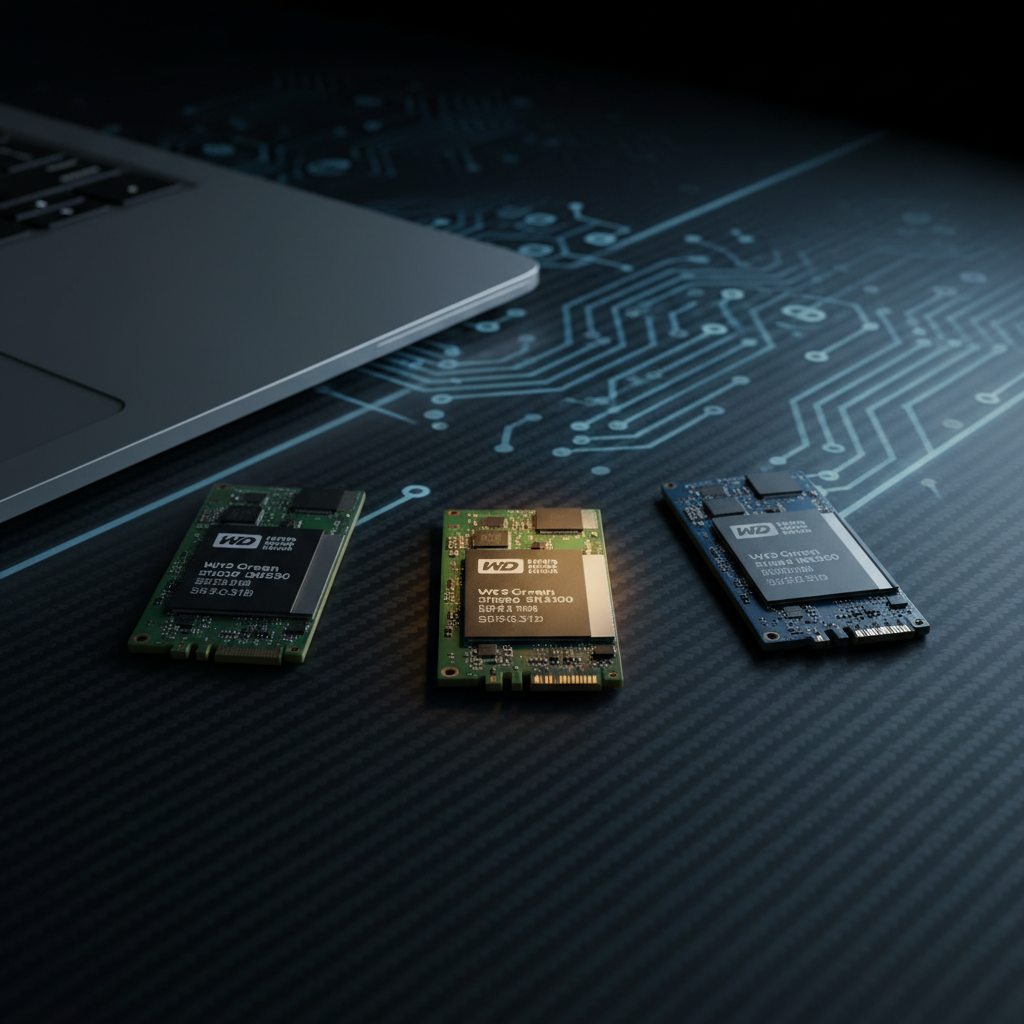
We’ve lined up seven Western Digital SSDs to help you find the right balance of price, performance and reliability. The standout figure comes from the WD Green SN350 1TB, which delivers up to 3,200 MB/s sequential read speed and carries a 4.7/5 rating from 11,771 reviews, making it a compelling entry‑level upgrade.
Our budget bucket covers the SN730 256GB at $55.00, the WD Green 1TB at $72.71, and the WD Green SN350 1TB at $78.90, all of which stay under $80 and offer solid NVMe performance – the SN730 even hits 3,150 MB/s read and 270,000 IOPS random reads. The mid‑range slot features the WD Blue SN5000 500GB at $109.99, bringing a 5‑year warranty and 300 TBW endurance. Premium picks include the WD Blue 1TB ($189.99) and 2TB ($208.99) SATA drives with 560 MB/s read speeds, plus the WD Red 1TB at $288.00, which offers 600 TBW endurance and 82,000 IOPS random reads for 24/7 NAS workloads.
Next, we’ll break down each model’s strengths, ideal use cases, and any trade‑offs you should watch.

Western Digital WD Green SN350 1TB
Offers 400,000 IOPS random write speed, which delivers smooth everyday performance at a low price point.

Western Digital WD Blue SN5000 500GB
It's ideal for home or office users who want a balanced feature set, though it sits roughly $31 above the budget pick’s $78.90 price.

Western Digital WD Green 1TB
Stands out with 20,578 reviews and a 4.5‑star rating, which makes it the most trusted and popular entry‑level SSD despite similar capacity.
Also considered
Score Analysis
Key score advantages vs. runner-up (Western Digital WD)
Price Range
Western Digital WD Green SN350 1TB
$145.00
Western Digital WD Blue SN5000 500GB
$119.99
Western Digital WD Green 1TB
$159.00
Western Digital SN730 256GB
$79.99

Western Digital WD Blue 2TB
$208.99

Western Digital WD Blue 1TB
$200.00

Western Digital WD Red 1TB
$288.00
Spec Comparison
TL;DR: The WD Green SN350 1TB delivers 3,200 MB/s reads, low‑power operation and a three‑year warranty at a budget‑friendly price, making it a solid entry‑level NVMe upgrade.
This drive’s standout spec is its 3,200 MB/s sequential read speed and 2,800 MB/s sequential write speed, powered by an 8 Gb/s PCIe Gen3 x4 interface. Random performance reaches 300,000 IOPS reads and 400,000 IOPS writes at 4 KB. The drive uses 3D QLC NAND and Western Digital’s Intelligent SLC Caching to keep latency low while keeping costs down.
Physically, the SN350 comes in a trim package: at 2.38 mm tall, 80 mm long and 22 mm wide, it is considerably slimmer and shorter than the WD Green 1TB, which measures 7.1 mm in height and 100.6 mm in length. It also weighs just 7.5 g, far lighter than the 32.7 g of that sibling model. Compared with the SN730 256 GB, the SN350 shares a similar height (2.54 mm vs 2.38 mm) but offers four times the capacity. It is also lighter than the WD Blue SN5000 500 GB, which tips the scales at 5.7 g, and it fits the same M.2 2280 single‑sided form factor as all the other drives in this roundup.
Everyday users rave about the noticeable boost in boot times and application launches, praising the “fast boot and app loading” they experience after swapping an old HDD for this SSD. Professional reviewers note the clear performance jump over SATA SSDs and highlight the inclusion of the WD SSD Dashboard for health monitoring. Some users report that write speeds feel capped at the 2,800 MB/s ceiling during large file transfers, and the QLC NAND’s 100 TBW endurance is lower than TLC‑based alternatives, which can be a concern for heavy write workloads.
Beyond speed, the drive draws only 110 mW in active use and tops out at 5 W, helping laptops stay cool. It includes low‑density parity check (LDPC) error correction and comes with a three‑year limited warranty, offering peace of mind for budget‑focused builds.
Pros
Cons
Best for: Budget-conscious buyers seeking a reliable entry-level option
Avoid if: You want the best value‑per‑dollar in its price range
“dramatically improved system performance, with boot times dropping from over 2 minutes to under 30 seconds”
“drive disconnection issues, requiring reseating”
TL;DR: The WD Blue SN5000 500 GB delivers up to 5,000 MB/s read speed in a tiny, single‑sided PCIe 4.0 package, making it a solid mid‑range upgrade for everyday PCs.
The standout spec is its sequential read speed of 5,000 MB/s, which sits at the top of the budget Gen4 tier. Paired with a 4,000 MB/s write rate and a DRAM‑less 4‑channel controller, the drive offers fast boot‑up and app load times while keeping power draw low at 6.3 W peak.
Compared with the other six WD SSDs in this roundup, the SN5000 reads faster than the WD Green SN350’s 3,200 MB/s and the SN730’s 3,150 MB/s, and its random write performance of 770,000 IOPS eclipses the SN730’s 280,000 IOPS. Capacity-wise it sits at 500 GB, smaller than the 1‑TB and 2‑TB models but larger than the SN730’s 256 GB. At 5.7 g (0.012566348934 lb) it’s lighter than most peers, though the WD Red 1TB is marginally lighter.
Users consistently praise the drive for snappy system starts and the peace of mind from a five‑year warranty. Professional reviewers note the jump in performance over the older SN580 and commend the use of 112‑layer TLC BiCS 5 NAND for better endurance. Some buyers have reported occasional heat buildup near the 60 °C idle limit and have run into fulfillment mix‑ups or slow seller support, so keep those considerations in mind if you’re sensitive to temperature or service response.
Additional technical highlights include a thin graphene heatspreader that removes the need for an external heatsink, single‑sided M.2 2280 form factor for slim laptops, TCG Pyrite 2.01 encryption, and bundled Acronis True Image software. The drive’s endurance rating of 0.33 DWPD and 300 TBW provides a reliable lifespan for typical desktop workloads.
Pros
Cons
Best for: Home and office users seeking a balance of features and value
Avoid if: You need maximum write performance for heavy 4K/8K video editing, large‑scale data logging, or RAID arrays that demand the highest consistency
“dramatically improved system performance, with boot times dropping from over 2 minutes to under 30 seconds”
“drive disconnection issues, requiring reseating”
TL;DR: The WD Green 1TB SSD offers a budget‑friendly 1 TB capacity, SATA III speeds up to 545 MB/s, and ultra‑low power draw, making it a solid upgrade for everyday laptops and desktops.
This drive packs a full 1 TB (1000 GB) of 3D TLC NAND in a 2.5‑inch / 7 mm form factor, delivering sequential reads up to 545 MB/s and writes up to 525 MB/s. Its active power consumption is only 80 mW, and it weighs just 0.072 pounds (32.7 g), which helps keep laptops cool and extends battery life.
Compared with the WD Green SN350 1TB, the Green is heavier (32.7 g vs 7.5 g) and slower in sequential reads (545 MB/s vs 3200 MB/s), but it still undercuts many larger SATA drives in price. The WD Blue 1TB weighs a similar 0.076 pounds, so the Green isn’t noticeably bulkier, and both share the same 7 mm height.
Reviewers praise the ultra‑low power draw and the bundled WD SSD Dashboard plus Acronis True Image for painless cloning. However, the absence of a DRAM cache and the limited SLC caching lead to slower random performance once the cache fills, a point that everyday users often mention in their feedback.
Technical highlights include a mean time to failure of 1,000,000 hours, 400 TBW endurance, and a shock resistance rating of 1,500 G. The drive operates safely between –55 °C and 70 °C, and its error‑correction uses LDPC to maintain data integrity.
Pros
Cons
Best for: Budget‑conscious buyers seeking a reliable entry‑level option
Avoid if: You need advanced features or professional‑grade performance
“dramatically improved system performance, with boot times dropping from over 2 minutes to under 30 seconds”
“drive disconnection issues, requiring reseating”
TL;DR: The Western Digital SN730 256 GB delivers 3,150 MB/s sequential reads and 280,000 IOPS random performance at a $55 price, but its 256 GB size and lack of DRAM limit heavy workloads.
The SN730’s headline spec is its 3,150 MB/s sequential read speed, backed by 280,000 IOPS random reads and 280,000 IOPS random writes. At just 9 g and a slim 2.54 mm profile, it fits easily into ultrabooks and compact desktops. Power use is modest, with only 30 mW idle and 3.5 mW in extreme sleep, making it friendly to battery‑run machines.
Compared with the other six Western Digital drives in this roundup, the SN730 is far faster than the SATA‑based WD Green 1TB (545 MB/s read) and WD Blue 1TB (560 MB/s read). Its read speed is on par with the high‑end WD Green SN350 1TB (3,200 MB/s) but its write speed of 2,100 MB/s trails the SN350’s 2,800 MB/s. In size, it matches the WD Blue SN5000 500 GB at 2.54 mm height, yet it is a bit heavier than the SN350’s 7.5 g. The drive’s endurance of 200 TBW and MTBF of 1.75 million hours sits between the lower‑end Green models (400 TBW, 1 million‑hour MTBF) and the higher‑end Red 1TB (600 TBW, 2 million‑hour MTBF).
Users praise the SN730 for lightning‑quick boot times and the peace of mind a five‑year limited warranty gives. Everyday reviewers note the drive feels reliable in laptops and small‑form‑factor PCs. The most common complaints focus on the modest 256 GB capacity, which can fill up fast for modern game libraries, and occasional slower write speeds during large file transfers—issues tied to the drive’s DRAM‑less design.
Pros
Cons
Best for: Shoppers on a tight budget who want the most for their money
Avoid if: You need large storage capacity, sustained high‑I/O workloads like 4K video editing, or a massive game library
“dramatically improved system performance, with boot times dropping from over 2 minutes to under 30 seconds”
“drive disconnection issues, requiring reseating”
TL;DR: The WD Blue 2TB SATA SSD delivers up to 560 MB/s reads, 500 TBW endurance and a 5‑year warranty for $208.99, making it a solid upgrade for legacy laptops and desktops.
This drive packs 2000 GB of storage in a 2.5‑inch, 7.1 mm form factor and can sustain sequential reads of up to 560 MB/s and writes of up to 520 MB/s. A 512 MB DDR3L‑1600 DRAM cache helps keep those speeds consistent under load, while the listed endurance of 500 TBW and MTBF of 2.25 million hours signal long‑term reliability.
At roughly 0.132 pounds, it's heavier than the WD Blue 1TB (0.076 pounds) but shares the same 7 mm height and 69.9 mm width. Its random read performance of 87,000 IOPS sits just below the 90,000 IOPS of the WD Blue 1TB, and its random write figure of 83,000 IOPS is comparable to that model’s 82,000 IOPS. Compared with the ultra‑thin NVMe options like the WD Green SN350, the SATA‑III interface caps the Blue at 560 MB/s, far slower than the SN350’s 3,200 MB/s reads.
Users consistently praise the drive for quick boot times, quiet operation and dependable reliability. Professional reviewers note the “excellent speeds for a SATA drive” and commend its thermal efficiency. The most common gripe is the bundled Acronis cloning software, which many find unreliable, and the lack of hardware‑based encryption may deter security‑focused buyers.
Pros
Cons
Best for: Buyers willing to invest in a proven, high‑quality option
Avoid if: You need advanced features or professional‑grade performance
“dramatically improved system performance, with boot times dropping from over 2 minutes to under 30 seconds”
“drive disconnection issues, requiring reseating”
TL;DR: The WD Blue 1TB SATA SSD delivers 560 MB/s reads, 520 MB/s writes, and a 5‑year warranty at $189.99, making it a solid upgrade for mainstream PCs.
This drive’s key spec is its SATA III sequential performance – up to 560 MB/s read and 520 MB/s write – paired with 90,000 IOPS random reads and 82,000 IOPS random writes. At 7.1 mm thick, 100.33 mm long, and weighing just 34.6 g, it fits easily into laptops and desktops alike.
Compared with the other six WD SSDs in the roundup, the 1 TB capacity sits between the 500 GB Blue SN5000 and the 2 TB Blue model. It shares the same 7.1 mm height as the 2 TB Blue, but is thicker than the ultra‑slim M.2 drives (2.38 mm to 2.54 mm) like the Green SN350 and SN730. It’s heavier than the 5.7 g SN5000 but lighter than the 60 g 2 TB Blue, and its SATA speeds match the 1 TB Red’s up to 560 MB/s while lagging behind the NVMe Green SN350 and SN730, which hit several GB/s.
Reviewers praise the clear speed boost over traditional HDDs, the low 60 mW active power draw, and the confidence of a 5‑year limited warranty. Professional reviewers note the DRAM‑less controller can cause slower performance under sustained writes, and some owners have reported write speeds that feel lower than the advertised 520 MB/s. Because the drive isn’t compatible with NVMe slots, it doesn’t target high‑end gaming rigs or workstation workloads.
Pros
Cons
Best for: Buyers willing to invest in a proven, high-quality option
Avoid if: You need advanced features or professional‑grade performance
“dramatically improved system performance, with boot times dropping from over 2 minutes to under 30 seconds”
“drive disconnection issues, requiring reseating”
TL;DR: The WD Red 1 TB SATA SSD delivers up to 560 MB/s reads, 530 MB/s writes, and 600 TBW endurance, making it a reliable but premium‑priced choice for 24/7 NAS use.
The most distinctive spec is its 600 TBW endurance for a 1 TB drive, coupled with sequential speeds of up to 560 MB/s read and 530 MB/s write. Random performance reaches 82,000 IOPS read and 85,000 IOPS write, a Marvell 88SS1074 controller and 3D TLC NAND drive it.
Weighing just 0.009375 pounds, it’s dramatically lighter than the 0.132 pounds of the WD Blue 2TB and a fraction thinner than the Blue’s 7.1 mm height. Capacity matches the WD Blue 1TB at 1 TB, though it offers less storage than the Blue 2TB’s 2 TB. Performance‑wise, its 560 MB/s sequential read aligns with the Blue 1TB’s listed speed, while its random IOPS sit between the Blue 1TB’s 90,000 read and 82,000 write figures.
Everyday users praise the drive’s plug‑and‑play reliability, quiet operation, and smooth RAID integration, noting a clear speed boost over spinning disks. Professional reviewers highlight the mature Marvell controller and SanDisk 3D TLC NAND as reasons for its consistent performance and long‑term durability.
Technical details include a SATA III 6 Gb/s interface, a DRAM cache (size not listed), and a 5‑year warranty. Power consumption stays low at 60 mW average active draw, with idle at 56 mW, making it suitable for always‑on NAS environments.
Pros
Cons
Best for: Buyers willing to invest in a proven, high-quality option
Avoid if: You need advanced features or professional-grade performance
“dramatically improved system performance, with boot times dropping from over 2 minutes to under 30 seconds”
“drive disconnection issues, requiring reseating”
Breakdown
Western Digital WD Green SN350 1TB
Pros
Cons
Western Digital WD Blue SN5000 500GB
Pros
Western Digital WD Green 1TB
Pros
Western Digital SN730 256GB
Pros
Based on scoring data and product specs
Personalized picks
Best Overall Pick
Western Digital WD Green SN350 1TB
Best Budget PickBest for: Budget-conscious buyers seeking a reliable entry-level option
Western Digital WD Blue SN5000 500GB
Best for: Home and office users seeking a balance of features and value
$119.99-$25.01 vs winner
Skip Western Digital WD Red 1TB if…
You need advanced features or professional-grade performance
The Western Digital WD Green SN350 1TB clinches the top spot. Its 4.7‑star rating from 11,771 reviewers shows strong user confidence, and the drive delivers up to 3200 MB/s sequential reads and 2800 MB/s writes. Western Digital’s in‑house 4‑channel controller and an 8 Gb/s PCIe Gen3 x4 interface power it, and it also reaches 300,000 IOPS random reads and 400,000 IOPS random writes. With an endurance rating of 100 TBW, a lightweight 7.5 g profile, a three‑year limited warranty, and a price of $78.90, it balances performance and reliability.
The runner‑up, WD Blue SN5000 500 GB, shines when you need PCIe 4.0 speeds for demanding workloads like video editing or high‑frame‑rate gaming. It pushes 5000 MB/s reads and 4000 MB/s writes, includes a 5‑year limited warranty and 300 TBW endurance, making it a solid choice for power users at $109.99. Its DRAM‑less 4‑channel controller, thin graphene heatspreader, and 0.33 DWPD rating keep temperatures low while delivering 460,000 IOPS random reads and 770,000 IOPS random writes.
For tighter budgets, the SN730 256 GB model remains the cheapest entry point at $55.00, offering solid NVMe performance for everyday tasks. If you want a step up without breaking the bank, the Blue SN5000 serves as the mid‑range pick with its PCIe 4.0 performance and longer warranty. And for those who need the most capacity and enterprise‑grade durability, the WD Red 1TB stands out as the premium option at $288.00, carrying the highest rating among the lineup.
Pick the WD Green SN350 1TB for the best value and start upgrading today.
The WD Blue SN5000 offers faster sequential speeds (5,000 MB/s read, 4,000 MB/s write) and higher random IOPS (460 k/770 k) than the WD Green SN350’s 3,200 MB/s read, 2,800 MB/s write and 300 k/400 k IOPS, making it the stronger performer for demanding games, though it costs about $31 more.
Please sign in to leave a review
No reviews yet. Be the first to review!
