Rankings
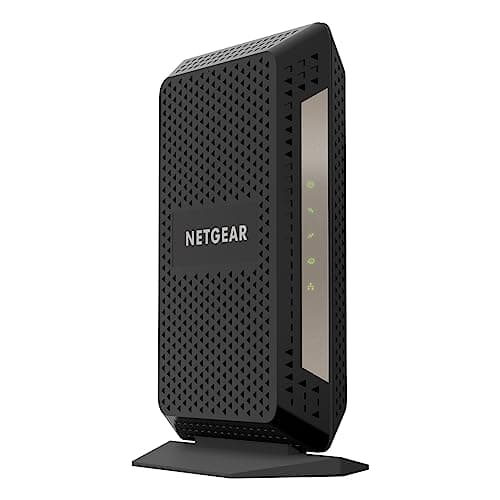
The NETGEAR CM1000 is a DOCSIS 3.1 modem delivering up to 1 Gbps download with IPv6 and QoS support. Its single Ethernet port and top-heavy chassis are trade-offs. Ideal for gigabit cable users who already have a separate router.
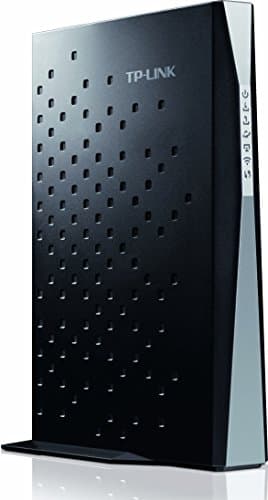
The TP-Link Archer CR700 is a 2-in-1 DOCSIS 3.0 gateway offering up to 680 Mbps cable download and 1.75 Gbps dual-band Wi-Fi. Its DOCSIS 3.0 channel bonding limits it for future gigabit services, and it only provides USB 2.0 connectivity. Ideal for small-to-medium homes with typical cable plans seeking a single device with solid Wi-Fi and basic networking features.
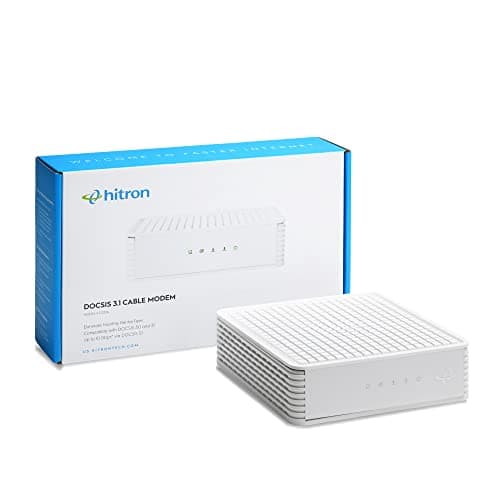
The Hitron CODA is a DOCSIS 3.1 cable modem supporting up to 1 Gbps plans with dual Gigabit Ethernet ports and MoCA immunity filtering. It lacks integrated Wi-Fi and advanced management, requiring an additional router. Ideal for cable subscribers who need high wired speeds and already have a separate wireless solution.
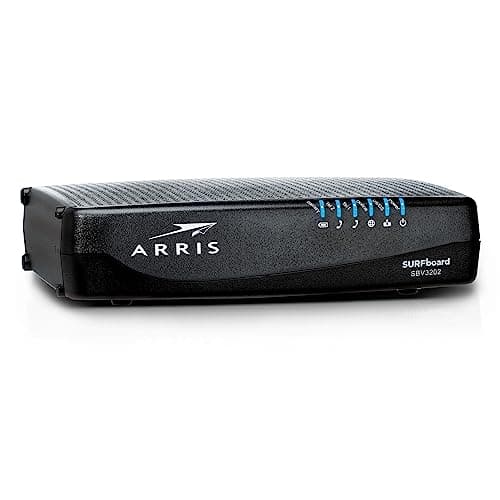
The ARRIS SURFboard SBV3202 is a DOCSIS 3.0 cable modem designed for Xfinity Internet and Voice, offering up to 800 Mbps download speeds and a built-in firewall with battery-backup support. It lacks Wi-Fi, uses an older DOCSIS standard, and provides only a single Ethernet port, limiting future-proofing and multi-device wiring. Best suited for Xfinity subscribers needing VoIP lines on modest-speed plans.
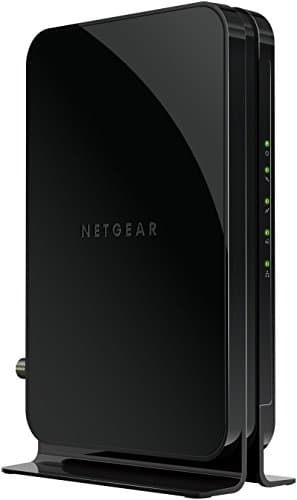
The NETGEAR CM500 is a compact DOCSIS 3.0 cable modem delivering up to 680 Mbps download and 132 Mbps upload with advanced QoS and broad ISP compatibility. Its main trade-off is the lack of built-in Wi-Fi and a single Ethernet port, limiting flexibility for higher-speed or wireless-only setups. Ideal for budget-conscious households on mid-tier cable plans that already have a separate router.
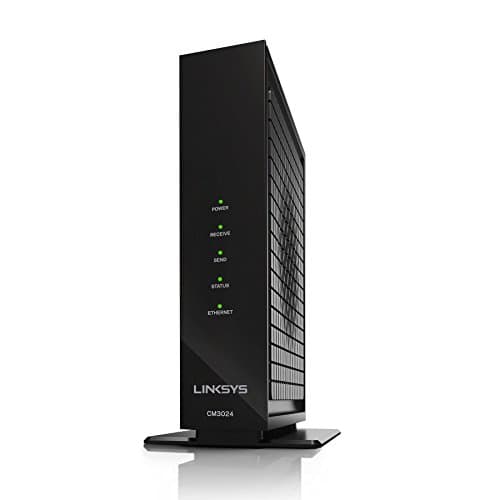
The Linksys CM3024 is a high-performance DOCSIS 3.0 cable modem with 24 downstream and 8 upstream channels, supporting up to 960 Mbps download speeds. It does not include Wi-Fi or USB ports, limiting its use as a standalone gateway. Suited for users who already have a router and need a robust modem for mid-to-high-speed cable plans.
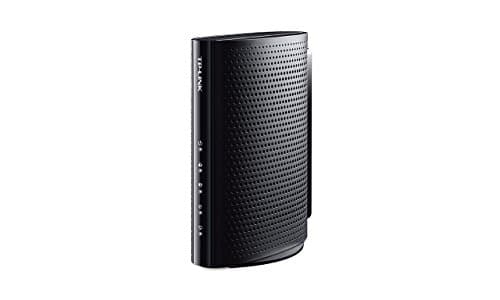
The TP-Link TC-7610 is a DOCSIS 3.0 cable modem offering up to 343 Mbps downstream and 143 Mbps upstream speeds. It lacks integrated Wi-Fi and advanced features, making it less suitable for power users. Best for households that already own a router and need a cost-effective modem for mid-tier cable plans.
| Attribute | | | | | | | |
|---|---|---|---|---|---|---|---|
680 Mbps | 1,000 Mbps | 960 Mbps | 1,200 Mbpsbest | 800 Mbps | 343 Mbps | 680 Mbps | |
132 Mbps | — | 240 Mbps | 700 Mbpsbest | 240 Mbps | 143 Mbps | — | |
1 ports | 1 ports | 1 ports | 2 ports | 1 ports | 1 ports | 4 portsbest | |
— | — | — | — | — | — | 2 portsbest | |
| ↓ lower better | 18 Wbest | 30 W | 24 W | — | — | — | — |
| ↓ lower better | 0.648 kg | 0.381 kgbest | 0.953 kg | 0.464 kg | 1.08 kg | 0.544 kg | 1.197 kg |
1 years | 1 years | — | — | 2 yearsbest | 2 yearsbest | — |
Click an attribute name to sort · Green = best, red = worst (relative to this comparison)
| Attribute | | | | | | | |
|---|---|---|---|---|---|---|---|
Performance(2) | |||||||
Maximum Download Speed (Mbps) | 680 Mbps | 1000 Mbps | 960 Mbps | 1200 Mbps | 800 Mbps | 343 Mbps | 680 Mbps |
Maximum Upload Speed (Mbps) | 132 Mbps | — | 240 Mbps | 700 Mbps | 240 Mbps | 143 Mbps | — |
Network(1) | |||||||
DOCSIS Standard | 3.0 | 3.1 | DOCSIS 3.0 | 3.1 | DOCSIS 3.0 | DOCSIS 3.0 | DOCSIS 3.0 |
Ports(2) | |||||||
Ethernet Ports (count) (ports) | 1 ports | 1 ports | 1 ports | 2 ports | 1 ports | 1 ports | 4 ports |
WAN Port Type | Coaxial | Coaxial | — | Ethernet | Ethernet | — | — |
Power & Energy(2) | |||||||
Power Consumption (W) | 18 W | 30 W | 24 W | — | — | — | — |
Operating Temperature Range | — | — | 0°C to 40°C | — | -40 to 70 | — | — |
Build & Design(3) | |||||||
Weight (kg) | 0.648 kg | 0.381 kg | 0.953 kg | 0.464 kg | 1.08 kg | 0.544 kg | 1.197 kg |
Dimensions (HxWxD) (mm) | 60x185x124 mm mm | 223 x 150 x 137 mm mm | 204x177x45 mm mm | 2.03x6.73x6.73 inches mm | 7.1 x 7.1 x 1.8 inches mm | 73x202x228 mm mm | 2.48x7.62x9.7 inches mm |
Form Factor | — | Upright | Modem | — | Wall-mountable | Modem | Gateway |
General(2) | |||||||
Provider Compatibility | Xfinity, Cox, Spectrum, Cablevision | Xfinity, Spectrum, Cox | Comcast Xfinity, Time Warner Cable, Charter, Cox, Cablevision and more | Comcast Xfinity, Comcast Xfinity Business, Charter Spectrum, Cox, CableOne Sparklight, Cogeco Breezeline, Zito Media, Astound, Grande, RCN, Wave | Xfinity | Xfinity, Spectrum, Cox, Charter, Time Warner Cable, Bright House Networks, Cablevision | Certified for Comcast XFINITY, Spectrum, Cox and More |
Warranty (years) (years) | 1 years | 1 years | — | — | 2 years | 2 years | — |
Products in the top-left offer the best value (high score, low price).
Professional reviewers consider the CM500 a reliable, entry-level DOCSIS 3.0 modem that excels on cable plans up to 600 Mbps, thanks to its 16×4 channel bonding, IPv6 support, and easy ISP activation. However, they caution that its speed ceiling and lack of Wi-Fi make it less suitable for users seeking future-proof gigabit performance.
Everyday users generally praise the CM500 for its straightforward setup, solid wired speeds for streaming and gaming, and the savings from avoiding ISP rental fees. The most common criticism centers on the absence of built-in Wi-Fi and the limitation of only one Ethernet port.
The CM500 is a cost-effective DOCSIS 3.1 option for current gigabit plans, but the CM1000 offers more channel bonding for better long-term performance.
Professional reviewers consider the CM1000 a reliable and straightforward DOCSIS 3.1 solution that delivers fast gigabit speeds, broad ISP support, and useful features like IPv6 and QoS. However, they caution about its unstable base and the limitation of a single Gigabit Ethernet port despite the high theoretical bandwidth.
Consumers generally appreciate the modem's consistent high-speed performance, easy setup, and cost savings from avoiding rental fees, but they frequently mention the top-heavy design that can tip over and the absence of built-in Wi-Fi as drawbacks.
Professional reviews are not provided in the source data; however, manufacturers emphasize that the DOCSIS 3.1 technology offers significantly faster speeds and lower latency compared to legacy DOCSIS 3.0 modems, making the CODA suitable for modern high‑bandwidth applications.
No specific consumer reviews were found, but the available information highlights strong interest in the modem's high speeds, dual Gigabit ports, and provider certifications, while users may be disappointed by the lack of built-in Wi-Fi and limited ISP compatibility.
Professional reviewers and editors describe the SBV3202 as a solid, budget-friendly option for Xfinity customers who need reliable wired connectivity and VoIP support. They commend its easy setup, LED indicators, and battery-backup feature, but caution that the older DOCSIS 3.0 standard and single Ethernet port limit its longevity and multi-device use.
Everyday users generally appreciate the modem's ability to hit advertised speeds and its space-saving mounting options, especially when paired with a separate router. However, many express frustration over its provider-specific compatibility, lack of Wi-Fi, and the perception of outdated technology, resulting in mixed overall satisfaction.
Professional reviewers commend the TC-7610 for its cost-effective approach to eliminating modem rentals, solid 8x4 channel bonding, and broad provider compatibility. However, they note the lack of integrated Wi-Fi and advanced features makes it less appealing for power users or those seeking an all-in-one solution.
Everyday users appreciate the modem's simple setup, affordability, and reliable performance for typical streaming and gaming needs. Common complaints focus on the missing Wi-Fi, occasional ISP verification hiccups, and the speed ceiling that prevents use with gigabit-level plans.
Professional reviewers view the Archer CR700 as a solid value proposition, emphasizing its dual-band Wi-Fi, broad ISP compatibility, and the convenience of a single device that eliminates separate modem and router rentals.
Typical consumers praise the easy setup, reliable wired and wireless performance, and the added flexibility of guest networks and USB sharing, while noting the device meets the needs of average cable plans but may feel limited for newer high-speed services.
