Rankings
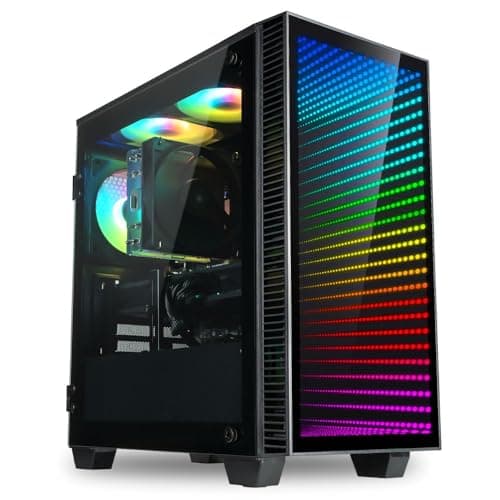
The Continuum Micro Gaming PC delivers a Ryzen 7 5700X and RTX 5060 Ti in a compact micro-ATX chassis with six ARGB fans. It may require a separate power supply and has limited USB connectivity. Perfect for users with limited desk space seeking high performance.
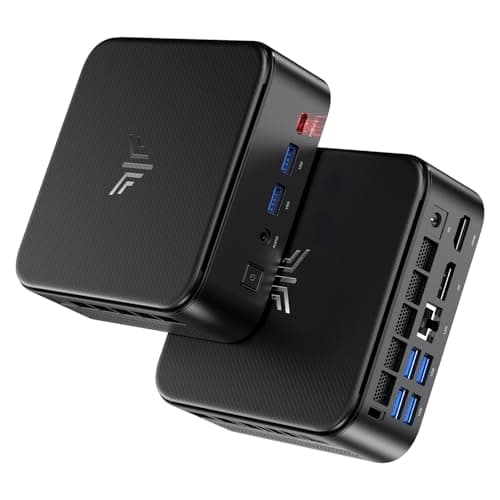
The Kamrui E3B Mini Gaming PC is a lightweight, ultra-compact device powered by a Ryzen 5 7430U, offering 16 GB RAM and triple-4K display capability. Its integrated graphics and limited USB-C connectivity keep it from handling demanding games or heavy peripheral setups. Best suited for office workers, students, and light gamers who need a portable, multi-monitor workstation.
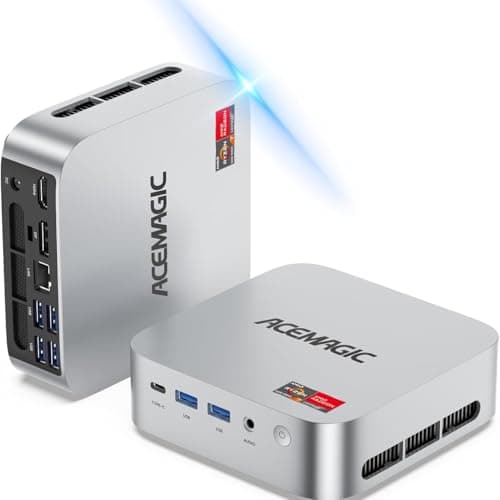
The ACEMAGIC M1 Mini PC packs a Ryzen 7 7735HS CPU, 24 GB LPDDR5 RAM and a 1 TB PCIe SSD into a tiny 3.2-liter case, offering desktop-level performance for gaming and productivity while supporting three 4K monitors. Its limitations are the integrated Radeon 680M GPU and modest power envelope, which keep it from handling demanding AAA titles at high settings. Best suited for compact home offices, media centers and casual gamers who value space efficiency.
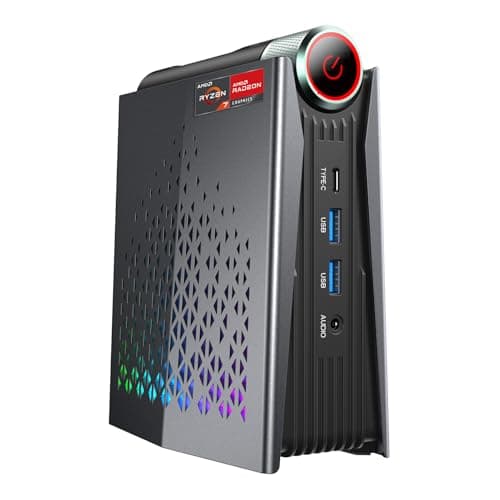
The Acemagician S3A Mini PC is a compact vertical mini-PC powered by an AMD Ryzen 7 5700U and 16 GB DDR4 RAM, offering strong CPU performance and quiet dual-fan cooling. Its integrated Radeon Vega 8 graphics and DDR4 memory limit high-end gaming and bandwidth-intensive tasks. It is best suited for home-office users and casual gamers who value a small footprint and upgrade flexibility.
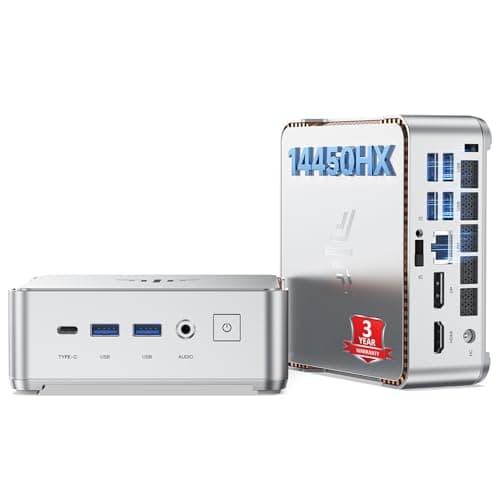
The Kamrui Hyper H2 Mini Gaming PC packs a high-performance 10-core i5-14450HX CPU into a compact 128 mm cube, delivering strong multitasking and triple-4K support. Its integrated graphics are a bottleneck for demanding games and fan noise may rise under heavy load. Best suited for office workers, home-lab enthusiasts, and light-gaming or media-server use.
The Lenovo ThinkCentre M700 SFF is a compact business desktop built on a 6th-gen Skylake platform with an i7-6700 CPU and optional GT 1030 graphics, offering robust connectivity and easy maintenance. Its older CPU and low-power GPU make it unsuitable for modern gaming or heavy graphics tasks. Ideal for small-office or home-office environments that need reliable performance and legacy port support.
| Attribute | | | Lenovo ThinkCentre M700 SFF | | | |
|---|---|---|---|---|---|---|
10best | 6 | 4 | 8 | 8 | 8 | |
32 GBbest | 16 GB | 16 GB | 24 GB | 16 GB | 32 GBbest | |
— | — | 2 GB | — | — | 16 GBbest | |
2.4 GHz | — | 3.4 GHzbest | 3.2 GHz | 1.8 GHz | 3.4 GHzbest | |
4.8 GHzbest | 4.3 GHz | 4 GHz | 4.75 GHz | 4.3 GHz | 4.6 GHz | |
1,000 GBbest | 512 GB | 512 GB | 1,000 GBbest | 512 GB | 1,000 GBbest | |
— | — | 210 Wbest | — | — | — | |
3,200 MHzbest | 3,200 MHzbest | 2,133 MHz | — | 3,200 MHzbest | 3,200 MHzbest |
Click an attribute name to sort · Green = best, red = worst (relative to this comparison)
| Attribute | | | Lenovo ThinkCentre M700 SFF | | | |
|---|---|---|---|---|---|---|
Performance(8) | ||||||
Processor | Intel Core i5-14450HX | AMD Ryzen 5 7430U | Intel Core i7-6700 | AMD Ryzen 7 7735HS | AMD Ryzen 7 5700U | AMD Ryzen 7 5700X |
CPU Cores | 10 | 6 | 4 | 8 | 8 | 8 |
CPU Base Clock (GHz) | 2.4 GHz | — | 3.4 GHz | 3.2 GHz | 1.8 GHz | 3.4 GHz |
CPU Boost Clock (GHz) | 4.8 GHz | 4.3 GHz | 4.0 GHz | 4.75 GHz | 4.3 GHz | 4.6 GHz |
Graphics Card | Intel UHD Graphics | AMD Radeon Vega 8 | NVIDIA GeForce GT 1030 | AMD Radeon 680M | AMD Radeon Vega 8 | NVIDIA GeForce RTX 5060 Ti |
GPU Memory (GB) | — | — | 2 GB | — | — | 16 GB |
RAM Capacity (GB) | 32 GB | 16 GB | 16 GB | 24 GB | 16 GB | 32 GB |
RAM Speed (MHz) | 3200 MHz | 3200 MHz | 2133 MHz | — | 3200 MHz | 3200 MHz |
Storage(2) | ||||||
Total Storage Capacity (GB) | 1000 GB | 512 GB | 512 GB | 1000 GB | 512 GB | 1000 GB |
SSD Type | PCIe 4.0 NVMe | NVMe | — | PCIe | NVMe | NVMe |
Features(1) | ||||||
Cooling System | Silent high-speed centrifugal fan, 2 copper heat pipes, dual fins | — | — | Low-noise cooling | Dual-fan cooling with copper alloy heat sink | 6 ARGB Lotus fans |
Build & Design(2) | ||||||
Weight (kg) | 1.338 kg | 0.5 kg | 5.6 kg | 1.2 kg | — | 8.6 kg |
Dimensions (H×W×D) (cm) | 4.14×12.8×12.8 cm cm | 13.2×13.2×5.0 cm cm | 33.8×35.7×8.8 cm cm | 1.614 x 5.039 x 5.039 inches cm | — | 41.5×19.3×40.3 cm cm |
Connectivity(2) | ||||||
Wi‑Fi Standard | WiFi 6 | WiFi 6 | — | WiFi 6 | WiFi 6 | Wi‑Fi |
Ethernet Speed (Gbps) | 1 Gbps | 1 Gbps | 1 Gbps | 2.5 Gbps | 2.5 Gbps | — |
Ports(1) | ||||||
USB Ports (total) | 7 | 8 | 10 | 7 | 7 | 2 |
Products in the top-left offer the best value (high score, low price).
Professional reviewers commend the Hyper H2 for its powerful 10-core i5-14450HX CPU, low idle power, Quick Sync media transcoding, and abundant connectivity, while noting that the integrated graphics are a bottleneck for demanding games and that fan noise can rise under load. They also flag SKU inconsistencies that may affect RAM channel configuration.
Everyday users praise the device for smooth multitasking, fast boot-ups, and its suitability as a compact, low-power media server, especially appreciating the VESA mount. Recurring complaints focus on the limited graphics capability, confusing SKU details, and occasional fan noise at high loads.
“smooth multitasking, fast boot-ups, and compact media server use”
“Plex efficiency via Quick Sync”
“solid build, 256 GB SSD speed, and port variety (VGA/DP, PS/2, DVD-RW), calling it reliable for business use.”
Professional reviewers consider the Kamrui E3B a solid budget mini‑PC that punches above its weight for everyday productivity, thanks to its Ryzen 7 CPU, extensive I/O and triple‑4K capability, but they all agree its integrated graphics are a bottleneck for serious gaming.
Everyday users love the abundant ports, compact size and smooth 4K streaming, yet they repeatedly complain about limited gaming performance, the need for three cables for triple displays, and occasional BIOS tweaks for optimal operation.
Professional reviewers view the M700 SFF as a solid, business-focused machine with a robust chassis, fast SSD performance and a comprehensive port selection that suits enterprise needs. However, they caution that its older Skylake CPU and low-power GPU options limit its suitability for modern gaming or heavy graphics workloads, and thermal constraints can become a bottleneck under sustained load.
Everyday users praise the ThinkCentre for its rapid boot times, quiet operation and the convenience of legacy ports, making it a reliable choice for home and small-office setups. Recurring complaints focus on the lack of an optical drive, dated integrated graphics for creative work, and occasional needs to upgrade the power supply for more demanding add-ons.
Professional reviewers consider the ACEMAGIC M1 one of the best mini PCs of 2025, lauding its powerful Ryzen 7 7735HS CPU, integrated Radeon 680M GPU, and ability to drive three 4K displays. They emphasize the impressive performance-to-size ratio, versatile port selection, and the flexible power-mode system that balances speed with efficiency.
Consumers are consistently impressed by the device's speed and compactness, often expressing surprise at how much power is packed into a 3.2-liter case. Praise centers on its fast response, silent operation in media-center mode, and the convenience of multi-monitor support for home office and gaming setups.
Professional reviewers commend the Acemagician S3A for its quiet dual-fan cooling, robust connectivity and solid value, noting it delivers respectable gaming performance for a Vega 8 GPU and excels in multi-monitor productivity. However, they criticize its older integrated graphics, DDR4 memory speed, and absence of an AI NPU, suggesting that power users may prefer higher-end S3A variants.
Everyday users appreciate the fast storage, silent operation and ease of connecting multiple 4K displays, finding it well-suited for home-office and light gaming. Recurring complaints focus on the limited graphics capability for newer titles, desire for DDR5 support, and the lack of clear size specifications.
Professional reviewers and editors view the Continuum Micro as a well-engineered micro gaming PC that balances compact dimensions with full-size component support. They commend its airflow-centric design, six-fan RGB system, and premium tempered-glass aesthetics, while noting the occasional omission of a power supply and the lack of independent thermal benchmarks.
Everyday consumers generally praise the Continuum Micro for delivering high performance in a space-saving package, its eye-catching RGB lighting, and the confidence provided by a solid warranty. Recurring concerns revolve around the need to buy a separate power supply and occasional spec-listing errors that cause confusion.
