Rankings
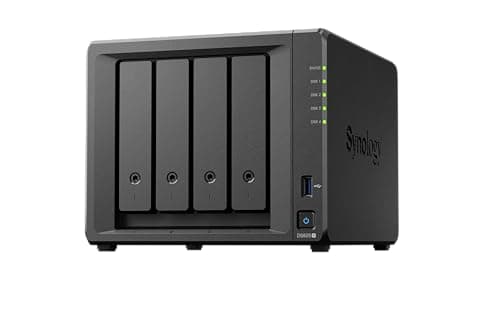
The Synology DiskStation DS925+ is a high-performance 4-bay NAS powered by an AMD Ryzen V1500B CPU, dual 2.5 GbE networking, and ECC memory with M.2 NVMe caching. It lacks native 10 GbE and requires a separate expansion unit for additional bays. Targeted at small businesses and prosumers needing scalable, reliable storage.
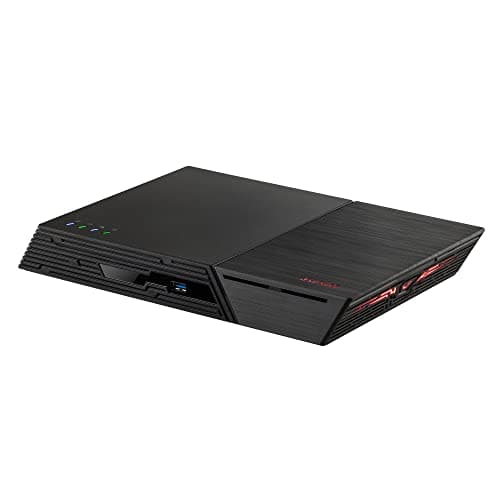
The ASUSTOR Flashstor FS6706T is a compact 6-bay all-SSD NAS delivering blazing 2.5 GbE performance and 4K transcoding. Its limitations include a modest 4 GB RAM base and the inability to use HDDs, which may restrict capacity flexibility. Best suited for content creators and small-to-medium businesses that prioritize speed over massive raw capacity.
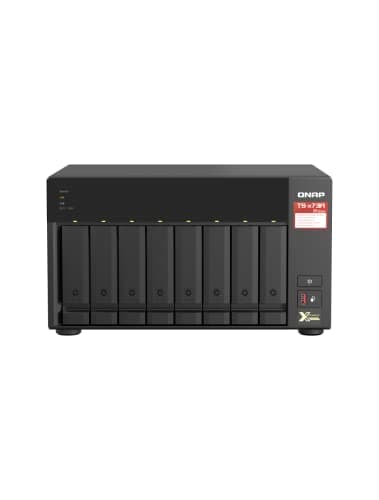
The QNAP TS-873A-8G is an 8-bay NAS with an AMD Ryzen quad-core processor, expandable up to 64 GB RAM and dual 2.5 GbE ports, delivering strong performance for demanding workloads. It lacks built-in 10 GbE and has a relatively high active power draw. Suited for small-business labs and media servers requiring large capacity and virtualization.
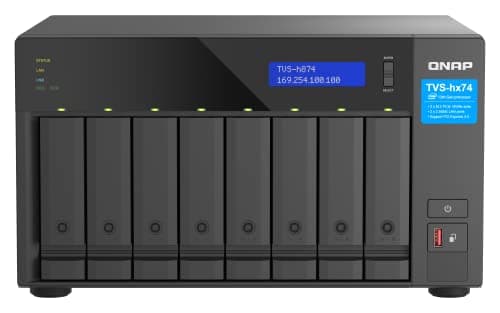
The QNAP TVS-h874-i7-32G is an 8-bay high-speed desktop NAS featuring a 12th-Gen Intel i7 12-core CPU, 32 GB RAM and extensive PCIe/M.2 expansion, targeting SMBs with demanding ZFS, virtualization and GPU-accelerated workloads. Its large size, weight and premium cost may deter home users or small offices with limited space and budget. Ideal for businesses needing top-tier performance and flexible expansion.
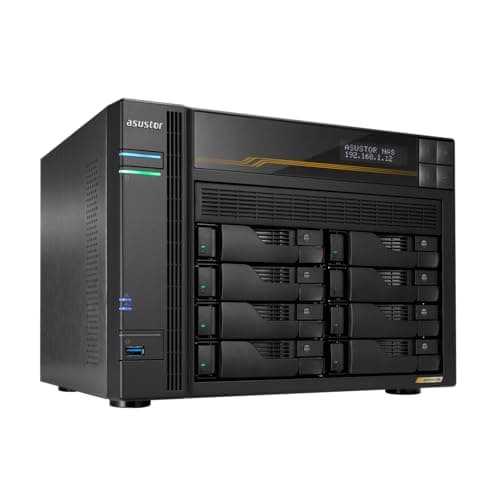
The Asustor Lockerstor 8 Gen3 is an 8-bay hybrid NAS featuring a Ryzen quad-core CPU, dual 10 GbE, four PCIe 4.0 NVMe slots and ECC DDR5 memory, delivering high-throughput storage for demanding workloads. Its drawbacks are the absence of independent reviews, a large footprint and potentially high power draw. It is aimed at content creators, SMBs and power users needing top performance and expansion flexibility.
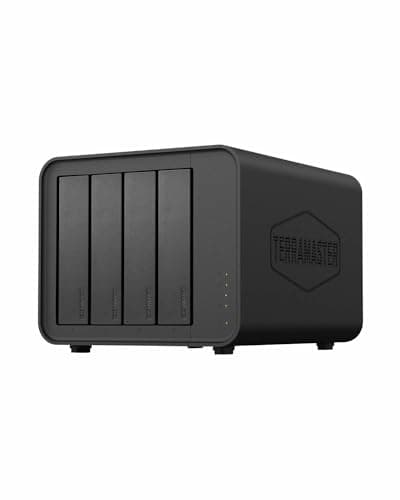
The TerraMaster F4-424 Pro is a 4-bay NAS delivering desktop-grade performance with an Intel i3-N305 CPU, 32 GB DDR5 RAM and dual 2.5 GbE ports. Its lack of 10 GbE networking and limited M.2 bandwidth temper its appeal for high-throughput environments. Ideal for prosumer media enthusiasts and small businesses needing strong transcoding.
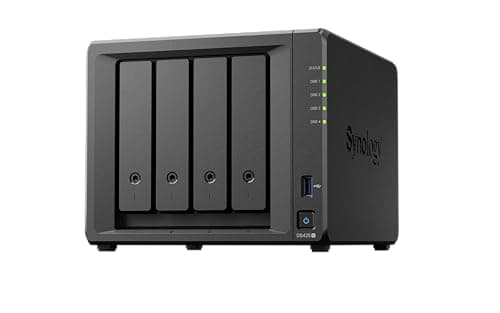
The Synology DiskStation DS425+ is a 4-bay NAS featuring an Intel Celeron J4125, 2.5 GbE plus 1 GbE connectivity, and a built-in hardware encryption engine. Its limited RAM capacity and absence of 10 GbE limit high-performance scenarios. Suitable for home offices and small teams needing secure, energy-efficient storage.
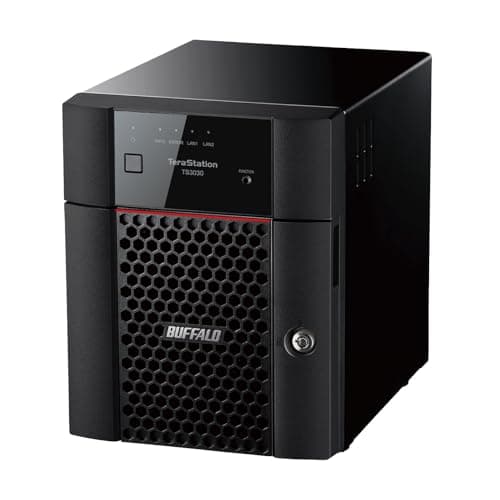
Buffalo's TeraStation Essentials 2025 provides 16 TB of pre-configured RAID-5 storage with 2.5 GbE networking and enterprise-grade security features. The modest 2 GB RAM and 2.0 GHz quad-core CPU may constrain demanding applications, and power draw peaks at 85 W. Best suited for small businesses seeking an all-in-one secure NAS.
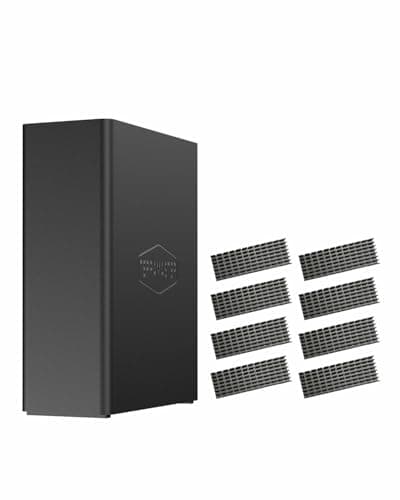
The TerraMaster F8 SSD is an ultra-compact 8-bay all-flash NAS delivering up to 64 TB raw capacity and fast 10 GbE transfers. Its trade-offs include relatively high power draw, a single network port and OS space consumption. It suits small businesses and creators needing portable high-performance storage.
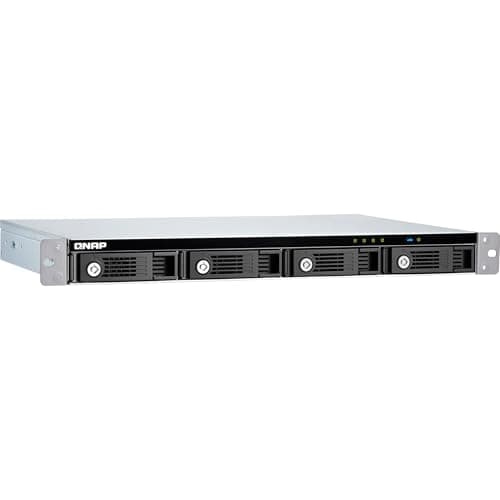
The QNAP TR-004U is a 1U rack-mountable 4-bay expansion enclosure that offers flexible RAID options and hot-swappable trays. Its reliance on USB 3.2 Gen 1 and lack of built-in networking can limit throughput. Ideal for data-center environments needing compact local storage expansion.
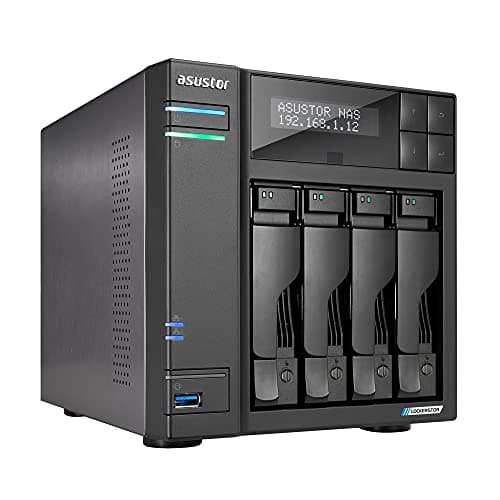
The ASUSTOR Lockerstor 4 Gen2 is a 4-bay NAS powered by a quad-core Celeron, dual 2.5 GbE and four M.2 NVMe slots, aimed at home and small-office creators. Its limitations include lack of native 10 GbE and sparse power/weight data. It fits users who want flexible SSD caching and Docker support without needing enterprise-grade networking.
| Attribute | | | | | | | | | | | |
|---|---|---|---|---|---|---|---|---|---|---|---|
— | — | — | 88 TB | 64 TB | — | 16 TB | — | 108 TB | 200 TBbest | — | |
4 | 6 | 4 | 4 | 8best | 8best | 4 | 8best | 4 | 4 | 8best | |
— | 4 | 4 | 8 | 4 | 4 | — | 12best | 4 | 4 | 4 | |
— | 2 GHz | 2.9 GHz | 3.8 GHzbest | 3.4 GHz | 2.2 GHz | 2 GHz | — | 2 GHz | 2.2 GHz | 2.3 GHz | |
— | 4 GB | 4 GB | 32 GBbest | 8 GB | 8 GB | 2 GB | 32 GBbest | 2 GB | 4 GB | 16 GB | |
239.1 MB/s | 590 MB/s | — | — | 1,020 MB/s | — | — | — | 278 MB/s | 522 MB/s | 2,005 MB/sbest | |
224.8 MB/s | 583 MB/sbest | — | — | — | — | — | — | 281 MB/s | 565 MB/s | — | |
— | 4best | 2 | 2 | 3 | 4best | 2 | 3 | 2 | 3 | 1 |
Click an attribute name to sort · Green = best, red = worst (relative to this comparison)
| Attribute | | | | | | | | | | | |
|---|---|---|---|---|---|---|---|---|---|---|---|
Storage(2) | |||||||||||
Storage Capacity (TB) | — | — | — | 88 TB | 64 TB | — | 16 TB | — | 108 TB | 200 TB | — |
Drive Bays | 4 | 6 | 4 | 4 | 8 | 8 | 4 | 8 | 4 | 4 | 8 |
Performance(6) | |||||||||||
CPU Model | — | Intel Celeron N5105 | Intel Celeron N5105 | Intel Core i3-N305 | Intel N95 | AMD Ryzen V1500B | Alpine AL-524 | Intel Core i7 12-core 12th Gen | Intel Celeron J4125 | AMD Ryzen V1500B | AMD Ryzen Embedded V3C14 |
CPU Cores | — | 4 | 4 | 8 | 4 | 4 | — | 12 | 4 | 4 | 4 |
CPU Clock Speed (GHz) | — | 2.0 GHz | 2.9 GHz | 3.8 GHz | 3.4 GHz | 2.2 GHz | 2.0 GHz | — | 2.0 GHz | 2.2 GHz | 2.3 GHz |
Memory (RAM) (GB) | — | 4 GB | 4 GB | 32 GB | 8 GB | 8 GB | 2 GB | 32 GB | 2 GB | 4 GB | 16 GB |
Sequential Read Speed (MB/s) | 239.1 MB/s | 590 MB/s | — | — | 1020 MB/s | — | — | — | 278 MB/s | 522 MB/s | 2005 MB/s |
Sequential Write Speed (MB/s) | 224.8 MB/s | 583 MB/s | — | — | — | — | — | — | 281 MB/s | 565 MB/s | — |
Connectivity(3) | |||||||||||
USB Ports | — | 4 | 2 | 2 | 3 | 4 | 2 | 3 | 2 | 3 | 1 |
Ethernet Ports | — | 2 | 2 | 2 | 1 | 2 | 2 | 2 | 2 | 2 | 2 |
Ethernet Speed (Gbps) | — | 2.5 Gbps | 2.5 Gbps | 2.5 Gbps | 10 Gbps | 2.5 Gbps | 2.5 Gbps | 2.5 Gbps | 2.5 Gbps | 2.5 Gbps | 10 Gbps |
Power(2) | |||||||||||
Power Consumption (Idle) (W) | 4.79 W | 0.83 W | — | — | 9 W | 25.7 W | 20-48 W | — | 6.10 W | 35 W | — |
Power Consumption (Active) (W) | 18.9 W | 18.2 W | — | — | 45 W | 54.1 W | 29-57 W | 250 W | 28.25 W | 50 W | — |
Security(1) | |||||||||||
Supported Protocols | — | — | — | SMB, AFP, NFS, FTP, SFTP, WebDAV, iSCSI | — | — | SMB/CIFS, AFP, FTP/SFTP, NFS, HTTP/HTTPS, SNMP, iSCSI | — | — | — | — |
Build & Design(3) | |||||||||||
Weight (kg) | 2 kg | 1.35 kg | 3.5 kg | 1.905 kg | 0.6 kg | 8 kg | — | 7.3 kg | 2.18 kg | 2.26 kg | 0.49 kg |
Dimensions (H×W×D) (cm) | 20×42×54 cm cm | 30.7×4.8×19.3 cm cm | 32 x 30 x 24 cm cm | 15.4×17.9×22.2 cm cm | 4 x 10 x 15 cm cm | 28.1×29.5×18.8 cm cm | 37.6×36.6×31.5 cm cm | 35.56×43.18×40.64 cm cm | 19.89 x 16.61 x 22.30 cm cm | 19.89 x 16.61 x 22.30 cm cm | 37 x 35 x 41 cm cm |
Noise Level (dB) | — | — | — | — | 19 dB | 23 dB | — | — | 21.6 dB | 20.5 dB | — |
Compliance(1) | |||||||||||
Certifications | — | — | — | — | — | — | TAA | — | FCC | FCC, CE, BSMI, VCCI, RCM, UKCA, EAC, CCC, KC, BIS | — |
Products in the top-left offer the best value (high score, low price).
Professional reviewers commend the FS6706T for its blistering all-flash performance that pushes the limits of 2.5 GbE, its silent operation, and robust 4K transcoding for Plex streaming, while noting the base 4 GB RAM and lack of HDD support as trade-offs.
Home users and small-business owners praise the fast SSD speeds, quiet operation and low energy use, but note occasional concerns about limited memory and the inability to add traditional hard drives.
“Super quiet and portable-like two phones”
“Fast 1024MB/s transfers”
“OS eating 40GB per SSD”
Choose the DS425+ for a straightforward, low-maintenance NAS, but opt for the AS6704T when you need faster networking and extensive expansion.
TerraMaster is a cost-effective alternative for users focused on raw capacity, while DS425+ is better for those who value a refined OS and low noise.
DS925+ offers solid performance for mid-range workloads; Lockerstor outperforms it in raw speed and NVMe capability.
Professional reviewers commend the AS6704T for its powerful N5105 CPU, dual 2.5 GbE ports, and extensive PCIe and M.2 expansion options, calling it an efficient platform for content creation and future-proof upgrades. They also praise the quiet cooling system and modern software stack, while noting that full performance hinges on user-installed RAM and optional 10 GbE cards, and that missing power and weight data limit planning.
Everyday users praise the NAS for its easy, tool-less installation, fast M.2 caching, and reliable 4K streaming over a robust 2.5 GbE connection. However, they express frustration over the need for DIY hardware upgrades to reach peak performance and the lack of clear power and weight specifications.
Professional reviewers consider the F4-424 Pro the most powerful media-class 4-bay NAS on the market, lauding its desktop-grade i3-N305 CPU, 32 GB DDR5 memory, dual 2.5 GbE, HDMI 2.1 and NVMe caching. They commend its cooling redesign and tool-free bays, but criticize the immature TOS software, absence of 10 GbE/SFP+ and the limited PCIe Gen3 ×2 M.2 bandwidth.
Everyday users love the raw performance for 4K streaming, quiet operation, easy drive swaps and fast initial setup. Common frustrations revolve around the basic TOS app store, occasional firmware bugs, throttled M.2 speeds and the desire for easier RAM upgrades and a built-in battery backup.
Professional reviewers commend the F8 SSD series for delivering desktop-class performance in a palm-sized chassis, with the Plus model's i3-N305 and 16 GB DDR5 providing a clear boost for virtualization and 4K media tasks. However, they caution that the OS's 40 GB footprint and the 45 W power draw under load diminish its efficiency, and the single 10 GbE port may be a limitation for enterprise-grade redundancy.
Everyday users love the silent, portable nature of the device and its lightning-fast 10 GbE transfers, noting the ease of tool-free SSD swaps and upgradable memory. Recurring frustrations focus on the OS consuming significant space, higher power usage, limited Ethernet options, and occasional heat under sustained workloads.
Professional reviewers consider the TS-873A a solid high-performance NAS that delivers high compute performance for virtualization and media transcoding; eight hot-swappable bays provide up to 64 TB of raw storage; dual 2.5 GbE ports enable faster network transfers; expandable DDR4 memory up to 64 GB with ECC support ensures data integrity; multiple USB 3.2 ports for high-speed peripheral connectivity; optional PCIe slots allow adding 5 GbE/10 GbE adapters for future network upgrades.
Direct consumer reviews are scarce, but the specifications suggest users would likely appreciate the high-speed connectivity, transcoding performance and flexibility for multiple workloads. Potential concerns that surface in discussions revolve around the limited two-bay design and the non-expandable 8 GB RAM, which may restrict future growth.
Professional reviewers and editors have not published independent evaluations of this 2025 model; manufacturer materials position it as a business-class value solution with emphasis on easy deployment, built-in security, and cloud sync capabilities.
No consumer reviews or forum discussions were found in the source data, so user sentiment cannot be assessed beyond the promotional claims repeated in listings.
StorageReview.com and other editors commend the TVS-h874-i7-32G for its high-end Intel i7 CPU, ample RAM and robust caching, positioning it as a powerful SMB solution for ZFS-based storage, media transcoding and virtualization.
Professional reviewers and editors consistently praise the DS425+ for its solid performance, fast 2.5 GbE networking, and the polished DSM software that makes setup and management straightforward.
Everyday users generally commend the DS425+ for its solid performance, fast 2.5 GbE networking, and energy-efficient operation.
Professional reviewers consider the DS925+ a solid, future-proof 4-bay NAS for small businesses, emphasizing its ECC memory, strong Ryzen CPU, and fast 2.5 GbE networking.
Everyday users generally commend the DS925+ for its quiet operation, low power consumption, and flexible expandability, especially the option to add NVMe caching.
Professional reviews are not available in the provided sources; Asustor’s marketing emphasizes that this is the company’s fastest NAS, highlighting its dual 10 GbE, PCIe 4.0 NVMe support and Ryzen processor for demanding workloads.
No consumer reviews or feedback were found, so everyday user sentiment cannot be assessed at this time.
