Rankings
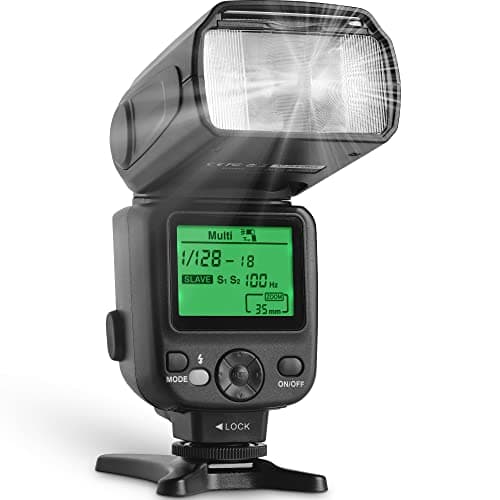
The Altura AP-UNV2 is an affordable speedlite with a strong 68 m guide number and a feature-rich LCD interface. Its main trade-offs are slower recycle with alkaline batteries and limited high-speed sync capability. Best suited for beginner to intermediate Nikon shooters who need portable power without the cost of OEM units.
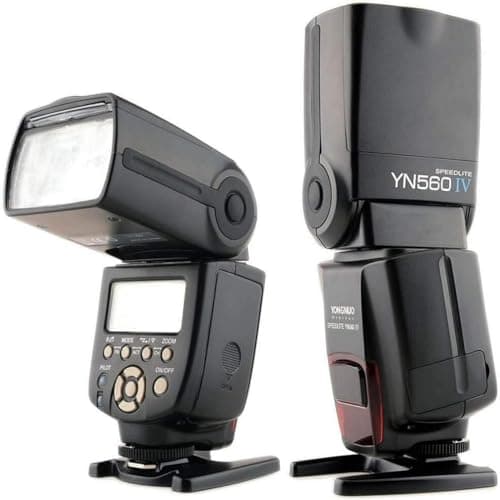
The Yongnuo YN560 IV is a manual speedlite with a strong GN58 output and integrated 2.4 GHz wireless system, offering a wide 24-105 mm zoom and fast 3-second recycle. Its lack of TTL and high-speed sync, plus limited three-group control, restrict advanced shooting scenarios. Ideal for budget-conscious photographers needing powerful off-camera flash without TTL.
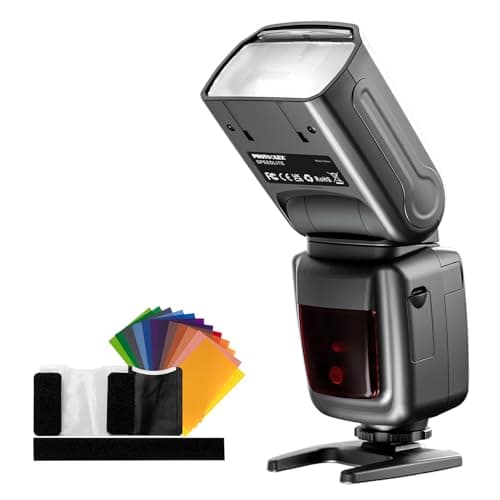
The Photoolex FK300 is a compact manual speedlite offering 8 power levels and wireless S1/S2 triggering, making it suitable for product and portrait work. Its main trade-offs are the lack of TTL and limited low-light reach, as well as dependence on AA batteries. Best for budget-conscious creators who need manual control and portability.
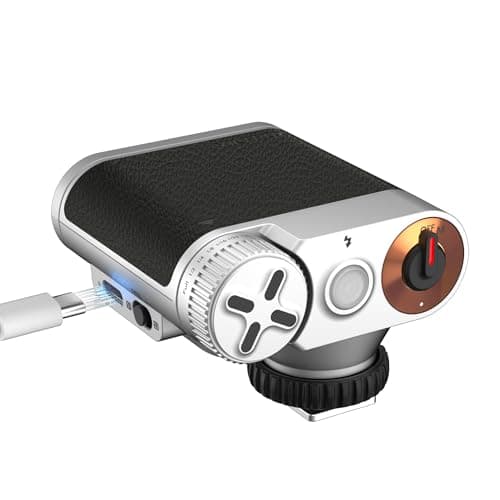
The Viltrox Vintage Z1 (second listing) is a pocket-sized, manual-only flash with a retro metal look and USB-C rechargeable battery. Its trade-offs are limited output, lack of TTL and high-speed sync, and slower recycle at full power. It best serves street and travel photographers who need a discreet fill flash with minimal weight.
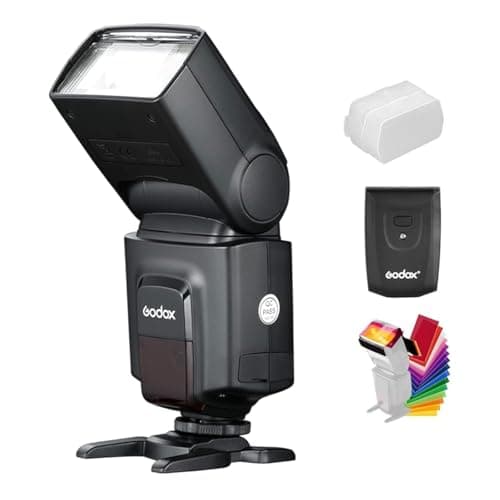
The Godox TT520III provides an affordable, compact flash with 33 m guide number and built-in 433 MHz wireless triggering. It lacks TTL, high-speed sync and a built-in diffuser, limiting its use for advanced lighting setups. Suited for budget-conscious DSLR shooters needing a portable fill flash and basic wireless capability.
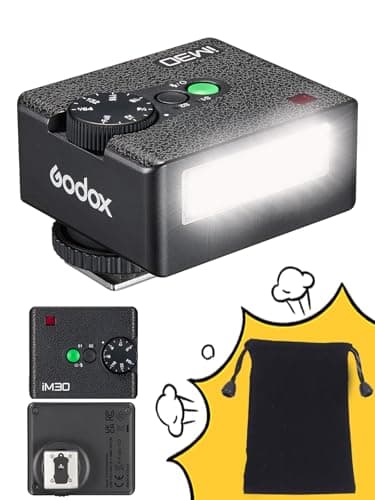
The Godox iM30 is an ultra-compact, pocket-sized manual flash offering GN 15 and seven power levels with optical wireless S1/S2. Its fixed head and lack of TTL limit creative control and convenience. Best suited for travel and street photographers who prioritize size over power.
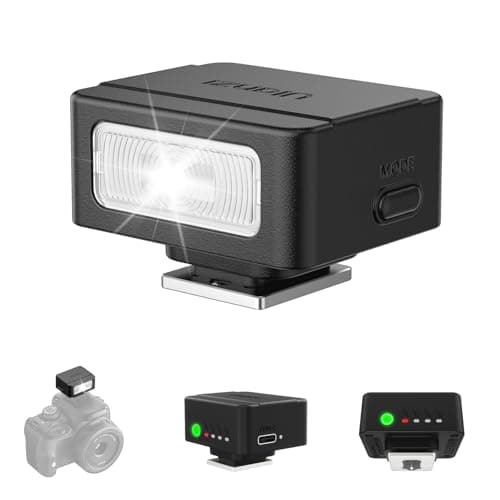
The Ulanzi SL01 Mini Flash is an ultra-compact, 33 g manual flash with a GN 8 output and USB-C rechargeable battery. It lacks TTL, wireless and bounce capabilities, making it unsuitable for advanced lighting setups. Best for beginners and travel shooters who need a tiny fill light.
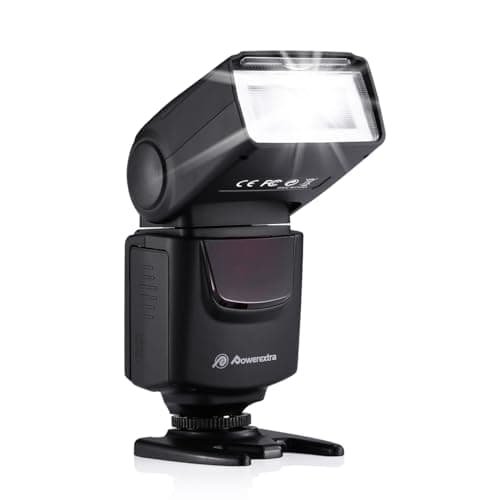
The Powerextra DF-400 is a budget manual speedlite offering a GN33 output, full head swivel and a 18-180 mm zoom range. Its trade-offs include the absence of TTL, high-speed sync and a relatively slow full-power recycle. It is best for beginners and hobbyists needing an affordable, versatile flash for indoor and off-camera use.
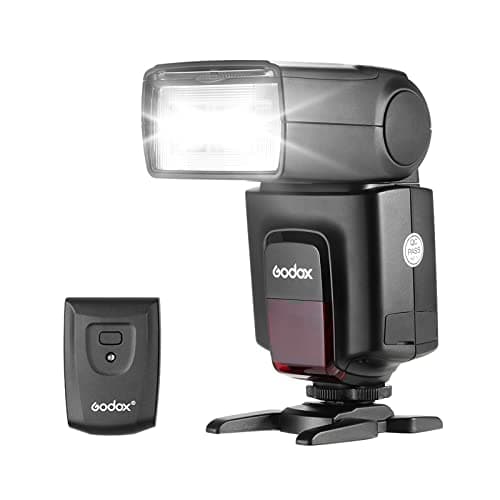
The Godox TT520II is a budget manual flash offering a solid 33 m guide number and lightweight AA-battery operation. Its main drawbacks are the lack of TTL, high-speed sync and a fixed zoom head, which limit advanced shooting scenarios. Best suited for beginners and hobbyists needing a simple, portable flash.
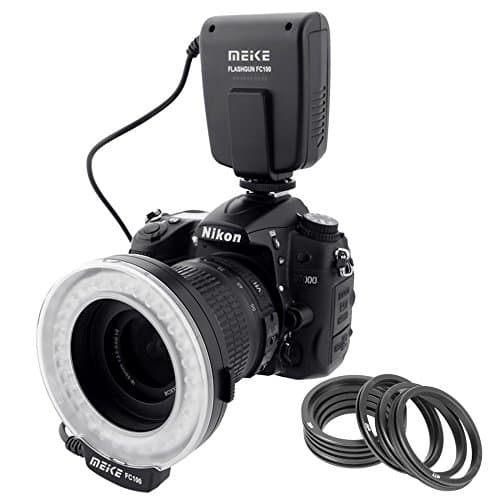
The Meike FC-100 is a manual LED macro ring flash that offers versatile continuous and flash lighting with a lightweight design and affordable price. Its low 15 GN output and lack of TTL automation limit its usefulness for demanding macro work. Best suited for beginners and video shooters needing basic close-up illumination.
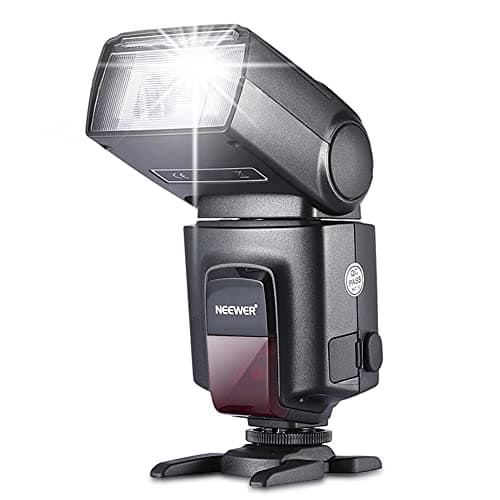
The Neewer TT560 is a budget-friendly manual speedlite with a solid GN38 output and versatile head rotation. Its main trade-offs are the absence of TTL, high-speed sync, and a relatively slow full-power recycle. It is best suited for beginners and hobbyists needing an inexpensive indoor flash.
| Attribute | | | | | | | | | | | |
|---|---|---|---|---|---|---|---|---|---|---|---|
38 m | 33 m | 33 m | 58 m | 12 m | 33 m | 15 m | 33 m | 68 mbest | 8 m | 15 m | |
| ↓ lower better | — | 2.8 seconds | 1.8 secondsbest | 3 seconds | — | 3 seconds | 3.6 seconds | 5 seconds | 4 seconds | 5 seconds | — |
| ↓ lower better | 454 g | 304.9 g | — | 348 g | 116 g | 315 g | 78 g | 315 g | 280 g | 33 gbest | 230 g |
— | — | — | — | 1,100 mAhbest | — | — | — | — | 250 mAh | — | |
8best | 8best | 8best | 8best | 7 | 8best | 7 | 8best | — | 4 | 7 | |
— | — | — | 105 mmbest | — | — | — | — | — | — | — | |
— | — | 20 m | 100 mbest | — | — | — | 15 m | — | — | — | |
5,600 K | 5,600 K | — | 5,600 K | 6,500 Kbest | 5,800 K | 6,500 Kbest | 5,600 K | — | 6,500 Kbest | 5,500 K |
Click an attribute name to sort · Green = best, red = worst (relative to this comparison)
| Attribute | | | | | | | | | | | |
|---|---|---|---|---|---|---|---|---|---|---|---|
Performance(1) | |||||||||||
Recycle Time (seconds) | 0.1-5 seconds | 2.8 seconds | 1.8 seconds | 3 seconds | 0.2-3.5 seconds | 3 seconds | 3.6 seconds | 5 seconds | 4 seconds | 5 seconds | — |
General(1) | |||||||||||
Compatible Mount Types | Standard hot shoe, Sony MI hot shoe | hot shoe | — | Hot shoe | Hot Shoe | Canon, Nikon, Sony, Pentax, Olympus, Panasonic, etc. | Hot shoe | — | Hot Shoe | Hot shoe | Universal hot shoe |
Connectivity(2) | |||||||||||
Wireless Capability | — | true | true | true | true | true | true | true | true | false | — |
Wireless Range (m) | — | — | 20 m | 100 m | — | — | — | 15 m | — | — | — |
Features(3) | |||||||||||
High‑Speed Sync | false | — | false | false | — | false | false | false | true | false | — |
Number of Flash Modes | 3 | 3 | 3 | 2 | 1 | 3 | 1 | 3 | 5 | 1 | 4 |
TTL Support | false | — | false | false | false | false | false | false | true | false | false |
Battery & Power(3) | |||||||||||
Battery Type | 4 x AA (Alkaline or Ni-MH) | Standard | AA | AA | Li-ion | 4× AA alkaline | AAA | AA | AA | Li-ion | AA |
Battery Capacity (mAh) | — | — | — | — | 1100 mAh | — | — | — | — | 250 mAh | — |
Power Levels (steps) | 8 | 8 | 8 | 8 | 7 | 8 | 7 | 8 | — | 4 | 7 |
Design(2) | |||||||||||
Weight (with batteries) (g) | 454 g | 304.9 g | — | 348 g | 116 g | 315 g | 78 g | 315 g | 280 g | 33 g | 230 g |
Dimensions (L×W×H) (mm) | 221×80×102 mm mm | 75×58×189 mm mm | 2.95x7.5x2.15 inches mm | 78x190x60 mm | 68.5 × 50.2 × 74 mm mm | 190×75×55 mm mm | 75.96x71.5x205.99 mm mm | 190x75x55 mm mm | 5 in × 3.2 in × 2.9 in mm | 43x35x28 mm mm | 80 x 60 x 120 mm mm |
Lighting(4) | |||||||||||
Guide Number (m) | 38 m | 33 m | 33 m | 58 m | 12 m | 33 m | 15 m | 33 m | 68 m | 8 m | 15 m |
Flash Duration (ms) | 3.33-0.05 ms | — | 1/510-1/31000 ms | — | 1/5000–1/50000 s ms | 5-0.05 ms | — | 1/800-1/2000 ms | — | — | — |
Zoom Range (mm) | — | — | — | 24-105 mm | — | 18-180 mm | — | — | — | — | — |
Color Temperature (K) | 5600 K | 5600 K | — | 5600 K | 6500 K | 5800 K | 6500 K | 5600 K | — | 6500 K | 5500 K |
Products in the top-left offer the best value (high score, low price).
Professional reviewers consider the TT560 a solid entry-level manual flash, lauding its GN38 power, accurate 5600 K color, and extensive head rotation for creative indoor lighting, while noting its lack of TTL, HSS, and weather sealing makes it less suitable for advanced or outdoor work.
Everyday users commend the flash for its sturdy build, straightforward operation, and good value, especially for indoor portrait and product setups, but repeatedly mention the absence of TTL, slow full-power recycle, and occasional battery life inconsistencies as pain points.
“works really well”
“comparable to other speedlights”
“value as a basic manual flash for beginners or backups”
Professional reviewers praise the FK300 for its intuitive control layout, especially the plus/minus buttons, and the innovative continuous blue light mode that aids focusing without firing full power. They note the flash's simplicity and the broad flash duration range as strengths for creative lighting, while acknowledging that it lacks advanced TTL features found in higher-end speedlites.
Everyday users highlight the solid build, easy usability, and the value of the included accessories such as the magnetic filter and stand. The adjustable power levels receive consistent commendation, and the price point is seen as a strong advantage.
Professional reviewers praise the YN560 IV for delivering higher output than the Nikon SB-700 at a fraction of the cost, fast recycle times with NiMH batteries, and a rich feature set that surpasses earlier YN560 models. However, they note its limitation to three remote groups and the lack of TTL and high-speed sync as drawbacks for more advanced multi-flash or high-speed shooting scenarios.
Professional reviewers commend the Viltrox Vintage Z1 for its pocketable size, retro styling, reliable GN 12 output, and long-lasting USB-C rechargeable battery, positioning it as a stylish, no-frills fill flash for travel and street work. However, they also point out its limited power, lack of TTL or high-speed sync, and slow full-power recycle, making it less suitable for demanding or fast-paced photography.
Everyday users appreciate the flash's feather-light weight, simple dial interface, long battery life, and the included diffuser that softens light without extra gear. Common complaints focus on the slow full-power recycle, low guide number, and the absence of bounce or zoom, which limit its usefulness beyond close-range fill lighting.
Professional reviewers consider the Powerextra DF-400 a solid entry-level flash that offers good value for its price, thanks to its GN 33, full head swivel, and wireless slave capabilities. However, they note significant drawbacks such as the lack of TTL/HSS, a relatively slow full-power recycle, and a plastic build that feels less robust than competing models.
Everyday users praise the flash for its low price, long battery life, and ease of use across many camera brands, while repeatedly criticizing the cheap plastic construction, slow full-power recycle, and inconsistent performance at very high shutter speeds.
Professional editors praise the iM30 for its unprecedented compactness, solid build, and surprisingly bright output (GN 15) that handles most direct-flash scenarios. They also value its retro styling and the inclusion of optical wireless S1/S2 modes, which bring remote capability to a pocket-size unit. The main criticisms focus on the fixed head and limited power, which constrain creative lighting and performance in bright conditions.
Everyday photographers love how the iM30 slips into pockets and adds just enough light for street, travel and small-studio work. Reviewers repeatedly mention its excellent price-to-performance ratio and practical brightness, while no major complaints appear in the available user data beyond the expected limitation of a non-tilting head.
Professional reviewers position the TT520II as a cost-effective learning tool rather than a feature-rich workhorse. Its simplicity, solid guide number, and wireless optical slave functions are highlighted as strengths for newcomers, while the lack of TTL, HSS, and a fixed zoom head are noted as significant limitations for more advanced or fast-moving applications.
Professional reviewers consider the Altura AP-N1001 a solid entry-level option that delivers impressive output and intuitive controls at a low price. They commend its reliable i-TTL performance, useful LCD interface, and wireless slave capability, while noting that it falls short of OEM flashes in terms of full HSS support and advanced features.
Everyday users consistently praise the flash's bright power, easy TTL synchronization via the LCD, and sturdy construction, seeing it as great value for beginners. Recurring complaints focus on slower recycle times with alkaline batteries, the need for manual adjustments on mirrorless bodies, and limited high-speed sync functionality.
Professional reviewers praise the SL01 for its unprecedented miniaturisation, high CRI and convenient USB-C charging, positioning it as a budget-friendly entry-level speedlite for beginners and travel shooters. However, they consistently note the lack of TTL, bounce capability and video lighting, which limits its appeal for more advanced or video-centric workflows.
Everyday users celebrate the flash's pocket-size portability, straightforward operation and reliable battery life, especially for social-media content creation. Recurring complaints centre on the manual-only nature, the relatively slow full-power recycle, and the absence of bounce or video-light functions that competitors provide.
Professional reviewers commend the FC-100 for its low price, portability, and versatile lighting modes, especially the flash capability that sets it apart from pure continuous rings. However, they consistently note that its 15 GN output is too weak for true 1:1 macro work and that the manual-only operation can be challenging for users expecting automatic exposure.
Everyday users praise the ring's affordability, easy adapter system, and usefulness for video or basic close-up photography, but they frequently complain about insufficient power for high-magnification subjects, manual exposure difficulties, and limited effective range.
