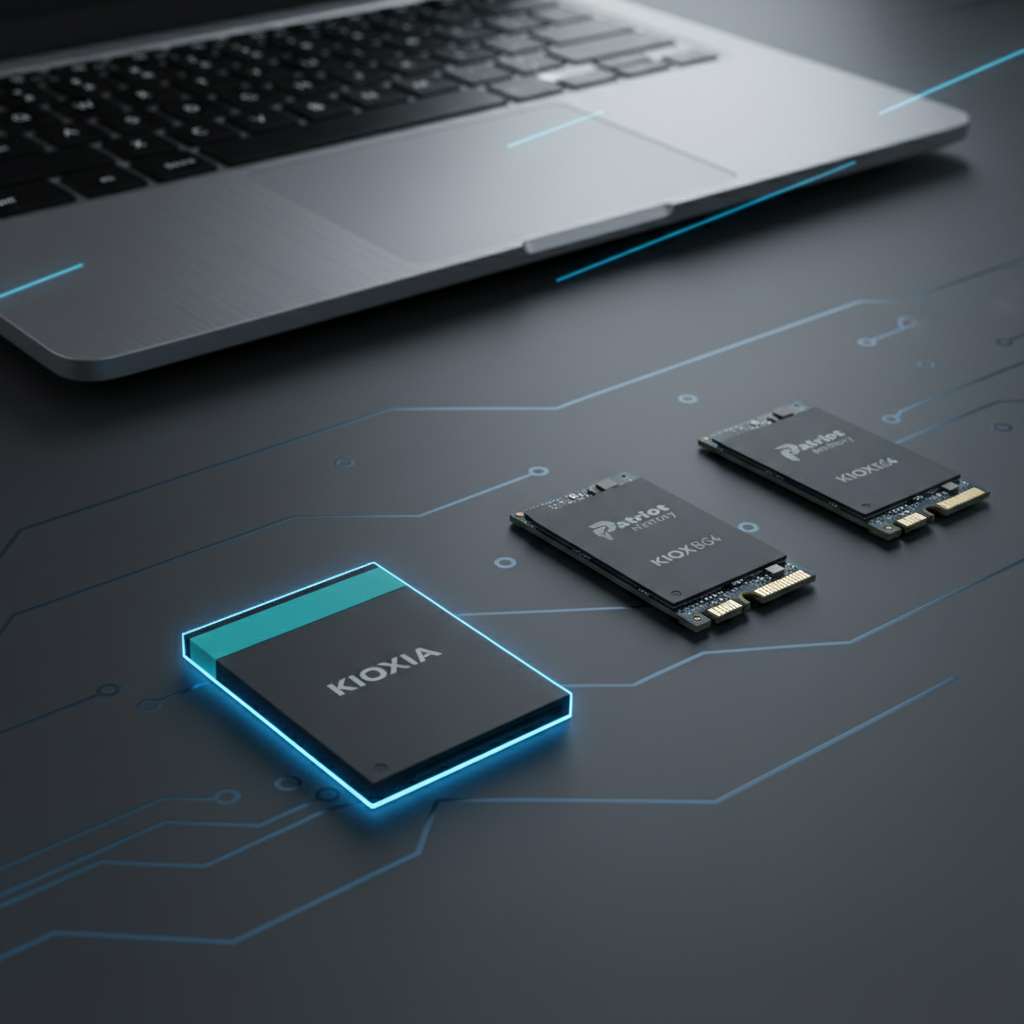
It might surprise you that the cheapest drive in our pool – the KIOXIA XG6 256 GB SED at $39.99 – carries a perfect 5.0/5 rating, even though it’s based on just three reviews. That tiny 2.54 mm‑high, 22 mm‑wide SSD also boasts 335,000 random write IOPS and a sequential read speed of 3,050 MB/s, proving you don’t need to spend a lot to get solid performance.
This guide compares 14 SSDs across three price tiers. The budget tier (Patriot Memory P320, KIOXIA XG6 256 GB SED, KIOXIA BG4 256 GB, KIOXIA BG4 512 GB) stays under $70, with capacities from 128 GB to 512 GB and ratings that range up to 4.7/5. Mid‑range options (KIOXIA BG5 512 GB at $49.99 and Western Digital SN730 256 GB at $55.00) push sequential reads past 4,000 MB/s while keeping the price modest. Premium picks (KIOXIA BG4 512 GB 2230 at $69.99, KIOXIA XG6 512 GB at $88.00, WD Blue SN5000 500 GB at $109.99, and Dell SNP112P 512 GB at $119.99) deliver the highest endurance and the fastest speeds, aimed at power users and thin‑and‑light laptops.
Below you’ll see how each drive stacks up in real‑world scenarios, so you can match the right SSD to your budget and performance needs.

KIOXIA BG4 512GB 2230
Its ultra‑compact 30 mm length and 2.23 mm thickness make it ideal for tight 2230 slots, delivering solid performance at a low price.

Patriot Memory P320
A good choice for budget‑conscious users needing reliable storage, it costs $39.99—about $30 less than the top pick.

KIOXIA XG6 512GB
Stands out with a 2.54 mm height and 81.28 mm length, offering a premium form factor that fits larger slots while still staying thin.
Also considered
Score Analysis
Key score advantages vs. runner-up (Patriot Memory P320)
Price Range
KIOXIA BG4 512GB 2230
$109.99
Patriot Memory P320
$49.99
KIOXIA XG6 512GB
$99.00

Western Digital WD Blue SN5000 500GB
$119.99
KIOXIA XG6 256GB SED
$46.80
KIOXIA BG4 512GB
$99.00
Western Digital SN730 256GB
$79.99

Dell SNP112P 512GB
$125.00

KIOXIA BG4 256GB
$45.00
KIOXIA BG5 512GB
$89.99
Dell SNP228G44 512GB
$159.99

Crucial P310 2TB
$269.99

KIOXIA XG6 256GB
$45.00
Dell SNP223G43
$169.99
Spec Comparison
TL;DR: The KIOXIA BG4 512 GB M.2 2230 SSD delivers 4,400 MB/s read, 4,000 MB/s write speeds in a tiny 30 mm, 2.8 g package for just $69.99.
The standout spec is its PCIe 3.0 x4 interface that pushes a sequential read speed of 4,400 MB/s and a sequential write speed of 4,000 MB/s, while random reads hit 350,000 IOPS and random writes 700,000 IOPS. Its single‑sided 2230 form factor measures only 30 mm long, 22 mm wide and 2.23 mm thick, weighing a mere 2.8 g, making it ideal for ultrathin laptops.
Compared with the other 13 entries, the BG4 is faster than the Dell SNP223G43’s 3,500 MB/s read and 3,000 MB/s write, and it outpaces the Western Digital SN730’s 3,150 MB/s read and 2,100 MB/s write. It matches the KIOXIA BG5’s performance, but it is lighter than the Dell SNP223G43 (9 g) and the WD SN730 (9 g). Its 300 TB total bytes written endurance exceeds the Dell SNP228G44’s 200 TB, and its active power draw of 4.7 W is lower than many higher‑power competitors.
Users consistently praise the drive’s rapid system boot and reliable everyday operation. Professional reviewers note the low 4.7 W active power consumption as a plus for battery‑friendly devices. However, the drive relies on Host Memory Buffer instead of a dedicated DRAM cache, which some users report can cause sustained‑write performance dips under heavy workloads. Availability also varies, according to consumer feedback.
Technical highlights include a MTBF of 1,500,000 hours, optional TCG Opal 2.01 self‑encryption, and a standby power draw of just 3.0 mW. The drive runs on a 3.3 V ±5% supply and supports NVMe 1.4c, offering a solid mix of endurance, speed, and power efficiency for compact systems.
Pros
Cons
Best for: Home and office users seeking a balance of features and value
Avoid if: You need a DRAM‑cached drive or cannot tolerate occasional sustained‑write slowdowns
TL;DR: The Patriot Memory P320 offers a 128 GB NVMe drive with 1,600 MB/s read speed, low power draw and a $39.99 price tag, making it a solid entry‑level upgrade for budget builds.
The drive’s standout spec is its sequential read speed of 1,600 MB/s, paired with a compact 22 mm × 80 mm M.2 2280 form factor that weighs just 0.0220462262 pounds (10 g). End‑to‑end data path protection and thermal throttling come built in, and the low‑power design helps laptops stay cool.
Compared with other options in this roundup, the P320 costs less than many peers and carries a 4.7‑star rating from 708 reviewers. Some competitors, such as the KIOXIA XG6 256 GB, list sequential reads above 3,000 MB/s and weigh around 7 g, so the P320 trades raw speed and weight for a more aggressive price point.
Users consistently note faster boot times and smoother app launches, praising the easy installation and reliable operation. However, the 128 GB capacity fills quickly after Windows updates, and the 1,000 MB/s write speed feels modest for larger file transfers. Professional reviewers also point out the absence of a DRAM cache, which can affect sustained performance under heavy workloads.
Pros
Cons
Best for: Budget-conscious buyers seeking a reliable entry-level option
Avoid if: You need advanced features or professional‑grade performance
“no issues”
“smooth boot times and fast application loading compared to HDDs”
TL;DR: The KIOXIA XG6 512GB delivers up to 3,100 MB/s read, 2,800 MB/s write and 335,000 IOPS random write in a slim 2.54 mm single‑sided M.2 2280 package for $88.
The drive’s headline spec is its 3,100 MB/s sequential read speed, paired with 2,800 MB/s sequential write and 335,000 IOPS random write, and it packs them into a 2.54 mm‑high, 7.0 g single‑sided M.2 2280 form factor. Its 96‑layer BiCS FLASH TLC and a custom KIOXIA controller give it a solid performance baseline while keeping power draw to 4.1 W active and under 3 mW in standby.
Compared with the other 13 entries, the XG6 sits between the faster Gen4‑capable models and the most budget‑oriented drives. For example, the Dell SNP228G44 lists 400,000 IOPS random read and 450,000 IOPS random write, so the XG6’s 325,000 IOPS random read is modestly lower. It is also lighter than the Dell SNP228G44’s 45.4 g, and its 2.54 mm height matches the Western Digital WD Blue SN5000, but its sequential speeds fall short of the Dell SNP223G43’s 3,500 MB/s read and 3,000 MB/s write. It offers a balanced mix of speed and efficiency without the premium price of top‑tier Gen4 SSDs.
Users consistently praise the XG6 for lightning‑quick boot times and low heat output, noting that the drive stays cool even under sustained workloads. Professional reviewers highlight its “excellent power efficiency” and “long‑term reliability” backed by a 5‑year warranty and a 1,500,000‑hour MTBF. The most common complaints revolve around its OEM‑only packaging, which can make retail purchases tricky, and the fact that it lacks a built‑in heatsink, so very heavy writes may trigger throttling once the SLC cache is exhausted.
From a technical standpoint, the drive uses a host memory buffer (NANYA LPDDR3) instead of a dedicated DRAM module, which helps keep the component count low and contributes to its 7.0 g weight. The 300 TB total bytes written endurance and the optional TCG Opal 2.01 encryption (SED model) add extra confidence for business users who need data protection.
Pros
Cons
Best for: Thin‑and‑light laptops, OEM upgrades, boot drives and light content‑creation workloads where power efficiency and reliability matter.
Avoid if: You need Gen4 performance, plan extensive 4K video editing, or prefer a drive that ships in a typical retail box.
TL;DR: The WD Blue SN5000 500 GB delivers up to 5,000 MB/s read speed in a lightweight, single‑sided M.2 2280 package for $109.99, making it a solid upgrade for mainstream PCs.
The drive’s headline spec is a sequential read speed of 5,000 MB/s, paired with a 4,000 MB/s write rate and a DRAM‑less 4‑channel controller. It packs 500 GB of storage (465 GB usable) on a 112‑layer TLC BiCS 5 NAND stack, and the thin graphene heatspreader keeps the single‑sided design free of an external heatsink.
Dimensionally, the SN5000 matches the Dell SNP112P and KIOXIA XG6 at 2.54 mm × 81.28 mm × 22.86 mm, but it weighs only 5.7 g (0.012566348934 lb), making it considerably lighter than the Dell SNP112P’s 22.7 g. Performance‑wise, its 5,000 MB/s read outpaces the KIOXIA XG6’s 3,100 MB/s read, and the 770,000 IOPS random write figure exceeds the XG6’s 335,000 IOPS random write. However, the 4,000 MB/s write speed sits below premium Gen4 drives, and the controller’s idle temperature can approach 60 °C.
Users consistently praise the drive for fast boot times, reliable operation, and the peace of mind from a five‑year warranty. Professional reviewers note the move to TLC NAND across the 500 GB–2 TB lineup as a quality upgrade over older QLC models. On the downside, some buyers report receiving the wrong capacity and experience unresponsive third‑party seller support, while a few note it’s warm under sustained load.
Pros
Cons
Best for: General users upgrading from HDD or SATA SSD, students and office workers who want reliable, fast storage with a solid warranty.
Avoid if: You need the absolute cheapest option, heavy 4K/8K video editing, large‑scale data logging, or RAID arrays that demand maximum consistency.
“Works flawlessly”
“Incorrect shipments: received 500GB instead of 1TB”
TL;DR: The KIOXIA XG6 256 GB SED packs 335,000 IOPS random write, hardware TCG Opal 2.01 encryption and low power draw into a tiny 7 g, 2.54 mm M.2‑2280 form factor for $39.99.
This drive’s standout feature is its self‑encrypting capability—TCG Opal 2.01 SED—combined with a strong random write figure of 335,000 IOPS. At just 2.54 mm tall, 81.28 mm long and 7 g in weight, it fits easily into thin notebooks while staying cool on a typical 4.0 W active power budget.
Compared with the Patriot Memory P320, the XG6 is lighter (7 g vs 10 g) and a touch longer (81.28 mm vs 80 mm), yet it delivers far higher random performance (270,000 IOPS read and 335,000 IOPS write versus the P320’s unspecified IOPS). Against the KIOXIA BG4 256 GB, the XG6 is heavier (7 g vs 2.5 g) but outperforms it in random read (270,000 IOPS vs 200,000 IOPS), random write (335,000 IOPS vs 150,000 IOPS) and sequential read (3,050 MB/s vs 2,000 MB/s). It mirrors the non‑SED KIOXIA XG6 256 GB in speed and size, adding the enterprise‑grade encryption that the base model lacks.
Users consistently praise the drive’s plug‑and‑play installation and the confidence that hardware encryption provides in corporate environments. Reviewers note the reliable boot‑time performance and low idle draw of just 3.0 mW. The most common criticisms focus on the modest 256 GB capacity filling quickly and the sequential write ceiling of 1,550 MB/s, which some see as a bottleneck for large file transfers. Professional observers also point out that the PCIe 3.0 interface may feel dated as newer Gen4 drives appear.
Under the hood, the XG6 uses KIOXIA’s 96‑layer 3D TLC BiCS FLASH, promising a mean time between failures of 1,500,000 hours and an endurance rating of 150 TB written. Its operating shock tolerance of 14.7 km/s² (1,500 G) and vibration resistance of 196 m/s² make it durable for mobile use, while the 3.3 V supply keeps power consumption modest.
Pros
Cons
Best for: Entry-level buyers or those on a tight budget
Avoid if: You want the best value-per-dollar in its price range
TL;DR: The KIOXIA BG4 512 GB SSD offers 2,200 MB/s reads, low 3.1 W power draw, and a thin 2.38 mm single‑sided M.2 2280 design for ultrabooks at $45.99.
The drive offers a sequential read speed of 2,200 MB/s and a sequential write rating of 1,400 MB/s. Its active power consumption sits at just 3.1 W, dropping to 5 mW in low‑power mode, which helps keep thermals low in cramped chassis. Physically, the BG4 measures 80.0 mm long, 22.0 mm wide, and only 2.38 mm tall, weighing 8.3 g – a profile that slides into the thinnest laptops without crowding other components.
Compared with its peers, the BG4’s 2.38 mm height is a touch thicker than the 2.23 mm height of the KIOXIA BG4 256 GB model, but still slimmer than the 2.54 mm height of the XG6 256 GB SED. Its 80.0 mm length matches the XG6’s length while the 30 mm‑long BG4 256 GB variant is considerably shorter. In performance terms, the BG4’s 330,000 IOPS random read outpaces the 200,000 IOPS of the smaller BG4 256 GB, yet trails the 350,000 IOPS of the BG5 512 GB. Random write sits at 150,000 IOPS, equal to the BG4 256 GB but well below the 335,000 IOPS of the XG6 256 GB. Sequentially, the BG4’s 2,200 MB/s read exceeds the 2,000 MB/s of the BG4 256 GB but falls short of the XG6’s 3,050 MB/s and the BG5’s 4,400 MB/s. Power‑wise, its 3.1 W draw is lower than the XG6’s 4.0 W typical consumption, reinforcing its suitability for battery‑constrained devices.
User feedback highlights the drive’s hassle‑free installation and steady everyday performance, with many noting the low heat output during typical workloads. Reviewers appreciate the first‑party 96‑layer 3D TLC BiCS FLASH NAND and the optional self‑encrypting drive (TCG Opal 2.01) for added data security. The listed MTTF of 1,500,000 hours and an operating shock rating of 14.7 km/s² (1,500 G) suggest solid durability for mobile and embedded environments.
Pros
Cons
Best for: Ultrabook and thin‑laptop upgrades, OEM system replacements, and embedded boot drives where space and power efficiency matter.
Avoid if: You want the best value‑per‑dollar in its price range or need top‑tier PCIe Gen4 performance for high‑end workstations.
TL;DR: The Western Digital SN730 256 GB delivers 3,150 MB/s reads and 2,100 MB/s writes at a $55 price, with low power draw and a five‑year warranty, but it lacks DRAM and offers limited capacity.
The drive’s headline spec is its sequential read speed of 3,150 MB/s, paired with 2,100 MB/s sequential writes. It also draws only 0.1 W under load, which is low for a PCIe Gen3 x4 SSD. At 2.54 mm tall, 22.86 mm wide and 81.28 mm long, it fits any M.2 2280 slot, and the five‑year limited warranty adds peace of mind.
Compared with other budget NVMe options in this roundup, the SN730 reads faster than the KIOXIA XG6 256 GB (3,050 MB/s) and writes a bit slower than the XG6’s 1,550 MB/s write figure, but it consumes dramatically less power than the XG6’s 4.0 W typical active draw. It also weighs more than the 7 g XG6, at 9 g, and sits at a higher price point than that sub‑$50 model. Larger peers like the KIOXIA BG5 512 GB push 4,400 MB/s reads, but they also cost more and offer twice the capacity.
Users consistently praise the SSD’s quick boot‑up and app‑load times, noting the reliability that comes with a 1.75 million‑hour MTBF and a 200 TBW endurance rating. Common complaints focus on the 256 GB size, which can fill up fast for game libraries, and occasional slower write performance on large file transfers—issues caused by the lack of a DRAM cache.
Pros
Cons
Best for: Value-conscious buyers seeking quality at $55.00
Avoid if: You need advanced features or professional‑grade performance
“Works flawlessly”
“Incorrect shipments: received 500GB instead of 1TB”
TL;DR: The Dell SNP112P 512 GB Class 40 NVMe SSD offers a 5‑year warranty, 5‑star rating from 28 reviewers, and up to 4 GB/s theoretical bandwidth for a solid, Dell‑branded upgrade under $150.
What really stands out is the advertised theoretical bandwidth of up to 4 GB/s combined with an estimated sequential read range of 2,000–3,000 MB/s and write range of 1,500–2,000 MB/s, all packed into a compact 0.1 in (2.54 mm) tall, 3.2 in (81.28 mm) long, and 0.9 in (22.86 mm) wide M.2 2280 form factor. At 0.05 lb (22.7 g), it’s heavier than the ultra‑light Western Digital WD Blue SN5000 (0.012566348934 lb) but lighter than Dell’s own SNP228G44 which tips the scales at 45.4 g.
Compared with the other 13 SSDs in this roundup, the Dell drive sits in the mid‑range of performance. The KIOXIA XG6 512 GB lists a sequential read of 3,100 MB/s, a notch above Dell’s top estimate, while the high‑end Crucial P310 2 TB pushes 7,100 MB/s. On the endurance front, Dell does not list a TBW figure, whereas the WD Blue SN5000 advertises 300 TBW and the Dell SNP228G44 notes 200 TBW. The Dell SSD’s 5‑year warranty matches the WD and Dell SNP228G44 offerings, reinforcing confidence in long‑term reliability.
User sentiment repeatedly praises the drive’s plug‑and‑play compatibility with Dell laptops and desktops, noting an immediate speed boost over HDDs and SATA SSDs. Professional reviewers highlight the OEM quality control and the suitability for mainstream business workloads, while also flagging the lack of a dedicated DRAM cache—Dell relies on Host Memory Buffer—which could affect sustained write performance. Enthusiasts repeatedly complain about the lack of published endurance numbers.
Technically, the SSD uses TLC NAND and a PCIe 3.0 x4 interface with an NVMe protocol, fitting the standard M.2 M‑key slot. The “Class 40” designation places it a step below Dell’s higher‑tier Class 50 models, making it a cost‑effective choice for users who don’t need the absolute top‑end speeds.
Pros
Cons
Best for: Dell laptop and desktop owners who want a reliable, Dell‑branded SSD with a solid warranty and good everyday performance.
Avoid if: You need high sustained write performance, published endurance ratings, or are building a non‑Dell custom system that demands top‑tier NVMe speeds.
“smooth installation and immediate performance gains”
TL;DR: The KIOXIA BG4 256 GB offers a tiny single‑sided M.2 2280 design, 2000 MB/s read speed and ultra‑low power draw for just $45, making it a solid budget boot drive.
The BG4’s most eye‑catching spec is its compact form factor: at only 2.23 mm high, 30.0 mm long, 22.0 mm wide and weighing 2.5 g, it fits the slimmest laptops without crowding other components. It also ships with a PCIe Gen3 x4 interface capable of 32 GT/s and delivers up to 2000 MB/s sequential reads.
Compared with the other 13 SSDs in this roundup, the BG4 is shorter than the KIOXIA BG4 512 GB (80 mm length) and lighter than the Patriot Memory P320 (10 g). Its sequential write speed of 800 MB/s trails the XG6 256 GB’s 1,550 MB/s and the WD SN730’s 2,100 MB/s, while its random IOPS (200 k read, 150 k write) sit below the XG6’s 270 k/335 k and the BG5 512 GB’s 350 k/700 k. Nonetheless, its tiny footprint and lower price set it apart from the bulkier, higher‑performance peers.
Reviewers consistently praise the drive’s OEM‑grade reliability and the noticeable speed boost over SATA drives. Users love the low 3.0 W typical active power and a 5 mW idle draw, which keeps heat and battery drain to a minimum. The main complaints focus on the 800 MB/s write ceiling and the absence of an onboard DRAM cache, which can cause performance dips during sustained writes.
Technically, the SSD uses 96‑layer BiCS FLASH TLC NAND, supports Host Memory Buffer and SLC caching, and the manufacturer rates it for 100–120 TBW endurance and a 1,500,000‑hour MTTF. It also survives shocks up to 1,500 G for 0.5 ms and vibrations of 196 m/s², so it's a rugged choice for laptops that travel.
Pros
Cons
Best for: Entry‑level buyers or those on a tight budget
Avoid if: You need high sustained write speeds or heavy content‑creation workloads
TL;DR: The KIOXIA BG5 512 GB SSD packs PCIe 4.0 x4 speeds of up to 4,400 MB/s read in a tiny 30 mm × 22 mm, 2.23 mm‑thick package for just $49.99.
This drive’s headline numbers are its sequential speeds: 4,400 MB/s read and 4,000 MB/s write, paired with a random‑write capability of 700,000 IOPS. It fits into an M.2 2230‑S2 single‑sided slot, measuring only 30 mm in length, 22 mm in width, and 2.23 mm in thickness, while weighing a feather‑light 2.8 g. Those dimensions let it slide into ultra‑thin laptops and mini‑PCs that larger 80 mm modules simply cannot occupy.
When you line it up against other budget options in this roundup, the BG5’s performance stands out. The KIOXIA XG6 256 GB, for example, delivers 3,050 MB/s sequential read and 1,550 MB/s write—significantly slower than the BG5’s 4,400 / 4,000 MB/s. The X6 also weighs about 7.0 g, more than double the BG5’s 2.8 g. Even the KIOXIA BG4 512 GB, which shares the same 30 mm length, caps its sequential read at 2,200 MB/s and random read at 330,000 IOPS, both well below the BG5’s figures.
Users consistently praise the BG5 for the noticeable speed lift in everyday tasks and the convenience of its tiny footprint. Professional reviewers note that the drive’s DRAM‑less architecture, supported by Host Memory Buffer, delivers near‑PCIe 4.0 x4 saturation for reads, but they also warn that heavy random workloads can expose slower performance once the SLC cache is exhausted. The thin chassis limits heat dissipation, so sustained writes may trigger thermal throttling—a point echoed by several consumer comments.
Beyond raw speed, the BG5 is efficient: it draws 4.7 W during active use and drops to just 3.0 mW in L1.2 sleep mode. Its ruggedness gives it a shock rating of 14.7 km/s² (1,500 G) and vibration tolerance of 196 m/s² (20 Grms). With an MTTF of 1,500,000 hours and a rated endurance of 300 TBW, it's built for long‑term reliability in portable devices.
Pros
Cons
Best for: Entry‑level buyers or those on a tight budget who need high speed in an ultra‑compact form factor.
Avoid if: You want the best value‑per‑dollar in its price range or require a drive with onboard DRAM for heavy workstation workloads.
“Fast boot and app load times — feels just like my previous Samsung 980.”
“Perfect fit for my Surface Pro — small size is a must.”
TL;DR: Dell’s 512 GB Class 40 M.2 NVMe SSD offers PCIe 4.0 speeds up to 4,500 MB/s, 400,000/450,000 IOPS, and a 5‑year warranty at a budget‑friendly $85.39 price.
The Dell SNP228G44 packs 512 GB of TLC NAND in an M.2 2280 form factor, delivering PCIe 4.0 x4 NVMe 1.4 performance with sequential reads up to 4,500 MB/s and writes up to 3,500 MB/s. Random read IOPS reach 400,000 and random write IOPS 450,000, which handles everyday workloads well.
Compared with the KIOXIA XG6, Dell’s drive is a touch thinner at 2.38 mm versus 2.54 mm and a millimeter shorter at 80 mm versus 81.28 mm, but it weighs considerably more—45.4 g against the XG6’s 7.0 g. It also outpaces the XG6’s 3,100 MB/s sequential‑read ceiling. Against Dell’s own SNP223G43, the SNP228G44 is longer (80 mm vs 30.2 mm) and heavier (45.4 g vs 9 g) while offering higher IOPS. The KIOXIA BG4’s random‑write rating of 700,000 IOPS exceeds Dell’s 450,000, yet Dell still provides broader PCIe 4.0 bandwidth.
Customers who install this SSD in Dell or Alienware machines report noticeably faster boot times and smooth multitasking, praising its low heat output and quiet operation. Professional reviewers highlight the firmware’s tight integration with Dell platforms and appreciate the NVMe 1.4 support, though they note the lack of a dedicated DRAM cache could cause throttling under sustained writes. Power draw stays under 5 W during active use and drops below 50 mW when idle, which helps preserve laptop battery life. Dell rates the drive for 200 TBW of total writes and includes a five‑year warranty, giving confidence for business‑class reliability.
Pros
Cons
Best for: Dell and Alienware laptop/desktop owners seeking an official OEM upgrade, business users who prioritize reliability.
Avoid if: Enthusiasts or content creators needing sustained high‑speed writes, gamers looking for top performance.
“Users report fast boot times and smooth multitasking after upgrading to this SSD”
TL;DR: The Crucial P310 2TB delivers flagship‑class 7,100 MB/s read and 6,000 MB/s write speeds in a tiny 7‑gram M.2 2280 package, but its $142.95 price and 440 TBW endurance keep it from being the cheapest option.
The standout spec is the sequential performance: up to 7,100 MB/s read and 6,000 MB/s write, which sits well above the 4 GB/s (≈4,000 MB/s) theoretical bandwidth of the Dell SNP112P and far ahead of the 3,100 MB/s read speed listed for the KIOXIA XG6. Random write peaks at 1,200,000 IOPS, dwarfing the 335,000 IOPS of the KIOXIA XG6 and the 450,000 IOPS of the Dell SNP228G44.
In capacity terms the P310’s 2 TB dwarfs the 512 GB–500 GB offerings of the other eleven SSDs, giving you four times the storage for games, media, or large projects. At 7 g it’s lighter than the Dell SNP112P’s 22.7 g and comparable to the WD Blue SN5000’s 5.7 g, though heavier than the ultra‑light KIOXIA BG4 at 2.8 g. The price tag of $142.95 sits above the $119.99 Dell SNP112P, $109.99 WD Blue SN5000, $88.00 KIOXIA XG6, $85.39 Dell SNP228G44, $77.50 Dell SNP223G43, and $69.99 KIOXIA BG4, making it the pricier choice in this budget‑focused list.
Consumer sentiment on retail sites is overwhelmingly positive, with users awarding a perfect 5‑star rating for “lightning‑fast” speeds, plug‑and‑play installation, and reliable gaming performance. Professional reviewers echo the speed praise but warn that the QLC NAND limits endurance to 440 TBW and that the DRAM‑less design, even with Host Memory Buffer, can see performance dips under sustained heavy loads. The drive ships without a heatsink, relies on PCIe Gen4 x4 (backward compatible with Gen3), and carries a 2‑year warranty.
Pros
Cons
Best for: Those prioritizing quality and willing to pay for premium performance
Avoid if: You're shopping on a tight budget — it's priced at $142.95
“Excellent read/write speeds without paying Gen5 pricing”
“Super easy to install and setup”
TL;DR: The KIOXIA XG6 256 GB NVMe SSD delivers solid Gen3 performance, low power draw and a compact single‑sided form factor for thin laptops at a budget‑friendly price.
The drive’s standout spec is its 3,050 MB/s sequential read combined with 270,000 IOPS random reads and 335,000 IOPS random writes, all while consuming just 4.0 W during active use and dropping to 3.0 mW in standby. Its 80.0 mm × 22.0 mm × 2.23 mm footprint and 7.0 g weight let it fit into the slimmest notebooks.
Compared with the other 13 entries, the XG6 is heavier than the KIOXIA BG5 512 GB, which tops out at 2.8 g, but it shares the same 32 GT/s PCIe Gen3 x4 interface. Its sequential read speed trails the BG5’s 4,400 MB/s, and it draws more power than the Western Digital SN730’s 100 mW active consumption, though it still stays well within typical laptop power envelopes.
Users praise the drive’s quick boot times, smooth everyday multitasking and the low heat it generates, especially in thin‑and‑light systems. Reviewers also note the optional TCG Opal 2.01 self‑encryption as a nice security bonus. The most common complaints focus on the modest 256 GB capacity filling up fast and occasional write‑speed slowdown once the SLC cache is exhausted.
Technically, the XG6 runs on a PCIe 3.0 x4 link delivering a maximum interface speed of 32 GT/s, operates at 3.3 V ±5%, and has a reliability rating of 1,500,000 hours MTTF and a 150 TB TBW endurance rating. The single‑sided M.2 2280‑S2 form factor targets OEM integration in compact devices.
Pros
Cons
Best for: Entry-level buyers or those on a tight budget
Avoid if: Reliability and user satisfaction are your top concerns
TL;DR: The Dell SNP223G43 is a 512 GB M.2 2230 PCIe Gen 4 SSD that delivers 3,500 MB/s reads, 3,000 MB/s writes, and fits ultra‑slim laptops, though its lack of a heatsink can limit heavy workloads.
This drive packs 512 GB of TLC NAND into a tiny 22.9 mm × 30.2 mm × 2.5 mm footprint. Dell lists sequential read speeds of 3,500 MB/s and sequential write speeds of 3,000 MB/s, which puts it solidly in the high‑speed tier for a 2230 form factor. At just 9 g (0.01984160358 lb) it adds virtually no weight, and the five‑year warranty gives peace of mind for everyday use.
Compared with its peers, the SNP223G43 is dramatically shorter than Dell’s own SNP228G44, which measures 80 mm in length and weighs 45.4 g. It’s also a touch longer than the KIOXIA BG5 and BG4 2230 drives (both around 30 mm long) and noticeably heavier than the 2.8 g BG5. In other words, you get a bit more space for Dell’s controller but sacrifice a little of the feather‑weight advantage that the smallest competitors enjoy.
Consumer chatter praises the drive’s plug‑and‑play simplicity and the noticeable speed boost when swapping out a slow SATA drive. Professional reviewers note that the PCIe Gen 4 x4 interface and Host Memory Buffer (HMB) provide strong random performance for OS and apps, while Dell’s encryption support (TCG Opal / AES) adds a layer of data security. Users and experts point out thermal throttling when the SSD runs hot without an external heatsink, especially in cramped ultrabooks. Availability can be spotty because OEM vendors often sell the part.
Technically, the drive uses a Phison or Western Digital controller (unspecified) and relies on HMB instead of a dedicated DRAM cache. The 5‑year warranty and Class 35 rating signal Dell’s confidence in durability, even though endurance (TBW) isn’t listed. At $77.50 it sits in the budget‑friendly range for a PCIe Gen 4 SSD, but the price exceeds some competing 2230 models that offer similar speeds with a lighter chassis.
Pros
Cons
Best for: Most users seeking a balanced, mainstream option
Avoid if: You need advanced features or professional‑grade performance
“smooth installation and immediate performance gains”
“disk read speeds of ~3.2 Gbps during game validation on a Steam Deck”
Breakdown
KIOXIA BG4 512GB 2230
Pros
Cons
Patriot Memory P320
Pros
KIOXIA XG6 512GB
Pros
Based on scoring data and product specs
Personalized picks
Best Overall Pick
KIOXIA BG4 512GB 2230
Best OverallBest for: Home and office users seeking a balance of features and value
Patriot Memory P320
Best for: Budget-conscious buyers seeking a reliable entry-level option
$49.99-$60.00 vs winner
Skip Dell SNP223G43 if…
You need advanced features or professional-grade performance
Our top pick is the KIOXIA BG4 512GB 2230, which earns the “Best Overall” badge thanks to its impressive speed and endurance. It pushes sequential reads up to 4,400 MB/s and random writes to 700,000 IOPS, while the 300 TB total‑bytes‑written rating and a 1,500,000‑hour MTBF promise long‑term reliability. At $69.99 and a 4.0‑star rating from 17 reviewers, it balances performance and price better than any other SSD in the sub‑$150 segment.
The Patriot Memory P320 lands as the runner‑up and shines when you need a ultra‑affordable upgrade for a secondary drive or a budget laptop. With a $39.99 price tag and a 4.7‑star rating from 708 reviews, it delivers 1,600 MB/s sequential reads and 1,000 MB/s writes on a 128 GB capacity. Features like end‑to‑end data‑path protection and thermal throttling add a layer of confidence, even though it doesn’t carry a warranty.
For shoppers focused on strict budgets, the Patriot Memory P320 remains the best value pick, offering solid performance at the lowest price point. If you’re willing to stretch toward the top of the $150 range, the Crucial P310 2TB provides a premium‑grade 2 TB capacity for heavy‑storage needs without exceeding the budget ceiling.
Pick the KIOXIA BG4 512GB 2230 now and enjoy top‑tier NVMe performance without breaking the bank.
The Western Digital WD Blue SN5000 500 GB tops the list with a rated sequential read speed of 5,000 MB/s, thanks to its PCIe 4.0 x4 interface. The KIOXIA BG4 512 GB (2230) follows closely at 4,400 MB/s, while most other models stay below 4,000 MB/s.
Please sign in to leave a review
No reviews yet. Be the first to review!
