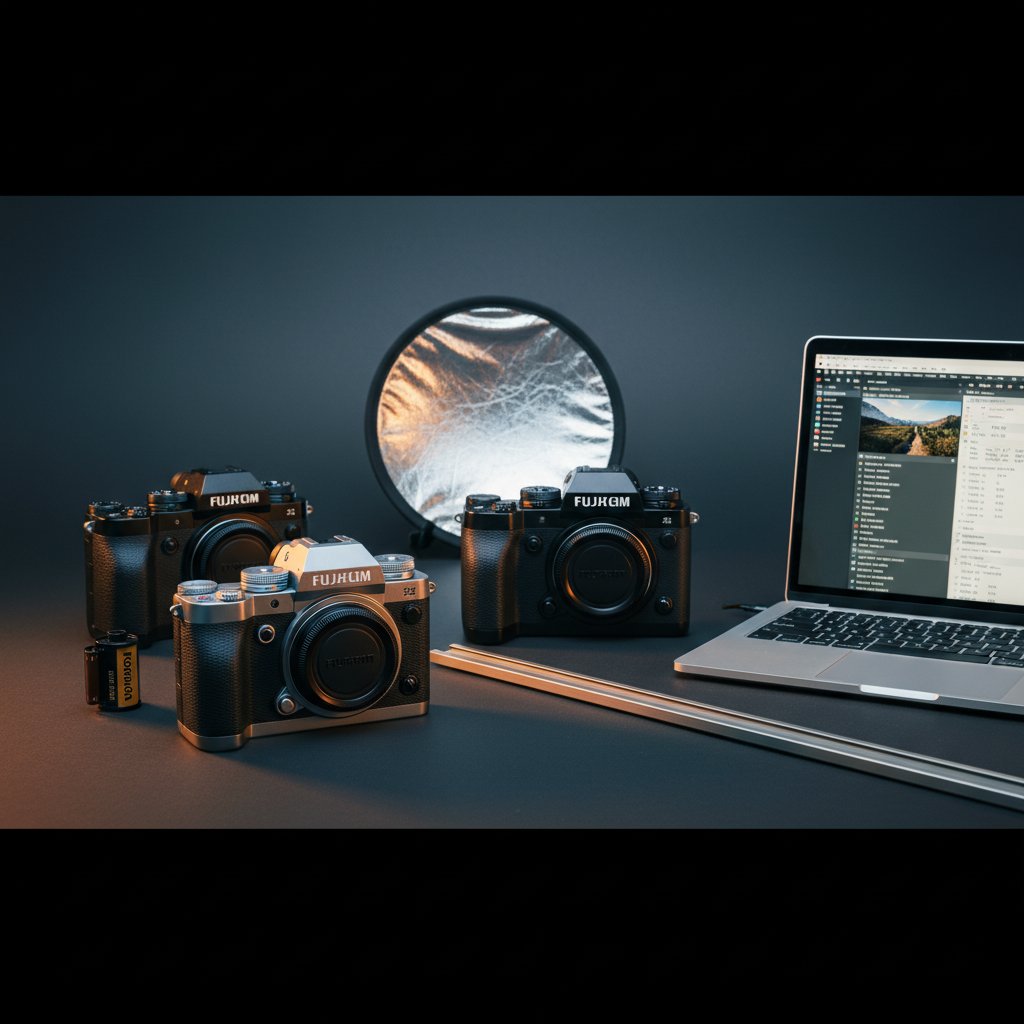
We’ve lined up 9 Fujifilm X‑Mount mirrorless cameras to help you find the right tool for your shooting style. The lineup splits cleanly into three price tiers: the budget corner features the $1299.00 X‑T100 Body and the $1459.00 X‑T30 III; the mid‑range tier offers the $1599.00 X‑T50 and the $1655.46 X‑S10, both praised for their blend of stills and video capability; and the premium tier rounds out the set with the $1699.95 X‑T4 (rated 5.0/5 by 619 reviewers) and the $3288.88 X‑Pro3 (rated 4.3/5 by 150 reviewers). Each camera brings a distinct mix of specs – from the X‑S10’s 4.7/5 rating (314 reviews) and 1.0251495183‑pound body weight to the X‑T30 III’s ultra‑light 329 g chassis.
If you’re after a lightweight travel companion, the X‑T30 III’s compact 329 g frame and 30 fps electronic burst make it a solid pick. For hybrid creators who need solid 4K video and in‑body stabilization, the X‑S10’s 5‑axis IBIS and fully articulating screen stand out. Professionals seeking rugged build and premium handling will gravitate toward the X‑Pro3’s 1089 g titanium body and dual viewfinder. Below, we’ll break down how each model performs in its sweet spot.

Fujifilm X-S10
The X‑S10’s battery life—about 505 shots in LCD ECO mode—delivers more shooting time than many rivals, supporting the mid‑range value promise.

Fujifilm X-T30 III
Enthusiasts who need fast burst shooting will appreciate its 30 fps electronic shutter, and at $1459 it’s about $196 cheaper than the X‑S10.

Fujifilm X-Pro3
With near‑full‑frame AF coverage (~100%) and 425 focus points, the X‑Pro3 delivers precision that the X‑S10 and X‑T30 III can’t match, justifying the premium price.
Also considered
Score Analysis
Key score advantages vs. runner-up (Fujifilm X-T30 III)
Price Range
Fujifilm X-S10
$1,655.46
Fujifilm X-T30 III
$1,399.00
Fujifilm X-Pro3
$3,288.88
Fujifilm X-T100 Body
$1,299.00

Fujifilm X-T4
$1,699.95

Fujifilm X-T20 Body
$679.99

Fujifilm X-T100 Gold
-$0.01
Fujifilm X-T50
$1,599.00

Fujifilm X-T10
-$0.01
Spec Comparison
TL;DR: The Fujifilm X‑S10 delivers 26.1 MP stills, 5‑axis IBIS up to 6 stops, and a fully articulating 3.0‑inch touchscreen for $1655.46, earning 4.7‑star ratings from 314 reviewers.
The Fujifilm X‑S10 packs a 26.1 MP X‑Trans BSI sensor and a 425‑point hybrid autofocus system, delivering fast phase‑ and contrast‑detection across the frame. Its 5‑axis IBIS offers up to 6 stops of shake reduction, helping keep handheld shots sharp.
At 1.0251495183 pounds (415 g body‑only) the X‑S10 is lighter than the X‑T4’s 1.33820593034 pounds but heavier than the X‑T30 III’s 329 g and a touch lighter than the X‑T50’s 438 g. Its depth of 65.4 mm is slightly deeper than the X‑T4’s 64 mm and noticeably deeper than the X‑T30 III’s 46.8 mm. Battery life in normal LCD mode delivers about 325 shots, lower than the X‑T4’s ≈600 shots per charge, though ECO mode pushes the count to about 505 shots.
Everyday users praise the camera’s image quality and the convenience of the fully articulating 3.0‑inch touchscreen, especially for vlogging. Professional reviewers highlight the 26.1 MP sensor and the 5‑axis stabilization as strong points, while both groups note the lack of weather sealing and the single UHS‑I SD slot as drawbacks. The modest battery endurance also shows up in user comments, with many planning to carry spare batteries for longer shoots.
Video creators benefit from 4K UHD recording at 3840 × 2160 at 30 p and a 10‑bit 4:2:2 HDMI output, plus F‑Log for grading flexibility. The electronic viewfinder offers 2.36 million dots of resolution and a 0.62× magnification, giving a clear preview despite the EVF eye point of 20 mm. With a rear LCD that covers roughly 100 % of the frame at 1.04 million dots, the X‑S10 balances still‑image and video performance in a compact package.
Pros
Cons
Best for: Buyers in the mid price range seeking the best quality at that price point
Avoid if: You need weather sealing, dual card slots, or extended battery endurance
TL;DR: The Fujifilm X‑T30 III packs a 26.1 MP X‑Trans sensor, 425‑point hybrid AF and 30 fps electronic burst into a 329 g, 46.8 mm‑deep body, delivering 6.2K video and 20 film simulations for travel‑ready creativity.
The X‑T30 III’s standout spec is its 26.1‑MP X‑Trans CMOS 4 sensor paired with the X‑Processor 5, delivering high‑resolution stills and 6.2K video (6240 × 4160 at 29.97 fps). Its 425‑point Intelligent Hybrid AF system works with AI subject detection, and the camera can shoot up to 30 fps in electronic‑shutter mode (1.25× crop). The 3.0‑inch tilting touchscreen shows 1.62 million dots, while 20 built‑in Film Simulation modes let you apply classic Fujifilm looks straight out of the camera.
At 329 g and 46.8 mm deep, the X‑T30 III is noticeably lighter and slimmer than the X‑T50 (438 g, 48.8 mm depth) and far more compact than the X‑T4 (607 g, 64 mm depth) or the X‑Pro3 (1089 g, 60.96 mm depth). However, it doesn't include in‑body image stabilization, a feature that the X‑T4, X‑S10 and X‑T50 list as IBIS (up to 7.0 stops on the latter two). The single SD card slot also limits instant backup options compared with models that offer dual slots.
Professional reviewers highlight the camera’s 6.2K video quality and the reliable AI autofocus, especially in low‑light scenes where the -7 EV sensitivity helps. Everyday users love the retro dials and the lightweight FUJINON XC 13‑33mm f/3.5‑6.3 lens with 4‑stop optical image stabilization, making it a favorite for travel and street shooting. Common complaints focus on moderate battery life—many photographers carry spare batteries—and the lack of a headphone jack for audio monitoring.
Pros
Cons
Best for: Enthusiasts, travel photographers, vloggers, and content creators who want high‑quality stills and video in a compact, retro‑styled body.
Avoid if: You want the best value‑per‑dollar in its price range.
“Users love the "film camera feel" and the ability to shoot in different Film Simulations without post-processing.”
“The compact size and lightweight kit are frequently mentioned as ideal for travel and daily carry.”
TL;DR: The Fujifilm X‑Pro3 blends a 26.1 MP X‑Trans sensor, a hybrid optical/e‑electronic viewfinder and a rugged titanium body, but its hidden screen and lack of IBIS keep it in a niche premium slot.
The standout feature is the hybrid viewfinder: a 0.5‑inch electronic viewfinder with 3.69 million dots and 100 % coverage sits alongside a 95 % optical viewfinder with 0.52× magnification, letting you switch instantly between electronic and optical framing. Under the hood, the camera delivers 425 autofocus points that cover roughly 100 % of the frame, paired with a low‑light sensitivity of –7.0 EV.
Compared with the other eight X‑mount models, the X‑Pro3 is noticeably heavier than the X‑T4, X‑S10, X‑T50, X‑T30 III and the X‑T10, yet it’s a touch lighter than the X‑T100. It also sits at the top of the price ladder, making it pricier than the rest of the lineup. While the X‑T4 offers in‑body image stabilization, the X‑Pro3 doesn't, and its battery delivers about 440 shots per charge—fewer than the X‑T4’s roughly 600‑shot rating.
Reviewers repeatedly highlight how the hidden 180° tilting touchscreen encourages a deliberate, street‑photography mindset, and they praise the 17 film‑simulation modes for delivering “unmatched” color science. Everyday users love the titanium body and weather‑sealing, but they also note the LCD’s concealment makes self‑portraits and vlogging awkward. Professionals point out the limited 4K video (max 29.97 fps) and short 15‑minute recording cap as drawbacks for serious videographers.
Technically, the X‑Pro3 packs a 14‑bit RAW APS‑C X‑Trans CMOS 4 BSI sensor, and the X‑Processor 4 processes it, supporting up to 1/32,000 sec electronic shutter speeds. It records 4K DCI (4096 × 2160) and UHD (3840 × 2160) video at up to 29.97 fps, with a 200 Mbps bitrate, and offers dual UHS‑II SD slots for up to 512 GB of storage. The 3.0‑inch, 1.62‑million‑dot touchscreen folds away, reinforcing the camera’s “shoot first, review later” philosophy.
Pros
Cons
Best for: Street and documentary shooters who value tactile controls, a premium build and rich film‑simulation colors.
Avoid if: You need in‑body stabilization, a fully articulating screen for video content, or extended 4K recording capabilities.
TL;DR: The Fujifilm X‑T100 offers a 24.2 MP APS‑C sensor, a 2.36 M‑dot EVF and a fully articulating 3‑inch touchscreen for $1299, making it a solid entry‑level mirrorless option.
The standout feature is its high‑resolution electronic viewfinder with 2,360,000 dots and 100% coverage, letting you compose shots with crisp detail. Combined with 91 hybrid AF points, the camera gives you decent focus control for everyday subjects.
At 2.55 Pounds (448 g) the X‑T100 is heavier than the X‑T30 III but lighter than the X‑T4, placing it in the middle of the lineup in terms of bulk. Its price sits above the X‑T30 III and below the X‑T4, so you’re paying more than the entry‑level sibling while getting a larger EVF than many budget options.
Reviewers praise the retro styling, the flip‑up 3.0‑inch touchscreen and the 24.2 MP sensor’s sharp, colour‑rich output. However, the 4K video mode tops out at 15 fps, which users find too choppy for serious video work, and reviewers say the autofocus is only average in low‑light scenes. The body lacks weather sealing, so keep it dry.
Technically, the camera uses a standard Bayer APS‑C sensor with a 1.5× crop factor and an extended ISO range of 100–51,200. It can shoot up to 6 fps in a 26‑frame buffer and offers a battery that delivers roughly 430 shots per charge, enough for a day of shooting.
Pros
Cons
Best for: Entry-level buyers or those on a tight budget
Avoid if: You need advanced features or professional‑grade performance
TL;DR: The Fujifilm X‑T4 packs a 26.1 MP BSI X‑Trans sensor, 6.5‑stop IBIS and a 425‑point hybrid AF system, delivering 600‑shot battery life and 4K/60p video in a weather‑sealed, ergonomically‑designed body.
One of the X‑T4’s standout specs is its in‑body image stabilization rated at 6.5 stops, which lets you shoot handheld video at 4K/60p without noticeable shake. Coupled with a 26.1‑megapixel backside‑illuminated X‑Trans CMOS 4 sensor and a hybrid autofocus system that offers 425 phase‑detect points, the camera balances resolution, low‑light performance (‑6 EV) and fast, accurate focus.
At 1.33820593034 pounds (607 g), the X‑T4 is heavier than the X‑S10’s 1.0251495183 pounds and the X‑T50’s sub‑pound body, yet it remains lighter than the X‑Pro3’s 2.4 pounds. Its CIPA‑rated battery delivers roughly 600 shots per charge, surpassing the X‑S10’s 505‑shot LCD‑ECO rating and matching the X‑T50’s 740‑shot EVF estimate. While the X‑T50’s IBIS claims up to 7.0 stops, the X‑T4’s 6.5‑stop system still provides professional‑grade shake reduction for most shooting scenarios.
Reviewers consistently praise the X‑T4’s tactile dials, film‑simulation modes and the fully articulating 3.0‑inch vari‑angle LCD with 1.62 million dots, calling it a “forever camera” for travel and street work. Users also note the effective IBIS and it’s built with a sturdy magnesium‑alloy, weather‑sealed construction. Common criticisms focus on the lack of a dedicated headphone jack—audio monitoring requires a USB‑C adapter—and the ISO dial’s limited range (160‑12,800), which forces menu navigation for extreme sensitivities.
The X‑T4 runs on the X‑Processor 4 and supports UHD and DCI 4K recording up to 60 fps in 10‑bit internally, with an external 10‑bit 4:2:2 HDMI output for higher‑end workflows. The electronic shutter tops out at 20 fps, and the EVF offers 3.69 million dots at a 100 fps refresh rate, delivering a clear viewfinder experience. Connectivity includes Bluetooth 4.2, Wi‑Fi 802.11b/g/n and a USB‑C 3.2 Gen 1 port, while dual UHS‑II SD slots give you flexible storage options.
Pros
Cons
Best for: Buyers willing to invest in a proven, high-quality option
Avoid if: You need a built‑in flash, native headphone jack, GPS or NFC, or prefer a simpler menu layout
TL;DR: The Fujifilm X‑T20 packs a 24.3 MP X‑Trans III sensor, full‑coverage EVF and 4K video into a 383 g magnesium‑alloy body, delivering high‑quality stills and video in a compact, retro‑styled package.
The standout hardware is the 24.3 MP APS‑C X‑Trans CMOS III sensor with no low‑pass filter, paired with 325 total hybrid AF points and 100 % EVF coverage at 2.36 million dots. A shutter lag of 0.050 sec and a start‑up time of 0.4 sec make the camera feel instantly ready, while the 0.25 sec shooting interval lets you capture quick bursts.
In practice, the X‑T20’s battery life of 350 shots per charge matches the X‑T10’s approximate 350‑shot rating but falls short of the X‑T100 Gold and X‑T100 Body, both listed at 430 shots. It’s also lighter than the X‑T100 models (448 g) and the X‑T50 (438 g), and its depth of 41.4 mm is shallower than the 47.4 mm depth of the X‑T100 Gold and Body, and the 46.8 mm depth of the X‑T30 III. With 325 AF points the X‑T20 outnumbers the X‑T10’s 77 points and the X‑T100 Body’s 91 points, though the X‑Pro3’s 425 points remain higher.
Reviewers consistently praise the X‑T20’s image quality, noting Fujifilm’s renowned color science and the richness of its 11 film‑simulation modes. The tilting 3.0‑inch touchscreen (1,040,000‑dot LCD) and the ability to record 4K video at up to 29.97 fps with a 100 Mbps bitrate add versatility for creators on the go. Professional testers highlight the fast hybrid autofocus and the crisp EVF, while everyday users love the lightweight feel and vintage controls. Common drawbacks include the modest 350‑shot battery, the lack of weather sealing, and a small grip that can become uncomfortable during long sessions; some users also note overheating during extended 4K recording.
Pros
Cons
Best for: Street and travel shooters who want high‑resolution APS‑C images, vivid film‑simulation colors and 4K video in a lightweight, retro‑styled body.
Avoid if: You need advanced features or professional‑grade performance.
“Loved for its vintage design and tactile controls”
“Users consistently praise JPEG color output, especially film simulations like Velvia and ACROS”
TL;DR: The Fujifilm X‑T100 Gold packs a 24.2 MP APS‑C sensor, 2.36 M‑dot OLED EVF and 430‑shot battery into a lightweight 448 g retro‑styled body, but its 15 fps 4K video may feel choppy.
The X‑T100 Gold’s standout spec is its 24.2 MP APS‑C CMOS sensor paired with a 2.36 million‑dot OLED electronic viewfinder, delivering the color fidelity Fujifilm is known for. Its 3.0‑inch fully articulating touchscreen offers 1.04 million dots of resolution, and the battery holds 1260 mAh for up to 430 shots per charge.
At 448 g, the camera matches the weight of the X‑T100 Body and is lighter than the X‑T4 (607 g) while being a bit heavier than the X‑S10 (415 g) and the X‑T30 III (329 g). Battery life of 430 shots exceeds the X‑T20 Body’s 350‑shot rating and equals the X‑T100 Body, though it falls short of the X‑T4’s roughly 600‑shot capacity. The 91 phase‑detect AF points match those of the X‑T20 and X‑T100 bodies, and the LCD resolution matches the X‑T20’s 1,040,000‑dot panel but falls short of the X‑T30 III’s 1.62 million‑dot display.
Reviewers consistently praise the X‑T100 Gold for its excellent image quality and the convenience of Bluetooth Low Energy for quick image sharing. Professionals highlight the high‑resolution EVF as a rare feature at this tier, and everyday users love the long battery life. The main drawbacks include 4K video limited to 15 fps, which produces choppy footage, the lack of an external microphone input, and noticeable AF hunting in continuous‑tracking mode, especially in low light.
Pros
Cons
Best for: Enthusiast photographers and street shooters who prioritize Fujifilm’s color science, a compact retro design, and long battery life.
Avoid if: You need advanced features or professional‑grade performance
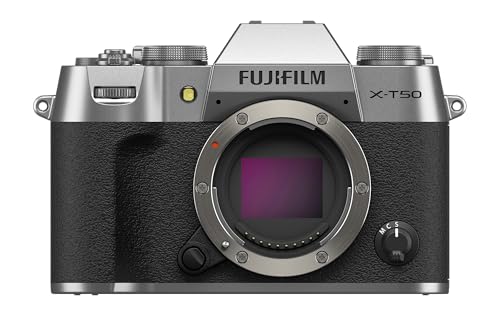
TL;DR: The Fujifilm X‑T50 packs a 40.2 MP X‑Trans sensor, 7‑stop IBIS and a dedicated Film Simulation dial into a 438 g, weather‑resistant body for $1,599, making it a strong mid‑range hybrid shooter.
At the heart of the X‑T50 is a 40.2‑megapixel X‑Trans CMOS 5 HR sensor paired with the X‑Processor 5, delivering 14‑bit RAW files and the full suite of 20 Film Simulation modes. The camera also offers 5‑axis sensor‑shift stabilization that compensates up to 7.0 stops, and a hybrid AF system with 425 phase‑detection points covering roughly 100 % of the frame.
Compared with the other eight Fujifilm models in this roundup, the X‑T50 sits in the middle of the weight range: it's a touch heavier than the X‑S10’s 415 g body‑only weight and the X‑T30 III’s 329 g, yet considerably lighter than the X‑T4’s 607 g and the X‑Pro3’s 1089 g. Its battery life of approximately 740 EVF shots and 850 LCD shots outstrips the X‑S10’s 505‑shot ECO mode and the X‑T4’s roughly 600‑shot CIPA rating, giving it an edge for all‑day shooting. The 7‑stop IBIS also edges out the X‑T4’s 6.5‑stop stabilization, while its 425‑point AF array matches the professional‑grade X‑Pro3.
Reviewers consistently highlight the camera’s color science and the joy of the dedicated Film Simulation dial, noting that the 40.2 MP sensor delivers “exceptional detail without sacrificing noise performance.” Everyday users love the lightweight design for travel and street work, and its battery endurance of roughly 740 EVF and 850 LCD shots gets frequent praise. The most common drawbacks are the single SD card slot, occasional overheating during long 6.2 K recordings, and the lack of a built‑in ND filter for bright‑light video.
The X‑T50 also supports 6.2 K video at up to 30 fps (10‑bit 4:2:2) and 4K 60 p, with F‑Log and F‑Log2 color profiles for high‑dynamic‑range grading. Connectivity includes Wi‑Fi 5, Bluetooth 4.2, and a USB‑C port that handles both charging and data transfer. A 3.0‑inch tilting touchscreen (1.62 million dots) and a 2.36‑million‑dot EVF (0.62× magnification) round out the ergonomics, while the magnesium‑alloy body provides dust‑ and moisture‑resistance.
Pros
Cons
Best for: Value-conscious buyers seeking quality at $1599.00
Avoid if: You need advanced features or professional‑grade performance, such as dual card slots, built‑in ND filters, or fully weather‑sealed bodies.
TL;DR: The Fujifilm X‑T10 packs a 16.3 MP X‑Trans sensor, 2.36 M‑dot EVF with 0.005 s lag, 8 fps burst and a lightweight magnesium body, making it a nimble choice for travel and street photography.
The standout feature is its organic‑viewfinder: a 2.36 million‑dot OLED panel with a world‑class 0.005‑second display lag and 0.62× magnification, letting you compose fast‑moving scenes without hunting for focus.
Compared with its siblings, the X‑T10’s 3.0‑inch LCD resolves 920,000 dots, which is lower than the X‑T20’s 1,040,000‑dot screen and the X‑T30 III’s 1.62‑million‑dot display. Its battery delivers about 350 shots per charge, trailing the X‑T100 Gold’s 430 shots and the X‑T50’s roughly 850 LCD‑mode shots. At 381 g, it’s lighter than the X‑T100 Body’s 2.55 lb and the X‑T4’s 607 g, and its 40.8 mm depth is slimmer than the X‑S10’s 65.4 mm or the X‑Pro3’s 60.96 mm. However, its autofocus system offers 77 zone points and 49 single points, fewer than the X‑T20’s 91 phase‑detection points (325 total) and the X‑Pro3’s 425 points.
Professional reviewers say the camera’s vivid color science, sharp JPEGs straight out of the body, and tactile analog dials speed up exposure tweaks. Everyday users love the retro look, compact feel, and Wi‑Fi convenience, but they frequently note the lack of weather sealing, the tilting‑only LCD without touch, and occasional autofocus hunting in low light.
Under the hood, the APS‑C X‑Trans CMOS II sensor (23.6 mm × 15.6 mm) pairs with an EXR Processor II, delivering up to 400% dynamic range and ISO 100–51200. Continuous shooting reaches 8 fps with continuous AF, while the electronic shutter can hit 1/32,000 sec. The pop‑up flash offers a guide number of 7, and eight creative filters add in‑camera flair.
Pros
Cons
Best for: Enthusiasts, travel photographers, and street shooters who value compact size, tactile controls, and fast EVF performance.
Avoid if: You need advanced features or professional‑grade performance.
Breakdown
Fujifilm X-T30 III
Pros
Cons
Fujifilm X-Pro3
Cons
Fujifilm X-T100 Body
Pros
Based on scoring data and product specs
Personalized picks
Best Overall Pick
Fujifilm X-S10
Best Mid-Range PickBest for: Buyers in the mid price range seeking the best quality at that price point
Fujifilm X-T30 III
Best for: Users with specific technical requirements or compatibility needs
$1,399.00-$256.46 vs winner
Skip Fujifilm X-T10 if…
You need advanced features or professional-grade performance
We crown the Fujifilm X‑S10 as the outright winner of the X‑Mount mirrorless showdown. Its 425‑point hybrid autofocus paired with phase‑ and contrast‑detection delivers fast, reliable focus, while the 5‑axis sensor‑shift IBIS offers up to six stops of shake reduction. The camera also shoots up to 30 fps in electronic burst mode and packs a 26.1 MP APS‑C X‑Trans sensor, and has earned a solid 4.7‑star rating from 314 reviewers.
The runner‑up, the Fujifilm X‑T30 III, shines when you need a lightweight travel companion that doesn’t sacrifice speed or video quality. Weighing just 329 g, it still manages a 30 fps electronic burst and benefits from a 4‑stop optical image‑stabilized kit lens (20‑50 mm equivalent). Its 4K UHD video at 59.94 fps and a high‑resolution 2.36‑million‑dot EVF make it ideal for on‑the‑go creators who want crisp footage without the bulk of a larger body.
For those on a tighter budget, the Fujifilm X‑T100 Body stands out as the best value at $1299.00. If you crave the ultimate premium experience, the Fujifilm X‑Pro3 remains the top‑tier choice, flagged as the “Best Premium Pick” and priced at $3288.88.
Pick the Fujifilm X‑S10 today and enjoy the most capable mid‑range mirrorless camera Fujifilm offers.
The Fujifilm X‑S10 is a strong choice for travel vlogging because it has a fully articulating 3.0‑inch touchscreen, a 3.5 mm microphone input, and 4K UHD video at 30 p. Its battery can deliver about 505 shots in LCD ECO mode and the body weighs roughly 465 g, making it portable for on‑the‑go shooting.
Please sign in to leave a review
No reviews yet. Be the first to review!
